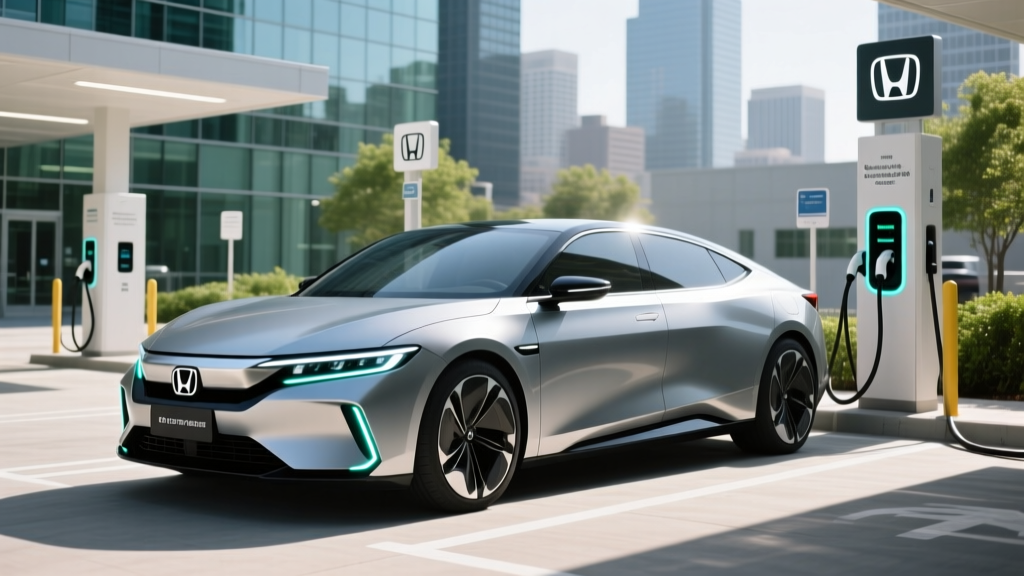
Honda's electric ambitions rest squarely on the Honda Prologue, the brand's first mass-market battery-electric SUV built on General Motors' Ultium platform. For buyers weighing a Honda electric vehicle lease versus an outright purchase, the math involves more than just the monthly payment. Federal tax credits, fuel savings, insurance premiums, and depreciation all shape the true cost of driving Honda's electric flagship.
This guide dissects the real ownership economics of the 2026 Honda Prologue — the only all-electric Honda currently available in the US — and explains how leasing interacts with the IRS §30D clean vehicle credit, what you'll actually spend on charging versus gasoline, and where the hidden costs live.
2026 Honda Prologue: The Specs That Drive Cost
Before calculating ownership costs, we need the hard numbers. The 2026 Prologue continues on the GM Ultium architecture with an 85 kWh (usable) NMC lithium-ion battery pack, available in front-wheel drive and dual-motor all-wheel drive configurations.
| Specification | FWD (EX/Touring) | AWD (Elite) |
|---|---|---|
| EPA Range | 296 miles (EX), 283 miles (Touring) | 273 miles (Elite) |
| Battery (Usable) | 85 kWh, NMC chemistry | |
| Horsepower | 288 hp | 300 hp |
| 0–60 mph | ~6.4 sec | ~5.9 sec |
| Peak DC Fast Charge | 150 kW (CCS/NACS via adapter) | |
| 10–80% DC Charge Time | ~32 minutes (with preconditioning) | |
| Level 2 Charge Rate | 11.5 kW (48A) | |
| MPGe (Combined) | 99 MPGe | 95 MPGe |
| Starting MSRP | $47,400 (EX) | $57,900 (Elite) |
| Battery/Powertrain Warranty | 8 years / 100,000 miles | |
How a Honda Electric Vehicle Lease Interacts With Federal Tax Credits
The single biggest financial variable in a Honda Prologue lease or purchase is the federal §30D Clean Vehicle Credit. Under current IRS rules, qualifying buyers can claim up to $7,500 — but eligibility depends on a matrix of income caps, MSRP limits, and battery-sourcing requirements that disqualify many buyers.
- Income Caps: Modified adjusted gross income (MAGI) must not exceed $150,000 (single), $225,000 (head of household), or $300,000 (married filing jointly).
- MSRP Caps: SUVs, vans, and pickups must have an MSRP at or below $80,000. Sedans and other body styles cap at $55,000. The Prologue qualifies as an SUV under the $80,000 cap — all current trims clear this threshold.
- Battery Sourcing: A percentage of critical minerals and battery components must be sourced from the US or free-trade-agreement countries. These percentages increase annually. Verify current-year compliance on the IRS qualified vehicle list at IRS.gov.
- Point-of-Sale Transfer: Since 2024, buyers can transfer the credit to the dealer at purchase, reducing the vehicle's purchase price directly — no need to wait for a tax refund. This applies to purchases only.
- Leasing Loophole (Commercial Credit): When you lease a Prologue, the §30D credit technically goes to the lessor (Honda Financial Services), not you. However, Honda has historically passed a portion of this benefit through as a "lease cash" incentive that reduces your monthly payment. This is not guaranteed and varies by model year and promotional period.
Key distinction for a Honda electric vehicle lease: Leasing does not give you a direct $7,500 federal tax credit. Instead, Honda Financial Services claims the credit (or a portion under §45W commercial clean vehicle provisions) and may apply it as lease cash. In recent promotional periods, Honda has offered $5,000–$7,500 in lease cash on the Prologue, effectively replicating the credit's benefit. Always confirm current lease incentive amounts with your dealer before signing.
Beyond federal credits, many states and utilities offer additional rebates. California's CVRP program, Colorado's innovative vehicle credit, and various utility companies (PG&E, SCE, ConEdison, Xcel Energy) provide $500–$5,000+ in additional savings. These vary by jurisdiction, income level, and utility territory. Check AFDC.energy.gov for your specific location. Home charger installation rebates from your utility ($200–$1,000) are also common.
5-Year Total Cost of Ownership: Prologue vs. Gas SUV Baseline
To understand whether a Honda electric vehicle lease makes financial sense, we need a full 5-year / 75,000-mile ownership projection. Below, we compare the Prologue EX FWD (purchased at MSRP with the §30D credit applied) against a comparably priced gas SUV (the Honda CR-V Hybrid AWD, MSRP ~$36,000) to isolate the EV economics.
| Cost Category | Honda Prologue EX FWD | Honda CR-V Hybrid AWD | Notes |
|---|---|---|---|
| Purchase Price (after credits) | $39,900 | $36,000 | Prologue: $47,400 - $7,500 §30D |
| Fuel / Electricity | $4,688 | $7,500 | See cost-per-mile breakdown below |
| Maintenance | $1,800 | $3,750 | EV: no oil, fewer brake replacements |
| Insurance (5-year total) | $11,250 | $8,750 | EV premiums ~25–30% higher |
| Depreciation (5-year) | $19,950 | $12,600 | EVs depreciate faster currently |
| Total 5-Year Cost | $77,588 | $68,600 | |
| Cost Per Mile | $1.03 | $0.91 |
The Prologue costs roughly $9,000 more over five years in this scenario, driven primarily by steeper depreciation and higher insurance premiums. However, this picture shifts significantly based on your electricity rate, driving habits, state incentives, and whether lease cash replaces the purchase credit.
Charging vs. Gasoline: The Per-Mile Cost Math
Fuel savings are where the Prologue earns back ground. Let's run the numbers with concrete assumptions.
| Metric | Prologue (EV) | CR-V Hybrid (Gas) |
|---|---|---|
| Energy Efficiency | 34 kWh / 100 mi (EPA) | 37 MPG combined (EPA) |
| Energy Cost Assumption | $0.14/kWh (home), $0.38/kWh (DCFC avg) | $3.50/gallon (national avg) |
| Home Charging (80% of miles) | $0.048/mile | $0.095/mile |
| Public DCFC (20% of miles) | $0.129/mile | $0.095/mile |
| Blended Cost Per Mile | $0.063/mile | $0.095/mile |
| Annual Fuel Cost (15,000 mi) | $938 | $1,418 |
| 5-Year Fuel Cost | $4,688 | $7,088 |
Sources: fueleconomy.gov, EIA average electricity and gasoline prices.
Annual fuel savings: approximately $480–$1,200, depending on your home electricity rate and how often you rely on public DC fast charging. If you charge exclusively at home on a time-of-use plan (off-peak rates as low as $0.08–$0.10/kWh), your cost per mile drops to roughly $0.03–$0.04, widening the savings gap substantially.
Conversely, if you lack home charging and rely heavily on public DCFC networks like Electrify America or EVgo at $0.35–$0.48/kWh, your charging cost can approach or exceed gasoline costs. Home charging access is the single biggest determinant of EV fuel savings.
Maintenance Savings: Where EVs Quietly Win
The Prologue's Ultium powertrain eliminates dozens of maintenance items that a gas SUV requires. Here's what you won't pay for over five years:
| Service Item | Prologue (EV) | CR-V Hybrid (Gas) |
|---|---|---|
| Oil Changes (5 visits × $60) | $0 | $300 |
| Transmission Fluid | $0 (no multi-speed trans) | $150 |
| Brake Pads/Rotors | $0–$200 (regen extends life 2–3×) | $600–$900 |
| Engine Air Filter | $0 | $100 |
| Coolant Flush | $0 (sealed system) | $150 |
| Spark Plugs | $0 | $200 |
| Tire Rotation & Cabin Filter | $500 | $500 |
| EV-Specific (battery health check) | $0 (warranty-covered) | $0 |
| Total Estimated | $1,800 | $3,750 |
The Prologue's regenerative braking system handles the majority of deceleration, dramatically reducing wear on the friction brake pads and rotors. Many EV owners report original brake pads lasting 80,000+ miles. Combined with no oil, spark plugs, or transmission fluid, the 5-year maintenance savings run approximately $1,950.
One EV-specific cost to budget for: tire replacement may come sooner. EVs are heavier (the Prologue weighs ~4,800 lbs) and deliver instant torque, which accelerates tire wear. Budget $800–$1,200 for a set of EV-rated tires around year 4.
Insurance Reality: The Cost EV Owners Often Overlook
Insurance premiums for the Prologue typically run 25–35% higher than for an equivalent gas SUV. Industry data from providers like AAA and the Insurance Information Institute consistently show EV insurance costs averaging $2,000–$2,500 annually versus $1,500–$1,800 for comparable ICE vehicles.
Why are EVs more expensive to insure?
- Higher repair costs: Battery pack damage, even minor, can trigger full-pack replacements costing $15,000–$25,000. Body shops require specialized EV training and equipment.
- Higher vehicle value: The Prologue's MSRP ($47,400–$57,900) is higher than many competing gas SUVs, increasing comprehensive and collision premiums.
- Fewer qualified repair facilities: Insurers factor in the limited network of EV-certified collision centers, which charge premium labor rates.
- Parts availability: Ultium-specific components may carry longer lead times and higher costs than mass-produced ICE parts.
Action step: Before signing a Prologue lease or purchase order, get insurance quotes from at least three carriers. Some insurers (Geico, Progressive, State Farm) now offer EV-specific policies with competitive rates. Bundling with homeowner's insurance and maintaining a clean driving record can narrow the premium gap.
Depreciation and Resale Value: The Biggest Unknown
Depreciation is the single largest ownership cost for any vehicle, and EVs have experienced steeper depreciation curves than gas vehicles in recent years. According to data from Kelley Blue Book and iSeeCars, the average EV loses approximately 45–55% of its value over five years, compared to 35–40% for comparable gas vehicles.
For the Prologue EX at $47,400 MSRP, expect a 5-year residual value of roughly $21,000–$26,000 (approximately 45–55% depreciation). Factors working against EV resale values include:
- Rapid technology advancement: Newer models with faster charging and longer range make older EVs less desirable.
- Battery degradation concerns: Even with Honda's 8-year/100,000-mile battery warranty (covering capacity below 70%), used-EV buyers discount for perceived battery risk.
- Price wars and incentive shifts: Aggressive new-EV pricing and tax credits compress used-EV values.
- Leasing prevalence: High lease volumes flood the used market with off-lease inventory, depressing prices.
The leasing advantage for depreciation: When you lease a Prologue, depreciation is Honda Financial Services' problem, not yours. Your lease payment is based on the projected residual value at signing. If the Prologue depreciates more than projected, you simply return the vehicle at lease end and walk away. If you purchase, you absorb the full depreciation hit at trade-in or sale time. For an EV in a rapidly evolving market, leasing transfers depreciation risk to the lessor.
Lease vs. Buy Decision Framework
- You want to transfer depreciation risk to the lessor in a volatile EV resale market.
- Honda is offering substantial lease cash ($5,000–$7,500) that effectively replicates the §30D credit.
- You plan to upgrade to a newer EV with better range or charging in 3 years.
- Your employer or state offers additional lease-friendly incentives.
- You drive under 12,000–15,000 miles annually (lease mileage caps typically 10K–15K/year).
- You qualify for the full $7,500 §30D credit and can apply it at point of sale.
- You drive high annual mileage (20,000+ miles), making lease overage penalties costly.
- You plan to keep the vehicle 7+ years, riding out the depreciation curve.
- You have access to low-cost home charging and want to maximize long-term fuel savings.
- You want to modify the vehicle or avoid lease-end wear-and-tear charges.
Frequently Asked Questions
How much does it really cost to own a Honda Prologue over 5 years?
Based on our analysis, a purchased Prologue EX FWD costs approximately $77,588 over 5 years and 75,000 miles (after the $7,500 §30D credit), or roughly $1.03/mile all-in. This is approximately $9,000 more than a CR-V Hybrid over the same period, driven primarily by higher insurance ($2,500 more) and steeper depreciation ($7,350 more). Fuel and maintenance savings offset about $4,350 of that gap.
Do I qualify for the $7,500 federal tax credit on the Honda Prologue?
You may qualify if your MAGI is below $150K (single) / $300K (joint), the Prologue's MSRP is under $80,000 (all trims qualify as an SUV), and the battery meets current-year critical-mineral and component sourcing thresholds. Check the IRS qualified vehicles list for the specific model year. If leasing, the credit goes to Honda Financial Services, but may be passed through as lease cash.
How much do I save on fuel and maintenance with the Prologue?
Combined fuel and maintenance savings versus a gas SUV total approximately $2,400–$3,000 over 5 years (assuming 15,000 miles/year, $0.14/kWh home charging, and $3.50/gallon gas). Savings increase with lower electricity rates and higher gas prices, and decrease if you rely on expensive public DC fast charging.
Are EVs more expensive to insure?
Yes. Expect Prologue insurance premiums to be 25–35% higher than a comparable gas SUV — roughly $2,000–$2,500/year versus $1,500–$1,800/year. Higher repair costs, battery replacement risk, and limited EV-certified body shops drive the premium. Get quotes before committing.
How well does the Honda Prologue hold its value?
Current projections suggest the Prologue will retain approximately 45–55% of its MSRP after 5 years, consistent with the broader EV market. This is weaker than gas SUVs (60–65% retention) due to rapid EV technology advancement, battery degradation perception, and competitive pricing pressure. Leasing insulates you from this depreciation risk.
What about state incentives for a Honda electric vehicle lease?
State incentives vary dramatically. California offers up to $2,000 (CVRP, income-dependent), Colorado provides a $5,000 state tax credit, and states like New York, Massachusetts, and Oregon have their own programs. Many utility companies offer $200–$1,000 rebates for home charger installation. These incentives can stack with federal credits and lease cash, substantially reducing your effective cost. Check your specific state and utility for current programs.
Tax credit rules, incentive amounts, and vehicle specifications are current as of the 2026 model year and subject to change. Always verify eligibility with a tax professional and confirm incentive availability with your dealer and state agency before purchasing or leasing.