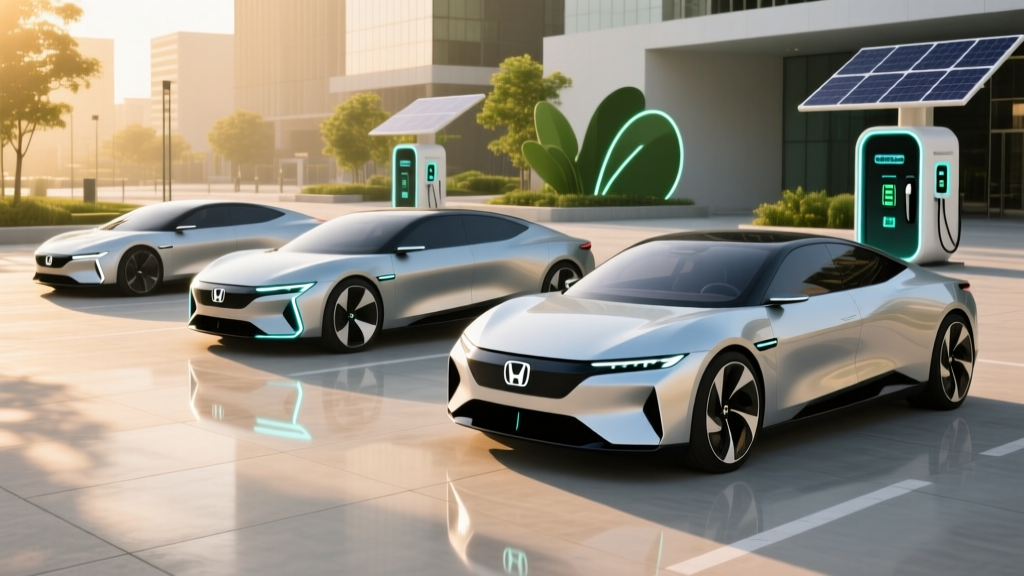
Quick Answer: Honda's electric vehicle concepts — previewed at CES and Tokyo Motor Show under the "0 Series" banner — are translating into production vehicles starting now. The 2026 Honda Prologue SUV (EPA range up to 296 miles, starting ~$47,400) is on sale today, while the sleek Honda Saloon concept and Space-Hub concept preview production models expected for 2027-2028. If you're shopping today, the Prologue is Honda's only available EV; if you can wait, the 0 Series platform promises 800V architecture, thinner batteries, and Level 3-capable ADAS.
Honda's EV Strategy: From Concept to Curb
Honda was late to the battery-electric game, but the company has been prolific in the concept-car circuit. The Honda 0 Series, unveiled at CES 2024, laid out a roadmap built on three principles: "Thin, Light, and Wise." Rather than simply stuffing massive battery packs into heavy platforms (the approach taken by many legacy automakers), Honda's engineering philosophy targets reduced energy consumption through aerodynamics, weight reduction, and a new dedicated EV architecture.
Here's what that concept pipeline actually looks like in terms of buyable or near-buyable vehicles:
- 2026 Honda Prologue: Production SUV, GM Ultium platform, on sale now
- Honda Saloon Concept: Low-slung sedan previewing a 2027-2028 production flagship
- Honda Space-Hub Concept: Compact minivan/MPV concept, production TBD
- Honda 0 Series SUV Concept: Midsize SUV on Honda's own EV platform, expected ~2027
The critical distinction: the Prologue rides on General Motors' Ultium platform (shared with the Chevy Blazer EV and Cadillac Lyriq). Honda's future 0 Series vehicles will ride on Honda's own dedicated EV architecture — a significant engineering pivot that promises thinner battery packs, a lower center of gravity, and steer-by-wire capability.
The 2026 Honda Prologue: Honda's Real EV You Can Buy Today
For buyers who can't wait for concept cars to hit showrooms, the 2026 Honda Prologue is the tangible result of Honda's electrification push. Here are the exact numbers that matter:
| Specification | FWD | AWD (Touring) |
|---|---|---|
| EPA Range | 296 miles | 281 miles |
| Battery (Usable) | 85 kWh (NMC) | 85 kWh (NMC) |
| Horsepower | 212 hp | 288 hp |
| Torque | 236 lb-ft | 333 lb-ft |
| 0-60 mph | ~7.4 sec | ~5.9 sec |
| Max DC Fast Charge | 150 kW | 150 kW |
| 10-80% DC Charge | ~34 min | ~34 min |
| Level 2 Charge Rate | 11.5 kW | 11.5 kW |
| MPGe (Combined) | 94 MPGe | 89 MPGe |
| Base MSRP | $47,400 | $57,900 (Touring) |
| Battery/Powertrain Warranty | 8 yr / 100,000 mi | |
Real-World Range Reality: The EPA rates the Prologue FWD at 296 miles, but expect 235-260 miles on sustained highway driving at 70-75 mph. In cold weather (below 30°F), range drops an additional 15-25%, putting realistic winter highway range closer to 190-220 miles. The Prologue lacks a heat pump — it uses resistive cabin heating, which draws significantly more energy in winter compared to heat-pump-equipped competitors like the Hyundai Ioniq 5 or Tesla Model Y.
Prologue Ownership Costs: EV vs. Gas vs. Hybrid
Concept cars are exciting, but the spreadsheet decides the purchase. Here's how the Prologue stacks up against Honda's own gas and hybrid alternatives over five years of ownership, assuming 15,000 miles per year:
| Cost Category | 2026 Prologue (AWD) | 2026 CR-V Hybrid (AWD) | 2026 CR-V (AWD Gas) |
|---|---|---|---|
| Base MSRP | $50,400 | $36,350 | $33,350 |
| Est. Federal Tax Credit (§30D) | $0-$7,500* | $0 | $0 |
| 5-Yr Fuel/Energy Cost | $3,750 (home L2)** | $6,200 | $8,100 |
| 5-Yr Maintenance | ~$1,800 | ~$3,500 | ~$3,800 |
| 5-Yr Insurance (avg) | ~$9,500 | ~$7,800 | ~$7,500 |
| Est. 5-Yr Depreciation | ~$22,000 | ~$14,500 | ~$13,800 |
| 5-Yr Total Cost | ~$42,950 | ~$39,350 | ~$38,950 |
*§30D credit eligibility depends on battery sourcing, buyer income caps ($150K single / $300K joint), and MSRP caps ($80K for SUVs). The Prologue's GM-sourced battery has faced critical-mineral sourcing scrutiny — check IRS qualified vehicle lists before purchase.
**Based on $0.13/kWh national average electricity rate and 3.5 mi/kWh efficiency. Public DC fast charging costs roughly 2-3x more.
The Prologue's higher purchase price and steeper depreciation (EV depreciation has been aggressive in the 2024-2026 market) make it more expensive over five years than the CR-V Hybrid — unless you qualify for the full $7,500 federal credit and primarily charge at home. The CR-V Hybrid at 40 MPG combined remains the pragmatic cost winner for buyers without reliable home charging access.
What Honda's 0 Series Concepts Promise for 2027-2028
The concept cars that have generated the most buzz — the Saloon sedan and the Space-Hub — preview Honda's proprietary EV platform, which addresses several Prologue limitations:
- 800V architecture: Enables DC fast charging at 250+ kW, targeting 10-80% in under 20 minutes (compared to the Prologue's 34 minutes at 150 kW)
- Thinner battery pack: Honda targets a battery height reduction of roughly 30%, improving interior space and lowering the center of gravity
- LFP and NMC options: Honda has indicated both chemistries will be available, with LFP for cost-sensitive trims (lower energy density but longer cycle life and no cobalt/nickel) and NMC for maximum range variants
- Steer-by-wire: Eliminates the mechanical steering column, enabling variable steering ratios and more cabin design flexibility
- SAE Level 3 ADAS: Honda targets conditional automation (eyes-off in specific highway scenarios) — a step above the current Level 2 Honda Sensing system in the Prologue
SAE Level Clarification: The Prologue's Honda Sensing suite is SAE Level 2 — adaptive cruise plus lane centering that requires continuous driver attention. Honda's 0 Series concepts target Level 3 (eyes-off in defined conditions like highway traffic jams), which is fundamentally different. No Honda currently sold in the U.S. offers Level 3. Only Mercedes-Benz (Drive Pilot) has certified Level 3 in limited U.S. jurisdictions as of 2026.
These are announced/preliminary specifications. Honda has not released final EPA range, battery kWh, or pricing for 0 Series production vehicles. Expect confirmed details closer to launch.
Real-World Ownership: What First-Time Honda EV Buyers Must Know
Whether you're eyeing the Prologue today or waiting for a 0 Series model, these ownership realities apply to any Honda EV:
Home Charging Is Non-Negotiable for Cost Savings
The Prologue's 11.5 kW onboard charger means a Level 2 home station (240V, 48A circuit) adds roughly 30-35 miles of range per hour of charging — enough for a full overnight replenishment. But installation costs vary widely:
| Item | Typical Cost Range |
|---|---|
| Level 2 Charger (hardware) | $350 – $700 |
| Electrician labor (standard install) | $500 – $1,500 |
| Electrical panel upgrade (if needed, 200A) | $1,500 – $3,500 |
| Permit & inspection | $100 – $400 |
| Total (no panel upgrade) | $950 – $2,600 |
| Total (with panel upgrade) | $2,450 – $6,100 |
If you live in an apartment or rely exclusively on public charging, your per-mile energy cost triples. Public DC fast charging networks like Electrify America and EVgo typically charge $0.35-$0.55/kWh, pushing the Prologue's fueling cost to roughly $0.12-$0.16 per mile — comparable to a 30 MPG gas car at $3.50/gallon. Home charging at $0.13/kWh drops that to $0.037 per mile.
Charging Connector: CCS Today, NACS Tomorrow
The 2026 Prologue uses a CCS1 (Combined Charging System) connector. Honda has committed to adopting the NACS (Tesla-style) connector for future models, and Honda owners will gain access to Tesla Superchargers via adapter. If you're buying a Prologue now, CCS gives you access to Electrify America, EVgo, and ChargePoint DC stations. For 0 Series models arriving in 2027+, expect native NACS ports.
Common Misconceptions About Honda's EV Concepts
| Myth | Fact |
|---|---|
| "Honda's EV concepts are just show cars that never get built." | The Prologue (from earlier concept previews) is on sale now. The Saloon and Space-Hub concepts have confirmed production timelines for 2027-2028. |
| "The Prologue is a rebadged Chevy — it's not a real Honda." | The Prologue uses GM's Ultium battery and platform, but Honda engineered its own suspension tuning, interior, software, and Honda Sensing ADAS integration. The driving experience is distinct from the Blazer EV. |
| "EVs cost more to own than any gas car, period." | With home charging and the federal tax credit, the Prologue's 5-year operating costs (fuel + maintenance) are ~$4,500 less than a gas CR-V. Higher purchase price and depreciation narrow the gap, but it's not a blowout in either direction. |
| "The battery will need replacing in 5 years." | Honda warrants the Prologue's battery for 8 years/100,000 miles against capacity loss below 70%. Industry data from fueleconomy.gov shows modern NMC batteries typically retain 85-90% capacity after 100,000 miles under normal use. |
| "Concept specs are what you'll get in the driveway." | Concept cars routinely overstate range and performance. Honda's 0 Series "300+ mile" target will depend on trim, wheel size, and EPA testing methodology. Expect production EPA figures to be 5-15% below concept claims. |
Decision Framework: Should You Buy a Prologue Now or Wait for the 0 Series?
Buy the 2026 Prologue if:
- You need an electric SUV in the next 6 months and want Honda's dealership/service network
- You have home Level 2 charging and drive under 250 miles/day (including highway)
- You qualify for the §30D federal tax credit (verify battery sourcing on the IRS qualified vehicles page)
- You prefer a traditional SUV form factor over sedan or minivan
- You're comfortable with CCS charging and the current ~150 kW peak charge rate
Wait for the Honda 0 Series (2027-2028) if:
- You want faster charging (800V architecture targeting 250+ kW and sub-20-minute 10-80% sessions)
- You prefer a sedan (Saloon) or compact van (Space-Hub) body style
- You want Honda's proprietary EV platform with steer-by-wire and a thinner battery
- You're interested in potential Level 3 ADAS capability (eyes-off highway driving)
- Your current vehicle runs fine and you don't face an urgent purchase timeline
Choose the CR-V Hybrid instead if:
- You lack reliable home charging access (apartment, street parking, no 240V outlet)
- You regularly drive 300+ miles in cold weather where EV range drops 20-30%
- You want the lowest total cost of ownership and the EV tax credit doesn't apply to you
- You tow regularly (the Prologue is rated for 1,500 lbs; a gas/hybrid CR-V handles similar loads without range penalty)
Frequently Asked Questions
Is the Honda Prologue eligible for the $7,500 federal EV tax credit in 2026?
Eligibility depends on current §30D rules including battery critical-mineral sourcing, buyer income limits ($150,000 single / $300,000 joint AGI), and the $80,000 MSRP cap for SUVs. The Prologue's GM-sourced battery has faced sourcing-rule challenges. Always check the IRS qualified clean vehicles list for the specific model year and trim before purchase. Point-of-sale transfer is available if eligible, reducing your dealer price directly.
How fast does the Prologue charge on a road trip?
The Prologue peaks at 150 kW on DC fast chargers, achieving 10-80% in approximately 34 minutes. However, like all EVs, the charge curve tapers significantly above 80% — expect 80-100% to take an additional 25-30 minutes. Plan road-trip stops around 10-80% sessions for efficiency. Preconditioning the battery (navigating to a charger via the infotainment system) is essential for achieving peak charge rates, especially in cold weather.
Will Honda's 0 Series concepts be sold in the United States?
Honda has confirmed that the 0 Series platform is a global strategy, and U.S. market availability is expected for production models. Honda's North American EV production is centered at its Ohio plants. Specific trim levels, pricing, and EPA certification for U.S. models will be announced closer to each vehicle's launch date.
How does the Prologue compare to the Tesla Model Y or Hyundai Ioniq 5?
The Prologue offers competitive range (296 mi EPA FWD) but trails on charging speed — the Ioniq 5 peaks at 240 kW (10-80% in ~18 minutes) and the Model Y at 250 kW on Superchargers (~15 minutes). The Prologue also lacks a heat pump, a front trunk (frunk), and a native NACS port. Where the Prologue wins: Honda's dealership network for service, a more traditional SUV interior layout, and a quieter, more compliant ride tuned by Honda engineers. Pricing is comparable at the mid-trim level.
What is the Prologue's battery degradation like after a few years?
Long-term Prologue-specific data is still accumulating (the model launched for 2024). However, the Ultium NMC platform shared with GM vehicles has shown approximately 5-8% capacity loss over the first 60,000 miles based on early fleet data. Honda's 8-year/100,000-mile battery warranty covers capacity below 70%. For maximum longevity, avoid frequent DC fast charging above 80% and try to keep the battery between 20-80% state of charge for daily use.