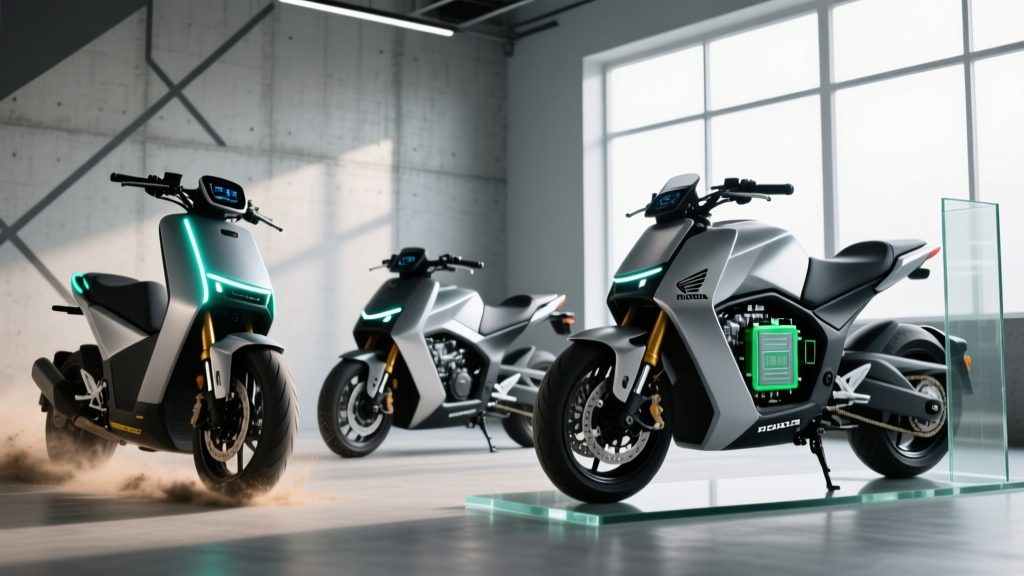
The short answer: Honda's primary electric motorcycle available in most markets is the EM1 e:, a compact urban scooter with a swappable battery and approximately 25 miles (41 km) of real-world range per charge. As of 2026, it is sold in select Asian and European markets but not yet available in the United States. For US riders, Honda has not announced a stateside launch date. If you need an electric two-wheeler now in the US, competitors like Zero Motorcycles, LiveWire, and NIU offer broader availability — but none match Honda's battery-swap ecosystem at the low end.
What Honda Electric Motorcycles Are Available in 2026?
Honda's electric two-wheeler strategy centers on the EM1 e: (stylized "e:") — a lightweight, low-speed electric scooter designed for short urban commutes and delivery use. It debuted in Japan and select ASEAN markets in late 2023 and expanded into parts of Europe through 2024-2025. As of early 2026, the EM1 e: remains Honda's only production electric motorcycle/scooter globally.
Honda has also announced broader electrification plans, including larger-displacement electric motorcycles in development, but these remain in the concept/preliminary stage. The company has committed to offering 10 electric motorcycle models globally by 2026, though most are targeted at Asian markets where small-displacement scooters dominate.
EM1 e: Specifications at a Glance
| Spec | Value |
|---|---|
| Motor Output | 1.7 kW (2.3 hp) continuous / 4.2 kW (5.6 hp) peak |
| Top Speed | ~28 mph (45 km/h) |
| Battery Type | Honda Mobile Power Pack e: (swappable, NMC lithium-ion) |
| Battery Capacity | 1.3 kWh (usable) |
| Claimed Range (WMTC) | ~25 miles (41 km) per battery |
| Real-World Range | ~18–22 miles depending on speed, hills, temperature |
| Charge Time (home, 120V) | ~5 hours (0–100%) |
| Battery Swap Time | Under 60 seconds at a Honda swap station |
| Weight (with battery) | ~209 lbs (95 kg) |
| Storage | Under-seat compartment fits one spare battery + small items |
| Price (Japan MSRP) | ¥438,900 (~$2,900 USD, varies by market) |
| US Availability | Not available — no announced US launch date |
How the EM1 e: Compares to Gas Scooters
The natural comparison for the EM1 e: is Honda's own gas-powered scooters, like the Honda Metropolitan (Navi) or the Honda Grom, which occupy similar urban-commuter niches. Here's how the numbers stack up:
| Metric | Honda EM1 e: (Electric) | Honda Metropolitan (50cc Gas) |
|---|---|---|
| Power | 4.2 kW peak (5.6 hp) | ~3.4 hp |
| Top Speed | 28 mph | ~40 mph |
| Range per Fill/Charge | ~22 miles real-world | ~130 miles (1.6-gal tank, 80 mpg) |
| Fuel/Energy Cost per Mile | ~$0.01 (at $0.15/kWh) | ~$0.05 (at $3.50/gal, 80 mpg) |
| Annual Fuel/Energy (3,000 mi) | ~$30 | ~$131 |
| Annual Maintenance | ~$50 (brakes, tires) | ~$200 (oil, filters, belts, spark plug) |
| Purchase Price | ~$2,900 (market-dependent) | ~$2,600 MSRP (US) |
| Emissions | Tailpipe: zero; upstream depends on grid | EPA-certified, but still emits CO₂ and NOx |
The trade-off is clear: The EM1 e: wins on per-mile operating cost (roughly 4–5× cheaper to "fuel") and near-zero maintenance, but loses badly on range and top speed. A gas Metropolitan can handle a 30-mile round trip without a thought; the EM1 e: requires planning, a spare battery, or access to a swap station.
Real-World Ownership: Charging, Swapping, and Limitations
Owning a Honda electric motorcycle — or any small-capacity electric two-wheeler — comes with practical realities that spec sheets gloss over:
Battery Swapping: The Ecosystem Question
Honda's Mobile Power Pack e: system is designed around a network of battery-swap stations (called "Honda e: Station" or partner networks). In markets like Indonesia and Japan, these are expanding — but coverage is still concentrated in dense urban corridors. If you don't live near a swap station, you're limited to home charging, which takes about 5 hours on a standard outlet.
For US riders, this is a moot point: Honda has not deployed any swap infrastructure stateside. Even if the EM1 e: launched in the US tomorrow, you'd be entirely dependent on home or workplace charging.
Cold-Weather Range Loss
Lithium-ion batteries lose capacity in cold temperatures. At 32°F (0°C), expect the EM1 e:'s already-modest 22-mile real-world range to drop to roughly 15–17 miles. In sub-freezing climates, this scooter is a fair-weather commuter at best. Honda's battery management system includes basic thermal protection, but the small pack has no active heating — a limitation shared by most electric scooters in this class.
Charging Access for Apartment Dwellers
The swappable battery is a genuine advantage here: you can carry the ~22-lb (10 kg) pack indoors and charge it from any standard 120V outlet. This solves the apartment-charging problem that plagues electric car buyers without garages. However, you'll need to check your building's rules on bringing lithium-ion batteries indoors — some HOAs and landlords restrict it.
Cost Breakdown: 5-Year Ownership Estimate
| Cost Category | Honda EM1 e: (Electric) | Honda Metropolitan (Gas) |
|---|---|---|
| Purchase Price | $2,900 | $2,600 |
| 5-Year Energy/Fuel (3,000 mi/yr) | $150 | $656 |
| 5-Year Maintenance | $250 | $1,000 |
| Insurance (est. 5 years) | $1,200 | $1,200 |
| Battery Replacement (if needed) | $500–$800 (est.) | N/A |
| 5-Year Total (no battery replacement) | $4,500 | $5,456 |
| 5-Year Total (with battery replacement) | $5,150 | $5,456 |
The EM1 e: reaches cost parity with the gas Metropolitan around year 3–4, assuming no battery replacement. If the battery degrades significantly (below 70% capacity, which Honda's NMC chemistry typically resists for 500+ full cycles), replacement cost eats into savings. Honda has not published a formal battery warranty for all markets, but in Japan, the Mobile Power Pack carries a standard warranty tied to the vehicle's coverage period.
Common Misconceptions About Honda Electric Motorcycles
| Myth | Fact |
|---|---|
| "Honda makes a full-size electric motorcycle like Zero or LiveWire" | Honda's only production electric two-wheeler is the EM1 e:, a low-speed urban scooter. No highway-capable electric motorcycle from Honda is currently on sale. |
| "The EM1 e: qualifies for the $7,500 federal EV tax credit" | The IRS §30D credit applies to four-wheeled vehicles with MSRP and income caps. Two- and three-wheeled electric vehicles may qualify for a separate, smaller credit (up to $2,500 under the qualified plug-in electric vehicle rules), but eligibility depends on specific IRS criteria — consult IRS guidance or a tax professional. |
| "Electric motorcycles have zero maintenance" | Tires, brakes, suspension, and electrical components still require service. What's eliminated: oil changes, spark plugs, air filters, fuel system maintenance, and exhaust work. |
| "You can charge an electric motorcycle anywhere" | Without a swap station, you need access to a standard outlet — which isn't guaranteed in parking garages, street parking, or workplaces. Plan your charging like you'd plan a gas stop. |
| "The battery will die in 2 years" | NMC lithium-ion packs in light-duty applications typically retain 80%+ capacity after 500–800 full charge cycles. At one charge per day, that's 1.5–2+ years of daily use before noticeable degradation — but partial cycling (common in real use) extends this significantly. |
Decision Framework: Is a Honda Electric Motorcycle Right for You?
Choose the Honda EM1 e: (when/if available in your market) if:
- Your daily round-trip commute is under 15 miles
- You ride primarily in flat, urban areas under 30 mph
- You have access to home or workplace charging (or a nearby swap station)
- You want minimal maintenance and low per-mile operating costs
- You're in a market where Honda sells and services the EM1 e:
Look elsewhere (Zero, LiveWire, NIU, Super Soco, or a gas scooter) if:
- You need highway speeds (55+ mph) or range over 40 miles
- You live in a US state where the EM1 e: isn't sold
- You regularly ride in freezing temperatures
- You need to carry a passenger or heavy cargo
- You have no reliable access to any charging point
What's Next for Honda's Electric Motorcycle Lineup?
Honda has signaled plans for larger electric motorcycles, including concepts shown at EICMA and the Tokyo Motor Show. The company is part of a battery-swap consortium with Yamaha, Suzuki, and Kawasaki — meaning future Honda electric motorcycles may share interchangeable battery packs across brands. However, as of early 2026, no larger Honda electric motorcycle has a confirmed production date or US market commitment.
For US riders watching this space, the most practical approach is to monitor Honda's US powersports announcements via Honda Powersports and track whether the swap-infrastructure partnerships extend to North America. Until then, Honda electric motorcycles remain a compelling but geographically limited option.
Frequently Asked Questions
Can I buy the Honda EM1 e: in the United States?
Not as of early 2026. Honda has not announced a US launch for the EM1 e:. It is currently sold in Japan, Indonesia, and select European markets. US riders interested in electric two-wheelers should look at Zero Motorcycles, LiveWire (Harley-Davidson), NIU, or CSC Motorcycles for available options.
How long does the Honda EM1 e: battery last before needing replacement?
Honda's NMC lithium-ion Mobile Power Pack is rated for approximately 500+ full charge cycles before dropping below 80% capacity. With typical partial-discharge use, real-world lifespan can extend to 3–5 years of daily riding before noticeable range reduction. Replacement batteries are estimated at $500–$800 depending on market.
Is the Honda EM1 e: street-legal?
In markets where it's sold, yes — it's classified as a low-speed electric scooter/moped and typically requires a standard motorcycle endorsement or moped license, depending on local regulations. Since it's not sold in the US, US street-legal classification is not yet applicable.
Does the Honda EM1 e: qualify for any EV tax credits?
The federal §30D clean vehicle credit applies to four-wheeled vehicles. Two-wheeled electric vehicles may qualify under different, smaller incentive programs, and some states offer separate rebates for electric motorcycles/scooters. Check your state's energy office and consult IRS.gov for current rules.
How does the EM1 e: compare to a Zero S or LiveWire ONE?
They're entirely different categories. The Zero S and LiveWire ONE are full-size, highway-capable electric motorcycles with 80–150+ miles of range, 80+ mph top speeds, and prices starting around $12,000–$22,000. The EM1 e: is a low-speed urban runabout at roughly $2,900 with 22 miles of range. They serve different use cases — think city bus vs. intercity train.