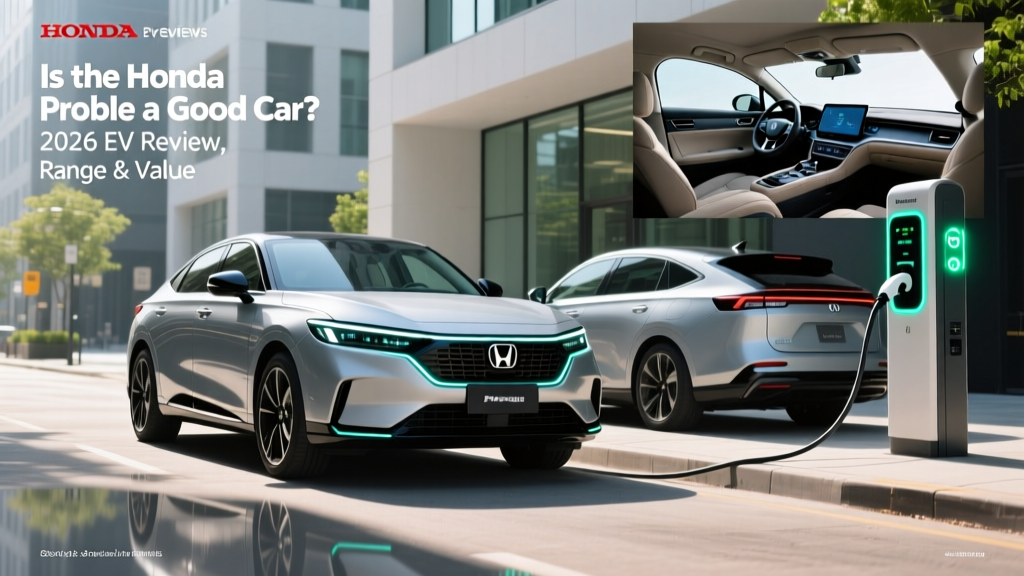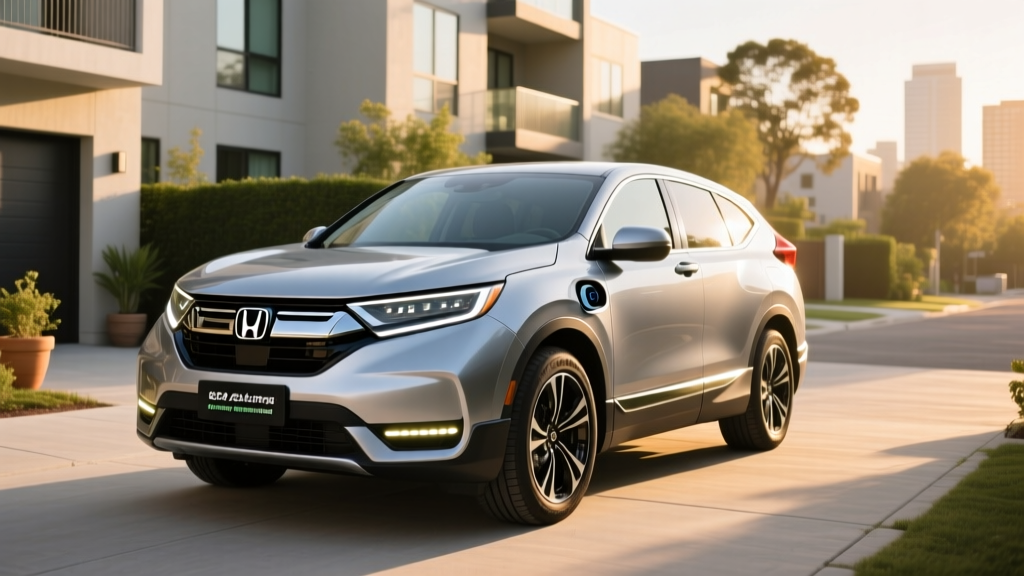
If you've been searching for an electric CRV Honda, here's the direct answer: Honda's first mainstream electric compact SUV, the 2026 Honda Prologue (marketed as the spiritual electric successor to the CR-V), delivers an EPA-estimated 296 miles of range in FWD trims, starts at $47,400 MSRP, and leverages GM's Ultium platform with NMC battery chemistry. However, real-world highway range drops to roughly 240–260 miles, and federal tax credit eligibility depends on your income, battery sourcing compliance, and the current-year §30D rules. For buyers who want a true CR-V-sized EV from Honda with DC fast charging up to 150 kW and Level 2 home charging at 11.5 kW, the Prologue is viable — but the Honda CR-V Hybrid at ~$34,000 remains a compelling alternative if home charging access is limited.
Quick Verdict: Honda's Electric CR-V Equivalent
Model: 2026 Honda Prologue (Honda's electric compact SUV, CR-V segment)
EPA Range: 296 mi (FWD) / 281 mi (AWD)
Battery: 85 kWh usable, NMC (nickel manganese cobalt)
Starting MSRP: $47,400 (EX FWD) before incentives
DC Fast Charge: 150 kW peak, 10–80% in ~30 minutes
0–60 mph: 7.2 seconds (FWD) / 6.5 seconds (AWD Elite)
Understanding the Electric CRV Honda: What Is the Prologue?
Honda does not currently badge any vehicle as an "electric CR-V." Instead, the Honda Prologue occupies the same compact SUV segment as the CR-V but rides on General Motors' BEV3 Ultium platform — the same architecture underpinning the Chevrolet Blazer EV and Cadillac Lyriq. This partnership means Honda skipped developing a dedicated EV platform and instead adapted a proven GM skateboard chassis with Honda-tuned suspension, interior design, and infotainment.
For 2026, Honda offers the Prologue in three trims:
- EX (FWD): $47,400 MSRP — 220 hp, 296 mi EPA range
- Touring (AWD): $51,400 MSRP — 288 hp, 281 mi EPA range
- Elite (AWD): $57,900 MSRP — 288 hp, 273 mi EPA range (21-inch wheels reduce efficiency)
According to fueleconomy.gov, the FWD EX achieves 99 MPGe combined (102 city / 95 highway), consuming approximately 34 kWh per 100 miles. That's competitive with the Hyundai Ioniq 5 (114 MPGe) but slightly behind the Tesla Model Y (122 MPGe) in overall efficiency.
Range Reality: EPA Sticker vs. Real-World Driving
The EPA's 296-mile estimate for the FWD Prologue assumes mixed driving at moderate temperatures. In practice, several factors compress that number significantly.
Real-World Range Expectations: Honda Prologue FWD (296 mi EPA)
| Condition | Expected Range | Notes |
|---|---|---|
| Mixed city/highway, 65–75°F | 265–280 mi | Closest to EPA estimate |
| Sustained highway (70+ mph) | 240–260 mi | Aerodynamic drag reduces efficiency ~15% |
| Cold weather (20–35°F) | 200–235 mi | Battery heating + cabin HVAC draw; NMC chemistry affected |
| Cold + highway combined | 185–215 mi | Worst-case scenario for road trips |
The Prologue's NMC battery chemistry is energy-dense but more temperature-sensitive than LFP (lithium iron phosphate). Honda includes a heat pump on all trims, which mitigates cold-weather range loss compared to resistive heating, but expect a 20–30% range reduction in sub-freezing conditions. The battery's usable capacity of 85 kWh sits within a gross capacity of approximately 89 kWh, with top and bottom buffers protecting long-term cell health.
Charging Speeds and Infrastructure: What to Expect
Charging is where the Prologue's GM DNA becomes apparent. The SUV supports NACS (North American Charging Standard) natively for 2026, giving access to Tesla Supercharger stations via adapter or built-in port depending on build date. It also supports CCS1 at Electrify America, EVgo, and other networks.
| Charging Level | Power (kW) | Miles Added per Hour | Typical Use Case |
|---|---|---|---|
| Level 1 (120V household) | 1.4 kW | ~4 mi/hr | Emergency / overnight trickle |
| Level 2 (240V, 48A) | 11.5 kW | ~33 mi/hr | Home daily charging (full charge ~8 hrs) |
| DC Fast Charge | 150 kW peak | ~210 mi in 30 min | Road trips; 10–80% in ~30 minutes |
Important charging-curve reality: The Prologue peaks at 150 kW only between roughly 10–40% state of charge. Above 60%, the charge rate tapers significantly — dropping to ~80 kW by 70% and ~40 kW above 85%. This means a 10–80% session takes approximately 30 minutes, but a 10–95% session can stretch past 50 minutes. Plan road-trip stops accordingly: charge to 80%, then move on.
For home charging, a Level 2 installation on a dedicated 60-amp circuit (supporting 48A continuous draw) will recharge the Prologue from 10% to full overnight. Installation costs typically range from $800–$2,500 depending on panel proximity, permitting, and whether your electrical panel needs a 200-amp upgrade (an additional $1,500–$3,000). Always consult a licensed electrician for final specifications.
Cost Comparison: Electric Prologue vs. Gas CR-V vs. CR-V Hybrid
The core buying decision for an electric CRV Honda comes down to total cost of ownership. Here's how the Prologue stacks up against the conventional and hybrid CR-V over a 5-year, 75,000-mile ownership period.
| Cost Category | 2026 Prologue EX (EV) | 2026 CR-V Hybrid (AWD) | 2026 CR-V Gas (AWD) |
|---|---|---|---|
| Base MSRP | $47,400 | $35,350 | $32,400 |
| Federal Tax Credit (§30D)* | Up to $7,500 | $0 | $0 |
| Effective Purchase Price | $39,900 | $35,350 | $32,400 |
| Fuel/Energy (5 years) | $3,750 (home charging)** | $6,875 (40 MPG, $3.67/gal) | $9,175 (30 MPG, $3.67/gal) |
| Maintenance (5 years) | ~$1,200 | ~$2,800 | ~$3,200 |
| Insurance (5-year avg) | ~$9,500 | ~$7,500 | ~$7,200 |
| Estimated 5-Year Total | $54,350 | $52,525 | $51,975 |
* Federal §30D tax credit eligibility requires meeting battery critical-mineral sourcing thresholds, buyer income caps ($150K single / $300K joint), and MSRP caps ($80K for SUVs). Verify current-year rules at irs.gov. Point-of-sale transfer available at participating dealers.
** Based on $0.14/kWh national average electricity rate and 34 kWh/100mi consumption. Public DC fast charging at $0.35–$0.48/kWh would raise energy costs to ~$6,000–$8,000.
The Prologue achieves cost parity with the CR-V Hybrid only if you qualify for the full $7,500 federal credit AND charge primarily at home. If you rely on public fast charging, the energy cost advantage narrows considerably. The gas CR-V remains the cheapest option upfront, but the hybrid's fuel savings close the gap over time without requiring any charging infrastructure.
Common Misconceptions About the Electric CRV Honda
| Myth | Fact |
|---|---|
| "The electric CR-V gets 296 miles no matter what." | 296 mi is the EPA estimate for FWD in ideal conditions. Expect 240–260 mi on the highway and 200–235 mi in freezing weather. |
| "Everyone gets the $7,500 tax credit." | The §30D credit has income caps, MSRP caps, and battery-sourcing requirements that change annually. Many buyers qualify for partial credit or none at all. Check IRS guidelines. |
| "It charges at 150 kW the entire session." | 150 kW is peak rate at low SoC. The charge curve tapers above 60%, averaging closer to 85–95 kW across a 10–80% session. |
| "Honda designed the Prologue from scratch." | The Prologue uses GM's BEV3 Ultium platform. Honda designed the interior, suspension tuning, and exterior, but the powertrain and battery are GM-sourced. |
| "EV maintenance costs nothing." | No oil changes, but tire rotation, cabin air filters, brake fluid, wiper blades, and cabin HVAC still apply. Budget ~$200–$300/year. |
Real-World Ownership: What First-Time EV Buyers Should Know
Owning the Prologue — or any EV — involves practical considerations that go beyond the spec sheet:
Home charging is the linchpin. Approximately 80% of EV charging happens at home. If you live in an apartment without charging access, or your home has a 100-amp electrical panel that can't support a 60-amp circuit, the daily convenience advantage of EV ownership disappears. Level 1 (120V) charging adds only ~4 miles per hour — insufficient for the Prologue's 34 kWh/100mi consumption if you drive more than 30 miles daily.
Insurance premiums run 15–25% higher for the Prologue compared to a gas CR-V, reflecting higher repair costs for EV-specific components and the vehicle's greater MSRP. Get quotes from your insurer before committing.
Battery warranty coverage: Honda provides an 8-year / 100,000-mile battery warranty, covering defects and capacity loss below 70% of original capacity. This aligns with industry standards. Based on NMC degradation data from similar Ultium-based vehicles, expect approximately 8–12% capacity loss over the first 100,000 miles under normal use, stabilizing thereafter. Full battery replacement (out of warranty) currently costs $12,000–$18,000 including labor, though prices are trending downward.
Regenerative braking on the Prologue offers multiple levels selectable via paddle shifters, but it does not provide true one-pedal driving to a complete stop like some competitors. You'll still use the friction brake at low speeds. Expect reduced brake pad wear — many EV owners report original pads lasting 80,000+ miles.
Decision Framework: Should You Buy the Electric CRV Honda?
Choose the Honda Prologue (Electric) If:
- You have reliable home Level 2 charging access (garage or driveway with 240V circuit)
- You qualify for the full or partial §30D federal tax credit (check income and sourcing rules)
- Your daily commute is under 80 miles round-trip, with occasional 200–250 mile road trips
- You live in a mild-to-moderate climate where cold-weather range loss is manageable
- You want Honda's dealer network and brand familiarity with an EV powertrain
- You value quiet, smooth acceleration and lower per-mile energy costs
Choose the CR-V Hybrid Instead If:
- You lack home charging access (apartment, street parking, older electrical panel)
- You regularly drive 300+ miles between stops in rural areas or charging deserts
- You live in extreme cold climates (sustained sub-20°F winters) where range loss exceeds 30%
- Your budget is firm at $35,000–$38,000 and you don't qualify for the EV tax credit
- You tow (the CR-V Hybrid is rated for 1,000 lbs; the Prologue is rated for 1,500 lbs but range drops sharply under load)
- You want proven long-term reliability data — the CR-V Hybrid has years of real-world track record
Choose the Gas CR-V If:
- Upfront purchase price is your primary concern and you drive fewer than 10,000 miles/year
- You plan to keep the vehicle 2–3 years and want maximum resale-market flexibility
2026 Honda Prologue Specifications at a Glance
| Specification | EX (FWD) | Touring (AWD) | Elite (AWD) |
|---|---|---|---|
| MSRP | $47,400 | $51,400 | $57,900 |
| EPA Range | 296 mi | 281 mi | 273 mi |
| Battery (usable) | 85 kWh NMC | 85 kWh NMC | 85 kWh NMC |
| Horsepower | 220 hp | 288 hp | 288 hp |
| 0–60 mph | 7.2 sec | 6.5 sec | 6.5 sec |
| DC Fast Charge Peak | 150 kW | 150 kW | 150 kW |
| 10–80% DC Charge Time | ~30 min | ~30 min | ~30 min |
| Level 2 Charge Rate | 11.5 kW | 11.5 kW | 11.5 kW |
| MPGe (city/hwy/combined) | 102/95/99 | 97/87/93 | 95/84/90 |
| Cargo Volume | 25.2 cu ft (rear seats up) | 25.2 cu ft | 25.2 cu ft |
| Towing Capacity | 1,500 lbs | 1,500 lbs | 1,500 lbs |
| Battery Warranty | 8 yr / 100,000 mi | 8 yr / 100,000 mi | 8 yr / 100,000 mi |
Frequently Asked Questions
Is the Honda Prologue the same as an electric CR-V?
Not exactly. Honda positions the Prologue as its electric compact SUV, competing in the same segment as the CR-V, but it's a distinct model built on GM's Ultium platform rather than the CR-V's architecture. It's slightly larger than the CR-V and shares no body panels or interior components with it. Honda has announced a next-generation, Honda-developed EV (expected 2027+) that may more directly carry the "electric CR-V" mantle.
Does the Honda Prologue qualify for the $7,500 federal tax credit?
Eligibility depends on current-year §30D rules, including battery critical-mineral sourcing percentages, buyer income limits ($150,000 single / $300,000 joint modified AGI), and the $80,000 MSRP cap for SUVs. The Prologue's MSRP falls under the cap, but battery sourcing compliance varies by production batch. Check the latest eligibility list at fueleconomy.gov and confirm with your tax professional before relying on the credit.
How long does it take to charge the Prologue at home?
On a Level 2 home charger (240V, 48 amps, 11.5 kW), a full charge from 10% to 100% takes approximately 8 hours. Most owners plug in nightly and wake to a full battery. On a standard 120V outlet (Level 1), expect roughly 4 miles of range per hour of charging — practical only for very low daily mileage or emergency top-ups.
What happens if the battery degrades significantly?
Honda warrants the battery for 8 years or 100,000 miles against capacity loss below 70%. Real-world NMC degradation data from Ultium-based vehicles suggests 8–12% loss over 100,000 miles, meaning you'd retain 88–92% capacity — well above the warranty threshold. Out-of-warranty replacement currently runs $12,000–$18,000, but battery costs have declined roughly 10–15% per year and are expected to continue falling through the decade.
Can the Honda Prologue use Tesla Superchargers?
Yes. For 2026, Honda provides NACS compatibility, allowing access to the Tesla Supercharger network. Depending on your vehicle's build date, this may be via a native NACS charge port or a CCS-to-NACS adapter supplied by Honda. The Supercharger network remains the most reliable and extensive DC fast-charging network in the U.S., with over 25,000 stalls nationally.
How does the Prologue compare to the Hyundai Ioniq 5 or Tesla Model Y?
The Ioniq 5 offers faster charging (240 kW peak, 10–80% in ~18 min), slightly better efficiency (114 MPGe), and a lower starting price (~$42,000). The Model Y leads in range (320+ mi), efficiency (122 MPGe), and Supercharger-native access but carries brand-controversy baggage for some buyers. The Prologue's advantage is Honda brand loyalty, dealer familiarity, and a more traditional SUV driving feel — but it trails on charging speed and efficiency metrics.