Quick Answer: Honda's EV Reality Check
If you're searching for a Honda concept EV you can actually buy today, your only current option is the Honda Prologue (EPA range up to 308 miles, starting at $47,400 before incentives). Honda's headline-grabbing "0 Series" concept EVs — the Saloon and Space-Hub — remain announced prototypes targeting 2026–2028 production with projected 300+ mile ranges and 350 kW peak charging. These concepts signal Honda's long-term EV strategy, but buyers ready to purchase now must evaluate the Prologue against its platform sibling, the Chevy Blazer EV, and competing midsize electric SUVs. Below, we break down what's real, what's concept, and what ownership actually costs.
What Is Honda's Concept EV Strategy?
Honda's electric vehicle roadmap has gone through several public pivots. The most significant is the Honda 0 Series, unveiled at CES 2024, which represents a ground-up dedicated EV architecture — a sharp departure from the Prologue, which rides on General Motors' Ultium platform developed during a now-dissolved partnership.
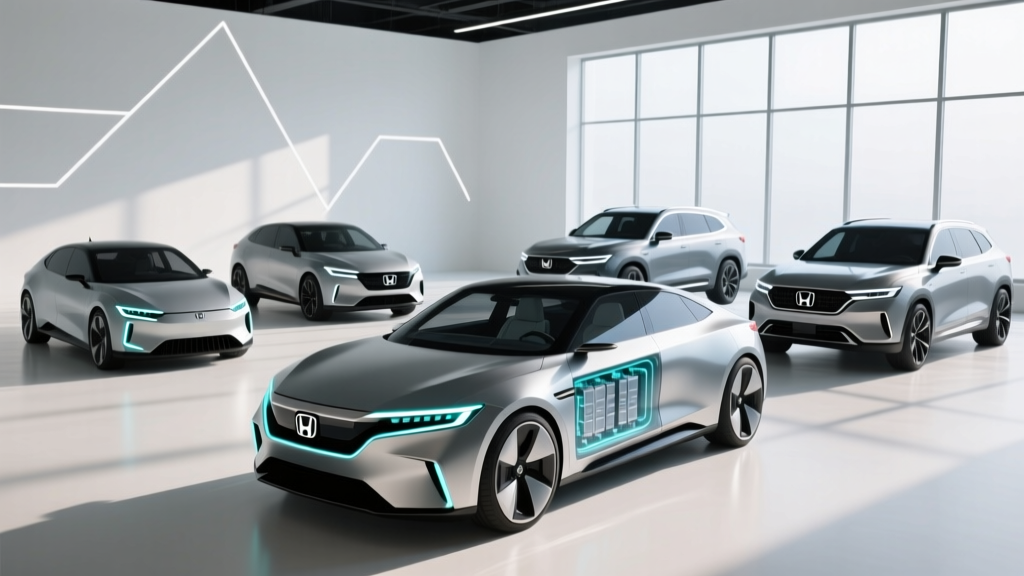
The 0 Series encompasses multiple concept EV models:
- Honda 0 Series Saloon — A low-slung sedan concept targeting production in North America by late 2026 or 2027, with Honda's proprietary thin, lightweight battery pack and a projected range exceeding 300 miles (EPA estimated, preliminary).
- Honda 0 Series Space-Hub — A compact, cab-forward minivan/crossover concept aimed at maximizing interior volume on a smaller footprint, also slated for 2026–2028 production.
- Next-generation Honda EVs — Honda has committed to launching seven 0 Series models globally by 2030, all on a new dedicated skateboard platform with steer-by-wire and Level 3 autonomous capability in limited conditions.
The critical distinction for buyers: none of these concept EVs are available for purchase or pre-order as of early 2026. Honda has shared preliminary specifications but not final MSRP, exact battery kWh, or confirmed EPA certifications. If you need an electric Honda today, the Prologue is your vehicle.
Honda Prologue: The EV You Can Actually Buy
Developed on GM's Ultium platform alongside the Chevrolet Blazer EV, the Honda Prologue is a midsize electric SUV that serves as Honda's bridge to its dedicated 0 Series architecture. Here are the exact specifications buyers need:
| Specification | Prologue EX (FWD) | Prologue Touring (AWD) | Prologue Elite (AWD) |
|---|---|---|---|
| Base MSRP | $47,400 | $51,400 | $57,400 |
| EPA Range | 308 miles | 296 miles | 283 miles |
| Battery (Usable) | 85 kWh (NMC) | 85 kWh (NMC) | 85 kWh (NMC) |
| Horsepower | 212 hp | 288 hp | 288 hp |
| 0–60 mph | ~7.5 sec | ~6.0 sec | ~6.0 sec |
| Peak DC Fast Charge | 190 kW | 190 kW | 190 kW |
| 10–80% DCFC Time | ~30 min | ~30 min | ~30 min |
| Level 2 Charge Rate | 11.5 kW | 11.5 kW | 11.5 kW |
| Combined MPGe | 95 MPGe | 92 MPGe | 90 MPGe |
| Battery Warranty | 8 yr / 100,000 mi | 8 yr / 100,000 mi | 8 yr / 100,000 mi |
Real-World Range vs. EPA Sticker
The Prologue EX's 308-mile EPA rating is competitive on paper, but real-world results depend heavily on conditions. In highway driving at 70 mph, expect approximately 250–270 miles before needing to charge. In cold weather (below 30°F), range can drop 20–30%, putting realistic winter range closer to 215–250 miles for the FWD model. The AWD trims sacrifice 12–25 EPA miles due to the rear motor's weight and parasitic drag, even when the rear axle is decoupled during cruising.
Prologue vs. Gas and Hybrid: The Cost Comparison
The Prologue competes internally with Honda's own CR-V Hybrid and externally with the Toyota RAV4 Hybrid, Chevrolet Blazer EV, and Hyundai Ioniq 5. Here's how the numbers stack up over five years of ownership, assuming 15,000 miles per year and national average electricity/gas prices:
| Cost Factor (5 Years) | Honda Prologue EX (EV) | Honda CR-V Hybrid (AWD) | Toyota RAV4 (Gas AWD) |
|---|---|---|---|
| Purchase Price (MSRP) | $47,400 | $36,350 | $33,945 |
| Federal Tax Credit (§30D) | Up to $7,500* | $0 | $0 |
| Effective Purchase Price | ~$39,900 | $36,350 | $33,945 |
| Fuel/Energy (5 yr, 75k mi) | $4,125 (home L2)** | $6,750 (40 MPG) | $9,375 (28 MPG) |
| Maintenance (5 yr) | ~$1,500 | ~$3,200 | ~$3,800 |
| Estimated Insurance (5 yr) | ~$9,500 | ~$7,500 | ~$7,200 |
| Total 5-Year Cost | ~$55,025 | ~$53,800 | ~$54,320 |
* §30D federal tax credit eligibility depends on buyer income caps ($150k single / $300k joint), MSRP caps ($80k for SUVs), battery sourcing, and critical mineral requirements. Point-of-sale transfer available. Confirm at IRS.gov before purchasing.
** Home Level 2 charging at $0.14/kWh national average. Public DC fast charging costs 2–3× more per mile.
The Prologue's total cost of ownership is competitive with gas and hybrid alternatives only when you can charge at home and qualify for the full federal credit. Without the tax credit, the Prologue costs roughly $7,000–$8,000 more over five years than a CR-V Hybrid. Insurance premiums for the Prologue run 15–25% higher than comparable gas models, reflecting EV-specific repair costs and parts pricing — a factor many first-time EV buyers overlook.
Charging Reality: Home Access Is the Make-or-Break Factor
The Prologue's 190 kW peak DC fast-charging rate is respectable for road trips, adding roughly 100 miles of range in 15 minutes at a compatible station (though the charge curve tapers significantly above 80% SoC, as is standard for NMC batteries). But daily convenience hinges on home charging.
| Charging Level | Power | Miles Added per Hour | Use Case |
|---|---|---|---|
| Level 1 (120V outlet) | ~1.4 kW | ~4–5 miles | Emergency/overnight top-up only |
| Level 2 (240V, 48A) | 11.5 kW | ~35–38 miles | Daily home charging — full overnight refill |
| DC Fast Charge | Up to 190 kW | ~400+ mi/hr (peak) | Road trips — 10–80% in ~30 min |
A Level 2 home charger installation typically costs $800–$2,500 (charger hardware plus electrician labor), assuming your electrical panel has sufficient capacity. Homes with 100-amp panels may require a $2,000–$4,000 panel upgrade to support a 48-amp circuit — a cost that frequently surprises first-time EV buyers. If you live in an apartment or lack dedicated parking with electrical access, relying on public charging at $0.30–$0.50/kWh erases most of the Prologue's fuel-cost advantage over a CR-V Hybrid.
Honda provides Prologue buyers with a charging incentive package that includes a home charger or public charging credits (programs vary by model year and dealer). Check current offerings at your local Honda dealer before negotiating.
What the Honda 0 Series Concept EVs Mean for Your Decision
The 0 Series represents Honda's long-term bet on a dedicated EV platform with three core technical differentiators, according to Honda's published concept details:
- Thin, lightweight battery architecture — Honda claims a proprietary cell format and pack design that sits lower in the chassis than Ultium, improving handling and reducing vehicle weight. If validated in production, this could yield efficiency gains of 5–10% over the Prologue's current 3.1–3.3 mi/kWh.
- Steer-by-wire — Eliminates the mechanical steering column, enabling variable steering ratios and freeing interior space. This technology is proven in aviation but remains rare in production cars (Toyota bZ4X and Lexus RZ offer it as an option).
- Level 3 autonomy in limited conditions — Honda targets hands-off, eyes-off driving in highway traffic jams under 37 mph, a meaningful step above the Level 2 driver-assist systems (Honda Sensing) in current models. Level 3 means the car assumes driving responsibility in defined scenarios, unlike Level 2 where the driver must remain engaged at all times.
SAE Automation Level Clarification
Honda Sensing and the Prologue's driver-assist suite are SAE Level 2 — the system can steer and control speed, but the driver must continuously monitor the road and remain ready to take over. The 0 Series' announced Level 3 capability (if it reaches production) would allow hands-off/eyes-off driving only in specific, geo-fenced conditions like low-speed highway congestion. This is fundamentally different from Level 4 driverless operation (like Waymo robotaxis), which requires no human backup driver at all.
The strategic question for buyers: Do you wait for the 0 Series or buy a Prologue now?
If/Then Decision Framework
- Choose the Prologue now if: You need a midsize electric SUV within 6 months, you have home Level 2 charging access, you qualify for the §30D federal tax credit, and you value Honda's dealer network and service infrastructure over cutting-edge EV tech.
- Wait for the 0 Series if: Your current vehicle is reliable for 2+ more years, you want a dedicated EV platform with better efficiency, you're interested in steer-by-wire or Level 3 autonomy, or you want to see real-world EPA ratings and pricing before committing.
- Choose a CR-V Hybrid instead if: You lack home charging access, you regularly drive in extreme cold (below 10°F), your daily commute exceeds 80 miles with no mid-day charging, or the Prologue's MSRP minus tax credit still exceeds your budget.
- Consider the Hyundai Ioniq 5 or Kia EV6 if: You want faster DC charging (peak 240–350 kW vs. Prologue's 190 kW), a more mature dedicated EV platform, or access to Tesla's Supercharger network via the NACS adapter ecosystem.
Common Honda EV Misconceptions — Fact-Checked
| Myth | Fact |
|---|---|
| "The Honda 0 Series Saloon is available to order now." | The 0 Series models are concept vehicles. Honda targets North American production starting late 2026 or 2027. No pricing, final specs, or pre-orders are available as of early 2026. |
| "The Prologue is a Honda-engineered EV." | The Prologue is built on GM's Ultium platform at GM's Spring Hill, Tennessee plant. Honda designed the exterior, interior, and tuning, but the battery, motors, and electrical architecture are GM-sourced. |
| "Honda's EV battery will need replacing in 5 years." | The Prologue's 85 kWh NMC battery carries an 8-year/100,000-mile warranty (10 years/150,000 miles in CARB states). Industry data shows modern NMC packs retain 85–90% capacity at 100,000 miles under normal use. Full replacement, if needed out of warranty, runs $12,000–$18,000 — but this is rare within the first decade. |
| "All EVs qualify for the $7,500 federal tax credit." | The §30D credit has strict eligibility requirements: buyer income caps, MSRP caps ($80k for SUVs), North American final assembly, and battery mineral/component sourcing thresholds that change annually. The Prologue currently qualifies for up to $7,500, but always verify at IRS.gov before purchase. |
| "I can charge on any standard outlet." | A 120V Level 1 outlet adds only ~4–5 miles per hour of charging. For a depleted 85 kWh battery, a full Level 1 charge takes 60+ hours. A 240V Level 2 home charger is essential for practical daily EV ownership. |
Ownership Considerations Most Buyers Overlook
Beyond range and price, three factors disproportionately affect Honda Prologue ownership satisfaction:
1. Public charging network fragmentation. The Prologue ships with a CCS1 connector. While Honda has committed to adopting NACS (Tesla's connector) on future models — likely starting with the 0 Series — current Prologue owners need a CCS-to-NACS adapter to access Tesla Superchargers. Electrify America and EVgo stations support CCS natively, but real-world reliability at public chargers remains inconsistent: industry surveys show 15–20% of public charging sessions encounter errors or slower-than-advertised speeds.
2. Depreciation uncertainty. EV resale values have been volatile. The Prologue, as a first-generation Honda EV on a borrowed platform, faces steeper depreciation risk than a Tesla Model Y or a Toyota RAV4 Hybrid. Early data suggests 3-year EV depreciation of 40–55% for non-Tesla models, compared to 25–35% for popular hybrids. Factor this into your total cost calculation if you plan to sell or trade within five years.
3. Cold-weather charging slowdown. The Prologue's NMC battery charges significantly slower when cold. In sub-freezing temperatures, preconditioning the battery (via the Honda app while plugged in) is essential to achieve advertised DC fast-charge speeds. Without preconditioning, a 10–80% charge that takes 30 minutes at 70°F can stretch to 45–55 minutes at 20°F, because the battery management system limits charge rate to protect cell health.
Frequently Asked Questions
Can I pre-order a Honda 0 Series concept EV?
No. Honda has not opened pre-orders for any 0 Series production model. The Saloon and Space-Hub remain concept vehicles with targeted production dates of late 2026 through 2028. Honda has not released final pricing, confirmed battery specifications, or dealer reservation processes for these models.
Is the Honda Prologue eligible for the federal EV tax credit?
The Prologue has qualified for up to $7,500 under IRS §30D, with point-of-sale transfer available at participating dealers. However, eligibility depends on your taxable income (under $150,000 single / $300,000 joint filer), the vehicle's MSRP (under $80,000 for SUVs), and battery sourcing requirements that tighten annually. Always confirm current eligibility at fueleconomy.gov and IRS.gov before signing a purchase agreement.
How does the Prologue compare to the Chevy Blazer EV?
Both share the Ultium platform and similar battery capacity, but the Blazer EV offers a larger battery option (up to 102 kWh, EPA range up to 324 miles) and a lower starting MSRP. The Prologue differentiates on interior materials, Honda's dealer experience, and brand loyalty. Mechanically, they are closely related — test-drive both before deciding.
Will Honda switch to the NACS (Tesla) charging connector?
Honda has announced that future North American EVs will adopt NACS, likely beginning with the 0 Series production models. The current Prologue uses CCS1. Honda and other automakers are working with charging networks to ensure adapter compatibility, but Prologue owners should budget for a CCS-to-NACS adapter (~$200–$300) if they want Supercharger access.
What's the real cost to charge a Honda Prologue at home?
Charging the Prologue's 85 kWh battery from 10% to 100% at home on a Level 2 charger costs approximately $10.70–$14.50 depending on your electricity rate ($0.12–$0.17/kWh national average). That translates to roughly $0.04–$0.055 per mile — about one-third the per-mile cost of a 28 MPG gas vehicle at $3.50/gallon. Over 15,000 annual miles, home charging saves $1,200–$1,800 per year versus gasoline.
Sources: EPA fuel economy data via fueleconomy.gov, Honda Newsroom official specifications, IRS §30D clean vehicle credit guidance at irs.gov.