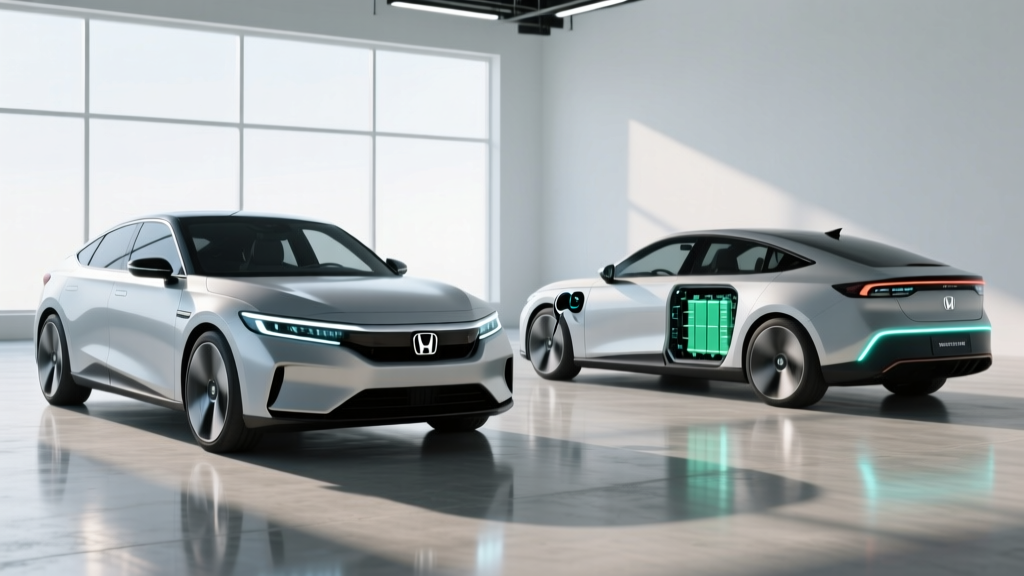
Quick Answer: Honda 0 Series electric vehicles are the automaker's next-generation dedicated EV lineup built on a new thin-and-light platform. The first models — the 0 Series SUV and 0 Series Saloon — are expected to launch in the 2026 model year with targeted EPA ranges of 300+ miles, 800V-class fast charging, and starting prices likely between $40,000 and $50,000. These are Honda's first ground-up EVs since the short-range e:NY1/Prologue era, and they represent a reset in Honda's electrification strategy. However, because these vehicles are still in the pre-production phase, final EPA figures, pricing, and IRS §30D tax credit eligibility remain unconfirmed.
What Is the Honda 0 Series?
The Honda 0 Series is not a single car — it's a platform and design philosophy that will underpin Honda's global EV lineup through the end of the decade. Honda unveiled the concept vehicles at CES 2024, showcasing two body styles: a sleek sedan (the Saloon) and a compact crossover (the SUV). Both ride on an entirely new architecture Honda calls "thin, light, and wise" — a dedicated EV skateboard with a low-slung battery pack, rear-wheel-drive bias (with AWD available), and a next-generation driver-assistance suite.
This matters because Honda's previous EV efforts relied heavily on repurposed platforms. The Honda Prologue, for instance, uses GM's Ultium platform — essentially a rebadged Chevrolet Blazer EV. The 0 Series represents Honda engineering its own EV DNA from the ground up, which typically yields better packaging efficiency, weight distribution, and charging performance.
Projected Specs: Range, Battery, and Charging
Honda has been deliberate about releasing hard numbers, but based on concept disclosures, executive statements, and supply-chain reporting, here is what we can reasonably project for the 2026-2027 production models:
| Spec | 0 Series SUV (Projected) | 0 Series Saloon (Projected) |
|---|---|---|
| Battery Capacity | ~85–100 kWh (NMC chemistry) | ~85–100 kWh (NMC chemistry) |
| EPA Range (Target) | 300–340 miles | 320–380 miles |
| Real-World Highway Range | ~260–290 miles | ~280–330 miles |
| Peak DC Fast Charge Rate | ~220–270 kW (800V architecture) | ~220–270 kW (800V architecture) |
| 10–80% DC Fast Charge Time | ~18–25 minutes (projected) | ~18–25 minutes (projected) |
| Level 2 Charging (Home) | ~11–19 kW (J1772/NACS) | ~11–19 kW (J1772/NACS) |
| Drivetrain | RWD standard / AWD optional | RWD standard / AWD optional |
| 0–60 mph (Est.) | ~5.5–6.5 sec (RWD) | ~5.0–6.0 sec (RWD) |
Real-World Range Reality Check: Honda is targeting 300+ miles of EPA range, but real-world highway driving at 70–80 mph typically reduces that figure by 10–15%. In freezing temperatures (below 32°F), expect an additional 20–30% range reduction due to battery resistance and cabin heating demands. A 340-mile EPA rating could realistically deliver 240–260 miles on a cold-weather highway road trip. This is consistent with industry norms for NMC-based packs — not a Honda-specific limitation.
Honda has confirmed an 800V-class electrical architecture, which enables significantly faster DC charging compared to the 400V systems used in older EVs. The practical benefit: if peak charging sustains near 250 kW, you could add roughly 150–180 miles of range in a 15-minute stop at a compatible 350 kW charger. However, charging curves taper significantly above 80% State of Charge (SoC), so the last 20% can take as long as the first 60%.
Honda 0 Series vs. Gas Cars and Key EV Rivals
The 0 Series will compete directly with mid-size electric sedans and crossovers in the $40,000–$55,000 bracket. Here's how projected specs stack up against current benchmarks:
| Vehicle | EPA Range | Battery (kWh) | Peak DC kW | 10–80% | Base MSRP |
|---|---|---|---|---|---|
| Honda 0 Series SUV (Proj.) | 300–340 mi | 85–100 | ~250 kW | ~20 min | ~$42,000–$48,000 |
| Tesla Model Y Long Range | 320 mi | 78.1 | 250 kW | ~22 min | $44,990 |
| Hyundai Ioniq 5 Long Range | 305 mi | 77.4 | 235 kW | ~18 min | $42,600 |
| Honda Accord (Gas, 2025) | ~490 mi (tank) | N/A | N/A | 5 min (fill-up) | $28,990 |
| Honda CR-V Hybrid | ~510 mi (tank) | 1.06 (HEV) | N/A | 5 min (fill-up) | $34,050 |
The gas and hybrid comparisons are important context. A Honda Accord Hybrid delivers roughly 48 MPG combined and a $29,000 starting price. Over 15,000 miles annually at $3.40/gallon, that's about $1,063 in fuel costs. The 0 Series SUV, at an estimated 3.0–3.5 kWh/mile and $0.14/kWh national average electricity rate, would cost roughly $630–$875 per year in home charging — a savings of $200–$400 annually. However, the $13,000–$19,000 higher purchase price means fuel savings alone won't close the gap for many buyers without tax incentives.
The Real Cost of Owning a Honda 0 Series EV
Purchase price is only part of the ownership equation. Here's a five-year cost projection comparing a 0 Series SUV (estimated) against a Honda CR-V Hybrid and a gas-only CR-V:
| Cost Category (5 Yr / 75K Mi) | Honda 0 Series SUV (Est.) | CR-V Hybrid | CR-V Gas |
|---|---|---|---|
| Purchase Price (Base) | $45,000 | $34,050 | $30,950 |
| Federal Tax Credit (§30D) | –$0 to –$7,500* | $0 | $0 |
| Fuel / Electricity | $3,500 | $5,300 | $7,200 |
| Maintenance | $1,200 | $2,800 | $3,400 |
| Insurance (Avg.) | $9,500 | $7,800 | $7,500 |
| Estimated Depreciation | $18,000 | $12,500 | $13,000 |
| Total 5-Year Cost | $50,700–$58,200 | $57,450 | $59,050 |
*IRS §30D credit eligibility depends on battery critical-mineral sourcing, buyer income caps ($150K single / $300K joint AGI), and MSRP caps ($55K sedans / $80K SUVs). Honda has not confirmed whether 0 Series batteries will meet domestic-sourcing requirements at launch. Consult a tax professional and check IRS guidance before assuming credit eligibility.
Key takeaways from the cost breakdown:
- Maintenance savings are real: EVs eliminate oil changes, transmission fluid, spark plugs, and exhaust-system repairs. Brake pad life extends significantly thanks to regenerative braking. Expect roughly 60% less scheduled maintenance versus a gas vehicle.
- Insurance premiums run higher: EV insurance averages 15–25% above comparable gas models due to higher repair costs and specialized parts. Shop quotes before buying.
- Depreciation is the wildcard: EV resale values have been volatile. Tesla price cuts in 2023–2024 battered used EV values. Honda's strong brand reputation may help the 0 Series hold value better than some competitors, but there's no guarantee.
Tax Credits, Incentives, and What You Can Actually Claim
The federal §30D clean vehicle credit offers up to $7,500 for qualifying new EVs, but the rules are stringent and subject to change. As of 2026, eligibility requires:
- MSRP Caps: ≤$55,000 for sedans (Saloon) / ≤$80,000 for SUVs and crossovers
- Buyer Income Caps: AGI ≤$150,000 (single) / ≤$225,000 (head of household) / ≤$300,000 (joint)
- Battery Component Sourcing: Increasing percentage of battery components must be manufactured or assembled in North America (phased annually)
- Critical Minerals: Increasing percentage of critical minerals must be sourced from the U.S. or free-trade-agreement partners
- Point-of-Sale Transfer: Qualified buyers can transfer the credit to the dealer at purchase, reducing the out-of-pocket price immediately
- Foreign Entity of Concern (FEOC): Vehicles with battery components from designated FEOC entities (primarily Chinese suppliers) are disqualified
Honda's battery supply chain for the 0 Series will be critical. Honda has announced a battery plant in Ohio (a joint venture with LG Energy Solution) that is expected to supply cells for North American 0 Series models. If production timelines align, vehicles built with Ohio-made cells could qualify for partial or full §30D credits — but this is not guaranteed for early production units. Always verify eligibility at fueleconomy.gov before purchasing.
Charging at Home and on the Road: What First-Time Buyers Need
If you're considering a 0 Series vehicle, your charging access will define the ownership experience more than any spec sheet number.
Home Charging (Level 2)
A Level 2 home charger (240V, 32–48 amps) will deliver roughly 11.5–19 kW, adding 35–55 miles of range per hour of charging. For an 85–100 kWh battery, a full 10–100% charge takes approximately 6–9 hours — ideal for overnight replenishment. Expect to pay $500–$1,500 for a quality Level 2 unit (ChargePoint Home Flex, Emporia Level 2, or similar) and $800–$2,500 for professional installation depending on your electrical panel's capacity. If your home has a 100-amp panel, a $1,500–$3,000 panel upgrade to 200 amps may be necessary.
Public DC Fast Charging
Honda has committed to NACS (North American Charging Standard) compatibility, meaning 0 Series vehicles will access Tesla's Supercharger network — currently the most reliable and extensive DC fast-charging network in the U.S. with over 25,000 stalls. Combined with Electrify America, EVgo, and other networks, long-distance travel is viable, though planning apps like A Better Routeplanner remain essential for trips through rural corridors.
| Charging Level | Power (kW) | Miles of Range per Hour | Best For |
|---|---|---|---|
| Level 1 (120V outlet) | 1.0–1.4 kW | 3–5 mi/hr | Overnight top-ups, PHEVs, emergencies |
| Level 2 (240V home/public) | 7.2–19.2 kW | 25–55 mi/hr | Daily home charging, workplace |
| DC Fast Charge | 50–350 kW | 150–600+ mi/hr (peak) | Road trips, quick stops |
Common Honda 0 Series Misconceptions
| Myth | Fact |
|---|---|
| "Honda already sells the 0 Series." | The 0 Series is expected for the 2026–2027 model year. The current Prologue uses GM's Ultium platform and is a separate vehicle. |
| "It'll charge to full in 20 minutes." | The 10–80% time is projected at ~20 minutes. Charging from 80–100% slows dramatically to protect battery health, adding 15–25 more minutes. |
| "I'll get 340 miles no matter what." | EPA range assumes mixed driving at moderate temperatures. Highway-only driving at 75+ mph, cold weather, and mountain terrain can reduce range by 20–40%. |
| "The $7,500 tax credit is guaranteed." | Eligibility depends on battery sourcing, your income, and MSRP. Rules change annually. Verify before purchasing. |
| "I need a special charger at home." | A standard NACS or J1772 Level 2 charger works. Honda is adopting NACS natively, so Tesla Wall Connectors and third-party NACS units will be compatible. |
Decision Framework: Is the Honda 0 Series Right for You?
Choose the Honda 0 Series if:
- You want a dedicated EV from a legacy brand with strong dealer support and reliability reputation
- You have access to Level 2 home charging (garage or driveway with 240V capability)
- Your daily commute is under 100 miles round-trip, with occasional 300+ mile road trips
- You value NACS/Supercharger access without adapters
- You prefer Honda's design language and interior ergonomics over Tesla's minimalist approach
Consider alternatives if:
- You need a vehicle now — the 0 Series is still pre-production, and early units may face allocation constraints
- You lack home charging and live in an area with sparse public DC infrastructure
- Your budget is strictly under $35,000 — a Honda CR-V Hybrid or a used EV may be more practical
- You regularly tow over 3,500 lbs — Honda hasn't published towing specs, but dedicated EVs in this class typically max out around 2,000–3,500 lbs
- Cold-weather range loss is a dealbreaker — consider a PHEV like the Toyota RAV4 Prime for winter reliability without range compromise
What to Watch Before You Buy
Honda is expected to reveal final production specifications, pricing, and trim details closer to the on-sale date. Key data points to monitor:
- EPA certification numbers — official range and MPGe figures, typically published on fueleconomy.gov weeks before vehicles reach dealers
- IRS §30D eligibility confirmation — whether Ohio-built battery cells meet critical-mineral and component-sourcing thresholds
- Trim-level pricing — Honda typically offers LX, EX, EX-L, and Touring-style tiers; AWD will likely add $2,000–$3,000
- ADAS capabilities — Honda's next-gen Honda Sensing suite is expected to include hands-on-lane-change assist, but it will remain SAE Level 2 (driver must stay engaged), not Level 4 autonomy
- Battery warranty terms — industry standard is 8 years / 100,000 miles with a 70% capacity-retention threshold; Honda is expected to match or exceed this
Frequently Asked Questions
When will the Honda 0 Series go on sale?
Honda has targeted a 2026 model-year launch for the 0 Series SUV in North America, with the Saloon following shortly after. Exact on-sale dates have not been confirmed. Japan and European markets may see staggered availability.
Will the Honda 0 Series qualify for the $7,500 federal tax credit?
Possibly, but it's not guaranteed. Credit eligibility depends on whether the battery meets IRS sourcing requirements for critical minerals and North American component manufacturing. Honda's Ohio battery plant (JV with LG Energy Solution) is designed to meet these requirements, but early production batches may use imported cells. Always verify at irs.gov before purchasing.
Is the Honda 0 Series better than the Honda Prologue?
On paper, yes — significantly. The Prologue uses GM's Ultium platform with a ~85 kWh battery and ~296 miles of EPA range. The 0 Series is Honda's own dedicated EV architecture, expected to offer faster 800V-class charging, better packaging, and NACS compatibility from the factory. If you can wait, the 0 Series will likely be the superior vehicle.
What battery chemistry will the 0 Series use?
Honda has indicated NMC (nickel manganese cobalt) chemistry for the initial 0 Series models, prioritizing energy density for maximum range. LFP (lithium iron phosphate) variants could follow for lower-cost trims, as Honda has mentioned exploring multiple chemistry options. NMC offers higher range per kilogram but degrades slightly faster than LFP over thousands of cycles.
Can I charge a Honda 0 Series at a Tesla Supercharger?
Yes. Honda has confirmed NACS as the native charging standard for the 0 Series in North America, meaning direct access to Tesla's Supercharger network without an adapter. This is a significant advantage over CCS-only vehicles, which still require adapters for Supercharger access.
How does cold weather affect the 0 Series range?
Expect 20–30% range reduction in sustained below-freezing temperatures, consistent with NMC-based EVs across the industry. Honda's thermal management system (including a likely heat pump) should mitigate some loss, but physics dictates that cold batteries charge slower and consume more energy for cabin heating. Preconditioning the battery while plugged in will help preserve range and improve charging speed.