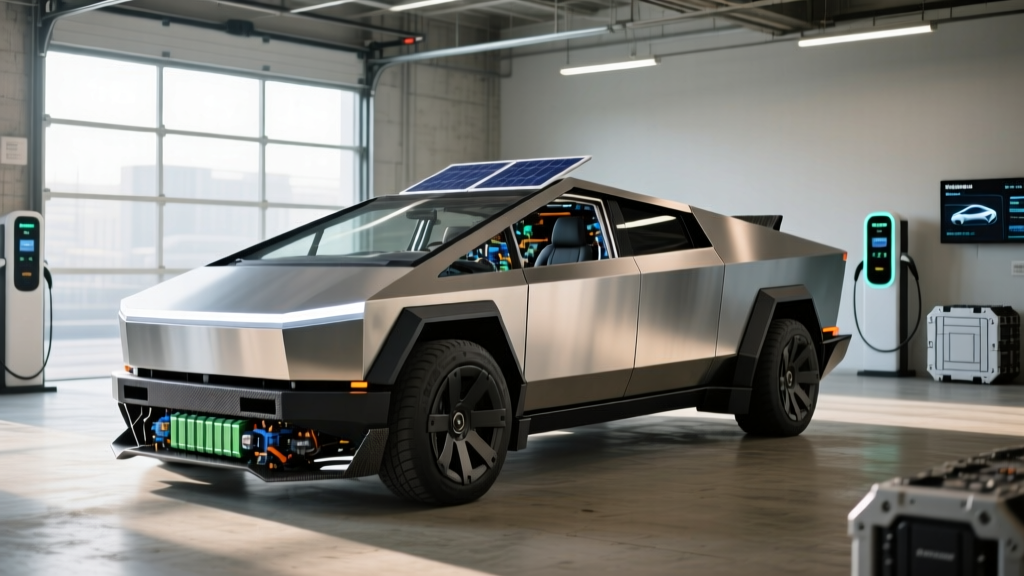
The internet can't stop talking about the homemade Cybertruck — DIY replicas welded in garages, bolted together from donor EVs, and paraded across YouTube and TikTok. Some are surprisingly polished; others are rolling art projects held together by optimism and angle grinders. But behind the viral appeal lies a question every EV-curious builder (or buyer) should ask: What does it actually take to build a homemade Cybertruck, and does the result hold up as a functional electric vehicle?
This isn't a traditional review. Tesla's actual Cybertruck is a production vehicle with EPA-certified range, NHTSA safety data, and a dealership network. A homemade Cybertruck is none of those things. What follows is a data-driven teardown of the DIY Cybertruck phenomenon — the donor platforms builders actually use, the real-world range and charging you can expect, the safety gaps that matter, and how a replica stacks up against the genuine article for someone who just wants a stainless-steel wedge in their driveway.
What Exactly Is a "Homemade Cybertruck"?
A homemade Cybertruck is a custom-built electric vehicle designed to visually replicate Tesla's angular Cybertruck, typically constructed on a salvaged or repurposed EV donor chassis. Builders start with a running electric platform — often a wrecked Tesla Model 3, Nissan LEAF, Chevrolet Bolt, or occasionally a gasoline truck converted to electric — and fabricate a new body from sheet metal, aluminum composite panels, or fiberglass to mimic the Cybertruck's distinctive origami silhouette.
The trend accelerated after Tesla began Cybertruck deliveries in late 2023 and continued into 2025–2026, as the vehicle's polarizing design and long waitlists pushed tinkerers to build their own. Some builds cost under $15,000 using a salvaged LEAF; others exceed $80,000 when builders source late-model Tesla drivetrains and commission professional metalwork. The results range from convincing replicas that fool people at stoplights to rough prototypes that barely meet street-legal requirements.
The Donor Platforms Builders Actually Use
The donor vehicle determines almost everything about a homemade Cybertruck's performance: range, charging speed, horsepower, and reliability. Here are the most common platforms in 2026 builds:
| Donor EV | Battery (kWh) | EPA Range (mi) | Peak DC Charge (kW) | 0–60 mph | Typical Salvage Cost |
|---|---|---|---|---|---|
| Tesla Model 3 RWD (2023–2025) | 60 (LFP) | 272 | 170 | 5.8s | $14,000–$22,000 |
| Tesla Model 3 LR AWD (2023–2025) | 79 (NMC) | 341 | 250 | 4.2s | $20,000–$30,000 |
| Nissan LEAF SV+ (2022–2024) | 62 (NMC) | 212 | 100 (CHAdeMO) | 6.9s | $8,000–$14,000 |
| Chevrolet Bolt EV (2022–2023) | 65 (NMC) | 259 | 55 (CCS) | 6.5s | $9,000–$15,000 |
| Gas truck + EV conversion kit | 40–80 (varies) | 100–200 (est.) | Varies widely | 8–14s | $25,000–$60,000+ |
The Tesla Model 3 Long Range is the most popular donor for high-end builds because it provides Supercharger access, over-the-air software updates, and a proven 250 kW peak DC fast-charging capability. Budget builds lean on the LEAF or Bolt, both of which offer affordable salvage titles but suffer from slower charging — the Bolt's 55 kW CCS peak is a particular bottleneck for anyone planning road trips.
Real-World Range: What the Sticker Doesn't Tell You
Here's the critical problem with homemade Cybertruck range claims: the body fabrication almost always makes the vehicle less aerodynamic than the donor. The Cybertruck's flat-panel design looks angular and efficient, but a garage-built replica rarely achieves the drag coefficient (Cd) of either the original Tesla (Cd ~0.34 for the production Cybertruck) or the donor sedan it started life as. Added weight from steel bodywork — often 300–600 lbs over the donor's curb weight — further erodes efficiency.
Expect a homemade Cybertruck built on a Tesla Model 3 LR donor (EPA 341 mi) to deliver approximately 240–280 miles of real-world range in mixed driving. Highway driving at 75 mph drops this to roughly 200–230 miles. In freezing temperatures (below 32°F / 0°C), plan for 170–200 miles due to battery chemistry limitations and cabin heating load. If the donor is a LEAF or Bolt, cut these numbers by 25–35%.
For context, the actual 2025 Tesla Cybertruck AWD achieves an EPA-estimated 340 miles with a 123 kWh battery pack. No homemade build approaches this, primarily because no builder has access to Tesla's structural battery pack or the 4680 cells that give the production Cybertruck its energy density advantage.
Charging Speed: Where DIY Builds Suffer Most
Charging infrastructure is where homemade Cybertruck builds reveal their biggest practical limitations. The charging speed is entirely inherited from the donor vehicle's onboard hardware — and body modifications can interfere with charge port placement, cable routing, and thermal management.
| Platform | DC Fast Peak (kW) | 10–80% Time | Level 2 Home (kW) | Miles/HR at L2 |
|---|---|---|---|---|
| Homemade (Model 3 LR donor) | 250 kW (NACS) | ~28 min | 11.5 kW | ~44 mi/hr |
| Homemade (Bolt EV donor) | 55 kW (CCS) | ~65 min | 7.7 kW | ~30 mi/hr |
| Homemade (LEAF donor) | 100 kW (CHAdeMO) | ~45 min | 6.6 kW | ~25 mi/hr |
| 2025 Tesla Cybertruck AWD | 350+ kW (NACS) | ~15 min | 11.5 kW | ~44 mi/hr |
A Model 3–based build retains Tesla's NACS connector and Supercharger network access — a massive advantage in 2026, as the NACS standard has become the dominant DC fast-charging connector across North America. LEAF-based builds are stuck with the legacy CHAdeMO connector, which has vanishingly few public chargers in most US markets. Bolt-based builds use CCS1, which remains widely available but faces a long-term transition to NACS.
One often-overlooked issue: charge curve taper. Many builders don't realize that a "250 kW peak" charge rate only applies between roughly 10–30% state of charge. Above 50%, the rate drops significantly to protect battery health. A Model 3 LR donor might peak at 250 kW but average closer to 120–140 kW over a full 10–80% session. This is normal EV physics, but builders accustomed to gas fill-ups often find it frustrating.
Performance, Safety, and the Gaps You Can't Weld Shut
A homemade Cybertruck built on a Tesla Model 3 Performance donor can hit 0–60 mph in roughly 3.5 seconds with 510 hp — genuinely quick. But straight-line acceleration is where the performance story ends favorably.
Safety is the largest gap between a homemade build and a production EV. The production Cybertruck underwent extensive crash testing, with advanced crumple zones, a stainless-steel exoskeleton engineered for specific load paths, and a full suite of airbags calibrated for the vehicle's mass and geometry. A homemade replica has none of this engineering validation.
No homemade Cybertruck has been crash-tested by the NHTSA or the IIHS. The fabricated body panels may not manage crash energy predictably. Airbag systems from donor vehicles may not deploy correctly when relocated into a custom frame. Builders assume all crash-safety risk.
Additionally, Tesla's Autopilot and Full Self-Driving (Supervised) features — classified as SAE Level 2 driver-assistance systems — rely on cameras calibrated to specific mounting positions and body geometry. Relocating cameras into a custom body almost always breaks calibration, meaning most homemade builds lose ADAS functionality entirely. The driver is 100% responsible for vehicle control at all times.
The Real Cost: Build Budget vs. Buying Production
The financial argument for a homemade Cybertruck depends entirely on how you value your time and risk tolerance.
| Cost Category | Homemade (Budget Build) | Homemade (High-End Build) | 2025 Cybertruck AWD |
|---|---|---|---|
| Donor vehicle / base MSRP | $9,000–$15,000 | $20,000–$35,000 | $79,990 |
| Body fabrication & materials | $3,000–$8,000 | $15,000–$35,000 | N/A |
| Electronics integration | $1,000–$3,000 | $5,000–$12,000 | N/A |
| Paint / finish / interior | $2,000–$5,000 | $8,000–$20,000 | N/A |
| Registration / street-legal | $500–$2,000 | $500–$2,000 | Varies by state |
| Total estimated cost | $15,500–$33,000 | $48,500–$104,000 | $79,990 |
| Federal §30D tax credit | Not eligible | Not eligible | Up to $7,500* |
*The IRS §30D clean vehicle credit requires the vehicle to be new, from an OEM, meeting battery-sourcing and critical-minerals requirements, with an MSRP under $80,000 for trucks, and the buyer's AGI below $300,000 (MFJ) / $150,000 (single). A homemade or custom-built vehicle does not qualify. The credit can be transferred at point of sale for eligible production vehicles. Always consult a tax professional for your specific situation.
The budget-build path is genuinely cheaper than a production Cybertruck — but you're getting a vehicle with no crash testing, no warranty, limited charging infrastructure (depending on donor), and essentially zero resale market. The high-end build path can easily exceed the price of a real Cybertruck, at which point the financial argument collapses entirely.
Who Should (and Shouldn't) Consider a Homemade Cybertruck
This Is For You If…
- You're a skilled fabricator or EV hobbyist who values the build process over the end product
- You want a one-of-one show vehicle or content-creation prop, not a daily driver
- You have access to a full shop, welding equipment, and EV high-voltage safety training
- You already own a reliable daily driver and this is a weekend project
- You understand the vehicle will be uninsurable through standard carriers in most states
Look Elsewhere If…
- You need a daily commuter with reliable range and charging
- You carry passengers — especially children — and care about verified crash safety
- You want warranty coverage, OTA updates, or ADAS features
- You need financing — banks and credit unions rarely lend on custom-built vehicles
- You plan to tow — homemade builds rarely have rated tow capacities
For practical EV buyers who simply love the Cybertruck's aesthetic, the production vehicle — or a used Model 3 with a vinyl wrap and angular body kit — offers dramatically better real-world usability.
How a Homemade Build Compares to the Real Cybertruck
| Attribute | Homemade (Model 3 LR) | 2025 Cybertruck AWD |
|---|---|---|
| EPA Range | N/A (est. 240–280 mi real-world) | 340 mi (EPA) |
| Battery | ~79 kWh NMC (donor) | 123 kWh (4680 cells) |
| DC Fast Charge Peak | 250 kW (NACS) | 350+ kW (NACS) |
| 10–80% Charge Time | ~28 min | ~15 min |
| 0–60 mph | ~4.2s (donor spec) | 3.9s |
| Horsepower | ~346 hp (donor) | 600 hp |
| Towing Capacity | Not rated | 11,000 lbs |
| Cargo (bed + frunk) | Custom / not rated | ~67 cu ft bed + frunk |
| Crash Tested | No | Yes (NHTSA/IIHS) |
| ADAS | Typically disabled | Autopilot (Level 2) |
| Warranty | None | 4 yr/50,000 mi basic; 8 yr/120,000 mi battery |
| Tax Credit | Not eligible | Up to $7,500 (§30D)* |
| Insurance | Specialty/kit-car only | Standard carriers |
Frequently Asked Questions
Is it legal to drive a homemade Cybertruck on public roads?
It depends on your state. Most states have "kit car" or "specially constructed vehicle" registration processes, but requirements vary widely. You'll typically need a state-assigned VIN, a safety inspection, proof of insurance, and sometimes emissions testing (waived for EVs in many jurisdictions). Some states make this process straightforward; others effectively block it. Check your local DMV before starting a build.
Can a homemade Cybertruck use Tesla Superchargers?
Only if the donor vehicle is a Tesla with an active Supercharger account linked to the VIN. Tesla's Supercharger network authenticates by VIN, so a Model 3 donor that retains its original Tesla electronics and VIN should work. Non-Tesla donors cannot access Superchargers without an adapter — and even then, only at stations with the Magic Dock or open NACS access.
What's the cheapest realistic budget for a homemade Cybertruck?
Approximately $15,000–$20,000, using a salvaged Nissan LEAF or Chevrolet Bolt as the donor, basic steel or aluminum body panels, and doing all labor yourself. This gets you a vehicle with roughly 150–180 miles of real-world range, slow DC charging (55–100 kW), and no ADAS features.
Does a homemade Cybertruck qualify for the $7,500 federal EV tax credit?
No. The IRS §30D credit applies only to new, OEM-manufactured clean vehicles that meet battery-sourcing, critical-minerals, MSRP, and buyer-income requirements. A custom-built or replica vehicle does not qualify under any current interpretation of the statute.
How long does a typical homemade Cybertruck build take?
Most documented builds take 6–18 months of part-time work (evenings and weekends). Professional shops completing high-end builds quote 3–6 months of full-time fabrication. Bodywork, paint, and electronics integration are the most time-consuming phases.
Is a homemade Cybertruck safe for passengers?
There is no crash-test data for any homemade Cybertruck build. The fabricated body structure has not been validated for energy absorption, and relocated airbag systems may not function as designed. Builders and passengers assume all risk. This is the single biggest practical difference between a replica and a production EV.