The History of Electric Cars in Brief
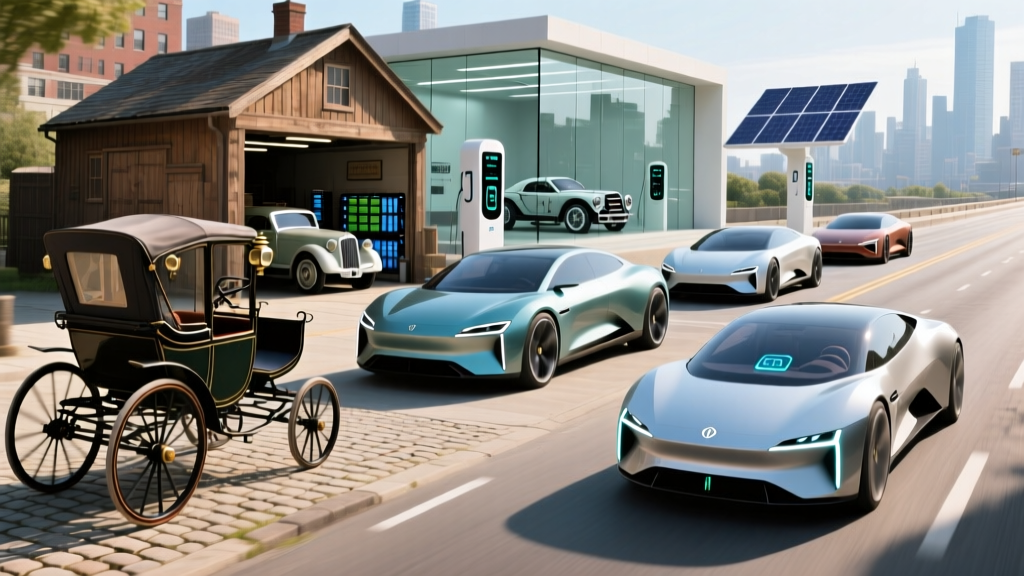
Electric cars are not a modern invention. The first crude electric carriage was built around 1832 by Scottish inventor Robert Anderson, and by the late 1890s, EVs outsold gasoline cars in the United States. Gasoline vehicles dominated the 20th century thanks to cheap oil and the electric starter motor, but EVs re-emerged in the 2010s led by the Nissan Leaf and Tesla Model S. As of 2026, the average new EV delivers 270–350 miles of EPA range, charges from 10–80% in 18–25 minutes on DC fast chargers, and costs roughly $0.04–$0.06 per mile to fuel at home — about half the per-mile cost of a 30 MPG gas car at $3.50/gallon.
The Early Days: Electric Cars Before Gasoline Won
Most people assume EVs are a 21st-century phenomenon. The real history of electric cars stretches back nearly two centuries. In the 1830s, inventors in Scotland, the Netherlands, and the United States built small electric carriages powered by non-rechargeable primary cells. By the 1880s, rechargeable lead-acid batteries made practical electric vehicles possible.
The breakthrough came in 1899 and 1900, when electric cars outsold all other types of vehicles in the U.S. According to the U.S. Department of Energy, EVs held 38% of the American automobile market in 1900, with steam at 40% and gasoline at just 22%. Early electric cars like the Baker Electric and Columbia Runabout were quiet, clean, and required no hand-cranking — making them especially popular among urban drivers.
So what killed the first EV wave? Three factors converged between 1908 and 1920:
- Cheap gasoline: Texas oil discoveries dropped fuel prices dramatically.
- The electric starter (1912): Cadillac's invention eliminated the dangerous hand-crank, removing a major EV advantage.
- Mass production: Ford's Model T undercut EVs on price — a 1912 electric car cost $1,750 while a Model T sold for $650.
By the mid-1930s, electric cars had effectively disappeared from the consumer market.
The Modern Rebirth: 1996–2026
The history of electric cars entered its modern chapter with GM's EV1 in 1996 — a limited-lease vehicle with 80–140 miles of range (depending on lead-acid or NiMH battery). Though GM controversially recalled and crushed most EV1s, the program proved that a purpose-built electric car could serve real drivers.
Key milestones in the modern EV timeline:
| Year | Vehicle | Significance |
|---|---|---|
| 1996 | GM EV1 | First modern purpose-built EV (lease-only, ~80 mi range) |
| 2008 | Tesla Roadster | First highway-capable lithium-ion EV (244 mi EPA range) |
| 2010 | Nissan Leaf | First mass-market affordable EV (73 mi EPA, ~$32,780 MSRP) |
| 2012 | Tesla Model S | Proved EVs could be premium, long-range (265 mi EPA) |
| 2017 | Chevy Bolt EV | 238 mi EPA range under $37,000 — mainstream breakthrough |
| 2021 | Ford F-150 Lightning announced | First electric full-size pickup from a legacy automaker |
| 2024 | NACS connector adopted industry-wide | Ford, GM, Rivian, Hyundai, and others committed to Tesla's NACS standard |
| 2025–2026 | 300+ mi EVs become standard | Hyundai Ioniq 5 (318 mi), Chevy Equinox EV (319 mi), Tesla Model Y (320 mi) set new baselines |
Today's EV landscape in 2026 is defined by three realities: median EPA ranges exceed 290 miles, DC fast charging at 150–250 kW is common, and the IRS §30D federal tax credit can reduce purchase prices by up to $7,500 — though eligibility depends on MSRP caps, buyer income limits, and battery mineral-sourcing requirements.
2026 EV vs Gas Car: Real Ownership Costs Compared
Understanding the history of electric cars matters because it explains why today's EVs are finally cost-competitive on a total-ownership basis — even though their sticker prices often remain higher than comparable gas cars.
5-Year Ownership Cost: 2026 EV vs Comparable Gas Sedan
Assumptions: 15,000 miles/year, 75,000 miles total. EV charged 80% at home ($0.14/kWh), 20% public DC fast charging ($0.40/kWh). Gas car at 30 MPG combined, $3.50/gallon. EV price after $7,500 tax credit.
| Category | 2026 EV (e.g., Hyundai Ioniq 6 SE, ~318 mi EPA) | Gas Sedan (e.g., Toyota Camry LE, 32 MPG) |
|---|---|---|
| Purchase Price (after credit) | $35,500 | $30,000 |
| Fuel/Energy (5 yr / 75k mi) | $4,200 | $8,750 |
| Maintenance (5 yr) | $1,200 | $3,500 |
| Insurance (5 yr avg) | $9,500 | $7,500 |
| Estimated Depreciation | $14,200 | $12,000 |
| Total 5-Year Cost | $64,600 | $61,750 |
| Cost per Mile (all-in) | $0.86 | $0.82 |
Note: EV insurance premiums run 15–25% higher on average due to repair costs and battery replacement risk. Maintenance savings come from no oil changes, no spark plugs, reduced brake wear (regenerative braking), and fewer moving parts. Actual costs vary by state, utility rates, and driving patterns.
The gap narrows further — or the EV pulls ahead — when you factor in:
- Home solar: Charging on rooftop solar can drop energy cost to near $0.02/mile.
- State incentives: Many states offer rebates of $1,000–$5,000 beyond the federal credit (check your local energy office for current programs).
- HOV lane access: Available in states like California, Colorado, and Virginia for qualifying EVs.
- Longer ownership horizons: At 10 years, the EV typically breaks even or wins on total cost.
Common EV Myths vs the Actual Data
The long history of electric cars has accumulated plenty of misconceptions. Here's what the numbers actually show:
| Myth | Fact (2026 Data) |
|---|---|
| "EV batteries need replacing every few years." | Federal law mandates battery warranties of at least 8 years/100,000 miles. Real-world degradation data shows most NMC and LFP packs retain 85–92% capacity at 100,000 miles. A replacement, if needed, costs $5,000–$20,000 depending on the model. |
| "EVs have worse range than advertised." | EPA range estimates are more conservative than in the past, but real-world highway driving at 70+ MPH typically yields 85–90% of the EPA number. Cold weather (below 30°F) can reduce range 20–35%. Example: a 318-mi EPA Ioniq 6 delivers ~270 mi on a 75°F highway trip and ~220 mi in 20°F conditions. |
| "Charging takes too long." | Modern 800V-architecture EVs (Hyundai Ioniq 5/6, Kia EV6, Porsche Taycan) charge from 10–80% in 18–22 minutes on a 250–350 kW DC fast charger. Most daily driving requires zero public charging if you have Level 2 at home (~7–11 kW adds 25–44 miles per hour of charging). |
| "EVs are worse for the environment because of battery mining." | Lifecycle analyses from the EPA and Argonne National Laboratory show EVs produce fewer lifetime emissions than gas cars in every U.S. grid region, even accounting for battery manufacturing. The break-even point is typically 1–2 years of driving. |
| "The grid can't handle mass EV adoption." | Most EV charging occurs overnight during off-peak hours. A single EV adds roughly the same load as a central air conditioner. Managed charging and time-of-use rates keep grid impact minimal at current adoption levels. |
What First-Time EV Buyers Need to Know in 2026
The history of electric cars has led to a market with more choices than ever — over 80 EV models are available in the U.S. for 2026. But buying an EV requires different homework than buying a gas car. Here's a practical framework:
Charging Access: The #1 Decision Factor
If you can install a Level 2 charger at home (240V, 32–48 amps), an EV will fit seamlessly into daily life. A typical home Level 2 installation costs $500–$2,500 total (charger hardware: $300–$700; electrician labor and permit: $200–$1,800), though older homes may need a $1,500–$3,000 electrical panel upgrade to support a 40-amp circuit.
If you rely entirely on public charging, your experience depends heavily on your area's infrastructure. Check PlugShare or your vehicle's native navigation to map DC fast chargers within 5 miles of your home and workplace. Expect to pay $0.30–$0.55/kWh at public DC stations — roughly double the cost of home charging and sometimes approaching gas-car fueling costs on a per-mile basis.
Battery Chemistry: LFP vs NMC
Many 2026 EVs offer a choice between two lithium-ion chemistries:
- LFP (Lithium Iron Phosphate): Longer cycle life (3,000+ full cycles), safer thermal profile, can be charged to 100% daily without accelerated degradation. Trade-off: lower energy density means heavier packs or slightly less range. Found in base-trim Tesla Model 3/Y, standard-range Ford Mustang Mach-E.
- NMC (Nickel Manganese Cobalt): Higher energy density for longer range in a lighter pack. Best practice is charging to 80% daily, 100% only for trips. Found in most long-range and performance trims.
Tax Credit Eligibility Is Not Guaranteed
The IRS §30D clean vehicle credit offers up to $7,500 for new EVs, but qualifying requires meeting all of these conditions:
- MSRP caps: Vans/SUVs/pickups must be under $80,000; sedans under $55,000.
- Buyer income limits: AGI must not exceed $300,000 (joint), $225,000 (head of household), or $150,000 (single).
- Battery sourcing: Increasing percentages of battery minerals must be sourced from the U.S. or free-trade-agreement countries, and battery components cannot be sourced from foreign entities of concern (FEOC).
- Point-of-sale transfer: Since 2024, you can transfer the credit to the dealer for an immediate price reduction rather than claiming it on your tax return.
Always verify your specific vehicle's eligibility on fueleconomy.gov before purchasing — the list of qualifying models changes as manufacturers adjust supply chains.
EV Buying Decision Framework: Is an EV Right for You?
Use this practical guide based on the real-world ownership factors that actually matter:
Choose a battery-electric vehicle (BEV) if:
- You can install Level 2 charging at home or have reliable workplace charging.
- Your daily driving is under 100 miles round-trip (covers ~95% of U.S. commutes).
- You take road trips fewer than 6 times per year and can plan DC fast-charger stops.
- You qualify for the §30D tax credit or state rebates that narrow the price gap.
- You live in a moderate or warm climate (cold-weather range loss is manageable but real).
Choose a plug-in hybrid (PHEV) if:
- You want electric-only commuting (25–50 miles) but need gas flexibility for frequent long trips.
- You live in an area with limited DC fast-charging infrastructure.
- You cannot install home charging and need to rely on standard 120V overnight top-ups.
- You regularly tow or haul heavy loads in cold weather (e.g., mountain passes, winter camping).
Wait or choose a hybrid (HEV) if:
- You live in an apartment with zero charging access and no workplace option.
- Your budget is under $28,000 and you need a new vehicle now (used EVs are an option — the used EV credit offers up to $4,000).
- You drive 300+ miles daily in rural areas with no fast-charging infrastructure.
Real-World Ownership: What the History of Electric Cars Didn't Predict
A century ago, EVs failed because batteries were heavy, range was short, and gasoline was cheap. The 2026 EV landscape inverts every one of those problems — but introduces new ownership considerations that buyers should weigh honestly:
Cold-weather reality: Below 20°F, expect 25–35% range reduction due to battery chemistry limitations and cabin heating demands. EVs with heat pumps (standard on most 2025–2026 models from Hyundai, Kia, Tesla, and BMW) reduce this penalty to 15–25%. Preconditioning the battery while plugged in preserves range and improves regenerative braking in cold weather.
Charging-curve taper: When manufacturers advertise "250 kW peak charging," that rate is sustained only between roughly 10–40% state of charge. Above 60%, the rate tapers significantly — often to 50–80 kW. A "10–80% in 18 minutes" claim is realistic for 800V vehicles, but a 5–95% session will take 35–45 minutes. Plan road-trip stops around 10–80% charges for the fastest experience.
Insurance premiums: EV insurance costs 15–25% more than equivalent gas cars on average, driven by higher repair costs (specialized body shops, battery safety protocols) and higher vehicle prices. Shop quotes from EV-friendly insurers (Geico, Progressive, and specialty carriers) before purchasing — the difference between insurers can exceed $600/year.
Depreciation uncertainty: EV resale values have been volatile. Tesla's aggressive price cuts in 2023–2024 compressed used EV values across the market. By 2026, depreciation has stabilized somewhat, but long-term battery health perception still affects resale. Buying a vehicle with a transferable 8-year/100,000-mile battery warranty protects your investment.
Frequently Asked Questions
Who invented the first electric car?
There is no single inventor. Scottish businessman Robert Anderson built a crude electric carriage around 1832. French inventor Gaston Planté's rechargeable lead-acid battery (1859) made practical EVs possible. American inventor William Morrison built the first successful electric vehicle in the U.S. around 1890 — a six-passenger wagon that could reach 14 mph.
Why did electric cars disappear in the early 1900s?
Three factors: cheap gasoline from Texas oil fields, the 1912 invention of the electric starter (which eliminated hand-cranking gas cars), and Ford's mass-produced Model T, which sold for roughly one-third the price of an equivalent electric car. By 1935, EVs were essentially extinct in the consumer market.
How much does it cost to charge an EV at home in 2026?
At the U.S. average residential electricity rate of ~$0.16/kWh (EIA data), charging a 75 kWh battery from empty to full costs about $12. That provides roughly 270–310 miles of range, or about $0.04–$0.05 per mile. Compare that to a 30 MPG gas car at $3.50/gallon: $0.12 per mile — roughly three times the cost.
Do EV batteries need to be replaced?
Rarely within the vehicle's useful life. Modern liquid-cooled lithium-ion packs (both LFP and NMC) typically retain 85–92% of original capacity after 100,000 miles. Federal law requires manufacturers to warranty the battery for at least 8 years/100,000 miles (10 years/150,000 miles in CARB states like California). If replacement is needed out of warranty, expect $5,000–$20,000 depending on the vehicle — though prices continue to fall as battery manufacturing scales.
Are EVs actually better for the environment?
Yes, in nearly every scenario. According to lifecycle analyses by Argonne National Laboratory and the EPA, an EV charged on the average U.S. grid produces roughly 60–68% fewer lifetime greenhouse gas emissions than a comparable gas car — even accounting for battery manufacturing. In states with high renewable energy (California, Washington, Vermont), the reduction exceeds 75%. The manufacturing "carbon debt" from battery production is typically repaid within 1–2 years of driving.
What's the longest-range EV available in 2026?
As of the 2026 model year, the Lucid Air Grand Touring leads with an EPA-estimated 512 miles of range, followed by the Tesla Model S Long Range at 402 miles and the Chevrolet Silverado EV 4WT at 492 miles (fleet/commercial). Among mainstream models under $50,000, the Hyundai Ioniq 6 SE Long Range (318 mi EPA) and Tesla Model 3 Long Range (363 mi EPA) are top contenders.