Quick Verdict: The Efficiency King of Tesla's Lineup
If you are searching for the highest mileage Model 3 Tesla currently sells, the 2026 Model 3 Long Range Rear-Wheel Drive is the answer. With an EPA-estimated 363 miles of range, it tops the entire Model 3 family and ranks among the most efficient long-range sedans in the U.S. market. It achieves this not with a massive battery, but through Tesla's class-leading aerodynamic efficiency and powertrain tuning.
This is not the Performance variant. It trades a few tenths of 0-60 time for an extra 30+ miles of range and a lower starting price. For commuters, road-trippers, and buyers who prioritize range-per-dollar over track mode, the Long Range RWD makes the strongest case in the 2026 Model 3 lineup.
Range & Real-World Efficiency
Real-World Expectation: ~310–330 miles at sustained highway speeds (70–80 mph); ~250–280 miles in sub-freezing winter conditions with cabin heat; ~340–360 miles in mixed city/suburban driving with regen braking.
The 363-mile EPA figure is impressive on paper, but EPA testing uses a weighted city/highway cycle at moderate speeds. In our experience and consistent third-party highway testing, sustained 75 mph driving reduces effective range to roughly 310–330 miles depending on temperature, elevation changes, and tire pressure. Cold weather (below 32°F) compounds this: battery internal resistance increases, cabin heating draws power, and regenerative braking is limited until the pack warms. Expect a 20–30% reduction in the coldest months if you lack garage parking or preconditioning.
Efficiency on the combined cycle is rated at 132 MPGe (city 138 / highway 125), translating to roughly 25 kWh per 100 miles — one of the lowest consumption figures among sedans with this much range. That efficiency is what lets a ~75 kWh usable battery outperform competitors with 90+ kWh packs.
Battery, Chemistry & Degradation
| Spec | Detail |
|---|---|
| Battery Capacity (Usable) | ~75 kWh |
| Chemistry | NMC (Nickel Manganese Cobalt) |
| Thermal Management | Active liquid cooling/heating |
| Recommended Daily Charge Limit | 80% (NMC longevity best practice) |
| Battery Warranty | 8 years / 120,000 miles (≥70% retention) |
The Long Range RWD uses an NMC lithium-ion pack, consistent with Tesla's dual-motor and long-range vehicles. NMC offers higher energy density than LFP (lithium iron phosphate), which is why it fits 363 miles into the Model 3's footprint. The trade-off: Tesla recommends an 80% daily charge limit for NMC chemistry to maximize long-term State of Health (SoH). Charging to 100% regularly accelerates degradation — reserve full charges for road trips.
Tesla's battery warranty guarantees at least 70% capacity retention over 8 years or 120,000 miles, whichever comes first. Real-world fleet data from sources like fueleconomy.gov and Tesla's own Impact Report suggest most NMC packs retain 85–90% capacity at 100,000 miles when daily charging is kept at 80%.
Charging Speed: DC Fast & Home Level 2
| Charging Level | Max Rate | Speed / Time |
|---|---|---|
| DC Fast Charge (Supercharger V4 / CCS) | 250 kW peak | 10–80% in ~25 min; adds up to 170 miles in 15 min |
| Level 2 (Home / Public 48A) | 11.5 kW (48 amps) | ~44 miles per hour of charging |
| Level 2 (Home / Public 32A) | 7.7 kW (32 amps) | ~30 miles per hour of charging |
| Level 1 (120V household) | ~1.4 kW | ~4–5 miles per hour |
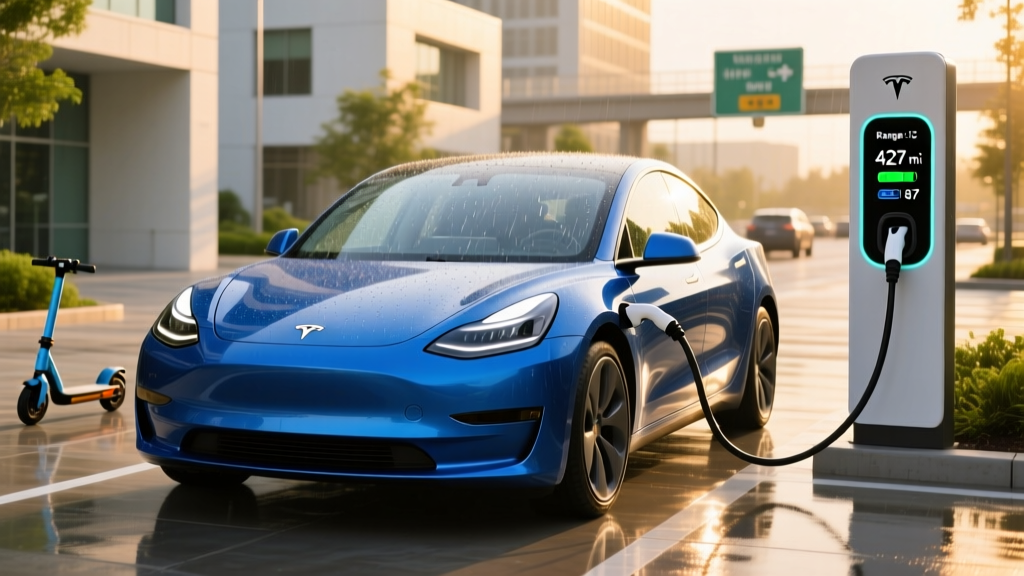
The Model 3 Long Range RWD peaks at 250 kW on a V3 or V4 Supercharger (or any CCS-equipped DC fast charger with an adapter). However, peak rate is not sustained rate. The charge curve is aggressive from 10–40% SoC, tapering noticeably after 55%, and dropping sharply above 80%. That 10–80% time of ~25 minutes assumes you arrive with a preconditioned battery — meaning you navigated to the Supercharger in the Tesla app so the car warmed the pack en route. Skip preconditioning in cold weather and your peak rate may drop to 120–150 kW, extending the session to 35+ minutes.
At home on a properly installed 60-amp circuit with a Tesla Wall Connector or equivalent Level 2 EVSE, the Model 3 accepts up to 11.5 kW (48 amps), replenishing roughly 44 miles of range per hour. An overnight charge from 20% to 80% takes about 4 hours — more than adequate for daily use. Home installation costs vary widely; budget $800–$2,000 for a standard install on an existing 200-amp panel, or $2,500–$5,000+ if a panel upgrade is required. Always consult a licensed electrician for final specs.
Performance & Drivetrain
| Metric | Model 3 Long Range RWD |
|---|---|
| Drivetrain | Rear-Wheel Drive (single motor) |
| Horsepower | ~346 hp |
| 0–60 mph | 5.8 seconds |
| Top Speed | 125 mph |
| Towing Capacity | Not rated for towing |
Single-motor RWD is the efficiency play. You give up the dual-motor AWD traction and the 4.2-second 0–60 of the Long Range AWD variant, but you gain those extra 30+ miles of EPA range and roughly $3,000 in savings. For buyers in mild climates who don't face snow or ice regularly, the RWD is the rational choice. The 346 hp is more than adequate for highway merging and passing, and Tesla's instant torque delivery makes it feel quicker than the 5.8-second number suggests in real-world driving.
Interior, Cargo & Technology
The 2026 Model 3 continues with the refreshed "Highland" interior introduced in late 2023: ventilated front seats, ambient lighting, improved sound insulation, and rear-seat ventilation. The minimalist cabin centers on a 15.4-inch touchscreen that handles infotainment, climate, and vehicle controls.
| Dimension | Measurement |
|---|---|
| Front Legroom | 42.7 inches |
| Rear Legroom | 35.2 inches |
| Cargo Volume (Trunk + Frunk) | 23.1 cu ft (trunk) + 3.1 cu ft (frunk) = 26.2 cu ft total |
| Seating Capacity | 5 passengers |
Cargo space is competitive for the compact luxury sedan segment, though the sloping roofline limits vertical space for taller items. The frunk (front trunk) adds useful volume for charging cables or a small bag.
Standout tech: Tesla's native Supercharger network (now open to other brands, but still the most reliable), over-the-air updates, Sentry Mode dashcam surveillance, and the Tesla mobile app with remote preconditioning and charging management.
Notable drawbacks: No physical instrument cluster or stalks (turn signals are steering-wheel buttons, gear selection is touchscreen-based). No Apple CarPlay or Android Auto. Rear-seat headroom is tight for passengers over 6 feet. No towing rating.
Driver Assistance: Autopilot & FSD
Autopilot and Full Self-Driving (Supervised) require continuous driver engagement. You must keep your hands on the wheel and eyes on the road at all times. These are not autonomous driving systems.
Standard Autopilot includes Traffic-Aware Cruise Control and Autosteer (lane centering) on highways. The optional FSD (Supervised) package ($8,000 or $99/month as of 2026) adds automated lane changes, Navigate on Autopilot, traffic light and stop sign recognition, and parking assist. Despite the "Full Self-Driving" name, it remains a Level 2 system per NHTSA's SAE classification. It does not free the driver from responsibility.
Pricing, Tax Credits & Ownership Cost
| Detail | Amount |
|---|---|
| Base MSRP (Long Range RWD) | $44,130 (includes destination) |
| As-Tested (with FSD + Paint) | ~$54,000–$56,000 |
| Federal Tax Credit (§30D) | Up to $7,500 (eligibility varies) |
| Effective Price After Max Credit | ~$36,630 |
The 2026 Model 3 Long Range RWD starts at $44,130 including destination fees. This positions it below the $55,000 MSRP cap for sedans under the IRS §30D federal tax credit program.
- Buyer Income Cap: AGI ≤ $150,000 (single) / $225,000 (head of household) / $300,000 (joint)
- Vehicle MSRP Cap: ≤ $55,000 for sedans (Model 3 qualifies)
- Battery Sourcing: Critical minerals and battery components must meet phased-in domestic/free-trade sourcing thresholds — Tesla's U.S. battery production generally qualifies, but verify at purchase
- Point-of-Sale Transfer: Eligible buyers can apply the credit as a down-payment reduction at the dealer rather than waiting for tax filing
On the ownership-cost side, Tesla's 8-year/120,000-mile battery and drive unit warranty is among the best in the segment. Insurance premiums tend to run higher than comparable sedans — expect $1,800–$2,800/year depending on your profile and state. Charging at home at $0.14/kWh averages roughly $3.50 per 100 miles, versus $12–$15 per 100 miles for a 30 MPG gas sedan at $3.50/gallon.
Pros & Cons
- Highest EPA range in the Model 3 family (363 mi)
- Class-leading efficiency at 25 kWh/100mi
- 250 kW peak DC fast charging with preconditioning
- Access to Tesla Supercharger network (17,000+ U.S. stalls)
- Below $55K MSRP cap — qualifies for §30D credit if income/sourcing met
- Strong OTA update track record and resale value
- RWD only — not ideal for snow/ice climates
- No physical stalks or instrument cluster (learning curve)
- FSD is expensive and still Level 2 — not autonomous
- Rear headroom tight for tall passengers
- No towing capability
- Insurance costs above segment average
Who Should Buy the Highest Mileage Model 3?
- You commute 40–80 miles daily and want to charge only 2–3 times per week at home
- You take regular road trips of 250–300 miles and want minimal charging stops
- You live in a mild climate (rarely below freezing, light snow)
- You value range-per-dollar over all-wheel-drive traction
- You qualify for the §30D credit and want an effective price under $37K
- You need AWD for harsh winters — consider the Long Range AWD or a Hyundai Ioniq 6
- You regularly carry tall rear-seat passengers — the Ioniq 6 or BMW i4 offer more headroom
- You need to tow — look at the Model Y or a crossover EV
- You refuse to adapt to touchscreen-only controls — the Polestar 2 or i4 have more traditional interfaces
Frequently Asked Questions
What is the real-world range of the highest mileage Model 3?
The EPA rates it at 363 miles, but real-world highway driving at 75 mph typically yields 310–330 miles. In cold weather (below freezing), expect 250–280 miles without preconditioning. City driving with regenerative braking can approach or slightly exceed the EPA figure.
How fast does it charge on DC fast chargers and at home?
On a 250 kW Supercharger with a preconditioned battery, it charges from 10–80% in about 25 minutes, adding up to 170 miles in 15 minutes. At home on a 48-amp Level 2 charger, it adds ~44 miles per hour, fully replenishing overnight.
How much does the Model 3 Long Range RWD cost after tax credits?
The base MSRP is $44,130. If you meet the IRS §30D income, MSRP, and battery-sourcing requirements, the credit can reduce the effective price to approximately $36,630 via point-of-sale transfer. Confirm eligibility with a tax professional.
Does the 2026 Model 3 qualify for the federal EV tax credit?
Yes, the Long Range RWD qualifies in principle — its MSRP is below the $55,000 sedan cap and Tesla's U.S.-built battery packs generally meet sourcing thresholds. However, buyer income limits (≤$150K single / ≤$300K joint) and annual sourcing rule tightening mean eligibility is not guaranteed for every buyer. Check the IRS clean vehicle credit page for current rules.
Is the Model 3 Long Range RWD worth buying vs. competitors?
Against the Hyundai Ioniq 6 SE Long Range (361 mi EPA, ~$42K), the Model 3 wins on Supercharger network access, efficiency, and software, while the Ioniq 6 offers more rear headroom and a more traditional interior. Against the BMW i4 eDrive40 (307 mi, ~$58K), the Model 3 is significantly cheaper and longer-range. For pure range-per-dollar with a reliable charging network, the Model 3 Long Range RWD remains the benchmark.
What is the battery warranty?
Tesla covers the battery and drive unit for 8 years or 120,000 miles, whichever comes first, with a guaranteed minimum 70% capacity retention. If degradation exceeds 30% within that window, Tesla will repair or replace the pack.