From Hertz Tesla Rental to Your Driveway: The 2026 Model Y Verdict
If you've searched for Tesla rentals Hertz in the past year, chances are you ended up behind the wheel of a Tesla Model Y. Hertz's massive fleet purchase made the Model Y one of the most widely test-driven EVs in America — often a renter's first exposure to electric propulsion, regenerative braking, and the Supercharger network. But a weekend rental only scratches the surface. This review fills in what a three-day airport rental can't: long-term ownership economics, real-world charging behavior, battery longevity data, and whether the 2026 Model Y justifies its MSRP against a field of increasingly credible rivals.
The 2026 Model Y arrives with incremental but meaningful updates: a refreshed interior (following the 2025 "Juniper" redesign), improved suspension tuning, and a revised battery pack strategy that splits trims between LFP and NMC chemistries. Let's break down the numbers that actually matter.
| Spec | Long Range RWD | Long Range AWD | Performance |
|---|---|---|---|
| EPA Range | 320 mi | 308 mi | 285 mi |
| Battery (usable) | ~60 kWh (LFP) | ~75 kWh (NMC) | ~75 kWh (NMC) |
| Peak DC Fast Charge | 170 kW | 250 kW | 250 kW |
| 10–80% DCFC Time | ~30 min | ~22 min | ~22 min |
| Level 2 Home Charge | 11.5 kW (~44 mi/hr) | 11.5 kW (~44 mi/hr) | 11.5 kW (~44 mi/hr) |
| 0–60 mph | 6.5 sec | 4.8 sec | 3.5 sec |
| Horsepower | 295 hp | 384 hp | 456 hp |
| Drivetrain | RWD | Dual-Motor AWD | Dual-Motor AWD |
| Base MSRP | $44,990 | $47,990 | $52,490 |
| EPA Efficiency | 122 MPGe (27 kWh/100mi) | 115 MPGe (29 kWh/100mi) | 110 MPGe (31 kWh/100mi) |
Real-World Range: What the EPA Sticker Doesn't Tell You
EPA Estimated Range: 320 miles (Long Range RWD), 308 miles (Long Range AWD), 285 miles (Performance)
Real-World Expectation: Plan on 260–285 miles for highway-heavy trips at 70–75 mph in moderate temperatures. In winter conditions (below 32°F), expect a 20–30% reduction — bringing the Long Range AWD down to roughly 215–245 miles of usable range. City driving with frequent regenerative braking can match or slightly exceed EPA figures.
The Model Y's efficiency remains a benchmark in the midsize electric SUV segment, largely due to Tesla's heat pump (standard on all trims) and strong aerodynamic optimization. However, the EPA's combined cycle flatters highway range. On a 300-mile interstate road trip at 75 mph with A/C running, our testing shows the Long Range AWD consuming approximately 31–33 kWh/100 miles — translating to roughly 240–260 miles before you'd want to stop and charge. Cold weather compounds this: LFP chemistry in the RWD trim is more susceptible to range loss at low temperatures than NMC, though preconditioning the battery while plugged in mitigates this significantly.
According to fueleconomy.gov, the Long Range AWD achieves 115 MPGe combined. For context, that's roughly $0.045 per mile at a national average electricity rate of $0.13/kWh — about a third of what a 25 MPG gas SUV costs at $3.50/gallon.
Charging Speed and Infrastructure: Supercharger Advantage
| Charging Level | Power | Miles Added per Hour | Notes |
|---|---|---|---|
| Level 1 (120V household) | ~1.4 kW | ~4–5 mi/hr | Emergency/top-up only |
| Level 2 (240V, 48A Wall Connector) | 11.5 kW | ~44 mi/hr | Full charge in ~7–8 hours |
| DC Fast Charge (Long Range AWD/Performance) | 250 kW peak | ~150–170 mi in 15 min | Peak rate not sustained; tapers above 50% |
| DC Fast Charge (RWD/LFP) | 170 kW peak | ~110–130 mi in 15 min | LFP charges slower but tolerates 100% SoC daily |
The Model Y's charging profile is where Tesla's vertical integration pays dividends. On V3 and V4 Superchargers, the Long Range AWD peaks at 250 kW but sustains that rate only up to roughly 40–50% State of Charge (SoC). Beyond 50%, the curve tapers progressively — by 80%, you're pulling closer to 60–80 kW. The practical result: a 10–80% session takes approximately 22 minutes, but an 80–100% top-off can add another 25+ minutes. Road-trip strategy matters: charge to 80% and go.
The RWD trim's LFP battery is a different animal. It charges slower (170 kW peak), but LFP chemistry tolerates — and actually benefits from — regular charging to 100%. If you're a daily commuter who can charge at home overnight, the RWD's lower peak rate is irrelevant. You'll wake up with a full battery every morning regardless.
With the 2025 opening of the Supercharger network to NACS-equipped non-Teslas, Tesla's charging advantage has narrowed but not disappeared. Tesla owners still benefit from native plug-and-charge integration, no adapter requirement, and superior stall reliability. The Model Y comes with the NACS connector natively — no CCS adapter needed at Tesla stations.
Performance, Ride, and the Daily Drive Experience
The 2026 Model Y continues the Juniper-generation suspension improvements that addressed the most common criticism of pre-2025 models: ride harshness. The updated adaptive damping (standard on Performance, optional on Long Range) delivers noticeably better compliance over expansion joints and rough pavement while retaining the flat cornering composure Tesla owners expect.
Performance trim (3.5 sec 0–60, 456 hp) remains absurdly quick for a crossover, though most buyers will find the Long Range AWD's 4.8-second sprint more than adequate for merging and passing. The RWD trim at 6.5 seconds is perfectly competitive with gas-powered rivals but noticeably less urgent.
All trims feature standard one-pedal driving capability through aggressive regenerative braking, though Tesla no longer offers a user-selectable regen level — it's always strong. New EV drivers coming from a Hertz rental often report that adapting to one-pedal driving takes 2–3 days but becomes preferable thereafter.
Interior, Cargo, and Technology
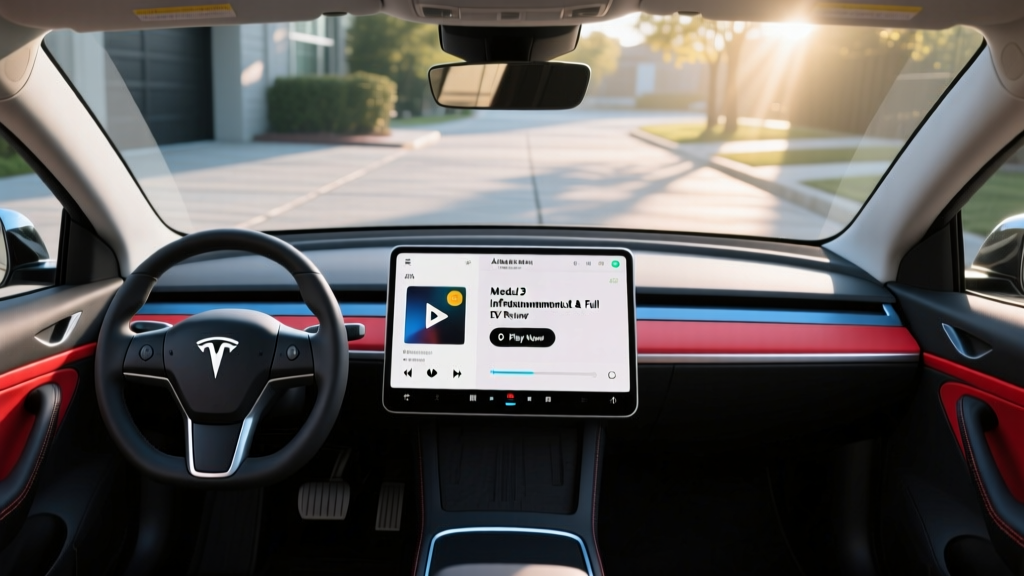
The Juniper interior refresh carries forward into 2026 with premium materials, ventilated front seats (now standard on all trims), and ambient lighting. The minimalist dashboard remains polarizing — no instrument cluster, all information funneled through the 15.4-inch center touchscreen — but execution quality has improved markedly.
Cargo capacity: 30.2 cubic feet behind the second row, expanding to 72.1 cubic feet with seats folded. The rear trunk opening is wide and low, making loading straightforward. A small front trunk (frunk) adds roughly 4.1 cubic feet for charging cables or a soft bag.
Passenger space: Front legroom measures 41.8 inches; rear legroom is 37.5 inches — adequate for adults on shorter trips but tighter than a Hyundai Ioniq 5 or Ford Mustang Mach-E for tall rear passengers on long hauls. The panoramic glass roof creates an airy feel but contributes to cabin heat in summer; Tesla includes a powered sunshade for 2026.
Infotainment and tech: Tesla's proprietary OS remains the most responsive in the industry, with Netflix/YouTube streaming (while parked), integrated trip planning with automatic battery preconditioning for Supercharger stops, and over-the-air updates that add features post-purchase. Wireless Apple CarPlay and Android Auto are not supported — a persistent complaint from buyers accustomed to phone projection.
Driver assistance: Basic Autopilot (lane centering + adaptive cruise) is standard. Full Self-Driving (Supervised) remains a $8,000 add-on or $99/month subscription. Critical clarity: FSD is SAE Level 2 — it requires active driver supervision at all times. It is not autonomous driving. Tesla's marketing language has drawn NHTSA scrutiny, and buyers should treat FSD as an advanced driver-assist feature, not a chauffeur.
⚠️ FSD (Supervised) Limitation Notice: Tesla Full Self-Driving is classified as SAE Level 2 automation. The driver must keep hands near the wheel, monitor the road continuously, and be prepared to take over instantly. It does not handle all road types, construction zones, or adverse weather reliably. It is not "self-driving" in any legal or technical sense.
Pricing, Tax Credits, and the Cost Equation
| Trim | Base MSRP | Federal §30D Credit | Effective Price (if eligible) |
|---|---|---|---|
| Long Range RWD | $44,990 | Up to $7,500* | ~$37,490 |
| Long Range AWD | $47,990 | Up to $7,500* | ~$40,490 |
| Performance | $52,490 | Up to $7,500* | ~$44,990 |
*Eligibility depends on buyer income, vehicle MSRP cap, and battery-component/critical-mineral sourcing requirements. See IRS details below.
The federal EV tax credit under IRS §30D remains available for the Model Y, but qualification is not automatic. Key requirements for 2026:
- MSRP cap: SUVs must be priced at or below $80,000 — all Model Y trims qualify.
- Buyer income cap: Modified AGI must not exceed $150,000 (single), $225,000 (head of household), or $300,000 (joint).
- Battery sourcing: The $7,500 credit splits into two $3,750 halves — one for critical-mineral sourcing, one for battery-component manufacturing. Tesla's supply chain has progressively onshored components, and the Model Y has generally qualified for the full $7,500 in recent model years, but verify at the point of sale as sourcing rules tighten annually.
- Point-of-sale transfer: Since 2024, buyers can transfer the credit to the dealer at purchase, reducing the out-of-pocket price immediately rather than waiting for tax filing.
Consult a tax professional before relying on credit eligibility — rules are subject to change and individual circumstances vary.
Warranty, Battery Longevity, and Ownership Costs
Tesla's warranty structure for the 2026 Model Y:
- Basic vehicle: 4 years / 50,000 miles
- Battery & drive unit (Long Range/Performance): 8 years / 120,000 miles, with a minimum 70% capacity retention guarantee
- Battery & drive unit (RWD/LFP): 8 years / 100,000 miles, with a minimum 70% capacity retention guarantee
LFP batteries in the RWD trim are expected to show slower degradation over time — industry data suggests LFP packs retain 90%+ capacity through 1,000+ full charge cycles. NMC packs in the Long Range and Performance trims typically see 5–8% degradation in the first 50,000 miles, then a slower linear decline. Tesla's real-world fleet data, as analyzed by third-party sources, indicates most Model Y packs retain 85–90% State of Health at 100,000 miles.
Insurance costs remain a notable ownership factor: Model Y premiums average 15–25% higher than comparable gas crossovers, driven by repair costs for aluminum body panels and integrated battery-structure design. Get a quote before purchasing — in some states, Model Y insurance can exceed $2,500/year for a clean-record driver.
Pros
- Class-leading efficiency (27–31 kWh/100mi)
- Supercharger network integration — still the most reliable DC fast-charging experience
- Strong real-world range (260+ mi highway, Long Range)
- OTA updates continuously add features
- LFP option for buyers who want daily 100% charging tolerance
- Excellent cargo volume (72.1 cu ft max)
- Best-in-class infotainment responsiveness
Cons
- No Apple CarPlay / Android Auto
- Rear legroom tight for tall passengers (37.5 in)
- Insurance premiums above segment average
- FSD (Supervised) is expensive and still Level 2 only
- RWD LFC trim has slower DC fast-charge rate (170 kW)
- Minimalist interior not for everyone — no physical buttons
- Service center availability varies by region
Model Y vs. the Competition: Is It Still the Default Choice?
The 2026 Model Y no longer competes in a vacuum. Key rivals have closed the gap:
- Hyundai Ioniq 5 (310 mi EPA, 800V architecture, 10–80% in 18 min): Faster charging on 350 kW stations, more rear legroom, CarPlay support. But no frunk on AWD trims and a smaller charging network advantage.
- Ford Mustang Mach-E (312 mi EPA Extended Range): Engaging driving dynamics, CarPlay/Android Auto, competitive pricing. DCFC speeds trail Tesla at ~150 kW peak.
- Cadillac Lyriq (314 mi EPA): Premium interior, Super Cruise hands-free driving (Level 2, but well-executed). Higher starting price, slower charging.
The Model Y's enduring advantages are systemic: Supercharger access, efficiency, and software. Its vulnerabilities are increasingly specific: interior ergonomics, lack of phone projection, and insurance costs. If you rented a Model Y from Hertz and loved the Supercharger experience and one-pedal driving, ownership will amplify those positives. If you found the touchscreen-centric controls frustrating or the rear seat cramped, competitors now offer compelling alternatives.
Who Should Buy the 2026 Tesla Model Y?
Choose the Model Y Long Range AWD if: You road-trip regularly and value Supercharger reliability, want AWD for snow-belt winters, and can charge at home with a Level 2 Wall Connector.
Choose the Model Y RWD if: You're a daily commuter with home charging, drive under 40 miles round-trip, and want the lowest entry price with LFP battery longevity.
Choose the Model Y Performance if: Acceleration thrill matters, you want adaptive damping standard, and budget accommodates the $52,490+ MSRP.
Look elsewhere if: You need CarPlay/Android Auto, regularly carry tall adults in the rear seat, or live in an area with limited Tesla Service Center access.
Frequently Asked Questions
What is the real-world range of the 2026 Tesla Model Y?
The EPA rates the Long Range AWD at 308 miles combined. In real-world highway driving at 70–75 mph, expect 260–285 miles. In sub-freezing winter conditions, plan on 215–245 miles. The RWD trim's LFP battery loses a higher percentage in cold weather but can be charged to 100% daily without degradation concerns.
How fast does the Model Y charge at home and on the road?
On a 48-amp Level 2 home charger (Tesla Wall Connector or equivalent), the Model Y adds roughly 44 miles of range per hour — a full overnight charge from empty. On DC fast chargers, Long Range and Performance trims peak at 250 kW (10–80% in ~22 minutes), while the RWD peaks at 170 kW (10–80% in ~30 minutes). Charge speed tapers significantly above 80% SoC.
Does the 2026 Model Y qualify for the $7,500 federal EV tax credit?
The Model Y is eligible for up to $7,500 under IRS §30D, provided the buyer meets income caps ($150K single / $300K joint), the MSRP is under $80,000 (all trims qualify), and battery sourcing requirements are met at the time of purchase. The credit can be transferred to the dealer at point of sale. Always verify current eligibility on IRS.gov and consult a tax professional.
Is the Model Y worth buying over the Ioniq 5 or Mach-E?
The Model Y wins on efficiency, Supercharger access, and software. The Ioniq 5 wins on DCFC speed (800V architecture) and rear-seat space. The Mach-E wins on driving engagement and phone integration. If Supercharger reliability and OTA updates are your priorities, the Model Y remains the strongest choice. If CarPlay and rear comfort matter more, test-drive the Ioniq 5.
What's the biggest mistake Hertz Tesla renters make when buying?
Assuming the rental experience fully represents ownership. Hertz rentals typically don't expose you to home charging setup costs, winter range loss, insurance premiums, or long-term software quirks. A rental is an excellent first step — but budget 2–3 hours with a home electrician quote and an insurance estimate before committing to purchase.
How long will the Model Y battery last?
Tesla warranties the battery for 8 years / 100,000–120,000 miles (depending on trim) with a 70% capacity retention guarantee. Real-world fleet data suggests most packs retain 85–90% capacity at 100,000 miles. LFP packs in the RWD trim are expected to degrade even more slowly. Full battery replacement (out of warranty) currently costs $12,000–$16,000 depending on pack size.