What Is a Hertz Manager Special EV, Really?
Quick Answer: A "Hertz manager special" EV is a used electric vehicle sold at steep discounts from Hertz's rental fleet — typically 2022–2024 Tesla Model 3s, Chevrolet Bolts, and Polestar 2s priced between $14,000 and $24,000, often 30–50% below comparable retail listings. These cars carry high mileage (30,000–70,000 miles), multiple renter drivers, and uncertain battery health. They can be genuine bargains for budget-minded EV buyers who can verify battery State of Health (SoH) and have home charging access — but they're not risk-free.
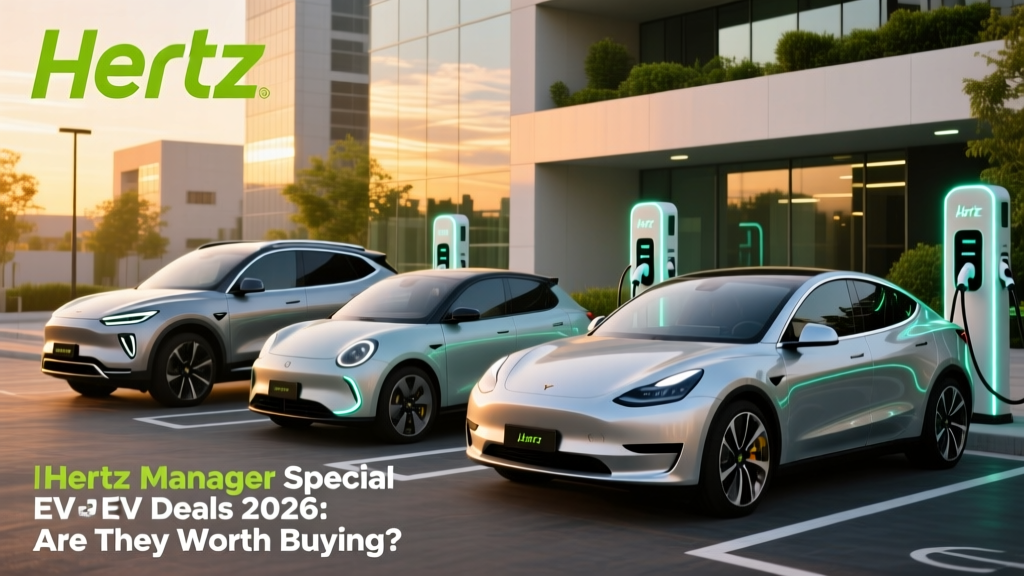
Hertz aggressively expanded its EV fleet starting in 2022, ordering 100,000 Teslas and 175,000 GM electric vehicles. By 2024, the company began offloading tens of thousands of these EVs due to higher-than-expected repair costs and faster depreciation than gas vehicles. That sell-off created the "manager special" phenomenon: deeply discounted fleet EVs sold through Hertz CarSales, auction sites like Manheim, and third-party dealers who acquire them in bulk.
If you're searching for a hertz manager special EV in 2026, you're likely looking at second- or third-wave fleet vehicles — cars with 40,000+ miles, out of basic bumper-to-bumper warranty, but potentially still covered under battery and powertrain warranty. Here's exactly what you need to evaluate before buying one.
Which EVs Show Up as Hertz Manager Specials?
The Hertz fleet was dominated by a handful of models. Here are the most common manager special EVs you'll encounter, with key specs that matter for a used purchase:
| Model | Model Years | Usable Battery (kWh) | EPA Range (mi) | Peak DC Charge (kW) | 10–80% Time | Typical Manager Special Price |
|---|---|---|---|---|---|---|
| Tesla Model 3 RWD | 2022–2023 | 57.5 (LFP) | 272 | 170 | ~25 min | $16,000–$21,000 |
| Tesla Model Y LR | 2022–2023 | 75 (NMC) | 330 | 250 | ~20 min | $22,000–$28,000 |
| Chevrolet Bolt EV | 2022–2023 | 65 (NMC) | 259 | 55 | ~55 min | $14,000–$18,000 |
| Polestar 2 LRSM | 2022–2023 | 75 (NMC) | 270 | 205 | ~22 min | $18,000–$23,000 |
| Ford Mustang Mach-E | 2022–2023 | 88 (NMC ext.) | 312 | 150 | ~38 min | $20,000–$26,000 |
Note: kW = charging power (speed); kWh = battery energy capacity. A higher kW charge rate means faster fills; a higher kWh battery means more range. These are not interchangeable.
The Tesla Model 3 with the LFP (lithium iron phosphate) battery is the most common Hertz manager special EV. LFP chemistry is notable for its longevity — these batteries typically degrade slower than NMC cells, retaining 90%+ capacity after 1,000+ charge cycles. However, LFP batteries have lower energy density (hence the 272-mile EPA range vs. 358 for the Long Range NMC variant) and perform worse in extreme cold, losing 30–40% range below freezing compared to 20–25% for NMC.
Real Costs: Hertz Manager Special EV vs. Comparable Gas Car
The sticker price is just the entry fee. Here's a 5-year total cost of ownership comparison between a typical Hertz manager special (2023 Tesla Model 3 RWD at $18,000) and a comparable used gas sedan (2023 Toyota Camry LE at $20,000), assuming 12,000 miles/year and home Level 2 charging:
| Cost Category | 2023 Tesla Model 3 (Hertz, $18K) | 2023 Toyota Camry LE (Used, $20K) |
|---|---|---|
| Purchase Price | $18,000 | $20,000 |
| Federal Used EV Credit (§25E, up to $4,000) | −$4,000 | $0 |
| Effective Purchase | $14,000 | $20,000 |
| Fuel/Energy (5 yrs, 60K mi) | $2,400 (home charging at $0.14/kWh) | $7,500 (gas at $3.50/gal, 30 MPG) |
| Maintenance (5 yrs) | $800 (tires, cabin filter, wipers) | $3,200 (oil, brakes, filters, belts) |
| Insurance (5 yrs avg) | $9,500 ($1,900/yr) | $7,000 ($1,400/yr) |
| Estimated Depreciation (5 yrs) | $6,000 | $7,000 |
| 5-Year Total Cost | $32,700 | $37,700 |
The math favors the EV — but only if you can charge at home. Public DC fast charging at $0.40–$0.60/kWh erases most of the fuel savings, pushing 5-year energy costs to $5,000–$7,000. If you rely exclusively on public charging, the Camry's total cost becomes competitive.
Insurance is the hidden penalty. EV insurance premiums run 20–35% higher than equivalent gas vehicles, driven by costlier collision repairs (specialized body shops, battery replacement risk). Get quotes before purchasing — a $1,900/year estimate is an average; your rate could be $1,500 or $2,600 depending on state, age, and driving record.
Battery Health: The Biggest Unknown on a Fleet EV
Every Hertz manager special EV has lived a hard life. Rental cars endure frequent DC fast charging (which accelerates degradation), aggressive acceleration from unfamiliar drivers, and inconsistent charging habits (some renters never plug in; others fast-charge to 100% daily).
Real-World Range Reality Check: A 2023 Model 3 RWD carries an EPA sticker of 272 miles when new. Expect 245–260 miles at 70% State of Health (SoH) after 50,000 fleet miles. In winter highway driving at 20°F, plan for 180–200 miles of usable range. Always check SoH before purchasing — Tesla's service center can run a battery health report, or use third-party tools like Recurrent's battery health score.
Here's what to know about battery degradation on these fleet vehicles:
- LFP batteries (Model 3 RWD): Typically lose 5–8% capacity over 50,000 miles. More resilient to frequent fast charging.
- NMC batteries (Model Y, Bolt, Mach-E, Polestar): Typically lose 8–12% capacity over 50,000 miles, especially if DC fast-charged frequently.
- Battery warranty still applies: Federal law mandates a minimum 8-year/100,000-mile battery warranty. A 2023 model's battery is covered until at least 2031 or 100K miles, whichever comes first. If capacity drops below 70% (Tesla's threshold), the manufacturer must replace or refurbish it at no cost.
Before buying any Hertz manager special EV, demand a battery State of Health report. For Teslas, navigate to Settings → Software → Battery Health on the touchscreen, or request a diagnostic from a Tesla Service Center. For the Bolt and Mach-E, a dealer OBD-II scan reveals SoH. Walk away if SoH is below 85% on a vehicle under 60,000 miles — that signals abnormal degradation.
Tax Credits and Incentives: What Applies to Used Fleet EVs?
The new-vehicle §30D credit (up to $7,500) does NOT apply to used EVs. However, the §25E Used Clean Vehicle Credit offers up to $4,000 — and this is where Hertz manager specials shine.
- Credit amount: 30% of the sale price, capped at $4,000
- Vehicle price cap: Sale price must be $25,000 or less (most Hertz manager specials qualify)
- Vehicle age: Must be at least 2 model years old (2022–2024 models qualify in 2026)
- Buyer income caps (AGI): $75,000 single / $112,500 head of household / $150,000 married filing jointly
- Dealer requirement: Must be purchased from a licensed dealer (not private party or auction)
- Point-of-sale transfer: You can apply the credit at purchase to reduce your out-of-pocket cost immediately
- One-time use per buyer: You can only claim §25E once every 3 years
An $18,000 Hertz Model 3 with the full $4,000 credit effectively costs $14,000 — making it one of the cheapest ways into a 250+ mile EV in 2026. But confirm eligibility with a tax professional before relying on this credit, as IRS rules on dealer reporting and income verification are strictly enforced.
Common Myths About Hertz Manager Special EVs
| Myth | Fact |
|---|---|
| "The battery is destroyed from fast charging" | LFP batteries tolerate frequent DC charging well. Expect 88–95% SoH at 50K miles. NMC batteries degrade faster but are still typically above 85% SoH. |
| "Rental EVs have been crashed and rebuilt" | Some have. Always pull a Carfax or AutoCheck report. Salvage/rebuilt titles are common on auction-sourced Hertz EVs — avoid them unless priced 40%+ below clean-title equivalents. |
| "I won't qualify for any tax credit on a used EV" | The §25E credit provides up to $4,000 for used EVs under $25,000 bought from dealers, subject to income caps. |
| "EV maintenance costs are the same as gas cars" | EVs eliminate oil changes, spark plugs, timing belts, and exhaust repairs. Expect 60–70% lower scheduled maintenance costs over 5 years, per fueleconomy.gov data. |
| "These cars have no warranty left" | The 8-year/100,000-mile battery and powertrain warranty follows the vehicle, not the owner. A 2023 model is covered through 2031 or 100K miles. |
Who Should (and Shouldn't) Buy a Hertz Manager Special EV?
Buy a Hertz manager special EV if:
- You have access to Level 2 home charging (a 240V outlet or installed wallbox at 7–11 kW)
- Your daily commute is under 80 miles round-trip
- You can verify battery SoH before purchase (above 85%)
- You qualify for the §25E used EV credit (income under caps)
- You're comfortable with a vehicle that has cosmetic wear and higher mileage
- You live in a region with moderate winters (or accept 30%+ winter range loss)
Look elsewhere if:
- You have no home or workplace charging access and would rely entirely on public DC fast chargers
- You regularly drive 200+ miles in a single trip in cold weather
- You need a vehicle with a clean, single-owner Carfax for resale peace of mind
- Your state offers no used EV incentives and your income exceeds §25E caps
- You plan to tow — most fleet EVs (especially the Model 3 and Bolt) have minimal or no towing capacity
Frequently Asked Questions
Where do I find Hertz manager special EVs for sale?
Hertz sells retired fleet vehicles through Hertz CarSales (hertzcarsales.com), where inventory is listed with pricing and vehicle history. Many also flow through wholesale auctions (Manheim, ADESA) to independent dealers. Search Autotrader, CarGurus, or Cars.com filtering by "fleet" or "rental" history. Prices on dealer lots may be $1,000–$3,000 higher than Hertz's direct pricing.
Can I get a pre-purchase inspection on a Hertz fleet EV?
Yes, and you should. For Teslas, a Tesla Service Center can run a full diagnostic including battery SoH, drive unit health, and software status for approximately $100–$150. For Chevrolet Bolts and Ford Mach-Es, any dealer with EV-certified technicians can scan the battery management system. Also check for open recalls — the Bolt's battery recall (fire risk) was resolved on 2022+ models with the Ultium-sourced pack, but verify the VIN on NHTSA's recall lookup.
How does a Hertz manager special compare to a new budget EV?
A new 2026 Chevrolet Equinox EV starts around $33,000 before incentives, offering 315 miles of EPA range and a fresh battery. A Hertz manager special Model 3 at $18,000 (minus $4,000 credit = $14,000 effective) saves $19,000 upfront but gives you 250 miles of degraded range and no bumper-to-bumper warranty. If your budget is tight and you can accept the mileage, the used fleet EV wins on pure economics. If you want warranty coverage and the latest tech, the new Equinox or a new Nissan Leaf ($28,000) may justify the premium.
What charging setup do I need at home?
Level 1 (120V standard outlet) adds 3–5 miles of range per hour — adequate if you drive under 30 miles daily. Level 2 (240V, 32–48 amp circuit) adds 25–44 miles per hour and is the practical standard for EV ownership. Expect $500–$1,500 for a Level 2 wallbox (ChargePoint Home Flex, Tesla Wall Connector) plus $800–$2,500 for electrician installation, depending on whether your panel needs upgrading to 200A. Total home charging setup: $1,300–$4,000.
Will the battery need replacing, and what does it cost?
Based on current degradation data, most LFP and NMC batteries retain 80%+ capacity at 150,000 miles. Out-of-warranty replacement costs $10,000–$16,000 for a Model 3 and $14,000–$18,000 for a Model Y, per Tesla service estimates. However, failure before 150K miles is uncommon. The 8-year/100K-mile federal battery warranty protects you on any 2022–2024 Hertz vehicle through at least 2030.
A hertz manager special EV is one of the most affordable on-ramps to electric vehicle ownership in 2026 — if you do the homework. Verify the battery, confirm your tax credit eligibility, get your home charging sorted, and price your insurance before signing. The savings are real; the risks are manageable, but only if you go in with eyes open.