The Short Answer: EV Heaters and Your Range
Heaters in electric cars draw power directly from the traction battery, which reduces driving range. A resistive heater can consume 3–5 kW continuously, cutting cold-weather range by 20–40% depending on temperature and trip length. EVs equipped with a heat pump use roughly 1–2 kW for the same cabin warmth, limiting range loss to about 10–20%. For a 300-mile EPA-rated EV, that means expecting 180–240 real-world miles in freezing weather without a heat pump, or 240–270 miles with one.
Why Heating an EV Is Fundamentally Different From a Gas Car
In a gasoline vehicle, the engine converts only about 20–30% of fuel energy into motion. The rest becomes waste heat — heat that the cabin heater simply redirects inside for free. You never notice the energy penalty because it was already being lost.
An electric motor is roughly 85–95% efficient. That means very little waste heat is generated. To warm the cabin, an EV must create heat intentionally, drawing from the same battery that powers the drivetrain. Every kilowatt-hour spent on heating is a kilowatt-hour not spent on driving.
This is the single biggest reason cold-weather range loss hits EVs harder than gas cars — and why the type of heater your EV uses matters enormously.
Resistive Heaters vs. Heat Pumps: The Numbers
There are two primary heating systems in modern EVs:
PTC Resistive Heaters
A Positive Temperature Coefficient (PTC) resistive heater works like a giant toaster. Electricity passes through a resistive element, generating heat. It is simple, inexpensive, and effective — but it requires 1 watt of electrical energy to produce 1 watt of heat energy (a Coefficient of Performance, or COP, of 1.0).
At full blast on a cold morning, a PTC heater can draw 3–5 kW. If you drive for an hour at highway speeds in 20°F weather with the heater running, you might use 4 kWh just for cabin heat — roughly equivalent to 12–16 miles of driving range in an average EV consuming 3–4 miles per kWh.
Heat Pump Systems
A heat pump works like a reversed air conditioner. Instead of generating heat, it moves heat from the outside air (or from the powertrain's waste heat loop) into the cabin. Even at 20°F, there is extractable thermal energy in the air. Modern EV heat pumps achieve a COP of 2.0–4.0 in moderate cold, meaning they deliver 2–4 watts of heat for every 1 watt of electricity consumed.
That same hour of highway driving in 20°F weather might require only 1–2 kW from a heat pump — saving 2–3 kWh, or roughly 6–12 miles of range per hour compared to resistive heating.
| Attribute | PTC Resistive Heater | Heat Pump |
|---|---|---|
| How it works | Generates heat via electrical resistance | Transfers heat from outside air / powertrain loop |
| Typical power draw (20°F) | 3–5 kW | 1–2 kW |
| Coefficient of Performance | 1.0 | 2.0–4.0 (drops in extreme cold) |
| Range impact at 20°F (300-mi EPA) | −25% to −40% | −10% to −20% |
| Added vehicle cost | Baseline (included) | +$500–$1,500 (or included on premium trims) |
| Effectiveness below 0°F | Consistent | Reduced (COP drops toward 1.0–1.5) |
Real-World Range Loss: What the Data Shows
EPA range estimates are measured at roughly 72°F. The moment temperatures drop, real-world range diverges from the sticker. Here is what testing and owner data consistently show:
- 40°F–50°F: Expect 5–15% range reduction. A 300-mile EPA EV delivers roughly 255–285 real-world miles.
- 20°F–30°F: Expect 20–35% reduction without a heat pump, 10–20% with one. That 300-mile EV drops to roughly 195–240 miles (PTC) or 240–270 miles (heat pump).
- 0°F–10°F: Expect 30–45% reduction. Heat pump advantage narrows as COP drops. Expect 165–210 miles regardless of system.
According to EPA data on fueleconomy.gov, cold temperatures reduce EV range due to both cabin heating demand and increased battery internal resistance. The battery itself is less efficient at low temperatures, compounding the heater's energy draw.
Short trips hit hardest. A 10-minute commute in 15°F weather means the cabin and battery never fully warm up, and the heater runs at maximum draw the entire time. The same EV on a 60-minute highway trip will see a smaller percentage range loss because the heating load is amortized over more miles and the powertrain generates some waste heat once warmed.
Which 2026 EVs Include a Heat Pump?
Heat pump adoption has expanded significantly. As of the 2026 model year, here is a snapshot of major models and their heating systems:
| Model | Heating System | EPA Range | Expected Cold-Weather Range (20°F) | Base MSRP |
|---|---|---|---|---|
| Tesla Model Y (Long Range) | Heat pump (standard) | 320 mi | ~260–290 mi | $44,990 |
| Hyundai Ioniq 5 (SEL) | Heat pump (standard on most trims) | 303 mi | ~245–275 mi | $42,600 |
| Ford Mustang Mach-E (Premium) | Heat pump (standard) | 290 mi | ~235–260 mi | $43,995 |
| Chevrolet Equinox EV (LT) | Resistive (PTC) | 319 mi | ~200–240 mi | $33,600 |
| Volkswagen ID.4 (Pro) | Heat pump (optional/standard varies) | 291 mi | ~235–265 mi | $40,795 |
| Rivian R1S (Dual Motor) | Heat pump (standard) | 321 mi | ~260–290 mi | $75,900 |
Always confirm the heating system on the specific trim you are considering. Some manufacturers make the heat pump standard only on higher trims, while on base models it may be absent or part of a cold-weather package.
Heated Seats and Steering Wheels: The Efficiency Hack
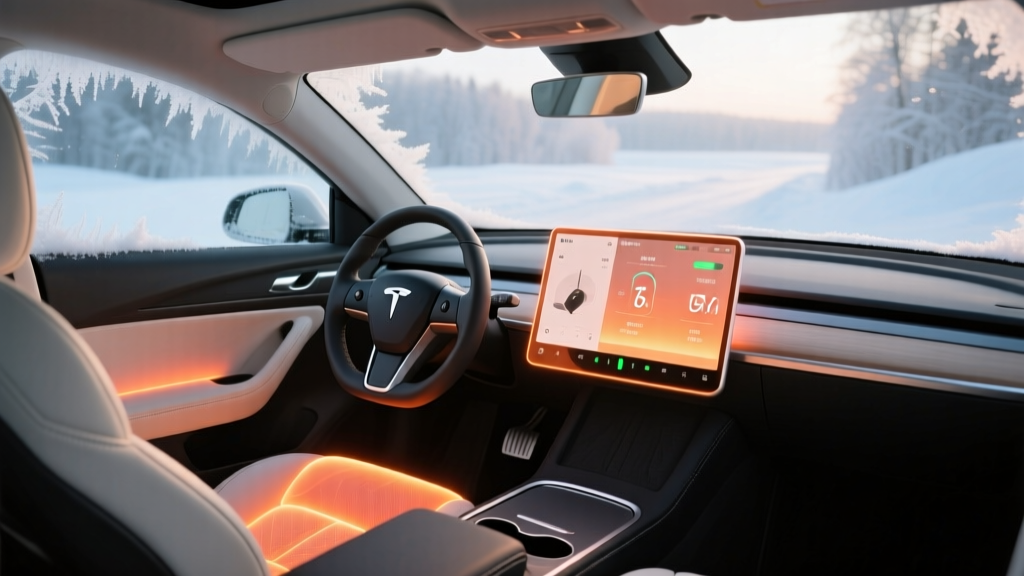
Heated seats and heated steering wheels use far less energy than cabin air heating — typically 50–150 watts combined versus 1,000–5,000 watts for the main cabin heater. That is a 10x to 50x reduction in energy draw.
The reason is physics: heated seats warm your body through direct conduction rather than heating the entire volume of air in the cabin. Your body feels warm even if the ambient air temperature remains cool.
| Myth | Fact |
|---|---|
| "Running the heater cuts EV range in half." | Range loss is typically 10–40% depending on temperature, trip length, and heating system type. Heat pumps cut this penalty substantially. |
| "Heated seats don't make a real difference." | Heated seats draw 50–100W vs. 3,000–5,000W for resistive cabin heat. Using seats instead of cabin air heat on short trips can save 10–15% of range. |
| "Heat pumps don't work in extreme cold." | Modern EV heat pumps extract heat down to about −15°F, though COP drops. Below 0°F, a supplemental resistive element typically kicks in. |
| "Preconditioning wastes energy." | Preconditioning while plugged in draws power from the grid, not the battery. You start your drive with a warm cabin and battery at full charge — net energy savings. |
| "EVs can't handle winter." | EVs start instantly in any cold (no engine cranking), have instant torque for traction, and with preconditioning plus a heat pump, winter commuting is practical for most drivers. |
Winter Ownership Costs: EV vs. Gas Car
Cold weather affects gas cars too — just less visibly. Gasoline engines run richer when cold, winter-blend fuel has slightly less energy density, and idling to warm up wastes fuel. The EPA estimates gas-car fuel economy drops roughly 12–22% in short-trip winter driving.
But because gas cars waste so much energy as heat anyway, the cabin heater penalty is effectively zero. For EVs, the heating cost is real but partially offset by lower energy costs per mile:
| Vehicle | Energy Used (Winter) | Cost per Trip | Monthly Cost (22 workdays) |
|---|---|---|---|
| Gas sedan (28 MPG combined, winter-adjusted to 24 MPG) | 1.25 gal at $3.10/gal | $3.88 | $85.36 |
| EV with heat pump (3.5 mi/kWh, winter-adjusted to 2.8 mi/kWh, home charging at $0.14/kWh) | 10.7 kWh | $1.50 | $33.00 |
| EV with resistive heater (3.5 mi/kWh, winter-adjusted to 2.2 mi/kWh, home charging at $0.14/kWh) | 13.6 kWh | $1.90 | $41.80 |
Even with maximum range penalty, the EV with a resistive heater costs roughly half as much per commute as the gas car. The heat-pump-equipped EV saves over $50/month on a 22-day commuting schedule. These figures assume home Level 2 charging at average residential rates — public DC fast charging at $0.35–$0.50/kWh would narrow the gap significantly.
Maximizing Winter Range: Practical Strategies
Beyond choosing a heat-pump-equipped EV, these techniques reduce heater-related range loss:
- Precondition while plugged in. Schedule your EV to warm the cabin and battery 15–30 minutes before departure while connected to your Level 2 home charger. The grid supplies the energy, not your battery. You depart at full SoC with a warm cabin.
- Use heated seats and steering wheel first. Set the cabin temperature 3–5°F lower than you normally would and let the seat heaters handle personal warmth. This alone can save 1–2 kW of continuous draw.
- Garage parking helps enormously. An EV starting from a 45°F garage uses significantly less energy to reach comfort temperature than one starting from a 15°F driveway. Even an unheated garage stays 15–25°F warmer than outside air in most climates.
- Use Eco or range mode. Many EVs reduce heater output and soften throttle response in Eco mode, trading a degree or two of cabin warmth for measurable range extension.
- Plan charging stops with preconditioning. Tesla, Rivian, and several other brands automatically precondition the battery when you navigate to a DC fast charger. A warm battery charges faster and wastes less energy during the session.
Decision Framework: Does Heater Type Matter for Your Purchase?
Choose a heat-pump-equipped EV if:
- You live where winter temperatures regularly drop below 35°F
- Your daily commute exceeds 40 miles round-trip in cold months
- You lack reliable home charging and rely on public infrastructure (range preservation matters more)
- You frequently take road trips over 200 miles in cold weather
A resistive-heater EV is fine if:
- You live in a mild climate where temperatures rarely drop below 45°F
- Your daily driving is under 30 miles and you charge at home every night
- The specific model offers significantly better value or features that outweigh the winter range penalty
- You primarily use the EV as a second car for shorter local trips
Frequently Asked Questions
Do heaters in electric cars drain the battery when parked?
No. The cabin heater only operates when the vehicle is on or actively preconditioning. Unlike a gas car idling to stay warm, a parked EV with the climate system off draws negligible power (just the 12V auxiliary system). If you use "camp mode" or "dog mode" to keep the cabin heated while parked, expect roughly 1–2 kW of draw with a heat pump, or 3–4 kW with resistive heat — meaning a 75 kWh battery could sustain cabin heat for 20–40 hours depending on the system.
Can I install an aftermarket heat pump in my EV?
No. Heat pump systems are deeply integrated into the vehicle's thermal management architecture — they share coolant loops with the battery, power electronics, and motor. Retrofitting is not practical or supported by any manufacturer. If a heat pump matters to you, choose a model that includes one from the factory.
Does using the defroster affect range as much as the heater?
Yes. The defroster runs the air conditioning compressor to dehumidify the air (even in winter) in addition to heating it. This combined operation can draw 4–6 kW with a resistive system. Heat-pump-equipped EVs handle this more efficiently, but defrost cycles still represent a meaningful range penalty on short trips.
How does cold weather affect DC fast charging speed?
A cold battery charges much slower than a warm one. Without preconditioning, a battery at 20°F might accept only 30–50 kW at a 150 kW charger. With proper preconditioning (navigation-based or manual), the same battery can accept its full peak rate. This is why preconditioning before a fast-charge stop is critical in winter — it can shave 15–25 minutes off your charge time.
Are LFP batteries worse in cold weather than NMC?
LFP (lithium iron phosphate) batteries have slightly higher internal resistance at low temperatures compared to NMC, which can mean marginally more range loss and slower cold-weather charging. However, the difference is modest — typically 5–10 percentage points of range — and is far less impactful than the choice between a heat pump and a resistive heater. If you are evaluating an LFP-equipped EV for the §30D federal tax credit, note that many LFP packs currently do not meet the critical-mineral sourcing requirements, so always verify eligibility on the IRS qualified vehicles list before purchasing.