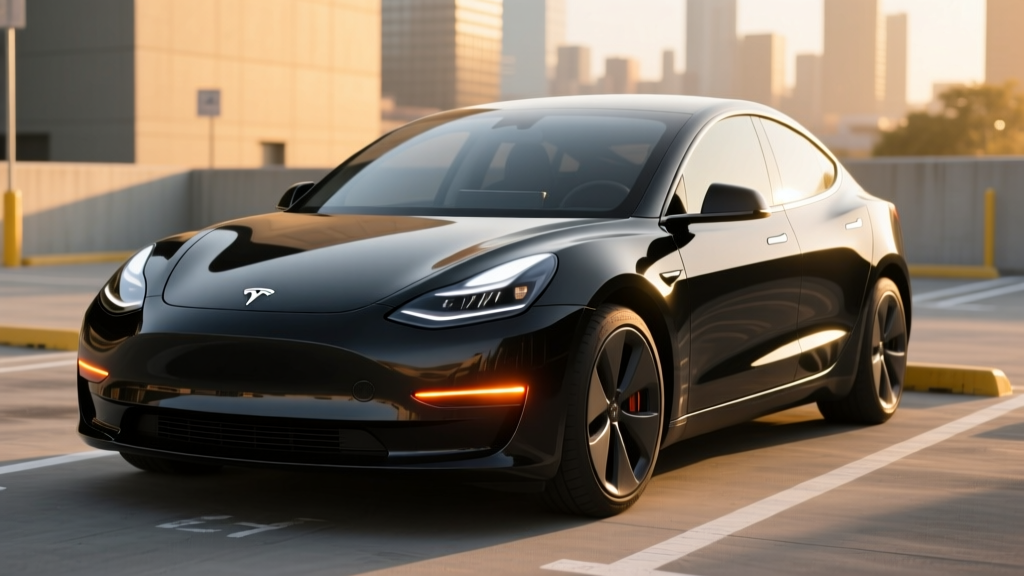
If you've just stepped into a Tesla Model 3 for the first time, one of the earliest surprises is the absence of a traditional hazard-light button on the dashboard. New owners and passengers alike frequently search for hazard lights Tesla Model 3 because the switch is tucked away compared to any conventional car. This review covers exactly where to find them, how they work, and then dives into the full ownership picture — range, charging, pricing, and whether the latest Model 3 earns a spot in your driveway.
Finding the Hazard Lights on the Tesla Model 3
In the current-generation Model 3 (the "Highland" refresh carried into the 2026 model year), the hazard-light switch is a small, recessed physical button located on the roof console, directly above the rearview mirror and integrated into the overhead map-light assembly. It is marked with the universal red-triangle icon.
This placement is intentional: Tesla's minimalist interior removes nearly all physical controls from the dashboard, routing wipers, mirrors, and glove-box release through the 15.4-inch central touchscreen. But federal safety regulations (FMVSS 108) require the hazard switch to be physically accessible without navigating menus, so Tesla keeps a dedicated hardware button overhead.
If you are a rideshare driver or frequently have passengers unfamiliar with EVs, it is worth pointing out this switch before your first trip — it is the single most common "where is it?" question new Model 3 riders ask.
Tesla Model 3 at a Glance: Key Specifications
| Spec | Long Range AWD | Performance AWD | RWD (Standard) |
|---|---|---|---|
| EPA Range | 341 mi | 315 mi | 272 mi |
| Battery (usable) | ~75 kWh (NMC) | ~75 kWh (NMC) | ~57.5 kWh (LFP) |
| Peak DC Fast Charge | 250 kW | 250 kW | 170 kW |
| 10–80% DC Time | ~25 min | ~25 min | ~30 min |
| Level 2 (11.5 kW) | ~44 mi/hr | ~44 mi/hr | ~30 mi/hr |
| 0–60 mph | 4.2 sec | 2.9 sec | 5.8 sec |
| Horsepower | ~346 hp | ~510 hp | ~271 hp |
| Drivetrain | Dual-motor AWD | Dual-motor AWD | Single-motor RWD |
| MPGe (combined) | 132 MPGe | 119 MPGe | 132 MPGe |
| Efficiency | 25 kWh/100 mi | 28 kWh/100 mi | 25 kWh/100 mi |
| Base MSRP | $47,740 | $54,990 | $38,990 |
Source: fueleconomy.gov and Tesla's official specifications. MSRP excludes destination fee.
Real-World Range: What the EPA Sticker Doesn't Tell You
Tesla's thermal management system — which includes a heat pump across all trims — mitigates cold-weather losses better than many competitors. Preconditioning the battery while plugged in (using scheduled departure in the Tesla app) recovers a significant portion of that winter range penalty by warming the pack before you drive. On the highway, the Model 3's low drag coefficient (~0.219 Cd) helps it punch above its battery size, but sustained 80+ mph speeds will compress range noticeably.
For the RWD trim with its LFP (lithium iron phosphate) battery, Tesla recommends periodic charging to 100% — unlike the NMC packs in the Long Range and Performance trims, which are best kept between 20–90% for daily use. LFP chemistry sacrifices some energy density but gains cycle-life longevity and thermal stability, making the RWD a smart pick for warm-climate commuters who charge at home nightly.
Charging Speed: DC Fast, Level 2, and Level 1
The Model 3 uses the NACS (North American Charging Standard) connector natively — Tesla's own plug, now adopted industry-wide. This gives Model 3 owners first-party access to the Tesla Supercharger network, widely regarded as the most reliable DC fast-charging infrastructure in the U.S.
| Level | Power | Miles Added per Hour | Notes |
|---|---|---|---|
| Level 1 (120V) | ~1.4 kW | ~3–5 mi/hr | Emergency/trickle only |
| Level 2 (240V, 48A) | 11.5 kW | ~44 mi/hr | Full overnight charge in ~7–8 hrs |
| DC Fast (Supercharger V3) | Up to 250 kW peak | ~175 mi in 15 min | Tapers significantly above 80% SoC |
A critical nuance: the 250 kW figure is a peak, not a sustained rate. The charge curve on the Long Range's NMC pack holds near peak power up to roughly 40–50% SoC, then progressively tapers. The 10–80% time of ~25 minutes reflects this curve. Charging from 80–100% on DC fast charge can add another 20+ minutes — plan your road-trip stops to leave at 80% unless you genuinely need a full pack.
At home on a Level 2 Wall Connector (Tesla's $420 unit, hardwired at 48 amps), the Long Range adds roughly 44 miles of range per hour. A full 10–100% charge takes about 7–8 hours — easily handled overnight on a standard off-peak electricity schedule. Home charging installation costs typically range from $800 to $2,500 depending on panel proximity and whether a 200-amp service upgrade is needed; consult a licensed electrician for your specific situation.
Performance, Interior, and Technology
The Performance trim's 2.9-second 0–60 mph time places it in sports-car territory, aided by dual-motor all-wheel drive and a low center of gravity from the underfloor battery pack. Even the RWD model's 5.8-second run is brisk for daily commuting. Regenerative braking is strong and adjustable, enabling one-pedal driving in most scenarios — lift off the accelerator and the car decelerates firmly without touching the brake pedal.
Inside, the Highland-generation Model 3 is a significant step up from pre-2024 models in cabin isolation and material quality. Acoustic glass, improved suspension bushings, and redesigned seats reduce road noise noticeably. The 15.4-inch touchscreen handles all vehicle controls, navigation, media, and climate. A rear 8-inch touchscreen for back-seat passengers controls rear climate and entertainment.
Standout tech:
- Tesla Autopilot (standard) — SAE Level 2 adaptive cruise and lane-centering. The driver must remain fully engaged at all times.
- Full Self-Driving (Supervised) — optional at roughly $8,000 or $99/month. Still SAE Level 2; requires continuous driver supervision despite the name.
- Over-the-air updates that add features and refine performance post-purchase.
- Sentry Mode dashcam surveillance while parked.
- Phone-as-key with Bluetooth proximity unlock.
Cargo and passenger space: The Model 3 offers 23 cu ft of cargo volume (including the front trunk, or "frunk," at ~3.1 cu ft). Rear legroom measures 35.2 inches — adequate for average-height adults but tighter than a midsize sedan. Headroom is generous in front (40.3 in) but the sloping roofline limits rear headroom to 37.8 inches. For families regularly carrying rear-seat passengers over 6 feet tall, the Model Y's taller roofline is a better fit.
Pricing, Tax Credits, and Ownership Cost
The Model 3 lineup currently spans three trims:
| Trim | Base MSRP | Est. Price After §30D Credit | Credit Eligibility |
|---|---|---|---|
| RWD | $38,990 | ~$31,490 | Up to $7,500 (subject to sourcing rules) |
| Long Range AWD | $47,740 | ~$40,240 | Up to $7,500 (subject to sourcing rules) |
| Performance AWD | $54,990 | ~$47,490 | Up to $7,500 (subject to sourcing rules) |
Federal tax credit (§30D) key rules for 2026:
- MSRP cap: Sedans must be at or below $55,000. The RWD and Long Range qualify; the Performance trim at $54,990 squeaks under the cap, but adding options can push it over.
- Buyer income cap: Modified adjusted gross income must not exceed $150,000 (single), $225,000 (head of household), or $300,000 (joint).
- Battery sourcing: The full $7,500 requires meeting both critical-minerals and battery-component sourcing requirements under the Inflation Reduction Act. Tesla's U.S.-built packs have generally met these thresholds, but partial credit ($3,750) is possible if only one requirement is satisfied. Verify current eligibility on IRS.gov before purchasing.
- Point-of-sale transfer: Buyers can transfer the credit to the dealer at purchase, reducing the upfront price rather than waiting for a tax refund.
On the ownership-cost side, the Model 3 benefits from low fueling costs (roughly $0.04–$0.06 per mile on home electricity versus $0.12–$0.16 for a comparable gas sedan), minimal scheduled maintenance (no oil changes, fewer brake replacements thanks to regen), and strong resale value. Insurance premiums, however, tend to run 15–30% higher than equivalent ICE sedans — get quotes before committing.
Warranty Coverage
Tesla provides the following warranty structure for the Model 3:
- Basic vehicle: 4 years / 50,000 miles
- Battery & drive unit (RWD): 8 years / 100,000 miles
- Battery & drive unit (Long Range & Performance): 8 years / 120,000 miles
- Battery capacity retention threshold: Tesla warrants that the battery will retain at least 70% of its original capacity during the warranty period.
The 70% retention floor is standard for the industry. Real-world degradation data from Tesla's fleet suggests most Model 3 packs retain approximately 88–92% capacity at 100,000 miles, with LFP packs in the RWD trim showing particularly slow degradation curves. Full battery replacement outside warranty currently ranges from $12,000 to $16,000 depending on pack size — a worst-case cost worth factoring into long-term ownership plans beyond the warranty window.
Pros and Cons
- Class-leading efficiency (25 kWh/100 mi on RWD and Long Range)
- Access to the Supercharger network — the most reliable DC fast-charging ecosystem
- Strong real-world range from a modest battery size
- Over-the-air updates continuously improve the vehicle
- Excellent performance even in base RWD trim
- Low per-mile fueling cost with home charging
- Minimalist interior frustrates some — no physical stalks for turn signals (steering-wheel buttons instead)
- Rear seat headroom is tight for tall passengers
- No Apple CarPlay or Android Auto — Tesla's proprietary system only
- Higher insurance premiums than comparable ICE sedans
- FSD (Supervised) remains Level 2 despite the name and cost
- Hazard light switch placement is non-obvious to first-time users
Who the Tesla Model 3 Suits Best
Choose the RWD ($38,990) if you are a commuter with reliable home charging, live in a moderate climate, and want the lowest entry price with LFP battery longevity. This is the value play — especially after the federal tax credit.
Choose the Long Range AWD ($47,740) if you take regular road trips, live in a cold-weather state, or need all-wheel-drive traction. The 341-mile EPA range and dual-motor setup make this the most versatile trim.
Choose the Performance ($54,990) if acceleration thrills are a priority and you accept the range trade-off (315 miles EPA). Track mode and adaptive damping give it genuine sports-sedan dynamics.
Look elsewhere if you need spacious rear seating for tall adults (consider the Model Y or Hyundai Ioniq 5), want Apple CarPlay integration, or lack access to reliable home or workplace charging.
Frequently Asked Questions
Where exactly are the hazard lights on a Tesla Model 3?
The hazard-light button is a physical red-triangle switch on the overhead roof console, above the rearview mirror between the map lights. It is not on the touchscreen — federal safety regulations require a dedicated physical switch.
What is the real-world range of the Tesla Model 3?
The Long Range AWD is EPA-rated at 341 miles, but expect 280–305 miles in real-world highway driving at 70–75 mph. In freezing temperatures, plan for 220–250 miles. The RWD's 272-mile EPA rating translates to roughly 220–240 highway miles in mild conditions.
How fast does the Model 3 charge at home and on road trips?
On a Level 2 home charger (11.5 kW), the Long Range adds ~44 miles per hour, fully charging overnight in 7–8 hours. On a V3 Supercharger (250 kW peak DC), it charges 10–80% in about 25 minutes, adding up to 175 miles in 15 minutes. The RWD peaks at 170 kW DC with a ~30-minute 10–80% time.
Does the Tesla Model 3 qualify for the federal EV tax credit?
All three trims fall under the $55,000 MSRP cap for sedans. However, the full $7,500 credit under IRS §30D depends on battery-sourcing requirements, buyer income limits ($150K single / $300K joint), and current-year rules. Check fueleconomy.gov and IRS.gov for the latest eligibility details before purchasing.
Is the Model 3 worth buying versus competitors?
Against the Hyundai Ioniq 6, BMW i4, and Polestar 2, the Model 3 wins on efficiency, Supercharger network access, and software. The Ioniq 6 offers more rear headroom and 800V ultra-fast charging; the BMW i4 provides a more traditional luxury interior and Apple CarPlay. If Supercharger access and over-the-air improvements matter most, the Model 3 remains the benchmark.
Are Tesla's Autopilot and FSD actually self-driving?
No. Both Autopilot (standard) and Full Self-Driving Supervised (optional) are SAE Level 2 driver-assistance systems. The driver must remain fully engaged, with hands on the wheel and eyes on the road, at all times. These systems assist with steering, acceleration, and braking but do not replace the driver.