The Tesla Model Y has quietly become one of the most popular platforms for car camping and overlanding among EV owners — and the Havnby Model Y mattress has emerged as a go-to sleep solution for owners who want to turn their crossover into a mobile bedroom. But a mattress is only half the equation. To actually camp comfortably in a Model Y, you need to understand how range, charging logistics, battery drain from climate control, and cargo dimensions all interact when you're spending the night off-grid or at a trailhead.
This guide pairs a complete 2026 Tesla Model Y spec profile with the practical, owner-tested realities of using a Havnby mattress for overnight trips. Whether you're a weekend warrior eyeing dispersed camping or a digital nomad planning multi-night stays, here's exactly what the numbers look like.
2026 Tesla Model Y: Core Specs at a Glance
The 2026 Model Y received Tesla's "Juniper" refresh, bringing updated styling, a more refined interior, ambient lighting, rear-seat ventilation, and improved suspension tuning. The powertrain lineup has been simplified but remains potent. Here are the essential numbers buyers and campers need.
| Spec | Long Range AWD | Performance AWD |
|---|---|---|
| EPA Range | 320 miles | 295 miles |
| Battery (usable) | ~78 kWh (NMC) | ~78 kWh (NMC) |
| Drivetrain | Dual-Motor AWD | Dual-Motor AWD |
| Horsepower | ~384 hp | ~456 hp |
| 0-60 mph | 4.8 sec | 3.5 sec |
| MPGe (combined) | 122 MPGe | 111 MPGe |
| Efficiency | 28 kWh/100mi | 30 kWh/100mi |
| Max DC Fast Charge | 250 kW (peak) | 250 kW (peak) |
| 10-80% DC Time | ~25 min | ~25 min |
| Level 2 Home Rate | 11.5 kW (~44 mi/hr) | 11.5 kW (~44 mi/hr) |
| Cargo (seats folded) | 72.1 cu ft | 72.1 cu ft |
| Rear Legroom | 41.6 in | 41.6 in |
| Base MSRP | $46,630 | $52,130 |
| Battery Warranty | 8 yr / 120,000 mi | 8 yr / 120,000 mi |
Sources: fueleconomy.gov, Tesla Model Y design page.
Real-World Range: What Campers Actually Get
EPA Sticker: 320 miles (Long Range AWD)
Real-World Highway (70-75 mph): ~260-280 miles
Cold Weather (below 32°F): ~210-240 miles
Camping Scenario (mixed driving + overnight climate): Plan for ~230 usable miles before needing a charge
The EPA number is measured on a mixed cycle with gentle acceleration and moderate speeds. Real-world highway driving at 70+ mph cuts range by roughly 12-18% because aerodynamic drag scales with the square of velocity. Cold weather compounds this: the battery must heat itself, and cabin heating draws significant energy even with the Model Y's heat pump (standard on Juniper models).
For campers, the critical number is overnight battery drain. With Camp Mode enabled, the Model Y maintains cabin temperature using the heat pump and HVAC system. In mild conditions (55-65°F), expect roughly 1-1.5% battery drain per hour, or about 10-15% over an 8-10 hour night. In freezing conditions (20-30°F), that climbs to 2-3% per hour — potentially 20-30% overnight. This means you should arrive at your campsite with at least 40-50% battery in winter to avoid range anxiety the next morning.
Charging Logistics for Camping Trips
The Havnby Model Y mattress is a compelling sleep setup, but the real enabler of EV camping is charging infrastructure. Here's what the Model Y's charging profile looks like in practice.
| Charging Level | Power | Speed (miles/hr) | Best For |
|---|---|---|---|
| Level 1 (120V) | ~1.4 kW | ~5 mi/hr | Emergency trickle, multi-day camping |
| Level 2 (240V, 48A) | 11.5 kW | ~44 mi/hr | Home charging, campgrounds with 240V |
| DC Fast (Supercharger) | 250 kW peak | ~1,000+ mi/hr (peak) | Road trips, highway corridor charging |
The charging curve matters for trip planning. The Model Y peaks at 250 kW only when the battery is preconditioned and at a low state of charge (typically 10-20%). Above 50% SoC, the rate tapers significantly — by 80%, you're typically at 60-80 kW. This means a 10-80% session takes about 25 minutes, but pushing from 80-100% can take another 25-30 minutes. For campers, the smart play is to charge to 80% at the last Supercharger before your campsite and avoid the taper penalty.
Tesla's Supercharger network now includes over 6,500 stations in North America, many positioned near national forests, state parks, and outdoor recreation corridors. PlugShare and Tesla's in-car trip planner both help identify chargers near camping destinations. For dispersed camping without grid access, a portable Level 1 cord is your only option — plan accordingly, as 5 miles of range per hour is barely enough to offset overnight climate drain.
Camp Mode, Cargo Space, and the Havnby Mattress Fit
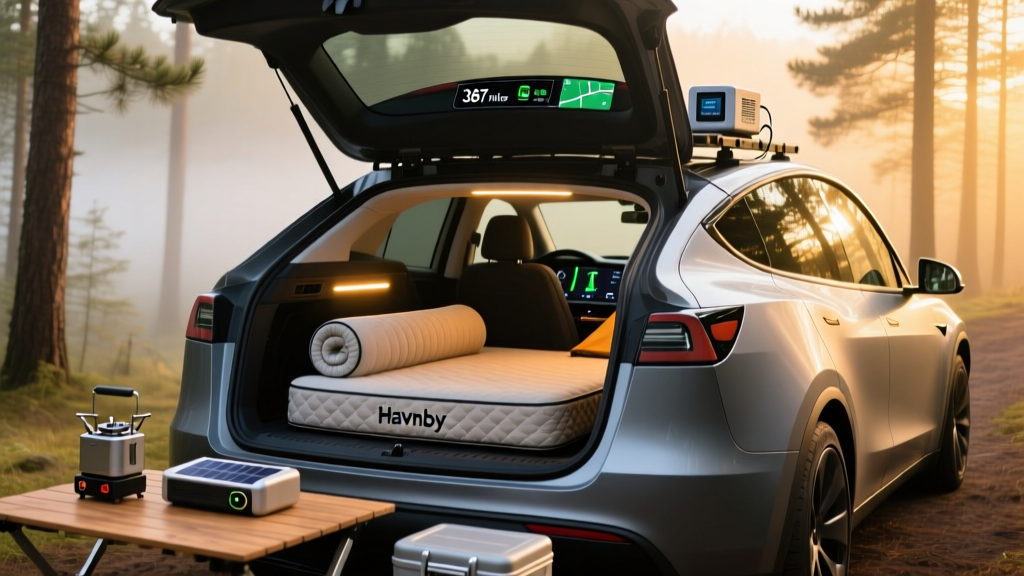
The 2026 Model Y offers 72.1 cubic feet of cargo space with the rear seats folded flat — slightly improved from pre-refresh models thanks to a flatter load floor. The maximum cargo length with the front seats pushed forward is approximately 72-74 inches, which accommodates most adults sleeping diagonally.
The Havnby Model Y mattress is a custom-cut foam mattress designed specifically for the Model Y's cargo dimensions. It typically features:
- Multi-panel folding design for easy storage when not camping
- Memory foam or high-density foam construction (3-4 inches thick)
- Custom contours that account for the Model Y's wheel wells and cargo shape
- Compatibility with the rear seats folded flat (no gap-filling needed in most cases)
Camp Mode is Tesla's built-in feature that keeps the HVAC system running, maintains a set temperature, disables walk-away auto-lock, and keeps the touchscreen on (with a campfire animation or media playback). It's accessed through the climate menu. Camp Mode also ensures the 12V auxiliary battery stays charged from the main traction battery — critical for powering USB ports, interior lights, and the touchscreen overnight.
Pro tip: Crack a window slightly (or use Tesla's vent mode if available on your firmware) to reduce condensation buildup inside the cabin during cold nights. The Havnby mattress paired with a reflective window cover kit creates a surprisingly comfortable sleep environment, but moisture management is the most overlooked aspect of EV car camping.
Pricing, Tax Credits, and Total Cost for Campers
| Trim | Base MSRP | Federal Credit (max) | Effective Price |
|---|---|---|---|
| Long Range AWD | $46,630 | Up to $7,500* | From ~$39,130* |
| Performance AWD | $52,130 | Up to $7,500* | From ~$44,630* |
*Critical tax credit caveats under IRS §30D:
- MSRP cap: SUVs/crossovers must be under $80,000 — the Model Y qualifies.
- Buyer income cap: AGI must not exceed $150,000 (single), $225,000 (head of household), or $300,000 (joint). Check IRS §30D guidelines for current-year thresholds.
- Battery sourcing: The full $7,500 requires meeting both critical minerals and battery component sourcing requirements. Tesla's supply chain has shifted significantly; verify current eligibility on the IRS qualified vehicles list at the time of purchase.
- Point-of-sale transfer: As of 2024, you can transfer the credit to the dealer at purchase, reducing your out-of-pocket cost immediately rather than waiting for tax filing.
For campers specifically, factor in the Havnby mattress ($200-400 depending on configuration), window covers ($50-100), and potentially a portable Level 1/Level 2 EV charger ($300-600) as part of your total camping setup investment.
Who the Model Y Camping Setup Suits Best
Choose the Model Y + Havnby mattress if:
- You're a weekend camper who wants to avoid tent setup and teardown
- You camp within 150-200 miles of home or near Supercharger corridors
- You value climate control (no sweaty summer nights or freezing winter mornings)
- You want dual use — daily commuter vehicle that converts to a camper on weekends
- You prioritize a quiet, emission-free campsite (no generator noise)
Look at alternatives (Rivian R1S, Rivian R1T, or a PHEV SUV) if:
- You need serious off-road capability for dispersed camping access
- You regularly camp 300+ miles from charging infrastructure
- You need to tow a trailer to your campsite (Model Y towing is limited to 3,500 lbs)
- You need more than two people sleeping in the vehicle
Pros and Cons: Model Y as a Camping Platform
Pros
- Camp Mode with heat pump = efficient overnight climate control
- Flat load floor accommodates the Havnby mattress with minimal gaps
- Supercharger network enables road-trip camping across the country
- Silent operation — no generator hum disturbing neighbors
- Preconditioning means a warm/cool cabin when you return from a hike
- OTA updates regularly add features (improved Camp Mode, vent settings)
- Frunk provides secure, weatherproof gear storage
Cons
- Overnight HVAC drain can consume 15-30% of battery in cold weather
- Ground clearance (~6.6 in) limits off-road campsite access
- No built-in AC power outlet for external devices (need a portable power station or inverter)
- Level 1 charging is too slow to sustain multi-night off-grid camping
- Interior width between wheel wells limits mattress width for taller campers
- Glass roof offers minimal insulation — condensation and heat gain are real issues
Frequently Asked Questions
What is the real-world range of the 2026 Tesla Model Y when camping?
On the highway at 70-75 mph, expect 260-280 miles from the Long Range AWD (EPA 320). Add overnight Camp Mode drain of 10-15% in mild weather or 20-30% in freezing weather, and your practical driving range the next morning drops to roughly 220-250 miles. Always plan your departure from the campsite with a known charging stop in mind.
How fast does the Model Y charge on a camping road trip?
At a V3 Supercharger (250 kW), the Model Y charges from 10-80% in approximately 25 minutes with a preconditioned battery. Above 80%, charging slows dramatically — avoid charging past 80% unless you have time to spare. At a Level 2 destination charger (common at campgrounds and hotels), expect roughly 44 miles of range per hour, which is ideal for overnight top-ups.
Does the 2026 Model Y qualify for the $7,500 federal EV tax credit?
It can, but eligibility depends on your income (AGI caps apply), the vehicle's battery sourcing compliance at the time of purchase, and MSRP (the Model Y is under the $80,000 SUV cap). The credit can be transferred at point of sale to reduce your purchase price immediately. Always verify current eligibility on irs.gov before committing.
Does the Havnby mattress fit all Model Y model years?
The Havnby mattress is designed around the Model Y's cargo dimensions, which have remained largely consistent across model years (2020-2026). However, the Juniper refresh (2025+) introduced minor interior changes. Confirm fit with the manufacturer for your specific model year, particularly if you have the 7-seat option, which alters the fold-flat configuration.
Is the Model Y worth buying for camping vs. a Rivian or PHEV?
The Model Y excels as a commuter-first vehicle that converts to a camper on weekends — the Supercharger network and Camp Mode make it genuinely practical. However, if your camping involves rough forest roads, deep backcountry access, or multi-night stays far from chargers, a Rivian R1S (better ground clearance, 400+ mile range options) or a PHEV like the Toyota RAV4 Prime (gas backup, no range anxiety) may serve you better. The Model Y is the best EV camping platform for paved-road and near-infrastructure camping.
How much battery does Camp Mode use overnight?
In 60°F weather with the cabin set to 68°F, Camp Mode typically uses 1-1.5% of battery per hour — about 10-15% over an 8-10 hour night. In 25°F weather with the cabin at 70°F, expect 2-3% per hour, or 20-30% overnight. The heat pump on Juniper models is significantly more efficient than resistive heating, but cold still demands more energy.
The Bottom Line for Model Y Campers
The Havnby Model Y mattress transforms a capable electric crossover into a legitimate camping platform — but the mattress is only comfortable if you've planned your energy logistics. The 2026 Model Y Long Range AWD at $46,630 (potentially ~$39,130 after the federal credit) offers 320 EPA miles, 250 kW fast charging, and a heat pump that makes overnight climate control viable in most conditions. Pair it with the Havnby mattress, a set of window covers, and disciplined charge planning, and you have a camping setup that's quiet, climate-controlled, and ready for any weekend within 200 miles of a Supercharger. Just respect the cold-weather battery math, and don't arrive at a dispersed campsite with less than 50% charge in winter.