Note: AutoEdgeView specializes in electric and hybrid cars, trucks, and SUVs. The HappyRun G300 Pro is an off-road electric dirt bike — outside our core automotive coverage. The analysis below applies our standard EV data methodology (battery chemistry, charge rates, real-world range, ownership cost) to this vehicle category for readers cross-shopping electrified transport options.
Quick Answer: Is the HappyRun G300 Pro Worth It?
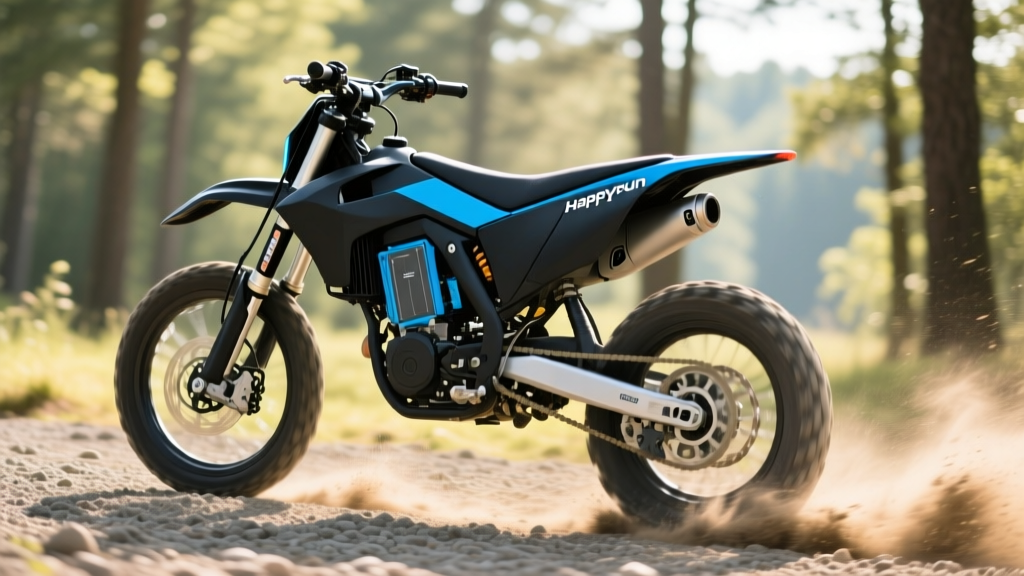
The HappyRun G300 Pro is a budget-tier electric dirt bike priced around $1,299–$1,499 with a claimed top speed of ~37 mph and a manufacturer-estimated range of ~43 miles on a single charge from its ~2.16 kWh lithium battery. It charges on a standard 120V outlet in roughly 4–5 hours. For casual trail riding, backyard laps, or farm use, it offers low noise and near-zero maintenance versus a gas dirt bike. For competitive motocross, sustained high-speed desert riding, or riders over ~200 lbs expecting full range, its limitations are significant. There is no federal §30D tax credit for electric dirt bikes — that credit applies to highway-capable four-wheeled vehicles only.
HappyRun G300 Pro: Battery, Motor, and Performance Specs
The G300 Pro sits at the top of HappyRun's off-road electric lineup. Below are the published and observed specifications as of early 2026. Note that HappyRun is a direct-to-consumer brand sold primarily through its own website and Amazon; it does not publish SAE-certified test data the way automotive OEMs do, so figures below combine manufacturer claims with independent rider reports.
| Specification | HappyRun G300 Pro |
|---|---|
| Motor | 2,000W brushless hub motor (peak output) |
| Top Speed (claimed) | ~37 mph (60 km/h) |
| Battery Capacity | ~2.16 kWh (60V, 36Ah) lithium-ion |
| Battery Chemistry | NMC (nickel manganese cobalt) — typical for this class |
| Range (manufacturer claim) | ~43 miles (eco mode, light rider, flat terrain) |
| Real-World Range Expectation | ~20–30 miles at mixed throttle; ~12–18 miles aggressive riding |
| Charge Time (120V household) | ~4–5 hours (0–100%) |
| Charger Included | Yes — standard 120V plug-in adapter, ~450W output |
| Weight | ~130 lbs (59 kg) |
| Max Rider Load | ~330 lbs (150 kg) claimed |
| Brakes | Hydraulic disc front and rear |
| Suspension | Inverted front fork, rear monoshock |
| Price (MSRP, 2026) | $1,299–$1,499 depending on retailer/promotions |
| Warranty | 1 year limited (frame/motor); battery warranty varies by seller |
Real-World Range vs. Claimed Range: What to Actually Expect
This is where most buyer disappointment originates. The 43-mile claim assumes optimal conditions: eco power mode, a rider under ~150 lbs, flat paved or hardpack surface, moderate ambient temperature (65–80°F), and no sustained full-throttle use. This is analogous to how EPA range estimates for electric cars can overstate highway range in cold weather.
Real-World Range Reality Check
Claimed: 43 miles (eco, ideal conditions)
Realistic mixed riding: 20–30 miles
Aggressive trail/motocross: 12–18 miles
Cold weather (below 40°F): Reduce all estimates by 20–30% due to lithium-ion internal resistance increase
The ~2.16 kWh battery is the limiting factor. For comparison, a Zero FX electric motorcycle carries a 7.2 kWh battery and achieves roughly 80+ miles of mixed riding — but costs $11,000+. The G300 Pro's battery is roughly one-third the capacity, which scales directly to range. Physics doesn't negotiate: at sustained 30+ mph on loose terrain, a 2,000W motor draws heavily, and 2.16 kWh is consumed in under an hour of aggressive riding.
Cost Breakdown: G300 Pro vs. a Gas Dirt Bike
The strongest argument for the G300 Pro is ownership cost over time. Here's a concrete 3-year comparison against a typical 250cc gas dirt bike (e.g., a used Yamaha YZ250F or Honda CRF250R in the $4,000–$6,000 range).
| Cost Category | HappyRun G300 Pro (Electric) | 250cc Gas Dirt Bike |
|---|---|---|
| Purchase Price | $1,300–$1,500 | $4,000–$6,000 (used); $8,500+ (new) |
| "Fuel" Cost Per Charge/Tank | ~$0.25–$0.35 (2.16 kWh at $0.14/kWh avg US electricity) | ~$8–$12 per tank (2 gal premium at $4.50/gal) |
| Fuel/Energy Cost Per Riding Hour | ~$0.10–$0.15 | ~$4–$6 |
| Annual Maintenance (oil, filters, chain, top-end) | $0–$50 (chain lube, brake pads) | $300–$800 (oil changes, air filter, valve checks, piston rings) |
| 3-Year Fuel/Energy Cost (50 hrs/year) | ~$20 | ~$900–$1,500 |
| 3-Year Maintenance Cost | ~$50–$100 | $900–$2,400 |
| Noise Complaints / Trail Access Risk | Near-silent — wider trail access | Loud — restricted on many public trails |
| 3-Year Estimated Total Cost | ~$1,400–$1,650 | $5,800–$9,900 |
The electric dirt bike wins decisively on operating cost. If you ride 50 hours per year, the G300 Pro saves roughly $1,500–$3,500 over three years in fuel and maintenance alone — often exceeding the entire purchase price of the bike. The gas bike wins on range, power, and competitive suitability.
Charging the G300 Pro: What First-Time EV Buyers Should Know
Unlike electric cars that use standardized connectors (NACS, CCS, J1772), the G300 Pro uses a proprietary barrel-style DC plug connected to its included charger. You plug the charger into any standard 120V household outlet — no Level 2 charger, no electrician, no panel upgrade required.
Charging Speed Explained
The included charger outputs roughly 450W (0.45 kW). To fill a 2.16 kWh battery from empty:
- 0–100%: ~4–5 hours (accounting for charging inefficiency and taper above 80%)
- Quick top-up (20–80%): ~2.5 hours
kW vs kWh reminder: The charger's output is 0.45 kW (power — the rate). The battery holds 2.16 kWh (energy — the total capacity). This is the same distinction that applies to EV car charging: a 150 kW DC fast charger fills a 75 kWh car battery; here, a 0.45 kW charger fills a 2.16 kWh bike battery. The ratio determines charge time.
Real Ownership Considerations for Charging
- No home garage? The charger is portable, but you need a grounded 120V outlet within cable reach. Apartment dwellers should check lease terms before running a charger on a balcony or common area.
- Cold-weather charging: Lithium-ion batteries (NMC chemistry) should not be charged below freezing (32°F/0°C). Doing so can cause lithium plating, permanently reducing capacity. Bring the bike indoors or to a heated garage before charging in winter.
- Battery longevity: NMC cells degrade faster when regularly charged to 100% or drained to 0%. For daily use, charge to ~80% and avoid storing the battery fully empty or fully full. Expect ~80% capacity retention after 500–800 full charge cycles, which for most riders means 3–5 years of usable life before noticeable range loss.
Common Misconceptions About Budget Electric Dirt Bikes
| Myth | Fact |
|---|---|
| "43 miles of range means I can ride 43 miles on a trail" | Real-world trail range is typically 12–30 miles depending on throttle use, terrain, and rider weight. The 43-mile figure is a best-case eco-mode estimate on flat ground. |
| "It qualifies for the $7,500 federal EV tax credit" | The IRS §30D clean vehicle credit applies to four-wheeled, highway-capable vehicles meeting specific MSRP, income, battery-sourcing, and VIN requirements. Electric dirt bikes are not eligible. |
| "Electric means zero maintenance" | Brakes, suspension, chain/sprocket, tires, and bearings all require maintenance. What's eliminated: oil changes, air filters, spark plugs, valve adjustments, fuel system work. |
| "2,000W motor means it's as fast as a 250cc gas bike" | A 250cc four-stroke gas dirt bike produces roughly 30–40 HP (~22,000–30,000W). The G300 Pro's 2,000W peak is approximately 2.7 HP. It's closer to a 50cc–80cc gas bike in power output. |
| "I can swap the battery for a bigger one" | The battery pack is integrated and uses a proprietary BMS (battery management system). Upsizing requires matching voltage, connector, BMS protocol, and physical dimensions — not a simple swap. |
| "It's totally silent, so I can ride anywhere" | While the motor is nearly silent, tires, chain, and suspension still generate noise. More importantly, riding on unauthorized land is illegal regardless of noise level. Check local land-use regulations. |
Who Should Buy the G300 Pro — And Who Shouldn't
Actionable Decision Framework
Buy the HappyRun G300 Pro if:
- You're a beginner or casual rider looking for low-cost entry into off-road riding
- You ride on private property, farms, or quiet trails where noise is a concern
- Your rides are typically under 20 miles and you can charge between sessions
- You want to eliminate gas, oil, and engine maintenance entirely
- You're buying for a teen or lighter-weight rider (under 180 lbs)
- Your budget is under $1,500 and you want electric
Look elsewhere (gas dirt bike or premium electric like Zero FX / Sur-Ron Ultra Bee) if:
- You ride competitively or need 40+ HP for motocross tracks and steep climbs
- You need sustained 50+ mile range without mid-ride charging
- You weigh over 220 lbs and expect full claimed performance
- You ride in remote areas with no access to electrical outlets for mid-day charging
- You need DOT-street-legal equipment (lights, mirrors, registration) — the G300 Pro is off-road only
- You need a manufacturer dealer network for warranty service and parts
Where the G300 Pro Fits in the Broader Electric Off-Road Market
The G300 Pro occupies the budget end of a rapidly segmenting market. Here's how it compares to nearby competitors in 2026:
| Model | Price | Battery | Top Speed | Real Range | Power |
|---|---|---|---|---|---|
| HappyRun G300 Pro | ~$1,400 | 2.16 kWh | ~37 mph | 12–30 mi | ~2.7 HP (2,000W peak) |
| Sur-Ron Light Bee X | ~$4,200 | 1.92 kWh (60V 32Ah) | ~47 mph | 20–40 mi | ~6 HP (4,000W peak) |
| Sur-Ron Ultra Bee | ~$6,500 | 4.08 kWh (74V 55Ah) | ~56 mph | 40–75 mi | ~12.5 HP (9,000W peak) |
| Zero FX (Z-Force) | ~$11,500 | 7.2 kWh | ~85 mph | 75–90 mi mixed | ~46 HP (34 kW peak) |
| KTM 250 SX-F (gas baseline) | ~$9,200 | N/A | ~75 mph | ~60 mi per tank | ~44 HP |
The G300 Pro is roughly one-tenth the price of a Zero FX and one-third the price of a Sur-Ron Light Bee, with proportionally lower capability. It's a legitimate entry point for riders who want to try electric off-road without committing thousands, but it is not a competitor to motocross-grade machines in any performance metric.
Frequently Asked Questions
Is the HappyRun G300 Pro street legal?
No. The G300 Pro is an off-road vehicle. It lacks DOT-required equipment (headlight, taillight, turn signals, mirrors, horn, speedometer, and VIN registration). Riding it on public roads is illegal in virtually all US jurisdictions. Some riders add aftermarket lighting kits, but this does not make the vehicle street-legal without proper titling and registration — which off-road-only vehicles typically cannot obtain.
How long will the G300 Pro battery last before needing replacement?
NMC lithium-ion batteries in this class typically retain ~80% of original capacity after 500–800 full charge cycles. For a rider charging twice a week, that's roughly 5–7 years before noticeable range loss. Replacement battery packs (when available from HappyRun or third-party suppliers) typically cost $300–$500, though availability can be inconsistent for direct-to-consumer brands.
Can I charge the G300 Pro from a portable power station?
Yes, if the power station has a standard 120V AC outlet rated for at least 500W continuous output. A Jackery 1000 or EcoFlow Delta (~$800–$1,200) can fully recharge the G300 Pro once. This is useful for multi-session trail days where no grid power is available — but adds significant cost and weight to your kit.
How does cold weather affect the G300 Pro?
Below 40°F, expect 20–30% range loss due to increased internal resistance in NMC cells. Below freezing, do not charge the battery — doing so risks permanent damage from lithium plating. Store and charge the bike in a heated space (garage, shed with heater) during winter months. Motor performance is unaffected by cold; it's purely a battery-chemistry limitation.
Does the G300 Pro qualify for any EV tax credit or incentive?
No. The federal IRS §30D Clean Vehicle Credit requires a four-wheeled vehicle with a gross vehicle weight under 14,000 lbs, a valid VIN, highway-capable design, and compliance with battery-sourcing and MSRP caps. Electric dirt bikes, e-bikes, and off-road motorcycles do not qualify. Some states offer separate e-mobility rebates that may cover electric bikes — check your state's alternative fuel vehicle incentives for specifics, as these vary widely by jurisdiction.
Is the G300 Pro a good first dirt bike for a teenager?
It can be, with supervision. The 37 mph top speed is manageable for a teen rider, and the electric powertrain eliminates the kick-start frustration and stall-prone clutch of a gas bike. However, at ~130 lbs, the bike is heavy for younger riders to pick up after a fall. Parental throttle limiting (if supported by the controller) and proper safety gear (helmet, boots, gloves, chest protector) are essential. For riders under 14, a smaller electric option like a Sur-Ron Light Bee (with speed limiting) may be more appropriate despite the higher cost.