Why the Tesla Model X GVWR Matters for EV Families
When most shoppers research the Tesla Model X, they fixate on 0-60 times and falcon-wing doors. But if you plan to tow a trailer, load up a family of six, or haul gear on road trips, the number that actually governs your daily limits is the Gross Vehicle Weight Rating (GVWR). For the 2026 Tesla Model X, that number dictates how much payload you can carry, how towing affects range, and whether you remain within safe, legal operating limits.
This review covers the full 2026 Model X lineup — Long Range and Plaid — with a focus on weight ratings, towing practicality, real-world range under load, charging infrastructure, and whether the math works after federal tax incentives.
2026 Tesla Model X Core Specs at a Glance
| Spec | Long Range AWD | Plaid |
|---|---|---|
| EPA Range | 348 miles | 320 miles |
| Battery (usable) | ~95 kWh, NMC | ~95 kWh, NMC |
| GVWR | 6,800 lbs | 6,800 lbs |
| Curb Weight (est.) | 5,183 lbs | 5,390 lbs |
| Max Payload | ~1,617 lbs | ~1,410 lbs |
| Max Towing Capacity | 5,000 lbs | 5,000 lbs |
| 0-60 mph | 3.8 sec | 2.5 sec |
| Horsepower | 670 hp | 1,020 hp |
| Drivetrain | Dual Motor AWD | Tri Motor AWD |
| MPGe (combined) | 109 MPGe | 98 MPGe |
| Efficiency | 31 kWh/100 mi | 34 kWh/100 mi |
| Base MSRP | $79,990 | $94,990 |
| Battery Warranty | 8 yr / 150,000 mi | 8 yr / 150,000 mi |
Source: fueleconomy.gov and Tesla spec sheets. GVWR is the manufacturer-set maximum total weight of the vehicle including passengers, cargo, and tongue weight. Curb weight estimates vary by configuration; payload = GVWR minus curb weight.
Real-World Range: What the EPA Sticker Doesn't Tell You
Long Range: EPA 348 mi — Expect 290-310 mi highway at 70 mph; 240-260 mi in sub-30°F winter conditions.
Plaid: EPA 320 mi — Expect 265-285 mi highway at 70 mph; 220-240 mi in cold weather.
Towing penalty: With a 3,500-lb trailer, expect range to drop 40-50%, yielding roughly 150-180 mi per charge (Long Range).
The Model X's large frontal area and boxy silhouette hurt highway efficiency more than city driving, where regenerative braking recaptures energy. In our experience with Tesla's large-platform vehicles, sustained 75-80 mph cruising in warm conditions yields roughly 85-90% of the EPA sticker. Cold weather compounds the loss: the battery must heat itself, cabin heating draws significant power (the heat pump helps, but isn't a cure-all), and denser cold air increases aerodynamic drag.
Towing is the real range killer. At 5,000 lbs — the Model X's rated maximum — you're effectively doubling the mass the motors must push and drastically increasing aerodynamic drag from the trailer. Plan charging stops every 130-160 miles when towing near max capacity. If your typical trailer is 2,000-3,000 lbs (small camping trailer or utility trailer), the penalty is more manageable: roughly 30-40% range reduction.
Charging Speed: DC Fast, Level 2, and the Towing Road-Trip Equation
| Charging Level | Max Power | Speed / Rate | Notes |
|---|---|---|---|
| Level 1 (120V) | 1.4 kW | ~3-4 mi/hr | Emergency/trickle only |
| Level 2 (240V, 48A) | 11.5 kW | ~34 mi/hr | Home Wall Connector; full charge in ~9-10 hrs |
| DC Fast (Supercharger V3/V4) | 250 kW (peak) | 10-80% in ~30 min | Peak rate sustained to ~50% SoC, then tapers |
The Model X supports up to 250 kW on DC fast chargers via its native NACS connector — meaning full access to Tesla's Supercharger network without adapters. On a V3 or V4 Supercharger, preconditioned battery management allows the pack to ramp to peak draw quickly. Expect roughly 175 miles of range added in 15 minutes under ideal conditions.
Here's where the charging curve matters: the 95 kWh NMC battery pulls peak power only through the lower portion of the state of charge. Above roughly 50% SoC, the rate begins tapering. By 80%, you're pulling well under 100 kW. This is standard lithium-ion behavior to protect cell longevity, but it means the last 20% of a charge takes disproportionately long. On road trips — especially towing — plan your stops around 10-80% charges rather than attempting full top-ups.
For home charging, Tesla's Wall Connector at 48 amps on a 240V/60A circuit delivers 11.5 kW, adding roughly 34 miles of range per hour. A full overnight session easily replenishes a day's worth of driving. If your home has a 200A electrical panel with available capacity, installation typically runs $800-$2,000 beyond the $475 connector cost. Homes needing a panel upgrade to 200A or 400A face $2,000-$5,000 in additional electrical work — consult a licensed electrician for your specific situation.
GVWR, Payload, and Towing: The Practical Limits
The 2026 Tesla Model X carries a GVWR of 6,800 lbs across both trims. This is the absolute maximum weight Tesla engineers have rated the vehicle to safely carry — including the vehicle itself, all passengers, cargo, and any tongue weight from a trailer.
Payload math that matters:
- Long Range curb weight: ~5,183 lbs → Available payload: ~1,617 lbs
- Plaid curb weight: ~5,390 lbs → Available payload: ~1,410 lbs
That payload must cover every person and item inside the vehicle. Six adults averaging 180 lbs each consume 1,080 lbs, leaving just 537 lbs for cargo (Long Range). In a seven-seat configuration with children, the math is more forgiving, but the GVWR is a hard ceiling you cannot legally or safely exceed.
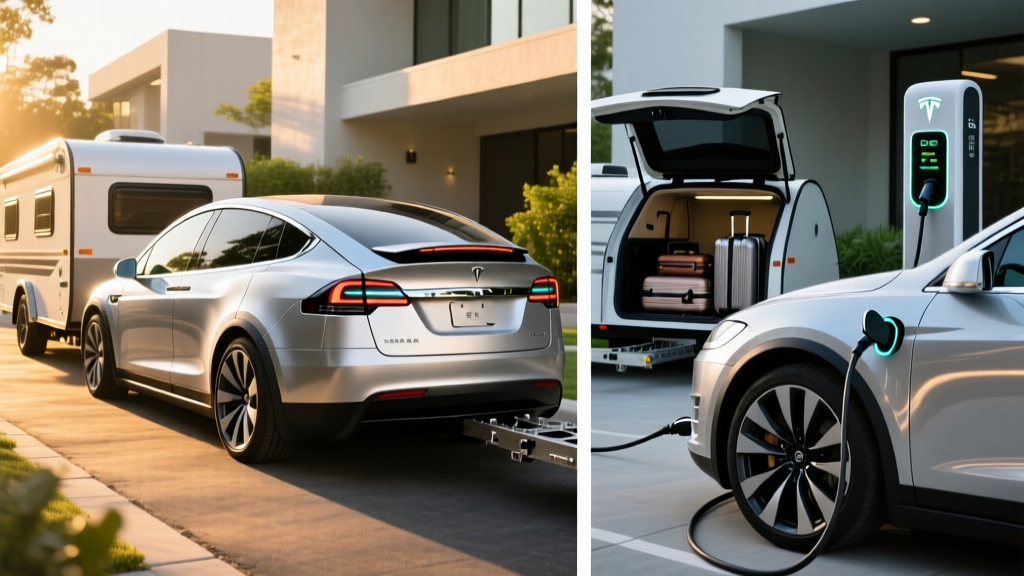
When towing, tongue weight typically represents 10-15% of trailer weight. A 5,000-lb trailer generates 500-750 lbs of tongue weight pressing down on the hitch — and that counts against your GVWR payload. So if you're towing at max capacity, you have roughly 867-1,117 lbs remaining inside the vehicle for passengers and cargo (Long Range). This is why real-world max towing often means a lighter passenger load or careful weight distribution.
The Model X includes a tow hitch receiver and Tesla's tow mode, which adjusts suspension height, stability control, and powertrain mapping for trailer duty. Integrated trailer sway control is standard. The air suspension can self-level under tongue load, which is a meaningful advantage over fixed-suspension competitors.
Pricing, Trims, and Federal Tax Credit Eligibility
| Trim | MSRP | Est. After §30D Credit | Eligibility Notes |
|---|---|---|---|
| Long Range AWD | $79,990 | $72,490* | Under $80K SUV cap ✓ |
| Plaid | $94,990 | $94,990 | Exceeds $80K SUV MSRP cap ✗ |
*Estimated after $7,500 federal tax credit. Actual eligibility depends on buyer income, battery component sourcing, and critical mineral requirements per IRS §30D rules. Point-of-sale transfer available at participating dealers.
The Long Range Model X sits just under the $80,000 MSRP cap for SUVs under current §30D rules, making it potentially eligible for the full $7,500 federal tax credit — assuming the buyer meets income thresholds ($300,000 joint / $225,000 head of household / $150,000 single MAGI) and the vehicle's battery components satisfy critical-mineral and sourcing requirements. These sourcing rules tighten annually; always verify current-year compliance on the IRS qualified vehicles list before purchasing.
The Plaid trim, at $94,990, exceeds the MSRP cap and does not qualify for the federal credit regardless of buyer income. Adding options like six-seat interior ($6,500), FSD Supervised ($8,000), or premium wheels can push a Long Range configuration above the cap as well — structure your build carefully if credit eligibility matters to your purchase decision.
Interior, Cargo, and Family Practicality
The Model X offers three seating configurations: five-seat (standard), six-seat (individual captain's chairs with center console), and seven-seat (third-row bench). The second-row captain's chairs are the comfort sweet spot, with generous legroom and easy third-row access via a powered slide-and-tilt mechanism — though the mechanism has historically been a maintenance point worth testing thoroughly during pre-delivery inspection.
Cargo volume:
- Behind third row: ~37 cu ft (seven-seat config)
- Behind second row (third row folded): ~75 cu ft
- Behind front seats (all rear rows folded): ~85 cu ft
- Front trunk (frunk): ~6.6 cu ft
Second-row legroom measures approximately 41 inches; third-row legroom is roughly 32 inches — usable for children or shorter adults on moderate trips, but tight for tall passengers on long drives. Compared to the Rivian R1S or BMW iX, the Model X offers competitive but not class-leading third-row space.
The 17-inch center touchscreen handles infotainment, climate, and vehicle settings. Rear passengers get their own 8-inch touchscreen for climate and entertainment. The yoke-style steering wheel remains standard (a conventional wheel is available at no cost). Build quality on 2025-2026 Model X vehicles has improved noticeably over earlier Fremont production years, though panel-gap consistency still trails German competitors.
Driver Assistance, Tech, and Notable Drawbacks
Tesla Autopilot (standard) and Full Self-Driving Supervised ($8,000 option) are SAE Level 2 driver-assistance systems. The driver must remain attentive, keep hands on the wheel (or demonstrate engagement), and be prepared to take over at any moment. These are not autonomous or self-driving systems.
Standard Autopilot includes Traffic-Aware Cruise Control and Autosteer (lane-centering on marked highways). FSD Supervised adds automatic lane changes, navigation-guided on/off-ramp transitions, traffic-light and stop-sign recognition, and enhanced parking features. In practice, FSD Supervised handles most highway scenarios competently but requires constant monitoring. Urban performance varies significantly by location and complexity.
Standout features:
- Falcon-wing rear doors — dramatic access to second and third rows, with ultrasonic obstacle sensing for low-clearance garages
- Air suspension with adjustable ride height and auto-leveling under load
- HEPA air filtration with Bioweapon Defense Mode
- Over-the-air software updates that add features post-purchase
- Access to Tesla's Supercharger network — the most extensive and reliable DC fast-charging network in North America
Notable drawbacks:
- High starting price relative to three-row EV competitors like the Rivian R1S or Kia EV9
- Plaid trim loses federal tax credit eligibility due to MSRP cap
- Falcon-wing doors add mechanical complexity; repair costs for door mechanisms are above average
- No Apple CarPlay or Android Auto — Tesla's proprietary infotainment only
- Insurance costs run 20-35% above comparable non-Tesla SUVs in most markets
Competitive Landscape: Is the Model X Worth It?
- Supercharger network access (17,000+ stalls in North America)
- Class-leading performance (Plaid: 2.5s 0-60 in a 3-row SUV)
- 5,000-lb towing with integrated sway control
- Over-the-air updates keep the vehicle current
- Strong real-world range (348 mi EPA, Long Range)
- $80K+ starting price; Plaid ineligible for federal credit
- Third row is tight for adults on long trips
- Falcon-wing door complexity and potential repair cost
- Higher insurance premiums than competitors
- Aging platform design (introduced 2015, refreshed 2021)
Choose the Model X Long Range if: You need a three-row electric SUV with genuine 5,000-lb towing, access to the best DC fast-charging network, and you want to stay under the $80K MSRP cap for potential §30D credit eligibility. It's the sweet spot in the lineup.
Choose the Model X Plaid if: Performance is non-negotiable and budget is flexible. You're paying a $15,000 premium for 1,020 hp and a 2.5-second 0-60 — spectacular, but you forfeit the federal tax credit.
Consider the Rivian R1S instead if: You prioritize off-road capability, a more conventional SUV form factor, or want a newer platform. The R1S Dual-Motor starts around $75,900 with comparable range and towing, though it lacks Supercharger access (NACS adapter required, with limitations).
Consider the Kia EV9 if: Budget is a primary concern. Starting near $55,000, the EV9 GT-Line AWD offers 270 miles of range, three rows, and significantly lower cost — though with 3,500-lb towing and slower 210-kW DC charging.
Frequently Asked Questions
What is the GVWR of the 2026 Tesla Model X?
The 2026 Tesla Model X has a GVWR of 6,800 lbs across both Long Range and Plaid trims. This is the maximum allowable total weight including the vehicle, passengers, cargo, and trailer tongue weight.
What is the real-world range of the Tesla Model X?
The EPA rates the Long Range at 348 miles and the Plaid at 320 miles. In real-world highway driving at 70 mph, expect 290-310 miles (Long Range) and 265-285 miles (Plaid). Cold weather below 30°F reduces range an additional 15-25%. Towing a 5,000-lb trailer cuts range roughly in half.
How fast does the Model X charge?
On a Tesla Supercharger (DC fast), the Model X peaks at 250 kW, achieving a 10-80% charge in approximately 30 minutes. At home on a Level 2 Wall Connector (11.5 kW / 48A), it adds roughly 34 miles of range per hour, with a full charge taking 9-10 hours.
Does the Tesla Model X qualify for the federal EV tax credit?
The Model X Long Range ($79,990 MSRP) falls under the $80,000 SUV cap and may qualify for up to $7,500 under IRS §30D, subject to buyer income limits, battery sourcing requirements, and point-of-sale transfer at participating dealers. The Plaid ($94,990) exceeds the MSRP cap and does not qualify. Verify current-year eligibility on the IRS qualified vehicles list.
How much can the Tesla Model X tow?
Both trims are rated for 5,000 lbs of towing with a properly equipped hitch. Tongue weight of 500-750 lbs counts against the GVWR payload. Expect 40-50% range reduction when towing near maximum capacity.
Is the Tesla Model X worth buying in 2026?
If you need a three-row EV SUV with Supercharger access, strong towing, and available federal tax credits, the Long Range is compelling. If budget is flexible and performance matters, the Plaid delivers supercar acceleration in a family hauler. However, newer competitors like the Rivian R1S and Kia EV9 offer strong alternatives at lower price points or with fresher platforms.