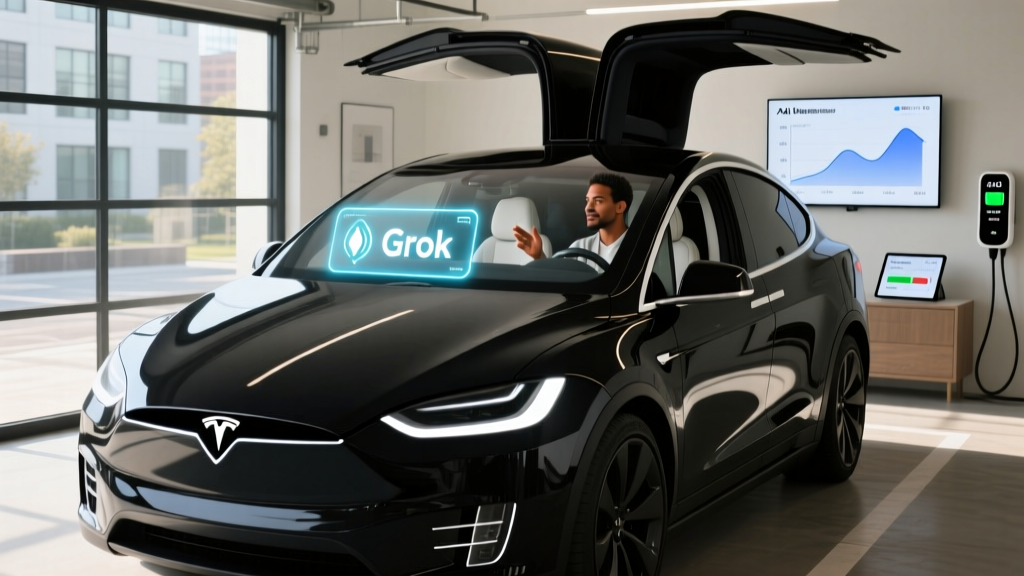
If you have driven a Tesla built after mid-2025, you have likely noticed a new voice on the other end of the microphone. Grok, the large-language-model assistant built by xAI, is now deeply integrated into Tesla's infotainment stack across the refreshed Model 3 Highland and the current Model Y Juniper. It is not a new battery, a new motor, or a new chassis — but it is the most significant software addition Tesla has shipped since the v11 UI overhaul, and it changes how owners interact with navigation, climate, trip planning, and even vehicle diagnostics.
This review evaluates what Grok in Tesla actually does behind the wheel, while delivering the full hardware profile buyers need: EPA range, real-world efficiency, charging speeds, pricing, and federal tax credit eligibility for the 2026 model year.
Real-World Range Reality Check
EPA estimate: 320 miles (Model Y Long Range AWD, 19" wheels)
Expect in practice: ~275–290 miles at sustained 70 mph highway speeds in mild weather; ~240–260 miles in sub-30°F winter conditions with cabin heat. City/regenerative driving can push above 310 miles. These figures align with independent testing from fueleconomy.gov and real-world loop data from owner communities.
What Grok Actually Does in Your Tesla
Grok replaces and extends the legacy Tesla voice-command system. Instead of parsing rigid phrases like "Navigate to 123 Main Street," Grok processes natural, conversational requests. Ask it to "find a Supercharger near a good coffee shop along my route" and it will cross-reference Tesla's charger database with business listings, present two or three options with detour times, and pre-condition the battery for your selected stop.
The integration goes deeper than trip planning. Grok can:
- Explain vehicle alerts: "Why is my charge rate slower today?" — Grok will check battery temperature, state of charge, and recent Supercharger session logs, then give a plain-English answer.
- Adjust climate and comfort: Natural-language requests like "I'm cold but my passenger is fine" adjust the driver-side temperature without touching the passenger zone.
- Summarize trip data: Post-drive, ask for an efficiency breakdown and Grok will narrate your kWh/mi consumption, regen usage, and how your driving compared to the fleet average.
- Troubleshoot issues: Tire pressure warnings, 12V battery alerts, and scheduled maintenance prompts can be queried conversationally.
Importantly, Grok runs as a cloud-assisted model. Complex queries require connectivity — in areas with poor cellular coverage, the system falls back to Tesla's legacy on-device voice parser, which is functional but far less capable. This is a real limitation on rural road trips.
Autonomy Clarification
Grok is a voice assistant, not a driving system. Tesla's Autopilot and Full Self-Driving (Supervised) remain SAE Level 2 driver-assistance features. The driver must remain fully engaged, hands on or near the wheel, and eyes on the road at all times. Grok does not steer, brake, or make driving decisions.
Full Vehicle Specs: 2026 Tesla Model Y Long Range AWD
Since Grok is most widely deployed in the Model Y — Tesla's global best-seller — here is the complete spec profile for the 2026 Long Range AWD variant, the volume trim.
| Specification | 2026 Model Y Long Range AWD |
|---|---|
| EPA Range | 320 miles (19" wheels); 295 miles (20" wheels) |
| Battery Capacity | ~78 kWh usable, NMC (nickel manganese cobalt) |
| Drivetrain | Dual-motor AWD |
| Horsepower | 384 hp combined |
| 0–60 mph | 4.8 seconds |
| Efficiency | 122 MPGe combined / 28 kWh/100 mi |
| Max DC Fast Charge | 250 kW peak (V3 Supercharger) |
| 10–80% DC Charge Time | ~27 minutes (at V3 station, preconditioned) |
| Level 2 Home Charge Rate | 11.5 kW (44 mi/hr on Wall Connector) |
| Cargo Volume | 30.2 cu ft (rear seats up); 72.0 cu ft (folded) |
| Rear Legroom | 38.8 inches |
| Towing Capacity | 3,500 lbs (with tow package) |
| Battery/Drive Unit Warranty | 8 years / 120,000 miles (whichever comes first) |
| Basic Vehicle Warranty | 4 years / 50,000 miles |
Charging Speed Deep Dive: What Grok Adds to the Equation
Tesla's charging hardware has not changed for 2026 — the Model Y still peaks at 250 kW on V3 Superchargers and charges at 11.5 kW on a 48-amp Level 2 home circuit. What Grok changes is how you plan and optimize charging.
| Charging Level | Power (kW) | Miles Added per Hour | Typical Use Case |
|---|---|---|---|
| Level 1 (120V outlet) | ~1.4 kW | ~4–5 mi/hr | Emergency/trickle top-off |
| Level 2 (240V, 48A Wall Connector) | 11.5 kW | ~44 mi/hr | Daily home charging (~7 hr for full) |
| DC Fast (V3 Supercharger) | 250 kW peak | ~162 mi in 15 min | Road trips, 10–80% in ~27 min |
| DC Fast (V4 Supercharger) | Up to 325 kW (supported vehicles) | Model Y capped at 250 kW by vehicle hardware | Future-proofing; current Model Y does not exceed 250 kW |
Charging-curve reality: The 250 kW peak only holds between roughly 10% and 35% state of charge. By 60% SoC, power tapers to ~150 kW; above 80%, it drops further to ~50–70 kW. This is why Tesla's navigation system (now enhanced by Grok) pre-conditions the battery before you arrive — cold batteries charge slower, and preconditioning can shave 5–8 minutes off a 10–80% session.
With Grok, you can ask "How long until I'm at 80%?" mid-session and receive a real-time estimate that factors in current taper, ambient temperature, and battery thermal state — far more useful than the static estimate on the charge screen.
Pricing, Trims, and Federal Tax Credit Eligibility
The 2026 Tesla Model Y lineup is streamlined. Here is what you will pay before and after incentives:
| Trim | Base MSRP | Est. After §30D Credit* | Key Difference |
|---|---|---|---|
| Long Range RWD | $44,990 | ~$37,490 | Rear-wheel drive, ~335 mi EPA range |
| Long Range AWD | $47,990 | ~$40,490 | Dual motor, 320 mi EPA, better traction |
| Performance AWD | $52,490 | ~$44,990 | 3.5s 0–60, track mode, 285 mi EPA |
*Federal tax credit amounts shown assume full eligibility under IRS §30D. Actual credit depends on multiple requirements — see checklist below. Point-of-sale transfer is available, reducing your purchase price at the dealer or on Tesla's checkout page.
- MSRP cap: SUVs/crossovers must be at or below $80,000 — all Model Y trims qualify.
- Buyer income cap (modified AGI): $150,000 single filer / $225,000 head of household / $300,000 joint filers.
- Battery sourcing: A percentage of critical minerals and battery components must be sourced from the U.S. or FTA-partner countries. Tesla's U.S.-built Model Y has historically met these thresholds, but the IRS approved-vehicles list should be verified at purchase time, as sourcing rules tighten annually.
- Point-of-sale transfer: You can elect to transfer the credit to Tesla at purchase, reducing your out-of-pocket cost immediately rather than waiting to claim it on your tax return.
- Consult a tax professional to confirm your personal eligibility — this is not tax advice.
Grok vs. the Competition: How Does It Stack Up?
Competitors have their own voice-AI strategies, and the gap is narrowing:
- Hyundai/Kia (Google Assistant integration): Natural-language navigation and climate control, powered by Google's cloud AI. Strong at general queries but lacks deep vehicle-diagnostic integration.
- BMW/Mercedes (native LLM assistants): Both brands have deployed conversational assistants in 2025–2026 models. BMW's iDrive assistant handles vehicle settings well; Mercedes MBUX is strong on comfort and navigation but less capable on trip-energy optimization.
- Ford (Sync with Amazon Alexa): Functional for smart-home and basic commands but significantly behind on contextual, vehicle-aware responses.
Tesla's advantage with Grok is vertical integration. Because Grok has access to the vehicle's full telemetry — battery health, thermal state, driving patterns, Supercharger history — it can answer questions no third-party assistant can. "Is my battery degrading faster than normal?" is a question only Tesla's own system can address with real data.
The trade-off: Tesla's ecosystem is closed. You cannot use Grok outside the car (yet — xAI offers a standalone Grok app, but it is not linked to your vehicle data), and Tesla does not support Apple CarPlay or Android Auto, which some buyers consider a dealbreaker.
Pros and Cons: The Honest Take
Pros
- Best-in-class Supercharger network with 6,500+ U.S. stations — now open to other brands but still seamless for Tesla owners
- Grok adds genuinely useful trip-planning and diagnostic voice interaction
- Class-leading efficiency at 28 kWh/100 mi
- Strong 250 kW DC fast-charging with reliable preconditioning
- Over-the-air updates continuously improve the vehicle post-purchase
- Spacious cargo area (72 cu ft folded) suits families and road trippers
- 8-year/120,000-mile battery warranty exceeds the industry norm of 8/100,000
Cons
- Grok requires cellular connectivity — rural dead zones degrade the experience
- No Apple CarPlay or Android Auto support
- 250 kW peak charge rate is being surpassed by Hyundai Ioniq 5 (350 kW) and Porsche Macan EV (270 kW sustained)
- Ride quality on 20" wheels is firm; road noise is noticeable at highway speed
- FSD (Supervised) remains a $8,000 upsell and is still Level 2 — not autonomous
- Insurance costs run 15–25% higher than comparable gas crossovers in most states
Who Should Buy This — And Who Should Look Elsewhere?
Choose the 2026 Model Y with Grok if:
- You want a daily-driver EV with excellent range, fast charging, and a voice assistant that understands your car's actual data
- You road-trip frequently and value the Supercharger network's reliability
- You are a tech-forward buyer who will actually use conversational AI features daily
- You need a family crossover with 3,500-lb towing and 72 cu ft of cargo space
Look at competitors if:
- CarPlay/Android Auto is non-negotiable (consider Hyundai Ioniq 5 or Kia EV6)
- You want faster peak charging speeds for frequent long-distance travel (Ioniq 5 at 350 kW)
- You prefer a traditional dealership experience with in-person service (Ford Mustang Mach-E, Chevrolet Equinox EV)
- You live in a rural area with poor cell coverage — Grok's cloud dependency becomes a liability
Frequently Asked Questions
What is the real-world range of the 2026 Tesla Model Y?
The EPA rates the Long Range AWD at 320 miles. In real-world highway driving at 70 mph in mild temperatures, expect 275–290 miles. In cold weather (below 30°F), range drops to roughly 240–260 miles due to battery resistance and cabin heating demands. City driving with regenerative braking can yield 300+ miles.
How fast does the Model Y charge at home and on the road?
On a Level 2 home charger (Tesla Wall Connector at 48 amps / 11.5 kW), you add about 44 miles per hour — a full overnight charge from near-empty takes roughly 7 hours. On a V3 Supercharger, peak rate is 250 kW, achieving 10–80% in approximately 27 minutes with a preconditioned battery. Expect slower rates at non-preconditioned stops or in extreme cold.
How much does the 2026 Model Y cost after tax credits?
The Long Range AWD starts at $47,990 MSRP. If you qualify for the full $7,500 federal §30D credit (income caps, MSRP caps, and battery-sourcing rules apply), your effective price is approximately $40,490. Point-of-sale transfer lets you apply this at purchase. Check the IRS approved vehicle list before ordering.
Is Grok in Tesla worth it vs. competing EVs?
If you value a voice assistant that can access deep vehicle data — battery health, charging optimization, trip efficiency analysis — Grok is currently unmatched in the EV market. However, it is a software feature, not a hardware advantage. The underlying Model Y competes on range, efficiency, and charging infrastructure. If voice AI is not a priority, the Model Y still stands on its specs; if it is, no competitor currently matches the integration depth.
Does the 2026 Model Y qualify for the federal EV tax credit?
As of early 2026, the U.S.-built Model Y appears on the IRS qualified vehicles list and meets the MSRP cap ($80,000 for SUVs). Eligibility for the full $7,500 credit also depends on your modified adjusted gross income (≤$150K single / ≤$300K joint) and the battery's critical-mineral and component sourcing percentages, which tighten each year. Verify current eligibility on irs.gov and with a tax professional before purchase.
What are the biggest drawbacks of Grok in Tesla?
Cloud dependency is the primary limitation — without strong cellular service, Grok reverts to basic voice commands. Privacy-conscious buyers should also review Tesla's data-sharing policies, as Grok processes voice queries through xAI's servers. Finally, Grok does not replace CarPlay/Android Auto for media and messaging; Tesla's native app ecosystem is more limited than phone-mirroring platforms.
Sources: fueleconomy.gov (EPA range and MPGe data), IRS §30D qualified vehicles, Tesla manufacturer specifications. All pricing and specs reflect 2026 model year at time of publication. Tax credit rules are subject to change — verify before purchase.