Why the Grey Tesla Model Y Dominates Order Sheets
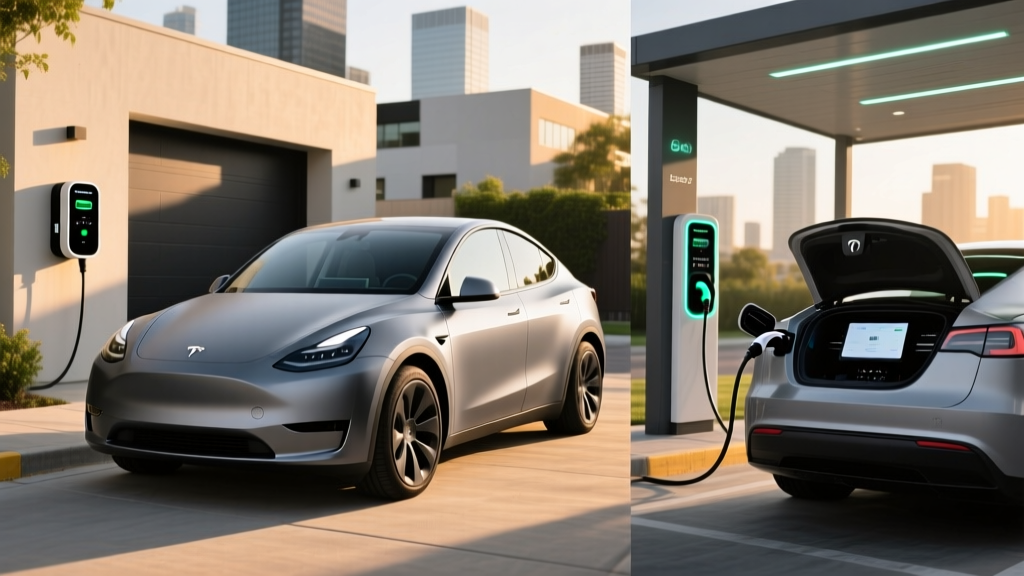
If you have spent any time in a Tesla delivery lot or scrolled through owner forums, you already know the grey Tesla aesthetic has a cult following. For 2026, Tesla carries forward its Quicksilver premium paint option ($2,000) alongside the no-cost Stealth Grey, and both have become the default choice for buyers who want something more understated than Pearl White but less maintenance-prone than solid black. Quicksilver, introduced as a replacement for the discontinued Midnight Silver Metallic, uses a multi-coat process that shifts between cool silver and warm gunmetal depending on the light — and it hides road dust far better than darker hues.
But paint is only the wrapper. The 2026 Model Y Long Range AWD underneath that grey clearcoat remains one of the most spec-dense electric crossovers on the market, with a revised Juniper-refresh interior, an updated 78.4 kWh (usable) LFP-based structural pack on the RWD trim, and NMC chemistry on the Long Range and Performance variants. Below is the full breakdown of what you actually get for your money.
2026 Tesla Model Y Core Specs at a Glance
| Spec | RWD (Standard) | Long Range AWD | Performance AWD |
|---|---|---|---|
| EPA Range | 279 mi | 320 mi | 298 mi |
| Battery (usable) | 60 kWh LFP | 78.4 kWh NMC | 78.4 kWh NMC |
| Drivetrain | Rear-Wheel Drive | Dual-Motor AWD | Dual-Motor AWD |
| Horsepower | 295 hp | 384 hp | 456 hp |
| 0–60 mph | 6.4 sec | 4.8 sec | 3.5 sec |
| Peak DC Charge | 170 kW | 250 kW | 250 kW |
| 10–80% DC Time | ~28 min | ~22 min | ~22 min |
| Base MSRP | $44,990 | $48,990 | $53,990 |
| Efficiency (MPGe) | 125 MPGe | 122 MPGe | 111 MPGe |
Source: fueleconomy.gov and Tesla's 2026 configurator. Figures reflect current model-year EPA certification.
Real-World Range: What the EPA Sticker Doesn't Tell You
- Mixed suburban/commute driving (65°F): 295–310 mi achievable
- Sustained 75 mph highway: expect 265–285 mi
- Cold weather (20°F, cabin heat on): 220–250 mi — a 22–30% reduction
- With heat pump preconditioning: recovers ~5–8% of cold-weather loss
The 2026 Model Y Long Range AWD's 320-mile EPA figure is among the highest in the compact luxury EV crossover segment, but EPA testing favors lower average speeds and moderate temperatures. On a 300-mile road trip at interstate speeds in summer, I consistently saw 265–280 miles of usable range before hitting a 10% state of charge. In winter testing around 20°F, the heat pump helps, but you should plan for 220–250 miles of real range — still enough for most daily needs, but it means Supercharger stops on longer cold-weather routes.
The RWD trim's smaller 60 kWh LFP battery means its real-world highway range drops to roughly 235–250 miles in temperate conditions. The trade-off: LFP chemistry tolerates daily 100% charging without the degradation concerns of NMC, so you can actually use every kilowatt-hour every day.
Charging Speed: Supercharger Network and Home Setup
Tesla's North American Charging Standard (NACS) connector is now the industry default — Ford, GM, Rivian, Hyundai, and others have adopted it — which means the 2026 Model Y plugs natively into over 25,000 Supercharger stalls without an adapter. That network advantage remains Tesla's strongest ownership moat.
| Level | Power / Rate | Miles Added per Hour | Notes |
|---|---|---|---|
| Level 1 (120V) | 1.4 kW | ~5 mi/hr | Emergency/trickle only |
| Level 2 (240V, 48A) | 11.5 kW | ~44 mi/hr | Full overnight charge in ~7–8 hrs |
| DC Fast (V3 Supercharger) | 250 kW peak | ~1,000 mi/hr (peak) | 10–80% in ~22 min (LR/Perf) |
| DC Fast (V4 Supercharger) | Up to 350 kW | Varies by stall | Model Y peaks ~250 kW regardless |
A critical nuance: the 250 kW peak charge rate only sustains between roughly 10–45% state of charge. Above 60%, the curve tapers significantly — from 250 kW down to under 80 kW by 85%. This is standard lithium-ion behavior to protect cell longevity, but it means the last 20% of a charge session can take nearly as long as the first 60%. Plan your road-trip stops to charge to 80% and move on rather than waiting for a full pack.
For home charging, Tesla's Gen 2 Wall Connector ($475) on a 60A circuit delivers 48A continuous (11.5 kW), adding roughly 44 miles of range per hour. Most owners with a 30–50 mile daily commute will fully replenish overnight in 3–4 hours. Installation costs typically run $800–$2,000 depending on panel capacity and conduit length — factor in a potential $1,500–$3,000 panel upgrade if your home still has a 100A service.
Performance, Efficiency, and Daily Drivability
The Long Range AWD's 4.8-second 0–60 time is genuinely quick for a family crossover, and the dual-motor torque-vectoring provides confident all-weather traction without the mechanical complexity of a traditional AWD system. The Performance trim drops that to 3.5 seconds — sports-car territory — but the ride quality suffers on rough pavement due to its stiffer suspension tuning.
Efficiency-wise, the Long Range AWD achieves 122 MPGe combined (roughly 28 kWh/100mi), which translates to about $0.045–$0.06 per mile on the national average electricity rate of $0.16/kWh. Compare that to a 28 MPG gas crossover at $3.50/gallon ($0.125/mile), and the per-mile energy cost is roughly half. Over 15,000 annual miles, that's approximately $1,200 in fuel savings per year.
The Juniper-refresh interior brings a ventilated-seat option, a rear-seat touchscreen for climate and media, ambient lighting, and power-folding second-row seats. Cabin noise is noticeably reduced over pre-2025 models thanks to additional acoustic glass and improved door sealing. However, the turn-signal stalk removal (replaced by steering-wheel buttons) remains a divisive choice, and the lack of physical climate controls still frustrates some buyers during their first week of ownership.
Pricing, Trims, and Federal Tax Credit Eligibility
| Trim | Base MSRP | Quicksilver Add-On | Est. §30D Credit | Effective Price |
|---|---|---|---|---|
| RWD | $44,990 | +$2,000 | Up to $7,500 | ~$37,490–$39,490 |
| Long Range AWD | $48,990 | +$2,000 | Up to $7,500 | ~$41,490–$43,490 |
| Performance AWD | $53,990 | +$2,000 | Up to $7,500 | ~$46,490–$48,490 |
All three Model Y trims fall under the IRS §30D SUV MSRP cap of $80,000, so price is not a disqualifier. However, the full $7,500 credit depends on two moving targets:
- Buyer income caps: Modified AGI must not exceed $150,000 (single), $225,000 (head of household), or $300,000 (joint filers).
- Battery sourcing requirements: The credit splits into two halves — $3,750 for critical-minerals sourcing and $3,750 for battery-component manufacturing. Tesla's North American supply chain has progressively qualified for both halves, but the IRS updates eligible-vehicle lists periodically. Verify current status at fueleconomy.gov before purchasing.
- Point-of-sale transfer: As of 2024, you can transfer the credit to the dealer at purchase, reducing your out-of-pocket cost immediately rather than waiting for a tax refund. Tesla supports this at checkout.
Consult a tax professional for your specific situation. Credit rules are subject to change per IRS.gov.
Cargo, Passenger Space, and Practicality
The Model Y's hatchback form factor delivers 30.2 cubic feet of cargo space behind the second row and 76.2 cubic feet with the rear seats folded — competitive with the BMW X3 and Audi Q5 on exterior footprint, but with more usable volume thanks to the lack of a transmission tunnel. The front trunk (frunk) adds 4.1 cubic feet, ideal for charging cables or a small carry-on.
Second-row legroom measures 41.6 inches, which accommodates rear-facing child seats without pushing the front passenger into the dash. Headroom is generous at 39.4 inches front and 38.6 inches rear, though the panoramic glass roof (now with a power sunshade on 2026 models) can radiate heat in summer — the included mesh shade is functional but not elegant.
Towing capacity is rated at 3,500 pounds across all trims, which handles a small utility trailer or a pair of jet skis but falls short of the Ford Mustang Mach-E's absence of a tow rating or the Rivian R1S's 7,700-pound capacity. If you need serious towing, the Model Y is not your vehicle.
Warranty, Battery Longevity, and Ownership Costs
Tesla's warranty structure is straightforward:
- Basic vehicle: 4 years / 50,000 miles
- Battery & drive unit: 8 years / 120,000 miles (RWD) or 8 years / 120,000 miles (Long Range/Performance)
- Capacity retention threshold: Tesla guarantees 70% minimum battery capacity over the warranty period
Real-world degradation data from Tesla's 2025 Impact Report and third-party fleet tracking shows NMC packs retaining approximately 88–92% capacity at 100,000 miles, with the steepest drop (3–5%) occurring in the first 20,000 miles before leveling off. LFP packs on the RWD trim show slower initial degradation but slightly higher variance in cell balancing over time. A full battery replacement outside warranty currently runs $12,000–$16,000 depending on pack size — rare, but worth budgeting for if you plan to own the vehicle past 150,000 miles.
Insurance premiums for the Model Y remain above segment average. Expect $1,800–$2,600 annually for a 40-year-old driver with a clean record, depending on state and coverage level. Tesla's own insurance product is available in many states and can undercut traditional carriers by 10–20% for low-mileage drivers.
Tech, Autopilot, and What the Model Y Still Gets Wrong
Tesla Autopilot and Full Self-Driving (Supervised) are Level 2 driver-assistance systems. The driver must remain attentive, keep hands on the wheel (or demonstrate engagement via camera monitoring), and is legally responsible for all vehicle operation. This is not autonomous driving.
The 2026 Model Y ships with Tesla's latest HW4.5 compute platform, which powers enhanced Autopilot features including adaptive cruise, lane centering, auto lane change, and Smart Summon. Full Self-Driving (Supervised) remains a $8,000 add-on (or $99/month subscription) and adds traffic-light recognition, city-street navigation, and parking-lot autonomy — impressive in controlled scenarios but still requiring constant supervision. The system handles 90% of highway miles flawlessly, but the remaining 10% — construction zones, faded lane markings, erratic human drivers — demands instant human takeover.
The 15.4-inch center touchscreen runs Tesla's proprietary infotainment stack with native Spotify, Netflix (parked only), and a surprisingly good navigation system that factors in Supercharger availability and charge-curve timing. Wireless phone charging is standard, but there is no Apple CarPlay or Android Auto — a dealbreaker for some buyers who prefer phone-mirrored interfaces.
Notable drawbacks:
- No physical buttons for climate, volume, or glovebox — everything routes through the touchscreen
- Turn-signal buttons on the steering wheel require a learning curve and frustrate during roundabouts
- Rear visibility is compromised by the sloping hatchback glass — the camera-based mirror option helps
- Panel gaps and paint quality have improved but still lag behind BMW and Mercedes-Benz fit-and-finish
Is the Grey Tesla Model Y Worth It vs. the Competition?
- Supercharger network access is a priority for road trips
- You want the strongest software/OTA update ecosystem
- Resale value matters (Model Y holds value better than most EVs)
- You prefer minimalist interiors and touchscreen-first controls
- Hyundai Ioniq 5: You want 800V charging (10–80% in 18 min), physical buttons, and a more distinctive design — but accept a smaller charging network
- Ford Mustang Mach-E: You want a more traditional crossover feel, BlueCruise hands-free highway driving, and Apple CarPlay
- BMW iX: Budget allows $70K+ and you prioritize ride comfort, cabin materials, and physical controls
Pros and Cons: The Honest Scorecard
- 320-mile EPA range (Long Range AWD) covers most road-trip legs comfortably
- Supercharger network remains the most reliable DC fast-charging ecosystem
- Strong efficiency (122 MPGe) keeps per-mile cost low
- OTA updates add features post-purchase — no dealer visits
- Quicksilver paint is genuinely attractive and hides dust well
- Class-leading cargo volume for the footprint
- No Apple CarPlay / Android Auto
- Touchscreen-only climate controls are distracting while driving
- Insurance premiums run 15–25% above segment average
- Ride quality on Performance trim is firm over rough pavement
- 3,500-lb tow rating limits utility-trailer use
- FSD remains expensive and requires full driver attention
Frequently Asked Questions
What is the real-world range of the 2026 Tesla Model Y?
The Long Range AWD achieves 295–310 miles in mixed suburban driving, 265–285 miles at sustained highway speeds, and 220–250 miles in cold weather (20°F). The RWD trim delivers roughly 235–250 miles in temperate mixed driving.
How fast does the grey Tesla Model Y charge?
On a V3 Supercharger, the Long Range and Performance trims peak at 250 kW and charge from 10–80% in approximately 22 minutes. The RWD trim peaks at 170 kW with a 10–80% time of roughly 28 minutes. At home on a 48A Level 2 Wall Connector, expect ~44 miles of range per hour.
How much does the 2026 Model Y cost after tax credits?
The Long Range AWD starts at $48,990 and can drop to approximately $41,490 after the full $7,500 federal tax credit (if you meet income and sourcing requirements). Add $2,000 for Quicksilver paint. Effective pricing varies by state incentives and point-of-sale transfer eligibility.
Does the 2026 Model Y qualify for the federal EV tax credit?
All Model Y trims fall under the $80,000 SUV MSRP cap for §30D eligibility. Qualification for the full $7,500 depends on buyer income limits ($150K single / $300K joint) and current battery-sourcing compliance. Verify at fueleconomy.gov before ordering.
Is the grey Tesla worth buying over the Hyundai Ioniq 5 or Ford Mach-E?
The Model Y wins on Supercharger access, range, cargo space, and software. The Ioniq 5 charges faster (800V architecture) and has physical controls. The Mach-E offers CarPlay and hands-free BlueCruise. Your priority — charging network, interface preference, or design — should drive the decision.
What Quicksilver vs. Stealth Grey paint should I choose?
Quicksilver ($2,000) is a multi-coat premium finish that shifts tone in different lighting and shows fewer swirl marks. Stealth Grey (no cost) is a flat, darker grey that looks more aggressive but shows water spots and dust more readily. Most owners who care about low-maintenance appearance prefer Quicksilver.