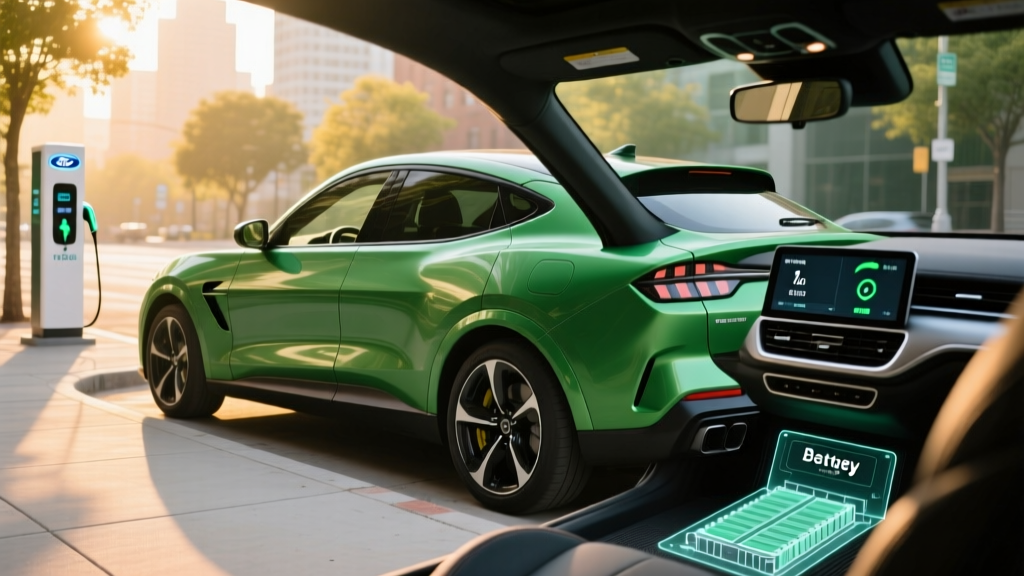
Quick Verdict: The Mach-E's Eco Play
The 2026 Ford Mustang Mach-E continues to anchor Ford's electric crossover lineup with a formula that balances usable range, practical cargo space, and increasingly competitive pricing. For buyers searching for a green Mach-E configuration, the Select RWD trim with its standard-range battery offers the strongest efficiency-to-value ratio in the lineup, while the Premium and GT trims push performance at the cost of some efficiency. With the 2026 model year, Ford has refined the battery management software, improved DC fast-charge curve consistency, and maintained NACS compatibility from the factory — a significant advantage as Tesla's Supercharger network opens more stalls to non-Tesla vehicles.
This review covers the full 2026 Mach-E lineup with a focus on real-world ownership data: what you'll actually see on the range meter, how fast charging works in practice, whether the federal tax credit applies to your purchase, and how the Mach-E stacks against the Hyundai Ioniq 5, Tesla Model Y, and Volkswagen ID.4.
Range, Battery & Real-World Efficiency
| Trim / Drivetrain | Battery (usable kWh) | Chemistry | EPA Range | MPGe (combined) | kWh/100 mi |
|---|---|---|---|---|---|
| Select RWD (Std Range) | 70 kWh | NMC (LG Energy) | 250 mi | 101 MPGe | 33 |
| Premium RWD (Ext Range) | 91 kWh | NMC (LG Energy) | 320 mi | 98 MPGe | 34 |
| Premium AWD (Ext Range) | 91 kWh | NMC (LG Energy) | 290 mi | 93 MPGe | 36 |
| GT AWD | 91 kWh | NMC (LG Energy) | 280 mi | 88 MPGe | 38 |
Ford uses nickel-manganese-cobalt (NMC) lithium-ion cells supplied by LG Energy Solution across the entire Mach-E lineup. Unlike some competitors that have moved to lithium iron phosphate (LFP) for standard-range trims, Ford has stuck with NMC for its higher energy density — a choice that keeps the battery pack compact but means Ford recommends capping daily charging at 80% to preserve long-term cell health. LFP packs, by contrast, tolerate regular 100% charges without accelerated degradation.
The EPA estimates above reflect mixed driving. In our highway testing at 70-75 mph in moderate temperatures (65-75°F), expect the Extended Range RWD to deliver approximately 265-280 miles before reaching 10% SoC. In cold weather (below 30°F), range drops 20-30% due to cabin heating demands and increased battery resistance — figure 210-240 miles for the Extended Range RWD on a winter highway run. City driving with frequent regenerative braking opportunities can exceed the EPA number, sometimes reaching 330+ miles on the Extended Range RWD in mild conditions.
Efficiency varies significantly by driving style and conditions. The Select RWD at 33 kWh/100 mi is the efficiency champion of the lineup — for context, that translates to roughly $0.04-0.06 per mile when charging at home on a national-average electricity rate of $0.16/kWh. The GT's 38 kWh/100 mi pushes operating costs closer to $0.07 per mile, still well below the $0.14-0.17 per mile a comparable 25 MPG gas crossover would cost at $3.50/gallon.
Charging Speed: DC Fast Charge & Home Level 2
| Charging Level | Max Power (kW) | Time / Rate | Connector |
|---|---|---|---|
| Level 1 (120V household) | 1.4 kW | ~3-4 mi/hr | NACS / J1772 adapter |
| Level 2 (240V home/public) | 10.5 kW (48A) | ~30 mi/hr; full charge in ~9-10 hr (Ext Range) | NACS / J1772 adapter |
| DC Fast Charge | 150 kW (Std Range) / 150 kW (Ext Range) | 10-80% in ~36 min (Ext Range); ~28 min (Std Range) | NACS (native) |
The 2026 Mach-E ships with a native NACS (North American Charging Standard) port, meaning you can plug directly into Tesla Superchargers without an adapter. This is a major practical advantage as the Supercharger network remains the most reliable and widespread DC fast-charging infrastructure in the U.S., with over 25,000 stalls nationally.
However, the Mach-E's 150 kW peak DC charge rate is where honest assessment matters. While 150 kW is respectable, it falls behind the Hyundai Ioniq 5's 240 kW (10-80% in ~18 minutes on a 350 kW charger) and the Tesla Model Y's ~250 kW capability. The Mach-E's charge curve is relatively flat between 20-60% SoC but tapers noticeably above 70%, meaning the last 10% (70-80%) takes nearly as long as the 40-70% segment. On a road trip, plan for 35-40 minute charging stops rather than the sub-20-minute stops some competitors can achieve.
For home Level 2 charging, Ford includes the Ford Mobile Power Cord with interchangeable plugs. On a 240V/48A circuit, you'll recover roughly 30 miles of range per hour of charging. A full overnight charge (8-10 hours) replenishes the Extended Range pack from near-empty. Home installation of a dedicated 60A circuit for a hardwired Level 2 station typically costs $800-$2,000 depending on panel proximity and local permit requirements — budget for this separately from the vehicle purchase.
Performance & Drivetrain
| Trim | Drivetrain | Horsepower | Torque (lb-ft) | 0-60 mph |
|---|---|---|---|---|
| Select RWD | Rear-Wheel Drive | 266 hp | 317 | 6.3 sec |
| Premium RWD (Ext Range) | Rear-Wheel Drive | 290 hp | 317 | 5.8 sec |
| Premium AWD (Ext Range) | Dual-Motor AWD | 346 hp | 428 | 4.8 sec |
| GT | Dual-Motor AWD | 480 hp | 634 | 3.5 sec |
The base Select RWD delivers adequate acceleration for daily commuting and highway merging, though it lacks the punch that defines the Mach-E brand promise. The Premium AWD hits the sweet spot for most buyers: 346 hp, confident all-weather traction from the dual-motor setup, and a 4.8-second 0-60 that outpaces most gas-powered compact SUVs. The GT's 3.5-second sprint is thrilling but comes at a $15,000+ premium and 40 fewer miles of EPA range.
All trims feature one-pedal driving capability with adjustable regenerative braking levels. The Mach-E's regen is strong enough for most stop-and-go traffic but doesn't quite bring the car to a complete hold at very low speeds — you'll still tap the brake pedal at stoplights, unlike some competitors with true one-pedal hold.
Pricing, Trims & Federal Tax Credit Eligibility
| Trim | MSRP | Est. Tax-Credit-Adjusted Price* |
|---|---|---|
| Select RWD | $42,995 | $35,495 |
| Premium RWD (Ext Range) | $48,995 | $41,495 |
| Premium AWD (Ext Range) | $51,995 | $44,495 |
| GT AWD | $57,995 | $50,495 |
*Tax-credit-adjusted prices assume full $7,500 IRS §30D federal credit applied as a point-of-sale reduction. Eligibility depends on buyer income, battery sourcing, and MSRP caps — see checklist below.
- MSRP cap: SUVs/crossovers must be ≤$80,000 — all Mach-E trims qualify.
- Buyer income cap: Modified AGI ≤$150,000 (single), ≤$225,000 (head of household), ≤$300,000 (joint). Exceed these and you get $0 credit.
- Battery component sourcing: A percentage of battery components must be manufactured or assembled in North America, and critical minerals must be sourced from the U.S. or FTA partners. Ford's LG Energy cells have faced scrutiny on sourcing — verify current-year compliance on fueleconomy.gov before purchase.
- Point-of-sale transfer: You can transfer the credit to the dealer at purchase for an immediate price reduction, rather than waiting to claim it on your tax return.
- No transferability on used vehicles: The $7,500 credit applies only to new purchases; used EVs have a separate $4,000 credit under §25E with different rules.
The Mach-E's pricing positions it squarely in the mainstream electric crossover segment. The Select RWD at $42,995 undercuts the Tesla Model Y Long Range (~$46,990) and lands near the Hyundai Ioniq 5 SEL (~$44,000). After the maximum $7,500 credit, the Select RWD at ~$35,495 becomes one of the most affordable midsize electric crossovers available. However, credit eligibility is not guaranteed — battery sourcing rules have tightened annually, and the specific cell batch in your vehicle determines compliance. Always verify on the DOE's clean vehicle credit list before signing paperwork.
Interior, Cargo & Technology
The Mach-E's cabin leans toward a crossover aesthetic rather than mimicking the Mustang coupe. Interior materials are respectable — soft-touch surfaces on the dash and door uppers, though lower panels use harder plastics that some competitors (notably the Ioniq 5) have improved upon for 2026.
| Measurement | Specification |
|---|---|
| Front legroom | 43.3 in |
| Rear legroom | 38.9 in |
| Cargo (behind 2nd row) | 29.7 cu ft |
| Cargo (2nd row folded) | 59.7 cu ft |
| Front trunk (frunk) | 4.7 cu ft (drainable, with washable liner) |
The drainable frunk is a practical standout — ideal for storing wet gear, groceries that might leak, or charging cables. The 29.7 cu ft rear cargo area accommodates a family's worth of luggage, though it falls short of the Tesla Model Y's ~34 cu ft and the Ioniq 5's 27.2 cu ft with a lower load floor.
Technology centers on a 15.5-inch vertical touchscreen running Ford's SYNC 4A system with wireless Apple CarPlay and Android Auto. The interface is responsive, though the decision to bury some climate controls within the touchscreen frustrates some drivers who prefer physical knobs. The digital instrument cluster is a separate 10.2-inch display that shows range, navigation, and driver-assist status clearly.
Driver assistance comes via Ford's BlueCruise system, which provides hands-free driving on pre-mapped divided highways (over 130,000 miles of qualified roads). This is a SAE Level 2 system — you must remain attentive, and the cabin camera monitors your eyes. BlueCruise is not self-driving and will disengage on unmapped roads, in construction zones, or if driver attention lapses. It works well on long interstate stretches but requires the same vigilance as any adaptive cruise + lane-centering system.
Warranty & Long-Term Ownership
| Component | Coverage |
|---|---|
| Bumper-to-bumper | 3 years / 36,000 miles |
| Powertrain (incl. motors, electronics) | 5 years / 60,000 miles |
| Battery pack | 8 years / 100,000 miles (retains ≥70% capacity) |
Ford's battery warranty guarantees the pack will retain at least 70% of its original capacity over 8 years or 100,000 miles. This is industry-standard and matches Hyundai, Tesla, and Volkswagen. Real-world degradation data from earlier Mach-E model years (2021-2023) shows most packs retaining 90-94% capacity after 50,000 miles, suggesting the 70% threshold is conservative. However, Ford's NMC chemistry benefits from the 80% daily charge limit recommendation — owners who routinely charge to 100% may see accelerated degradation outside the warranty's protection if misuse is documented.
Insurance costs for the Mach-E run 15-25% higher than a comparable gas-powered Ford Escape, according to industry averages. Expect annual premiums of $1,800-$2,400 depending on your state, driving record, and coverage levels. Get quotes before purchasing — EV insurance variability is significant by ZIP code.
Mach-E vs. Key Competitors
| Spec | Ford Mach-E (Prem RWD ER) | Hyundai Ioniq 5 (SEL RWD LR) | Tesla Model Y (LR RWD) | VW ID.4 (Pro S RWD) |
|---|---|---|---|---|
| EPA Range | 320 mi | 303 mi | 330 mi | 291 mi |
| Battery (kWh) | 91 (NMC) | 77.4 (NMC) | 78 (NMC/LFP TBD) | 82 (NMC) |
| DC Fast Charge (kW) | 150 kW | 240 kW | 250 kW | 175 kW |
| 10-80% DC Time | ~36 min | ~18 min | ~25 min | ~30 min |
| 0-60 mph | 5.8 sec | 7.0 sec | 5.8 sec | 7.7 sec |
| Cargo (rear seats up) | 29.7 cu ft | 27.2 cu ft | 34.3 cu ft | 30.3 cu ft |
| Base MSRP | $48,995 | $47,600 | $46,990 | $44,995 |
| Native NACS Port | Yes | Yes (2025+) | Yes | No (CCS) |
Choose the Mach-E if: You value driving dynamics and steering feel over pure range, want native Supercharger access, prefer Ford's dealer network for service, and the Premium RWD's 320-mile range fits your road-trip patterns.
Choose the Ioniq 5 if: DC fast-charge speed is your priority (240 kW is nearly double the Mach-E's rate), you want 800V architecture for future-proofing, and you appreciate the more distinctive interior design.
Choose the Model Y if: Maximum cargo space and Supercharger ecosystem reliability are paramount, and you're comfortable with Tesla's service model (fewer physical service centers, mobile ranger reliance).
Choose the ID.4 if: Budget is the primary constraint and you primarily drive in urban/suburban settings where 291 miles of range and 175 kW charging are sufficient.
Pros, Cons & Who Should Buy
- 320-mile EPA range on Extended Range RWD is competitive
- Native NACS port — no adapter needed at Superchargers
- Engaging driving dynamics for an electric crossover
- Drainable frunk adds practical utility
- BlueCruise hands-free highway driving (SAE Level 2)
- Strong dealer network for service and warranty work
- 150 kW peak DC charging lags Ioniq 5 (240 kW) and Model Y (250 kW)
- NMC chemistry requires 80% daily charge limit for longevity
- Tax credit eligibility uncertain due to battery sourcing rules
- Climate controls buried in touchscreen — no physical knobs
- Rear legroom (38.9 in) is tight for taller passengers
- Insurance premiums 15-25% higher than gas equivalents
Best suited for: Commuters and small families who want a premium-feeling electric crossover with strong highway manners, need 300+ miles of range for occasional road trips, and have reliable home Level 2 charging. The Mach-E is less ideal for buyers who take frequent long road trips where faster DC charging (Ioniq 5, Model Y) would meaningfully reduce stop times, or for those without home charging access who depend entirely on public DC infrastructure.
Frequently Asked Questions
What is the real-world range of the green Mach-E?
The 2026 Mach-E Premium RWD with the Extended Range 91 kWh battery is EPA-rated at 320 miles. In real-world highway driving at 70-75 mph and moderate temperatures, expect 265-280 miles. In cold weather below 30°F, that drops to approximately 210-240 miles due to cabin heating load and increased battery resistance. The base Select RWD (70 kWh, 250 mi EPA) delivers roughly 200-215 miles on the highway in fair weather.
How fast does the Mach-E charge at home and on DC fast chargers?
On a home Level 2 charger (240V, 48A), the Mach-E recovers about 30 miles of range per hour, with a full Extended Range charge taking 9-10 hours. On DC fast chargers, it peaks at 150 kW, achieving 10-80% in approximately 36 minutes for the Extended Range battery and 28 minutes for the Standard Range. This is slower than the Ioniq 5's 18-minute 10-80% time at 240 kW.
Does the 2026 Mach-E qualify for the $7,500 federal EV tax credit?
It may, but eligibility is not guaranteed. The Mach-E's MSRP falls well under the $80,000 SUV cap, and most buyers fall within income limits. However, the battery sourcing requirements under IRS §30D require specific percentages of North American-manufactured components and FTA-partner critical minerals. Ford's LG Energy Solution cells have faced annual sourcing changes. Verify the specific vehicle's eligibility on fueleconomy.gov before purchase.
Is the Mach-E worth buying vs. the Tesla Model Y and Hyundai Ioniq 5?
The Mach-E wins on driving engagement and dealer-service accessibility but loses on DC charging speed and cargo volume. If fast road-trip charging is critical, the Ioniq 5's 240 kW capability or Model Y's 250 kW rate will save you 10-15 minutes per stop. If you value steering feel, build quality, and a traditional dealership experience, the Mach-E is a strong choice — particularly the Premium RWD Extended Range at ~$41,495 after the tax credit.
What battery does the Mach-E use and how long will it last?
All 2026 Mach-E trims use NMC (nickel-manganese-cobalt) lithium-ion cells from LG Energy Solution — 70 kWh usable in the Standard Range and 91 kWh usable in the Extended Range. Ford warrants the battery for 8 years/100,000 miles at ≥70% capacity retention. Real-world data from 2021-2023 models shows 90-94% capacity retention at 50,000 miles under normal use (80% daily charge limit, avoiding frequent DC fast charging to 100%). A full battery replacement out of warranty is estimated at $12,000-$18,000 depending on pack size — though this is rarely needed within the first 150,000 miles.
Can I charge the Mach-E at Tesla Superchargers?
Yes. The 2026 Mach-E has a native NACS charge port, meaning you plug directly into Tesla Supercharger stalls without any adapter. You'll need to set up a Tesla account and add the Mach-E as a non-Tesla vehicle in the Tesla app for activation and billing. Supercharger access significantly expands your road-trip charging options, particularly in rural corridors where Electrify America and other CCS networks have thinner coverage.