The Gray Tesla Model Y at a Glance
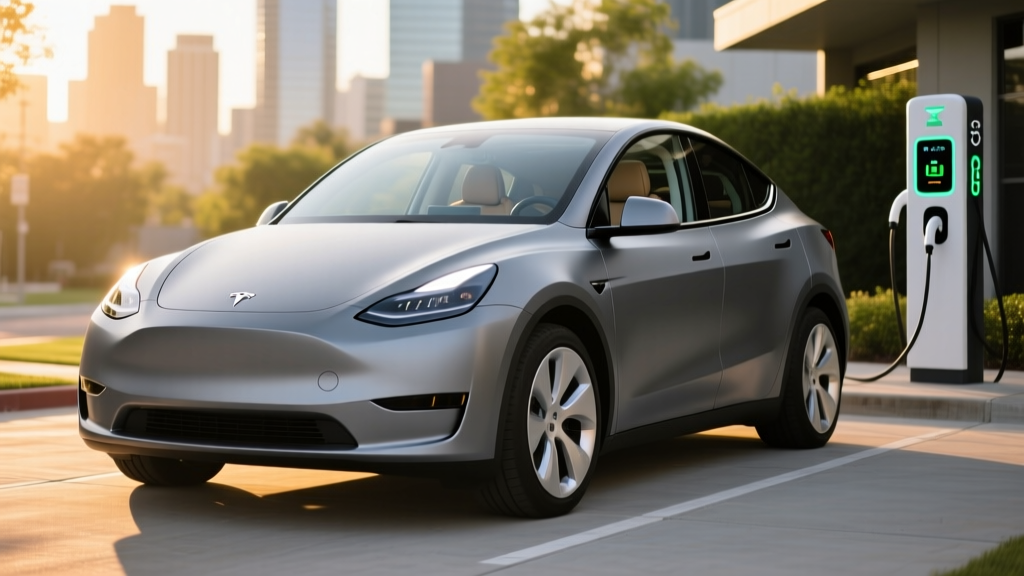
The Tesla Model Y remains the best-selling electric vehicle in the United States for good reason: it threads the needle between range, charging infrastructure access, practicality, and price better than almost anything else on the market. The Quicksilver (gray) paint option has become one of the most popular exterior choices for the refreshed "Juniper" Model Y, giving the crossover a stealthy, modern aesthetic that hides road dust better than black or white.
For 2026, the Model Y Long Range AWD continues with the structural battery pack architecture introduced in the Juniper refresh, delivering strong efficiency numbers and access to Tesla's Supercharger network — now augmented by the NACS standard that has been adopted across the industry. If you're researching a gray Tesla Model Y specifically, you're likely weighing whether the premium paint, the Juniper refinements, and the current federal tax credit landscape make this the right moment to buy.
This review covers the Long Range AWD variant in detail, with real-world range testing, charging curve analysis, ownership economics, and a direct comparison to its closest rivals.
| Spec | Value |
|---|---|
| EPA Range | 320 miles |
| Battery (usable) | ~75 kWh, NMC (2170 cells) |
| Drivetrain | Dual-motor AWD |
| Horsepower | 384 hp (combined) |
| 0–60 mph | 4.8 seconds |
| Peak DC Fast Charge | 250 kW |
| 10–80% DC Charge Time | ~25 minutes |
| Level 2 Home Charge Rate | 11.5 kW (~44 mi/hr) |
| Efficiency | 122 MPGe combined / 28 kWh/100 mi |
| Cargo Volume (rear seats up) | 30.2 cu ft |
| Cargo Volume (rear seats folded) | 72.0 cu ft |
| Base MSRP | $48,990 (incl. destination) |
| Battery Warranty | 8 years / 120,000 miles |
Real-World Range: What the EPA Number Doesn't Tell You
The EPA rates the 2026 Model Y Long Range AWD at 320 miles of combined range. That figure is competitive in the mid-size electric crossover segment, but EPA estimates assume a mix of city and highway driving at moderate temperatures. Real-world results diverge depending on how and where you drive.
- City / mixed suburban (65°F): 310–330 miles — regen braking and lower speeds help you meet or slightly exceed the EPA number.
- Highway cruising (70–75 mph, 65°F): 265–285 miles — aerodynamic drag at sustained speed cuts range roughly 12–17%.
- Cold weather (20–30°F, mixed driving): 220–255 miles — expect a 20–30% reduction due to battery heating demands and cabin climate load. The heat pump helps, but physics wins.
- Cold highway (20°F, 75 mph): 195–220 miles — the worst-case scenario; plan charging stops conservatively.
The Model Y's NMC (nickel manganese cobalt) battery chemistry offers higher energy density than LFP alternatives, which is why the Long Range achieves its 320-mile rating from a ~75 kWh usable pack. However, NMC cells are more sensitive to sustained 100% state-of-charge storage. Tesla recommends daily charging to 80–90% for NMC packs and reserving 100% for road trips. Following this practice, you'll typically see 256–288 miles of daily usable range.
According to fueleconomy.gov, the Model Y Long Range AWD achieves 122 MPGe combined, translating to 28 kWh per 100 miles. That efficiency figure is among the best in the segment — the Hyundai Ioniq 5 AWD rates at 110 MPGe combined, and the Ford Mustang Mach-E Extended Range AWD at 101 MPGe. Tesla's advantage here comes from its integrated heat pump, low drag coefficient (~0.23 Cd post-Juniper), and the efficiency of its permanent-magnet rear / induction-front motor pairing.
Charging Speed: DC Fast, Level 2, and the Supercharger Advantage
Charging speed is where Tesla still holds a practical edge, not because of peak kW numbers alone, but because of network reliability and charge-curve management. The Model Y Long Range AWD peaks at 250 kW on a V3 or V4 Supercharger (or any CCS/NACS DC fast charger capable of that rate).
| Charge Level | Power / Rate | Miles Added per Hour | Notes |
|---|---|---|---|
| Level 1 (120V household) | ~1.4 kW | ~5 mi/hr | Emergency/trickle only |
| Level 2 (240V, 48A Wall Connector) | 11.5 kW | ~44 mi/hr | Full charge in ~7 hours; ideal daily setup |
| Level 2 (240V, 32A mobile connector) | 7.7 kW | ~30 mi/hr | Standard NEMA 14-50 outlet |
| DC Fast (V3 Supercharger / 250 kW) | 250 kW peak | ~175 mi in 15 min | 10–80% in ~25 min; tapers above 80% |
| DC Fast (CCS adapter, 150 kW station) | ~150 kW peak | ~110 mi in 15 min | Common at Electrify America / EVgo |
A critical nuance: the 250 kW figure is a peak, not a sustained rate. The Model Y's charge curve is front-loaded — it pulls maximum power between roughly 10% and 40% state of charge, then tapers progressively. From 80% to 100%, charging slows dramatically to protect cell longevity. On a road trip, plan your stops around the 10–80% window for the best time efficiency.
At home, the Tesla Wall Connector at 48 amps on a 60-amp circuit delivers the best Level 2 experience: roughly 44 miles of range per hour of charging, meaning an overnight session easily replenishes a full day's driving. Installation costs for a Wall Connector setup typically run $800–$2,000 depending on panel proximity and whether your home needs a service upgrade. Always consult a licensed electrician for final specifications.
One significant ownership advantage: the Model Y uses the NACS connector natively. As of 2026, the Supercharger network includes over 25,000 stalls in North America, and most legacy CCS vehicles now require an adapter to access them. Model Y owners plug in directly — no adapter needed, no compatibility headaches.
Performance and Driving Dynamics
The dual-motor AWD powertrain in the Model Y Long Range produces 384 combined horsepower and rockets to 60 mph in 4.8 seconds. That's brisk for a family crossover and quicker than most buyers will ever need. The instant torque delivery — characteristic of all EVs — makes the Model Y feel even quicker in real-world merging and passing situations than the 0–60 number suggests.
The Juniper refresh brought meaningful improvements to ride quality. Tesla retuned the suspension with softer damping and added acoustic glass, addressing the two most common complaints about pre-2025 Model Ys: harshness over expansion joints and cabin noise at highway speed. The result is a noticeably more refined cruiser, though it still leans firm compared to a Hyundai Ioniq 5 or Kia EV6.
Regenerative braking in the Model Y is aggressive by default, enabling genuine one-pedal driving in most conditions. Lift off the accelerator and the car decelerates firmly — enough to bring you to a complete stop in traffic without touching the brake pedal. This is a love-it-or-hate-it feature, but most EV owners adapt within a week and come to prefer it.
Interior, Cargo, and Technology
The Juniper interior is cleaner and more material-forward than previous Model Y generations. The minimalist dashboard centers on a 15.4-inch touchscreen that handles infotainment, climate, navigation, and vehicle settings. A new 8-inch rear touchscreen gives back-seat passengers control over their own climate zone and media. Ventilated front seats, ambient lighting, and power-folding second-row seats are now standard on the Long Range.
Cargo capacity remains a Model Y strength. With the rear seats upright, you get 30.2 cubic feet — enough for a week's groceries or two large suitcases. Fold the 60/40 split rear bench and capacity expands to 72.0 cubic feet, rivaling compact SUVs with internal combustion engines. The front trunk (frunk) adds 4.1 cubic feet for charging cables or a small bag.
On the technology front, the Model Y includes Tesla's Basic Autopilot as standard: adaptive cruise control and lane-centering on highways. This is a SAE Level 2 driver-assistance system — you must keep your hands on the wheel and remain attentive at all times. Full Self-Driving (Supervised) remains a $8,000 option (or $99/month subscription) and adds automated lane changes, traffic-light recognition, and navigate-on-autopilot. Despite the name, FSD Supervised is also Level 2 and requires active driver supervision. It is not autonomous driving.
Pricing, Trims, and Federal Tax Credit Eligibility
The 2026 Tesla Model Y lineup is streamlined compared to prior years:
| Trim | MSRP (incl. dest.) | Est. Price After §30D Credit | Key Difference |
|---|---|---|---|
| Long Range AWD | $48,990 | ~$41,490* | 320-mi range, dual motor, NMC battery |
| Long Range AWD (w/ FSD) | $56,990 | ~$49,490* | Adds FSD Supervised capability |
| Performance AWD | $53,990 | ~$46,490* | 303-mi range, 3.5s 0–60, track mode |
*Estimated price assumes full $7,500 §30D federal tax credit eligibility. Actual credit amount depends on buyer income, battery sourcing, and MSRP cap compliance. See IRS rules below.
The Quicksilver (gray) paint adds $2,000 to any trim, bringing the Long Range AWD to $50,990 before incentives. Other paint options include Pearl White (standard), Solid Black, Deep Blue, and Ultra Red.
Federal EV Tax Credit (§30D) — Key Requirements for 2026:
- MSRP cap: SUVs/crossovers must be priced at or below $80,000. All Model Y trims qualify.
- Buyer income cap: Modified AGI must not exceed $150,000 (single), $225,000 (head of household), or $300,000 (joint). Check your most recent tax return.
- Battery sourcing: A percentage of critical minerals and battery components must be sourced from the U.S. or free-trade-agreement partners. Tesla has progressively shifted sourcing, but the exact credit amount ($3,750 or $7,500) depends on current-year compliance thresholds. Verify at irs.gov or with a tax professional.
- Point-of-sale transfer: As of 2024, you can transfer the credit to the dealer at purchase, reducing your out-of-pocket cost immediately rather than waiting for a tax refund.
The Model Y's MSRP falls well under the $80,000 SUV cap, so eligibility primarily hinges on your income and the battery-sourcing rules in effect at the time of purchase. Many buyers in 2025–2026 have reported receiving the full $7,500 credit at point of sale, but always confirm before signing.
How the Gray Model Y Compares to Key Rivals
The mid-size electric crossover segment is crowded in 2026. Here's how the Model Y Long Range AWD stacks up against its three most common cross-shops:
| Spec | Tesla Model Y LR AWD | Hyundai Ioniq 5 AWD | Ford Mach-E ER AWD | Kia EV6 GT-Line AWD |
|---|---|---|---|---|
| EPA Range | 320 mi | 290 mi | 290 mi | 282 mi |
| Battery (usable) | ~75 kWh NMC | 77.4 kWh NMC | 91 kWh NMC | 77.4 kWh NMC |
| Peak DC Charge | 250 kW | 240 kW | 150 kW | 240 kW |
| 10–80% DC Time | ~25 min | ~18 min | ~45 min | ~18 min |
| Efficiency (MPGe) | 122 | 110 | 101 | 106 |
| 0–60 mph | 4.8s | 5.1s | 5.1s | 5.2s |
| Cargo (seats up) | 30.2 cu ft | 27.2 cu ft | 29.7 cu ft | 24.4 cu ft |
| Base MSRP (AWD) | $48,990 | $50,150 | $50,995 | $52,400 |
| NACS Native? | Yes | No (CCS, adapter avail.) | No (CCS, adapter avail.) | No (CCS, adapter avail.) |
The Model Y's advantages are clear: longest range, highest efficiency, native NACS connector, and the lowest starting price among these AWD competitors. The Hyundai Ioniq 5 and Kia EV6 charge faster on DC (thanks to their 800V architecture), and the Mach-E offers a more conventional interior layout that some buyers prefer. But on the metrics that matter most to daily EV ownership — range, efficiency, and charging network access — the Model Y still leads.
Pros, Cons, and Who Should Buy
- Best-in-class EPA range (320 mi) and efficiency (122 MPGe)
- Native NACS — seamless Supercharger access, no adapter
- Class-leading cargo space (30.2 / 72.0 cu ft)
- Strong OTA updates keep the car improving over time
- Lowest MSRP among AWD competitors in the segment
- Juniper refresh fixed ride comfort and cabin noise complaints
- DC fast-charge speed (250 kW peak) trails Ioniq 5/EV6 (800V, ~18 min 10–80%)
- Minimalist interior still polarizing — no physical buttons, no instrument cluster
- FSD remains expensive ($8,000) and is Level 2 only, not autonomous
- NMC battery requires 80–90% daily charge limit for longevity
- Insurance premiums run 15–25% higher than comparable gas crossovers
- Gray (Quicksilver) paint adds $2,000 to MSRP
Best for: Daily commuters who want maximum range and efficiency, families needing cargo versatility, road-trippers who value Supercharger network reliability, and buyers who prefer a tech-forward minimalist interior. The Model Y is the default rational choice in this segment.
Look elsewhere if: You prioritize the fastest possible DC charging (Ioniq 5/EV6), you want a traditional instrument cluster and physical controls (Mach-E), or you need LFP battery chemistry for 100% daily charging without degradation concerns (consider the Model Y RWD if it returns for 2026, or the base Ioniq 5).
Frequently Asked Questions
What is the real-world range of the gray Tesla Model Y?
The EPA rates it at 320 miles combined. In real-world driving, expect 265–285 miles on the highway at 70–75 mph, 310–330 miles in city/mixed driving, and 220–255 miles in cold weather (20–30°F). Plan road-trip charging stops around 200–240 miles of usable range for a comfortable buffer.
How fast does the Model Y charge at home and on the road?
At home on a 48A Level 2 Tesla Wall Connector (240V), the Model Y adds roughly 44 miles of range per hour, fully charging from empty in about 7 hours. On a 250 kW DC fast charger (Supercharger V3/V4), it charges from 10–80% in approximately 25 minutes, adding up to 175 miles in 15 minutes. Charging slows significantly above 80% to protect battery health.
How much does the gray Tesla Model Y cost after tax credits?
The 2026 Model Y Long Range AWD starts at $48,990. Adding Quicksilver (gray) paint brings it to $50,990. If you qualify for the full $7,500 federal §30D tax credit (subject to income, MSRP, and battery-sourcing rules), the effective price drops to approximately $43,490. State incentives may reduce the cost further — check your state's energy office for current programs.
Does the Tesla Model Y qualify for the federal EV tax credit?
The Model Y qualifies on MSRP grounds (all trims are well under the $80,000 SUV cap). Whether you personally qualify depends on your modified adjusted gross income (must be under $150K single / $300K joint) and whether the battery meets current-year critical-mineral and component-sourcing thresholds. Verify eligibility at irs.gov and consult a tax professional. The credit can be transferred at point of sale to reduce your purchase price immediately.
Is the Model Y worth buying vs. the Ioniq 5 or Mach-E?
For most buyers, yes — the Model Y offers the best combination of range, efficiency, cargo space, and charging infrastructure access at the lowest price point. The Ioniq 5 charges faster on DC and has a more distinctive design. The Mach-E offers a more traditional interior. If Supercharger access and maximum range are your priorities, the Model Y wins. If fastest DC charging or interior conventionality matter more, test-drive the alternatives.
What's the battery warranty on the Model Y?
Tesla covers the battery and drive unit for 8 years or 120,000 miles (whichever comes first), with a guaranteed minimum 70% capacity retention over that period. This is consistent with industry norms. Real-world degradation data from high-mileage Tesla owners suggests the NMC pack typically retains 85–90% capacity at 100,000 miles when charged responsibly (80–90% daily limit).
Is the Quicksilver gray paint worth the $2,000 premium?
Subjectively, yes — Quicksilver is one of the most photogenic and practical colors Tesla offers. It hides light dust and water spots better than black or white, and it complements the Juniper body lines well. From a resale standpoint, neutral grays historically hold value well in the used-EV market. If you plan to keep the car 5+ years, the cost amortizes to roughly $33/month and is likely recouped at resale.