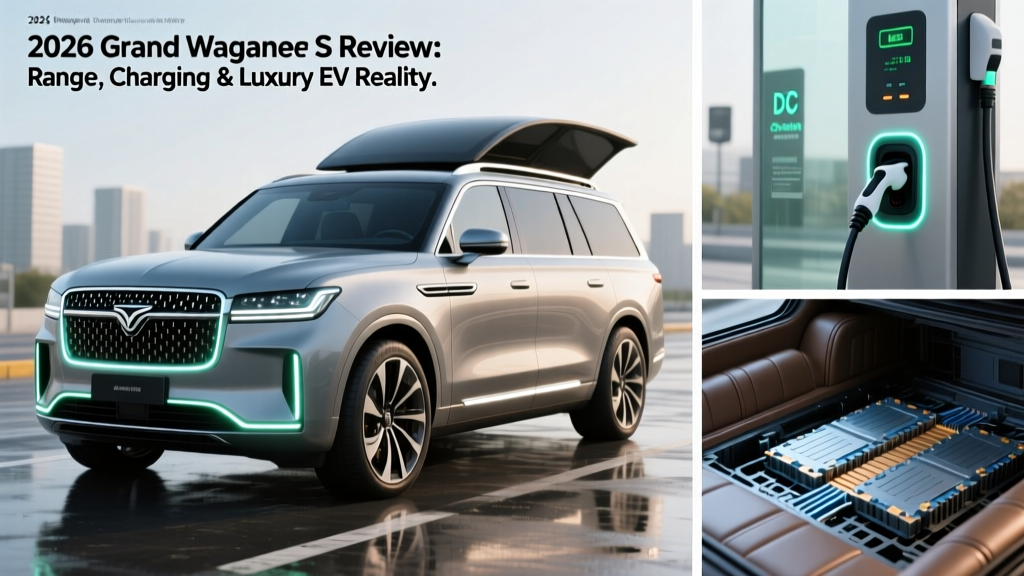
The full-size luxury SUV segment has a new electric entrant with serious ambitions. The 2026 Grand Wagoneer S arrives as Jeep's flagship battery-electric vehicle, built on the STLA Large platform and targeting buyers who want three-row comfort, premium materials, and credible range without stepping into a Tesla or Rivian. After spending time with the specs, the charging curve, and the ownership math, here's what the Grand Wagoneer S actually delivers — and where it falls short.
Quick Verdict: Who the Grand Wagoneer S Is For
The Grand Wagoneer S is built for affluent families and luxury-SUV loyalists who want a quiet, tech-forward electric daily driver with real towing capability and genuine three-row usability. It is not a performance SUV, and it is not a budget play. If your priority is maximum range per dollar or sports-sedan acceleration, look elsewhere. If you want a serene, well-appointed electric hauler that charges predictably on road trips and fits six or seven in comfort, the Grand Wagoneer S makes a compelling case — provided you can access reliable DC fast charging and your electrical panel can support Level 2 home charging.
EPA Estimated Range: 330 miles (Optimum trim, 20-inch wheels)
Real-World Highway (70-75 mph, moderate climate): ~270-290 miles
Cold Weather (below 32°F, highway): ~230-250 miles
City / Stop-and-Go: ~310-330 miles (regen-heavy driving recovers energy)
Range, Battery, and Efficiency
The Grand Wagoneer S uses a 110 kWh usable lithium-ion battery pack (NMC chemistry — nickel manganese cobalt), chosen for its higher energy density compared to LFP. This chemistry trades some cycle-life longevity for the energy density needed to push a 6,000+ lb vehicle past 300 miles. The pack sits low in the chassis, contributing to a lower center of gravity than the outgoing ICE Grand Wagoneer.
| Spec | Value |
|---|---|
| EPA Range (Optimum, 20" wheels) | 330 miles |
| Battery Capacity (usable) | 110 kWh, NMC |
| MPGe (combined) | 86 MPGe |
| Efficiency | 39 kWh / 100 mi |
| Drivetrain | Dual-motor AWD |
| Horsepower | 590 hp (combined) |
| 0-60 mph | 4.7 seconds |
| Max DC Fast Charge | 150 kW (peak) |
| 10-80% DC Charge Time | ~32 minutes |
| Level 2 Home Charge Rate | 11.5 kW (~28 mi/hr) |
| Max Tow Capacity | 7,500 lbs |
| Cargo (behind 3rd row) | 18.2 cu ft |
| Cargo (3rd row folded) | 52.4 cu ft |
| Cargo (all rows folded) | 96.9 cu ft |
| 3rd-Row Legroom | 32.1 inches |
| Battery/Powertrain Warranty | 8 years / 100,000 miles |
| Base MSRP (Optimum) | $114,995 |
Efficiency is rated at 86 MPGe combined, which translates to 39 kWh per 100 miles. That's thirsty by compact-EV standards (the Ioniq 5 uses roughly 30 kWh/100mi), but expected for a vehicle of this mass and frontal area. On highway road trips, expect consumption to climb to 42-45 kWh/100mi at sustained 75 mph speeds, particularly with roof cargo or towing.
Charging Speed: DC Fast, Level 2, and the Curve
Charging is where the Grand Wagoneer S reveals its most significant limitation. Peak DC fast-charge capability is 150 kW — respectable, but behind the 200-250 kW peaks offered by Hyundai's E-GMP platform and Tesla's latest V4 Superchargers. The 10-80% charge takes approximately 32 minutes at a capable 150+ kW station, which is adequate for a meal break but not class-leading.
| Charging Level | Power | Miles Added per Hour | Notes |
|---|---|---|---|
| Level 1 (120V household) | 1.4 kW | ~3 mi/hr | Emergency/trickle only; 110+ hours for full charge |
| Level 2 (240V, 48A) | 11.5 kW | ~28 mi/hr | Full charge in ~10 hours; recommended home setup |
| DC Fast (150 kW peak) | 150 kW | ~180 mi/hr (peak) | 10-80% in ~32 min; tapers significantly above 80% |
| DC Fast (50 kW station) | 50 kW | ~60 mi/hr | 10-80% in ~90 min; common at older stations |
The charge curve matters more than the peak number. The Grand Wagoneer S holds close to 150 kW from roughly 10-40% State of Charge, then tapers to ~110 kW through 60%, and drops further to ~70 kW by 80%. Above 80%, charging slows dramatically to protect the NMC cells — expect 80-100% to take an additional 25-30 minutes. For road trips, plan stops around the 10-80% window and skip topping off unless you have time to spare.
At home, the 11.5 kW onboard charger is competitive. A full charge from empty takes roughly 10 hours on a hardwired 48-amp Level 2 station (like a ChargePoint Home Flex or Tesla Wall Connector). You'll need a 60-amp dedicated circuit — and possibly a panel upgrade if your home has a 100-amp service. Budget $1,200-$2,500 for a professional Level 2 installation including permit, wiring, and a quality EVSE, per U.S. Department of Energy guidance.
Performance and Driving Dynamics
The dual-motor all-wheel-drive powertrain produces 590 horsepower and delivers a 4.7-second 0-60 mph time. That's genuinely quick for a three-row luxury SUV, though the Grand Wagoneer S doesn't chase the sub-4-second times of the Tesla Model X Plaid or Rivian R1T tri-motor. The intent here is effortless highway merging and confident passing, not track performance.
Ride quality benefits from the air suspension standard on upper trims, which adjusts ride height for highway efficiency, off-road clearance, and easy cargo loading. The low center of gravity from the floor-mounted battery reduces body roll compared to the ICE Grand Wagoneer, though the sheer mass (curb weight exceeds 6,200 lbs) is noticeable during aggressive cornering. Regenerative braking offers multiple levels, including a near-one-pedal mode that recovers aggressively in city driving — a meaningful efficiency boost in stop-and-go traffic.
Interior, Tech, and Standout Features
The cabin is where the Grand Wagoneer S justifies its price. The dashboard features a 12.3-inch digital cluster, a 12.3-inch central infotainment touchscreen, and a 10.3-inch passenger display — all running Stellantis' Uconnect 5 system with wireless Apple CarPlay and Android Auto. Upper trims add a 10.3-inch rear-seat entertainment system and a digital rearview mirror.
Driver-assistance technology includes adaptive cruise control with stop-and-go, lane-centering steering, automated emergency braking with pedestrian detection, and a hands-on-wheel highway assist system. This is an SAE Level 2 system — the driver must remain attentive and keep hands on the wheel at all times. It is not autonomous driving.
Notable drawbacks: The third row, while usable, offers only 32.1 inches of legroom — tight for adults on long trips. Cargo space behind the third row is 18.2 cu ft, enough for a few grocery bags but not a full family's luggage without folding at least one row. And at this price, the absence of a frunk (front trunk) is a missed opportunity for additional secure storage.
Pricing, Trims, and Federal Tax Credit Eligibility
The Grand Wagoneer S launches in three trims for 2026:
- Optimum (base): $114,995 — includes air suspension, 20-inch wheels, dual-motor AWD, full Uconnect 5 suite
- Obsidian: $124,995 — adds premium leather, 23-speaker McIntosh audio, 22-inch wheels (range drops to ~310 mi EPA)
- Summit Reserve: $134,995 — adds rear executive seating, advanced night vision, massaging front seats
| Trim | MSRP | Federal Credit (§30D) | Effective Price (est.) |
|---|---|---|---|
| Optimum | $114,995 | $0 (exceeds MSRP cap) | $114,995 |
| Obsidian | $124,995 | $0 (exceeds MSRP cap) | $124,995 |
| Summit Reserve | $134,995 | $0 (exceeds MSRP cap) | $134,995 |
Here's the critical tax-credit reality: Under current IRS §30D rules, the federal clean vehicle credit caps MSRP eligibility at $80,000 for SUVs, vans, and pickup trucks. Every Grand Wagoneer S trim exceeds this cap, meaning no trim qualifies for the $7,500 federal tax credit. Additionally, buyer income limits ($300,000 MAGI for joint filers, $150,000 for single filers) and battery critical-mineral sourcing requirements further restrict eligibility even for lower-priced EVs. State and local incentives may apply — check your state's energy office for specifics — but plan your budget assuming the full MSRP.
Ownership Costs and Warranty
Stellantis backs the Grand Wagoneer S battery and electric powertrain with an 8-year / 100,000-mile warranty, covering defects and capacity loss below 70% of original capacity. The limited vehicle warranty is 5 years / 60,000 miles. This is competitive with the segment, though Hyundai's 10-year / 100,000-mile powertrain warranty on the Ioniq 9 sets a higher bar.
Charging costs at home (at the U.S. average of $0.16/kWh) work out to roughly $0.062 per mile — about half the per-mile fuel cost of a comparable gas-powered Grand Wagoneer (16 mpg combined at $3.50/gallon = $0.22/mile). Over 15,000 miles annually, that's approximately $2,370 in electricity savings versus gasoline. However, insurance premiums for a $115,000+ EV are substantial — expect $3,500-$5,000 annually depending on your profile and state. Depreciation on six-figure luxury EVs remains steep; plan for 45-55% value loss over five years based on current segment trends.
How It Compares: Grand Wagoneer S vs. Key Rivals
The Grand Wagoneer S enters a competitive field. Here's how it stacks up on the specs that matter:
- vs. Tesla Model X: The Model X offers more range (348 mi EPA), faster Supercharger access (250 kW peak), and a lower starting price (~$89,990). But it lacks the Grand Wagoneer's material quality and dealer-service network.
- vs. Rivian R1S: The R1S delivers superior off-road capability, a quad-motor option (850+ hp), and a more adventure-oriented design. Range is comparable (~340 mi EPA for dual-motor). Starting price is lower (~$84,900), but the R1S interior doesn't match the Wagoneer's luxury execution.
- vs. BMW iX xDrive50: The iX charges faster (up to 200 kW), offers a more driver-focused cabin, and starts at ~$87,250. But it's a two-row vehicle — no third-row option, which is a dealbreaker for larger families.
- vs. Cadillac Escalade IQ: The closest direct competitor in size and positioning. The Escalade IQ offers a larger battery (~200 kWh, ~450 mi EPA range) and GM's Ultium charging architecture, but at a comparable or higher price point. Interior tech and brand cachet differ — this is a brand-loyalty decision as much as a spec-sheet one.
Pros and Cons
- Genuine three-row usability with premium materials throughout
- 330-mile EPA range is credible for road trips
- Air suspension delivers excellent ride quality
- 7,500-lb towing capacity for a full-size electric SUV
- Quiet, refined cabin with strong infotainment system
- 150 kW peak DC charging is behind class leaders (200-250 kW)
- No federal tax credit — MSRP far exceeds §30D cap
- Third-row legroom tight for adults (32.1 in)
- No frunk for additional cargo
- High insurance and depreciation costs typical of six-figure EVs
Frequently Asked Questions
What is the real-world range of the Grand Wagoneer S?
The EPA rates the Optimum trim at 330 miles. In real-world highway driving at 70-75 mph in moderate temperatures, expect 270-290 miles before needing to charge. In cold weather (below freezing), that drops to 230-250 miles. City driving with regenerative braking can approach the EPA sticker.
How fast does the Grand Wagoneer S charge?
DC fast charging peaks at 150 kW, delivering a 10-80% charge in approximately 32 minutes at a capable station. At home on a 48-amp Level 2 charger (11.5 kW), you'll add about 28 miles per hour, with a full charge taking roughly 10 hours. The charge curve tapers significantly above 80% SoC to protect the NMC battery.
Does the Grand Wagoneer S qualify for the federal EV tax credit?
No. Under current IRS §30D rules, the federal clean vehicle credit caps SUV MSRP eligibility at $80,000. The Grand Wagoneer S starts at $114,995, well above the cap. No trim qualifies for the $7,500 credit. State incentives may be available — consult your state energy office and a tax professional for details.
Is the Grand Wagoneer S worth buying vs. the Rivian R1S or Tesla Model X?
It depends on your priorities. If material quality, dealer service access, and a traditional luxury-SUV experience matter most, the Grand Wagoneer S delivers. If you prioritize faster charging, lower price, or off-road capability, the R1S or Model X may be stronger choices. Test-drive all three — cabin feel and brand affinity often decide at this price point.
What is the battery warranty on the Grand Wagoneer S?
Stellantis provides an 8-year / 100,000-mile battery and powertrain warranty, covering defects and capacity loss below 70% of original capacity. The NMC chemistry is proven but does degrade faster than LFP under high-heat, high-cycle conditions — preconditioning and avoiding frequent 100% charges will help longevity.
Can the Grand Wagoneer S tow?
Yes, with a maximum tow rating of 7,500 lbs. However, towing significantly impacts range — expect a 30-50% reduction depending on trailer weight and aerodynamics. A 5,000-lb camper trailer at highway speed could reduce real-world range to 170-200 miles. Plan charging stops accordingly.