The Golden Tesla Roadster: What We Actually Know in 2026
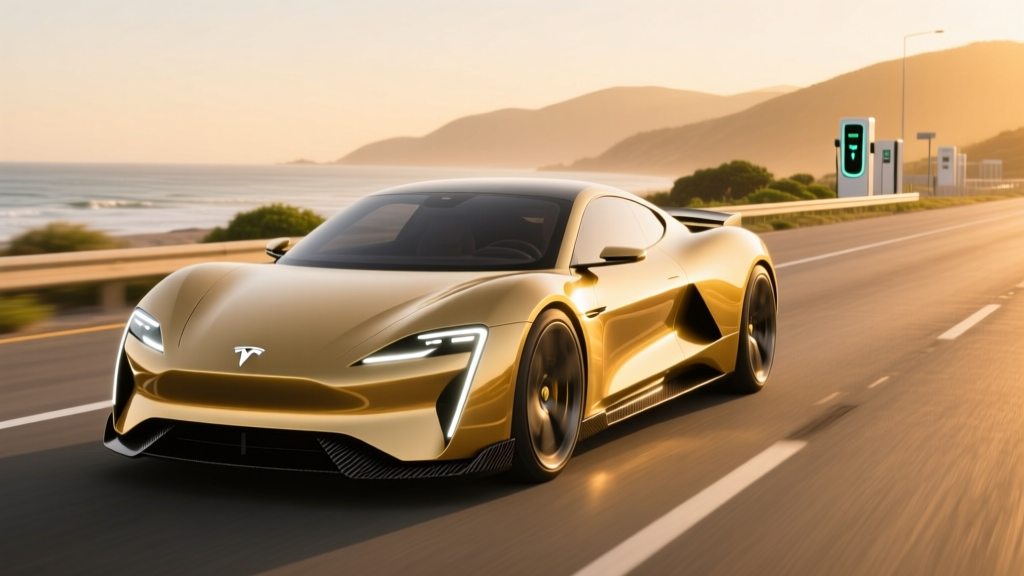
Search for "golden Tesla Roadster" and you'll find a tangle of Elon Musk promises, one-off promotional renders, and a vehicle that has been "coming soon" since 2017. Let's cut through the noise. As of early 2026, the next-generation Tesla Roadster remains an announced but unreleased vehicle. The "golden" variant refers to a one-off livery Tesla displayed at events and in promotional material — not a distinct production trim you can configure today.
That said, Tesla has published preliminary specifications for the Roadster, and enough engineering breadcrumbs exist to evaluate what this car will likely deliver if and when it reaches customer driveways. Below is a data-driven profile built on Tesla's stated specs, real-world EV physics, and honest caveats about what remains unconfirmed.
Projected Specifications: Tesla Roadster at a Glance
| Attribute | Tesla Stated / Projected |
|---|---|
| EPA Range (projected) | ~620 miles (unverified by EPA) |
| Battery Capacity | ~200 kWh (announced), chemistry unconfirmed (likely NMC/NCA) |
| Drivetrain | Tri-motor AWD |
| Horsepower | 1,000+ hp (wheel torque: 10,000 Nm claimed) |
| 0-60 mph | 1.9 seconds (with SpaceX cold-gas thruster package) |
| Top Speed | 250+ mph (claimed) |
| Base MSRP (announced) | $200,000 (base) / $250,000 (Founders Series) |
| Federal Tax Credit (§30D) | Not eligible (exceeds MSRP cap) |
| Battery Warranty | Expected 8 yr / 150,000 mi (based on Tesla precedent) |
Range Reality: 620 Miles on Paper, But What About the Real World?
Real-World Highway Expectation: ~430–490 miles (70–80% of sticker at sustained 70–80 mph speeds)
Cold-Weather Estimate (32°F and below): ~370–430 miles (40–50% reduction typical for high-performance EVs without aggressive heat-pump preconditioning)
Tesla's claimed 620-mile figure would shatter every production EV on the road. But context matters. The EPA test cycle includes low-speed city driving where regenerative braking recovers significant energy. At sustained highway speeds — the scenario that actually triggers range anxiety on road trips — aerodynamic drag dominates. The Roadster's low, wide sports-car profile helps, but a 200 kWh battery pushing 1,000+ hp through three motors will consume energy rapidly at velocity.
For comparison, the Lucid Air Grand Touring achieves an EPA-rated 516 miles from a 118 kWh pack, and real-world highway testing by independent reviewers consistently yields 380–420 miles at 75 mph. The Roadster's larger battery provides a buffer, but physics is unforgiving: expect 430–490 real highway miles in moderate weather, and substantially less when temperatures drop below freezing.
The 200 kWh pack also raises a weight question. At roughly 5–6 kWh per kilogram for current NMC cells, the battery alone could weigh 700–900 lbs, pushing total vehicle mass well above 4,500 lbs. That mass affects tire wear, braking distance, and ultimately efficiency at speed.
Charging Speed: The 200 kWh Problem
A 200 kWh battery is enormous by any standard — roughly double the capacity of a Tesla Model S Plaid. That creates a charging challenge that no amount of marketing can solve.
| Charging Method | Power / Rate | Estimated Time | Notes |
|---|---|---|---|
| Level 1 (120V household) | ~1.4 kW | ~140+ hours (0–100%) | Effectively unusable for a pack this size |
| Level 2 (240V / 48A home) | ~11.5 kW | ~17–18 hours (0–100%) | Overnight top-up only; full charge requires nearly a full day |
| Level 2 (240V / 80A Wall Connector) | ~19.2 kW | ~10–11 hours (0–100%) | Requires 100A circuit; still an overnight affair |
| DC Fast Charge (V4 Supercharger, projected) | Peak ~350 kW (announced architecture) | ~35–45 min (10–80%) | Sustained rate will taper significantly above 60% SoC; charge curve matters more than peak kW |
Here's the uncomfortable math: even at a sustained 350 kW (which no EV maintains for an entire session — the charge curve tapers as the battery fills), adding 140 kWh (a 10–80% session on a 200 kWh pack) takes roughly 24 minutes under ideal thermal conditions. In practice, battery thermal management limits, cell C-rate constraints, and taper above 60% state of charge push a realistic 10–80% session to 35–45 minutes.
For home charging, a 200 kWh battery is a paradigm shift. Most EV owners charge overnight and wake up full. With the Roadster, an 80A Level 2 circuit adds roughly 55–60 miles of range per hour of charging. If you drive 200 miles in a day, you'll need 3.5–4 hours on the plug just to recover. Owners will need to treat charging like fueling a private jet: plan ahead, or accept that the car isn't always at 100%.
Performance: 1.9 Seconds and the Physics Behind It
Tesla's claimed 0–60 mph time of 1.9 seconds would make the Roadster the quickest production car ever built — but with a critical asterisk. That figure includes the optional SpaceX cold-gas thruster package, which uses compressed air stored in carbon-fiber tanks to generate additional downforce and forward thrust. Without the thruster package, the tri-motor AWD powertrain alone is expected to deliver 0–60 in roughly 2.5–3.0 seconds, which is still supercar territory.
The tri-motor layout (one front, two rear) enables torque vectoring across the rear axle, improving corner exit grip. Tesla has claimed 10,000 Nm of wheel torque — note this is wheel torque after gear reduction, not motor torque. For reference, a Rimac Nevera produces roughly 2,360 Nm of motor torque through a similar multi-motor setup.
The top-speed claim of 250+ mph places the Roadster in hypercar territory alongside the Bugatti Chiron and Koenigsegg Jesko. Achieving that speed requires not just power but aerodynamic stability and tire technology rated for sustained 250+ mph operation. Whether Tesla's production tires will carry that rating remains to be seen.
Pricing, Tax Credits, and the $200,000 Question
| Trim | Announced MSRP | §30D Federal Credit | Effective Price |
|---|---|---|---|
| Roadster (Base) | $200,000 | $0 | $200,000 |
| Founders Series | $250,000 | $0 | $250,000 |
Under current IRS §30D rules, the federal EV tax credit has an MSRP cap of $80,000 for sedans, wagons, and sports cars (and $80,000 for SUVs/pickups). At $200,000 base, the Roadster exceeds this cap by $120,000. No buyer will qualify for the $7,500 federal credit on this vehicle, regardless of income or battery sourcing.
Additionally, §30D imposes buyer income limits ($150,000 single / $300,000 joint for modified AGI) and battery critical-mineral sourcing requirements — but those are moot when the MSRP cap disqualifies the vehicle outright.
Tesla has historically required a reservation deposit (previously $5,000–$50,000 depending on the tier) for the Roadster. Reservation holders should monitor Tesla's communications for updated delivery timelines, but the vehicle has been delayed repeatedly since its 2017 unveiling.
Interior, Cargo, and Daily Practicality
The Roadster is a 2+2 sports car (two front seats, two small rear seats) with a removable glass roof panel. Based on Tesla's published dimensions and the original Roadster's footprint, expect:
- Front legroom: ~42 inches (estimated)
- Rear legroom: ~28–30 inches (estimated — suitable for children or luggage, not adults on long trips)
- Cargo volume: ~5–8 cu ft rear trunk + small frunk (estimated)
- Curb weight: ~4,500–5,000 lbs (estimated, driven by 200 kWh pack mass)
This is a weekend car and a halo vehicle, not a daily commuter. The rear seats are essentially upholstered shelving. Cargo capacity won't accommodate more than a couple of overnight bags. If you need practicality, the Tesla Model S Plaid delivers 1,020 hp with 28 cu ft of cargo space and a usable back seat — for roughly $90,000 less.
Tech, Driver Assistance, and the SpaceX Factor
Expect the Roadster to ship with Tesla's latest hardware suite, including:
- Infotainment: 17-inch center touchscreen, yoke or round steering wheel (configurable), gaming-capable processor
- Autopilot / FSD (Supervised): Tesla's Level 2 driver-assistance system. Note: FSD Supervised requires active driver engagement at all times. It is not autonomous driving. The driver must keep hands on the wheel and eyes on the road.
- Active aero: Deployable rear spoiler and active front air management
- SpaceX thruster package (optional): Cold-gas thrusters around the vehicle for enhanced acceleration, braking, and cornering. This is a first in production automotive and raises regulatory questions about compressed-gas storage in a road vehicle.
Pros, Cons, and the Verdict
Pros
- Projected 620-mile range would be best-in-class by a wide margin
- 1.9-second 0–60 (with thrusters) rewrites the performance rulebook
- Tri-motor AWD with torque vectoring for exceptional cornering grip
- Tesla Supercharger network access (17,000+ stalls in North America)
- Halo-car status and likely strong initial resale value
Cons
- Not yet in production — repeated delays since 2017 erode confidence
- $200,000+ price with zero federal tax credit eligibility
- 200 kWh battery means slow home charging and heavy vehicle mass
- Minimal cargo and rear-seat practicality
- SpaceX thruster package raises untested regulatory and safety questions
- Real-world range likely 30–40% below sticker at highway speeds
Who Should Consider the Roadster (and Who Shouldn't)
This EV suits: Collectors and enthusiasts who want a halo vehicle, have access to high-power home charging (80A+ circuit), and view the Roadster as a weekend/experience car rather than primary transportation. If you already own a practical daily driver and want to own a piece of EV performance history — and can stomach the deposit risk on an unreleased vehicle — the Roadster occupies a unique niche.
Look elsewhere if: You need a daily commuter, family transport, or road-trip vehicle. The Tesla Model S Plaid ($89,990) delivers 1,020 hp, 396 miles EPA range, practical sedan cargo space, and eligibility for certain state incentives. The Lucid Air Sapphire ($249,000) offers 1,234 hp, 427 miles EPA range, and is actually available for delivery today. The Rimac Nevera ($2.2M) is a proven, delivered hypercar with 1,914 hp and independent verification of its performance claims.
Frequently Asked Questions
What is the real-world range of the Tesla Roadster?
Tesla claims a projected 620-mile range, but this figure has not been EPA-verified. Based on real-world EV physics, expect approximately 430–490 miles at sustained highway speeds in moderate weather, and 370–430 miles in cold conditions (below 32°F). Actual range depends heavily on driving style, temperature, and terrain.
How fast does the Tesla Roadster charge?
At a V4 Supercharger (projected peak ~350 kW), a 10–80% session should take approximately 35–45 minutes due to the massive 200 kWh battery and inevitable charge-curve taper. At home on a 48A Level 2 circuit (~11.5 kW), a full charge takes 17–18 hours. An 80A circuit (~19.2 kW) reduces that to 10–11 hours.
How much does the Tesla Roadster cost after tax credits?
The base Roadster is announced at $200,000 and the Founders Series at $250,000. Because both exceed the IRS §30D MSRP cap of $80,000 for passenger cars, neither qualifies for the $7,500 federal EV tax credit. The effective price equals the sticker price, plus destination and any state registration fees.
Is the Tesla Roadster worth buying vs. competitors?
If you can wait for an unproven, repeatedly delayed vehicle and value exclusivity above all, the Roadster offers unmatched projected specs. If you want a delivered, proven electric hypercar today, the Lucid Air Sapphire ($249,000, 427 mi EPA, 1,234 hp) is available now. The Tesla Model S Plaid ($89,990) delivers 90% of the thrill at less than half the price with genuine daily usability.
Does the Tesla Roadster qualify for the federal EV tax credit?
No. Under current IRS §30D rules, the federal clean vehicle credit has an MSRP cap of $80,000 for cars. At $200,000 base, the Roadster is ineligible regardless of buyer income, battery sourcing, or point-of-sale transfer rules. Consult a tax professional for personalized guidance on EV incentives.
What is the "golden" Tesla Roadster?
The "golden" Tesla Roadster refers to a one-off promotional vehicle displayed by Tesla with a gold/wrap finish. It is not a separate production trim. The standard Roadster is expected to offer conventional Tesla color options. No "golden" trim has been announced for production configuration.