The Gold Cybertruck Phenomenon: What Buyers Actually Get
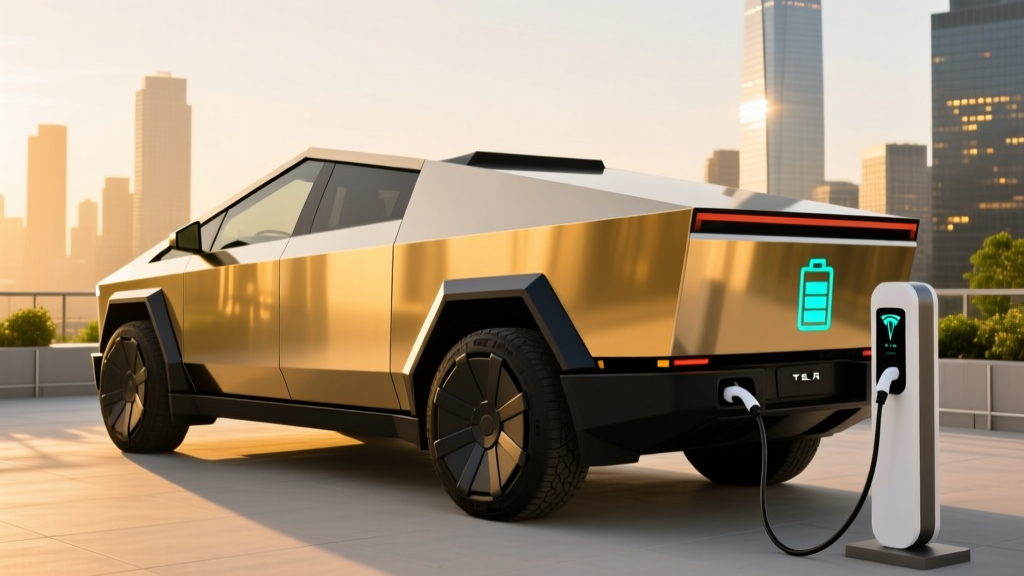
The "gold Tesla Cybertruck" has become one of the most-searched variations of Tesla's polarizing electric pickup — and for good reason. While Tesla does not offer a factory gold paint option, owners and third-party shops have wrapped Cybertrucks in satin gold, chrome gold, and brushed metallic gold finishes at an accelerating pace. What you're really evaluating when you search for a gold Cybertruck is the underlying vehicle: the 2025–2026 Tesla Cybertruck in its AWD and Cyberbeast trims, plus the cost and practicality of adding a premium vinyl wrap.
This review covers the Cybertruck's real-world range, charging performance, battery specs, pricing, and federal tax credit eligibility — then layers on what a gold wrap actually costs and how it affects ownership. Whether you've seen a gold Cybertruck on social media and want to know if the truck underneath is worth it, or you're a current reservation holder planning a custom build, here are the numbers that matter.
Cybertruck Specs at a Glance
| Spec | AWD (Dual Motor) | Cyberbeast (Tri Motor) |
|---|---|---|
| EPA Range | 340 miles | 320 miles |
| Battery (usable) | ~123 kWh, NMC | ~123 kWh, NMC |
| Horsepower | 600 hp | 845 hp |
| 0–60 mph | 4.1 seconds | 2.6 seconds |
| Drivetrain | Dual-motor AWD | Tri-motor AWD |
| Max DC Fast Charge | 250 kW | 250 kW |
| 10–80% DCFC Time | ~35 minutes | ~35 minutes |
| Level 2 Charge Rate | 11.5 kW (~37 mi/hr) | 11.5 kW (~37 mi/hr) |
| MPGe (combined) | 67 MPGe | 62 MPGe |
| Efficiency | 50 kWh/100 mi | 54 kWh/100 mi |
| Towing Capacity | 11,000 lbs | 11,000 lbs |
| Payload | 2,500 lbs | 2,500 lbs |
| Base MSRP | $79,990 | $99,990 |
| Battery/Drive Unit Warranty | 8 yr / 120,000 mi | 8 yr / 120,000 mi |
Source: fueleconomy.gov and Tesla's official specifications. Real-world efficiency varies with temperature, terrain, and speed.
Real-World Range: What the EPA Sticker Doesn't Tell You
EPA Estimated: 340 miles (AWD) / 320 miles (Cyberbeast)
Real-World Highway (70 mph, 75°F): ~260–290 miles
Cold Weather (30°F, mixed driving): ~200–240 miles
Towing (5,000-lb trailer, flat terrain): ~150–180 miles
The Cybertruck's angular stainless steel body creates significant aerodynamic drag compared to a sleek sedan like the Model S. At highway speeds above 70 mph, energy consumption climbs steeply — expect roughly 50–54 kWh per 100 miles in mixed driving, but closer to 60+ kWh/100 mi at sustained 80 mph. This is the single biggest factor separating EPA range from real-world range in any pickup-shaped EV.
In cold weather, the NMC battery chemistry loses some efficiency, and cabin heating draws substantial power. Tesla's heat pump system helps mitigate this, but owners in northern climates should plan for 25–35% range reduction below freezing. The Cybertruck's ~123 kWh usable battery capacity provides a large buffer — even with losses, you still have meaningful range — but the truck's efficiency is notably worse than the Ford F-150 Lightning's due to its heavier curb weight and less optimized aero.
For daily commuting under 80 miles round-trip, range is a non-issue. For road trips, plan charging stops every 220–250 miles to stay comfortable and avoid the steep charging-curve taper above 80% SoC.
Charging Performance: DC Fast Charging and Home Setup
| Charging Level | Power | Rate | Time to Full |
|---|---|---|---|
| Level 1 (120V, 12A) | ~1.4 kW | ~4 mi/hr | ~90 hours (10–100%) |
| Level 2 (240V, 48A) | 11.5 kW | ~37 mi/hr | ~11 hours (10–100%) |
| DC Fast Charge (V3 Supercharger) | 250 kW peak | ~200 mi in 15 min (peak) | 10–80% in ~35 min |
| DC Fast Charge (V4 Supercharger) | 250 kW peak | Similar to V3 for this pack | 10–80% in ~35 min |
The Cybertruck uses the NACS (North American Charging Standard) connector natively — no adapter needed at Tesla Superchargers. It supports a peak DC fast-charge rate of 250 kW on V3 and V4 Supercharger stalls. However, peak rate is not sustained rate. The charge curve tapers meaningfully above 60% SoC, and the large 123 kWh battery means the full 10–80% session takes approximately 35 minutes. This is slower than the Hyundai Ioniq 5's ~18-minute 10–80% time, but the Cybertruck's larger pack means you're adding more total energy.
For home charging, a 48-amp Level 2 wall connector on a 60-amp circuit delivers 11.5 kW, adding roughly 37 miles of range per hour. A full overnight charge easily replenishes even a near-empty battery. Installation typically costs $800–$2,000 for the wall connector plus electrician labor, depending on panel proximity and whether a panel upgrade is needed. Tesla's Wall Connector is the recommended unit.
Charging-curve reality check: You'll see 250 kW only briefly in the 10–30% SoC range. From 30–60%, expect roughly 150–180 kW. Above 80%, the rate drops below 50 kW. Plan road-trip stops to charge from 10–80% and move on rather than waiting for a trickle charge to 100%.
Performance, Drivetrain, and What 845 HP Feels Like
The Cyberbeast's tri-motor powertrain produces 845 horsepower and launches the 6,800-pound truck to 60 mph in 2.6 seconds — faster than a Porsche 911 Turbo S. The dual-motor AWD trim still manages 4.1 seconds with 600 hp. Both versions feature torque vectoring across the rear axle (Cyberbeast) or standard AWD traction (dual-motor).
Regenerative braking is aggressive enough for near one-pedal driving in most conditions. The steer-by-wire system — no mechanical connection between the steering wheel and the wheels — takes adjustment but provides variable ratios that reduce hand movement at low speeds. At highway speeds, it feels direct and stable.
The 48-volt electrical architecture is an industry first for a production vehicle, reducing wiring harness weight and enabling higher-power accessories. This is the kind of engineering detail that matters for long-term reliability but rarely shows up in marketing materials.
Pricing, Trims, and Federal Tax Credit Eligibility
| Trim | Base MSRP | §30D Credit Eligible? | Effective Price (if eligible) |
|---|---|---|---|
| AWD (Dual Motor) | $79,990 | No — exceeds $80,000 truck MSRP cap | $79,990 |
| Cyberbeast (Tri Motor) | $99,990 | No — exceeds $80,000 truck MSRP cap | $99,990 |
Under IRS §30D rules, the federal EV tax credit caps at $7,500 for qualifying vehicles, but pickup trucks must have an MSRP at or below $80,000 to be eligible. The Cybertruck AWD starts at $79,990 — technically under the cap — but Tesla's current pricing and any added options (FSD, foundation series packages, wraps) push the transaction price above the threshold. Additionally, the buyer must meet income caps ($150,000 single / $300,000 joint AGI), and the vehicle's battery components and critical minerals must meet domestic sourcing thresholds that have tightened annually through 2026.
As of the current tax year, the Cybertruck's battery sourcing does not consistently meet the critical-minerals and battery-component requirements for the full $7,500 credit. Always verify eligibility using the IRS's official list at fueleconomy.gov and consult a tax professional before relying on the credit in your purchase decision.
Gold wrap cost: A professional satin or chrome gold vinyl wrap for the Cybertruck's large, angular body typically runs $4,000–$7,500 depending on film quality (3M, Avery Dennison, XPEL), shop reputation, and whether you include the bed and tonneau cover. Chrome gold finishes sit at the higher end due to material cost and the difficulty of wrapping the truck's sharp creases.
Cargo, Interior Space, and Daily Practicality
The Cybertruck seats five across two rows. Front legroom measures 41.4 inches; rear legroom is 38.2 inches — adequate for adults on shorter trips but tighter than a full-size F-150 Lightning's rear seat. The 6-foot bed offers 68 cubic feet of lockable storage under the powered tonneau cover, and the front trunk (frunk) adds roughly 7 cubic feet — useful for charging cables and groceries.
The powered vault (bed) cover is a standout feature: it retracts electrically and supports up to 300 pounds of distributed weight when closed. Combined with the 11,000-pound towing capacity and 2,500-pound payload, the Cybertruck is a legitimate work truck — though its 6-foot bed is shorter than the 6.5- or 8-foot beds common on conventional pickups.
The 18.5-inch front touchscreen runs Tesla's latest software, including navigation, streaming, and vehicle controls. A 9.4-inch rear touchscreen serves back-seat passengers. The yoke-style steering wheel (standard) or optional round wheel controls the steer-by-wire system. Wireless phone charging, USB-C ports (65W front, 27W rear), and a HEPA air filtration system round out the interior.
Driver Assistance: Autopilot and FSD (Supervised)
Tesla Autopilot and Full Self-Driving (Supervised) are Level 2 driver-assistance systems. The driver must remain fully engaged — hands on the wheel (or torque-applied with the yoke), eyes on the road — at all times. The Cybertruck is not a self-driving vehicle. No consumer vehicle sold today operates at Level 3 or above without geofenced restrictions.
Autopilot (included) provides adaptive cruise control, lane centering, and automatic emergency braking. FSD (Supervised), a $8,000 add-on or $99/month subscription, adds automatic lane changes, traffic-light and stop-sign recognition, and navigation-guided on/off-ramp handling. It performs well on well-marked highways but requires constant supervision and can behave unpredictably in construction zones, heavy rain, or poorly marked roads.
The Cybertruck's camera-only vision system (no radar or ultrasonic sensors) means parking-assist features rely entirely on neural-net processing. Some owners report less precise parking guidance compared to vehicles with ultrasonic sensors, though Tesla's software updates have improved this incrementally.
Pros, Cons, and the Verdict on Going Gold
- 2.6-second 0–60 mph (Cyberbeast) — supercar acceleration in a truck
- 11,000-lb towing, 2,500-lb payload — genuine work capability
- Stainless steel exoskeleton requires no paint, resists minor scratches
- Lockable vault (bed) with powered tonneau — secure, weatherproof storage
- Large 123 kWh battery provides range buffer in cold weather
- NACS native — full Supercharger network access without adapters
- 48-volt architecture reduces long-term wiring complexity
- Efficiency is poor: 50–54 kWh/100 mi — among the worst of any EV
- Real-world highway range falls 50–80 miles below EPA estimate
- No federal §30D tax credit in most configurations
- Steer-by-wire and yoke require a significant adjustment period
- Rear seat comfort trails the F-150 Lightning and Rivian R1T
- Camera-only parking assist less precise than ultrasonic-equipped trucks
- Sharp body creases make vinyl wraps more expensive ($4,000–$7,500)
- No Apple CarPlay or Android Auto — Tesla ecosystem only
Who Should Buy the Cybertruck (Gold Wrap or Not)?
Buy it if: You want a high-performance electric truck that doubles as a statement vehicle, you tow boats or trailers under 11,000 pounds, you have reliable home charging, and you value the Supercharger network for road trips. The gold wrap amplifies the attention factor — this is a truck for owners who want to be seen.
Consider alternatives if: Efficiency and range are your top priorities (the Rivian R1T Dual-Motor gets ~3.0 mi/kWh vs the Cybertruck's ~2.0 mi/kWh), you need a full-size rear seat for three adults, you rely on the federal tax credit to make the math work, or you prefer CarPlay integration. The Ford F-150 Lightning is more practical for traditional truck buyers, and the Chevrolet Silverado EV offers a longer bed and more conventional driving dynamics.
Frequently Asked Questions
Does Tesla sell a factory gold Cybertruck?
No. Tesla offers the Cybertruck in unpainted stainless steel only. Gold finishes are achieved through aftermarket vinyl wraps, typically costing $4,000–$7,500 for professional installation. Some owners use gold-tinted PPF (paint protection film) for a subtler effect.
Does a gold wrap void the Cybertruck warranty?
A professionally installed vinyl wrap does not void Tesla's 8-year/120,000-mile battery and drive unit warranty or the 4-year/50,000-mile basic vehicle warranty. However, damage caused during wrap installation (scratches to trim, sensor obstruction) would not be covered. Ensure the wrap shop avoids covering camera lenses and sensor areas.
What is the real-world range of the Cybertruck?
Expect 260–290 miles on the highway at 70 mph in moderate temperatures for the AWD trim (EPA 340). In cold weather below freezing, plan for 200–240 miles. When towing a 5,000-pound trailer, range drops to approximately 150–180 miles. The Cyberbeast trim runs 10–20 miles fewer in each scenario due to its tri-motor power draw.
How fast does the Cybertruck charge at home?
On a 48-amp Level 2 home charger (11.5 kW), the Cybertruck gains roughly 37 miles of range per hour. A full charge from 10% to 100% takes approximately 11 hours. Most owners charging overnight from 20–80% SoC need only 5–6 hours.
Does the Cybertruck qualify for the $7,500 federal EV tax credit?
Generally no. While the AWD trim's $79,990 base MSRP technically falls under the $80,000 truck cap, battery-sourcing and critical-minerals requirements under §30D have tightened through 2026, and the Cybertruck does not consistently meet these thresholds. Buyer income limits ($150K single / $300K joint) also apply. Verify current eligibility at irs.gov before purchase.
Is the gold Cybertruck worth it vs. a Rivian R1T or F-150 Lightning?
If performance and visual impact are your priorities, the Cybertruck (especially in Cyberbeast trim) has no equal among electric trucks. For efficiency, interior comfort, and practicality, the Rivian R1T and F-150 Lightning are stronger choices. The gold wrap adds $4,000–$7,500 to an already expensive vehicle — factor this into your total cost of ownership.