The Electric Truck Showdown: GMC Sierra EV vs Tesla Cybertruck
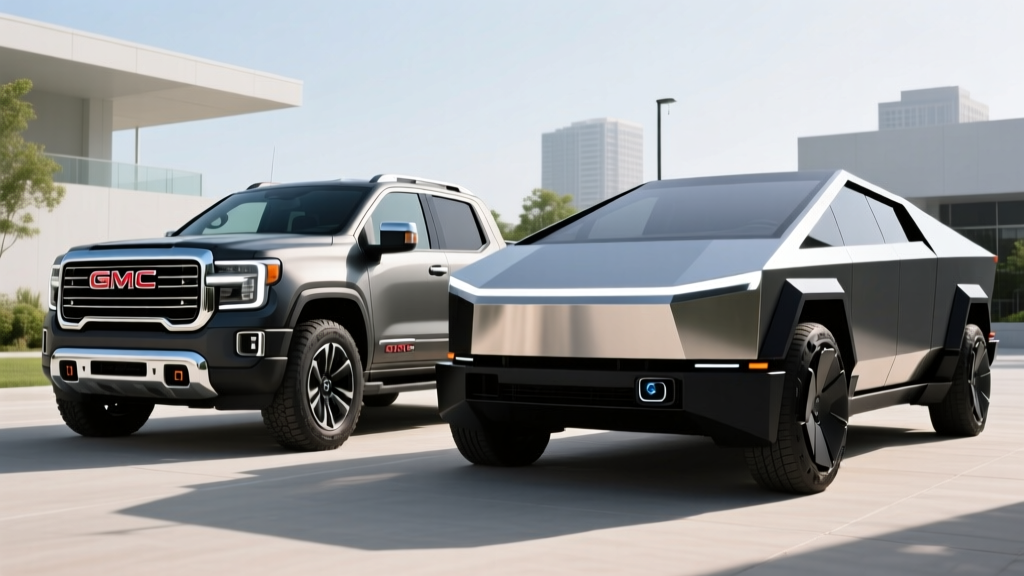
Buyers cross-shopping a GMC Sierra EV against a Tesla Cybertruck are weighing two fundamentally different philosophies of electric truck design. GMC leans into traditional truck utility — a familiar silhouette, a midgate for extended cargo, and Ultium-based battery tech shared across GM's lineup. Tesla bets on radical stainless-steel architecture, a 48-volt electrical system, and the Supercharger network. Both are full-size, dual-motor, all-wheel-drive pickups, but the numbers tell very different stories.
This comparison uses current 2026 model-year specifications from fueleconomy.gov, manufacturer press pages, and IRS §30D guidelines to break down range, charging, performance, pricing, and real-world ownership.
| Spec | GMC Sierra EV (Denali Edition 1 / Elevation) | Tesla Cybertruck (AWD / Cyberbeast) |
|---|---|---|
| EPA Range | 390 mi (Denali, 24-module) / 330 mi (Elevation) | 340 mi (AWD) / 320 mi (Cyberbeast) |
| Battery Capacity | ~200 kWh usable (Denali) / ~150 kWh (Elevation), NMC | ~123 kWh usable, NMC (4680 cells) |
| Max DC Fast Charge | 350 kW (peak) | 250 kW (peak, V3 Supercharger) |
| 10–80% DC Time | ~22 min (Denali, 350 kW stall) | ~17 min (AWD, 250 kW stall) |
| Level 2 Home Rate | 19.2 kW / ~47 mi/hr | 11.5 kW / ~30 mi/hr |
| 0–60 mph | 4.3 sec (Denali AWD) | 3.9 sec (AWD) / 2.6 sec (Cyberbeast) |
| Horsepower | 754 hp (Denali) | 600 hp (AWD) / 845 hp (Cyberbeast) |
| Max Towing | 9,500 lb (Denali) | 11,000 lb (AWD) |
| Bed Length | 5'11" (up to 10'11" w/ midgate open) | 6'0" |
| Cargo Volume (bed + frunk) | ~57 cu ft bed + ~11 cu ft frunk | ~55 cu ft bed + ~7 cu ft frunk |
| Efficiency | ~61 MPGe / ~55 kWh/100 mi | ~70 MPGe / ~48 kWh/100 mi |
| Base MSRP | $99,495 (Denali Ed. 1) / ~$60,000 (Elevation est.) | $79,990 (AWD) / $99,990 (Cyberbeast) |
| Battery Warranty | 8 yr / 100,000 mi | 8 yr / 120,000 mi |
Range and Efficiency: Real-World Expectations
GMC Sierra EV Denali: EPA 390 miles. Expect ~310–330 miles at sustained 70 mph highway speeds; ~250–280 miles in sub-30°F winter conditions with cabin heat. The 200 kWh battery is massive, which offsets its lower efficiency.
Tesla Cybertruck AWD: EPA 340 miles. Expect ~275–295 miles highway; ~225–250 miles in cold weather. The angular steel body creates more aerodynamic drag than a conventional truck, hurting highway efficiency disproportionately.
The Sierra EV Denali's range advantage comes almost entirely from its enormous battery pack, not from efficiency — at ~55 kWh/100 mi, it's thirstier than the Cybertruck's ~48 kWh/100 mi. That matters for charging cost. On a national average of $0.16/kWh for home electricity, filling the Sierra's 200 kWh pack from empty costs roughly $32; the Cybertruck's 123 kWh pack costs about $20. Over 15,000 miles annually, the Sierra consumes roughly $1,320 in home electricity versus $1,150 for the Cybertruck.
Towing slashes both trucks' range by 40–55%. If you're pulling a 7,000 lb trailer at highway speed, plan for 150–180 miles before needing a charge in either vehicle.
Charging Speed and Infrastructure
Charging is where the GMC Sierra EV vs Tesla Cybertruck debate gets nuanced. Peak kW alone doesn't tell the story — the charge curve (how long peak power is sustained) and connector ecosystem matter as much.
| Level | GMC Sierra EV | Tesla Cybertruck |
|---|---|---|
| Level 1 (120V, 12A) | ~1.4 kW / ~3 mi/hr | ~1.4 kW / ~4 mi/hr (better efficiency) |
| Level 2 (240V) | 19.2 kW / ~47 mi/hr | 11.5 kW / ~30 mi/hr |
| DC Fast Charge (peak) | 350 kW (CCS/NACS adapter) | 250 kW (NACS native) |
| 10–80% DC Time | ~22 min at 350 kW stall | ~17 min at 250 kW stall |
| Connector | CCS1 (NACS adapter included for Superchargers) | NACS (native Supercharger access) |
The Sierra EV supports faster peak DC charging (350 kW vs 250 kW), but its larger battery means more total energy to move. The Cybertruck's smaller 123 kWh pack charges to 80% faster in absolute time despite a lower peak rate. Both trucks taper charging speed significantly above 80% SoC — a physics constraint of lithium-ion cells to prevent lithium plating. Expect the final 80–100% to add another 20–35 minutes in both vehicles.
At home on Level 2, the Sierra's 19.2 kW onboard charger is a clear advantage: it can fully replenish overnight on a properly installed 100-amp circuit. The Cybertruck's 11.5 kW charger requires roughly 11 hours for a full charge from empty on a 60-amp circuit. Most owners charge nightly and rarely deplete fully, so this matters less day-to-day but is relevant for high-mileage drivers.
For public charging, the Cybertruck has native NACS access to the entire Tesla Supercharger network — the most reliable and expansive DC network in the US. The Sierra EV uses CCS1 natively but ships with a NACS adapter for Supercharger access. GM has also partnered with Electrify America and EVgo. Network reliability varies: Superchargers consistently report >95% uptime, while third-party CCS networks average 80–88% depending on the provider.
Performance and Drivetrain
Both trucks use dual-motor AWD, but their performance targets differ. The Sierra EV Denali pushes 754 hp with a 4.3-second 0–60 — impressive for a 9,000+ lb vehicle, but it prioritizes smooth, linear torque delivery over sports-car theatrics. The Cybertruck AWD hits 60 mph in 3.9 seconds at 600 hp, while the Cyberbeast variant (tri-motor, 845 hp) does it in 2.6 seconds — legitimately supercar territory in a pickup.
Towing is a practical split: the Cybertruck rates at 11,000 lb vs the Sierra's 9,500 lb. However, real-world towing in any EV decimates range (expect 6–8 miles of range per mile towed at 65 mph), so neither is ideal for long-haul towing without meticulous route planning around DC chargers.
Off-road, the Cybertruck offers steer-by-wire and rear-wheel steering for a tight turning circle. The Sierra EV's available Adaptive Air Ride suspension provides up to 2 inches of lift and a lower entry height. Both have approach/departure angles suitable for light trail use but aren't purpose-built rock crawlers.
Pricing, Trims, and Federal Tax Credit Eligibility
| Trim / Variant | MSRP | §30D Credit Eligible? | Effective Price (if eligible) |
|---|---|---|---|
| GMC Sierra EV Elevation | ~$60,000 (est.) | Likely — under $80K SUV/truck cap, pending battery sourcing | ~$52,500 |
| GMC Sierra EV Denali Edition 1 | $99,495 | No — exceeds $80,000 MSRP cap for trucks/SUVs | $99,495 |
| Tesla Cybertruck AWD | $79,990 | Borderline — under $80K cap, but battery sourcing and buyer income must qualify | ~$72,490 |
| Tesla Cybertruck Cyberbeast | $99,990 | No — exceeds $80,000 MSRP cap | $99,990 |
The IRS §30D clean vehicle credit caps eligible trucks and SUVs at $80,000 MSRP. This immediately disqualifies the Sierra Denali Edition 1 and Cyberbeast. The Cybertruck AWD at $79,990 squeaks under the cap, but eligibility also depends on:
- Buyer income caps: AGI ≤ $300,000 (joint), $225,000 (head of household), $150,000 (single).
- Battery sourcing: Critical minerals and battery components must meet phased-in domestic/free-trade-partner thresholds. As of 2026, these requirements are strict and subject to annual tightening. Tesla's 4680 cells are US-manufactured, which helps, but mineral sourcing varies by batch.
- Point-of-sale transfer: Eligible buyers can apply the credit as a down-payment reduction at the dealer, rather than waiting for a tax refund.
The Sierra EV Elevation, once in volume production, is the most likely variant to qualify for the full $7,500 credit, bringing its effective price near $52,500 — making it one of the most affordable full-size electric pickups. Always verify current eligibility on fueleconomy.gov before purchasing, as the IRS updates qualifying models periodically.
Interior, Cargo, and Daily Livability
The Sierra EV's party trick is the MultiPro Midgate: the rear cabin wall folds down, extending the 5'11" bed to nearly 11 feet with the tailgate down. This lets you haul lumber, kayaks, or ladders inside a closed-cabin vehicle — a genuine utility advantage no Cybertruck can match. Rear-seat legroom is 43.4 inches, and the cabin uses traditional GMC Denali materials (leather, open-pore wood, aluminum).
The Cybertruck's interior is minimalist Tesla: a single 18.5-inch touchscreen, yoke or round steering wheel, and stainless-steel surfaces. Rear legroom is 41.7 inches — adequate but tighter than the Sierra. The 6-foot bed is enclosed by a power tonneau, and the vault-like frunk is smaller than the Sierra's. The Cybertruck's angular design polarizes; the Sierra looks like a truck buyers already know.
Infotainment: the Sierra runs GM's Google Built-in (Google Maps, Google Assistant, Play Store) on a 16.8-inch portrait screen. The Cybertruck runs Tesla's proprietary OS with Netflix/YouTube streaming while parked, a strong app ecosystem, and over-the-air updates that regularly add features. Neither supports Apple CarPlay natively (GM dropped it for EVs; Tesla never offered it).
Driver Assistance and Safety
Neither GMC Super Cruise nor Tesla Autopilot/FSD (Supervised) is "self-driving." Both are SAE Level 2 driver-assist systems requiring continuous driver attention, hands-on-wheel (or eyes-on-road) monitoring, and immediate takeover capability. Only Level 4 robotaxi services (Waymo, Zoox) operate without a human driver.
GMC's Super Cruise enables hands-free driving on over 750,000 miles of mapped divided highways in the US and Canada. It uses a driver-facing camera to monitor eye gaze and will slow the vehicle if attention lapses. It's widely regarded as smooth and confidence-inspiring for long highway stretches.
Tesla's FSD (Supervised) works on any road, not just mapped highways, but requires active supervision. It handles stoplights, roundabouts, and city streets with varying competence. Controversy persists around Tesla's marketing language versus the system's real-world limitations. Neither system has NHTSA certification for hands-off, eyes-off operation.
Both trucks include standard automatic emergency braking, lane-keeping assist, blind-spot monitoring, and rear cross-traffic alert. Check NHTSA.gov and IIHS.org for crash-test ratings as they become available for 2026 models.
Battery Technology, Warranty, and Longevity
Both trucks use NMC (nickel-manganese-cobalt) lithium-ion chemistry, chosen for energy density over the LFP chemistry found in some lower-range Tesla sedans. NMC offers more range per kilogram but is more sensitive to sustained 100% SoC storage and extreme heat.
GMC backs the Sierra EV's Ultium battery with an 8-year / 100,000-mile warranty against defects and excessive degradation (typically defined as falling below 60–70% of original capacity). Tesla covers the Cybertruck battery for 8 years / 120,000 miles with a 70% minimum retention threshold.
Real-world degradation data from GM's Ultium platform is still accumulating (the platform launched in 2023). Tesla's NMC packs historically lose 10–15% capacity over 150,000 miles based on fleet data from Model S/X owners. Best practices for both: charge to 80% for daily use, avoid prolonged 100% storage, precondition before DC fast charging, and minimize repeated 0% depletion.
Battery replacement costs are significant: expect $18,000–$28,000 for the Sierra's large pack and $15,000–$22,000 for the Cybertruck, though replacements under warranty are free. Most EV batteries outlast their powertrain warranties in real-world use.
- Class-leading EPA range (390 mi Denali)
- Midgate enables 11-ft cargo hauling
- 19.2 kW Level 2 charging — fastest in class
- 350 kW DC fast-charge capability
- Super Cruise hands-free highway driving
- Traditional truck styling and dealer network
- Denali Edition 1 at ~$100K — no tax credit
- Heavy: ~9,300 lb curb weight hurts efficiency
- Elevation trim delayed; availability limited
- CCS native — requires adapter for Superchargers
- Lower towing capacity than Cybertruck (9,500 vs 11,000 lb)
- Native NACS / Supercharger network access
- 11,000 lb towing capacity
- Cyberbeast: 2.6-sec 0–60, 845 hp
- Stainless-steel exoskeleton — dent/corrosion resistant
- AWD variant potentially eligible for $7,500 tax credit
- Strong OTA update track record
- 340 mi EPA range — lowest in full-size EV truck class
- 11.5 kW Level 2 — slowest home charging in class
- Polarizing design limits resale appeal
- Steer-by-wire feels unfamiliar to traditional truck buyers
- No Apple CarPlay; Tesla-only ecosystem
- Build-quality inconsistencies reported in early deliveries
Who Should Buy Which?
Choose the GMC Sierra EV if: you prioritize maximum range, need the midgate for long cargo, prefer a traditional truck cabin with luxury materials (Denali), value fast home Level 2 charging (19.2 kW), or rely on Super Cruise for frequent highway commutes.
Choose the Tesla Cybertruck if: you want native Supercharger access without adapters, need the highest towing rating (11,000 lb), value acceleration performance (Cyberbeast), prefer Tesla's software ecosystem and OTA updates, or want the AWD variant near the $80K tax-credit threshold.
Neither truck is ideal for buyers who regularly tow long distances (range collapses), lack home charging access (both are large batteries expensive to fill on public DC), or need a compact footprint for urban parking. For lighter-duty needs, consider the Ford F-150 Lightning or Rivian R1T as alternatives.
Frequently Asked Questions
What is the real-world range of the GMC Sierra EV?
The Denali Edition 1 is EPA-rated at 390 miles, but expect 310–330 miles in real-world highway driving at 70 mph and 250–280 miles in freezing temperatures. The Elevation trim (smaller battery) targets ~330 miles EPA, with real-world highway around 265–285 miles.
How fast does the Tesla Cybertruck charge?
At a V3 Supercharger (250 kW peak), the Cybertruck AWD charges from 10–80% in approximately 17 minutes. On a home Level 2 charger (11.5 kW), it adds about 30 miles of range per hour, requiring roughly 11 hours for a full charge.
Does the GMC Sierra EV qualify for the federal EV tax credit?
The Denali Edition 1 ($99,495) does not qualify — it exceeds the $80,000 MSRP cap for trucks under IRS §30D. The Elevation trim (~$60,000 estimated) is expected to qualify, subject to battery-sourcing requirements and buyer income limits. Always verify on fueleconomy.gov before purchase.
Does the Tesla Cybertruck qualify for the $7,500 tax credit?
The AWD variant at $79,990 is under the $80K MSRP cap and may qualify, depending on the buyer's AGI (≤$300K joint) and current battery-sourcing compliance. The Cyberbeast ($99,990) does not qualify. Check the IRS qualified vehicles list at time of purchase.
Which truck tows more?
The Tesla Cybertruck AWD tows up to 11,000 lb vs the GMC Sierra EV Denali's 9,500 lb. However, towing at these weights in any EV reduces range by 40–55%, making long-distance towing impractical without careful DC-charger route planning.
Is the GMC Sierra EV better than the Tesla Cybertruck?
It depends on use case. The Sierra EV wins on range (390 vs 340 mi), home charging speed (19.2 vs 11.5 kW), and cargo versatility (midgate). The Cybertruck wins on towing (11,000 vs 9,500 lb), native Supercharger access, acceleration (Cyberbeast), and potential tax-credit eligibility on the AWD trim.
What is the battery warranty on both trucks?
GMC covers the Sierra EV battery for 8 years / 100,000 miles. Tesla covers the Cybertruck battery for 8 years / 120,000 miles with a 70% minimum capacity retention guarantee.