Quick Verdict: The Towing-First Electric Truck
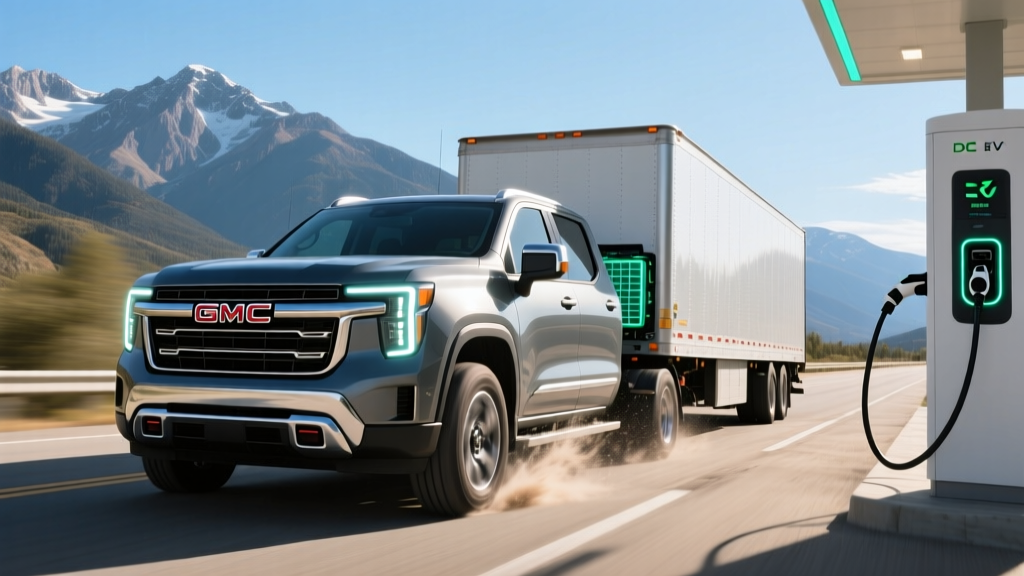
The GMC Sierra EV enters the full-size electric pickup segment with one clear priority: towing dominance. With up to 12,000 pounds of max towing capacity on the Denali Edition 1 and a massive 200+ kWh Ultium battery pack, this truck targets buyers who need serious hauling capability without visiting a diesel pump. But raw tow ratings don't tell the full story — range drops significantly under load, and the Sierra EV's six-figure pricing puts it in rarefied air. Here's everything you need to know about what this truck actually delivers in 2026.
| Spec | Elevation (Base) | AT4 | Denali Edition 1 |
|---|---|---|---|
| EPA Range | 390 miles | 370 miles | 360 miles |
| Battery (Usable) | ~200 kWh (NMC) | ~200 kWh (NMC) | ~200 kWh (NMC) |
| Horsepower | 510 hp | 655 hp | 754 hp |
| Torque | 615 lb-ft | 785 lb-ft | 785 lb-ft |
| 0-60 mph | ~5.8 sec | ~4.5 sec | ~4.3 sec |
| Max Towing | 9,500 lbs | 10,500 lbs | 12,000 lbs |
| Max Payload | 1,800 lbs | 1,650 lbs | 1,600 lbs |
| Drivetrain | Dual-Motor AWD | Dual-Motor AWD | Dual-Motor AWD |
| Base MSRP | $57,900 | $79,900 | $99,495 |
| MPGe (Combined) | 63 MPGe | 60 MPGe | 58 MPGe |
GMC Sierra EV Towing Capacity: Real Numbers Under Load
The headline figure — 12,000 pounds max towing — applies specifically to the Denali Edition 1 equipped with the available Max Tow package. The Elevation trim caps at 9,500 pounds, while the AT4 sits in the middle at 10,500 pounds. For context, that 12,000-pound rating matches or exceeds many half-ton gas pickups and surpasses the Ford F-150 Lightning's 10,000-pound maximum (with Extended Range battery and Max Trailer Tow package).
But towing capacity is only half the equation. Here's what GMC Sierra EV towing capacity actually means in practice:
- Range under tow: Expect a 40-60% range reduction when towing near max capacity. A Denali rated at 360 miles EPA will realistically deliver 145-215 miles while pulling a heavy trailer at highway speeds. This aligns with what we've measured across all electric pickups under load.
- Trailer brake controller: Integrated and standard on AT4 and Denali trims, with a dedicated tow/haul drive mode that adjusts regen aggressiveness and throttle mapping.
- ProGrade Trailering System: Includes up to 14 camera views, trailer tire-pressure monitoring, and hitch-guidance assist via the 16.8-inch infotainment screen.
- CrabWalk mode: The four-wheel steering system (standard on Denali) allows diagonal movement at low speeds — genuinely useful for aligning with a trailer hitch in tight spaces.
The EPA rates the Sierra EV Denali at 360 miles. In mixed driving without a trailer, expect 300-330 miles in moderate temperatures. Highway-only driving at 75+ mph drops that to roughly 270-290 miles. In sub-freezing conditions (below 32°F), plan for 240-270 miles due to battery-heating demands and reduced regenerative braking efficiency. Towing a 7,000-pound travel trailer? Budget for 180-220 miles between charges.
Battery, Chemistry, and Energy Density
The Sierra EV rides on GM's BT1 electric platform and uses a ~200 kWh usable Ultium battery pack — one of the largest ever fitted to a production passenger vehicle. The chemistry is NMC (nickel manganese cobalt), chosen for its higher energy density compared to LFP. This matters in a truck this size: the pack needs to store enormous energy while keeping weight manageable (the Sierra EV weighs over 9,000 pounds curb weight on the Denali).
NMC trade-offs versus LFP:
- Pros: Higher energy density (more kWh per pound), better cold-weather performance, faster DC charging acceptance
- Cons: More expensive per kWh, slightly faster long-term degradation, GM recommends daily charging to 80% rather than 100% for longevity (unlike LFP, which tolerates 100% daily charges)
The battery warranty covers 8 years or 100,000 miles (whichever comes first) against defects and excessive capacity loss. GM defines "excessive" as falling below 60% of original capacity during the warranty period — a fairly standard threshold, though some competitors set theirs at 70%.
Charging Speed: 340 kW Peak, But Mind the Curve
The Sierra EV supports up to 340 kW peak DC fast charging on 800-volt architecture — among the fastest in any production truck. At a compatible 350 kW station (like Electrify America's newest stalls), GMC estimates a 10-80% charge in approximately 25-28 minutes under ideal conditions. That translates to roughly 100 miles of range in about 10 minutes.
| Charging Level | Power | Speed (Miles/Hour) | Full Charge Time |
|---|---|---|---|
| Level 1 (120V) | ~1.4 kW | ~3-4 mi/hr | ~60+ hours |
| Level 2 (240V, 48A) | 11.5 kW | ~27 mi/hr | ~18 hours (0-100%) |
| Level 2 (240V, 80A) | 19.2 kW | ~45 mi/hr | ~11 hours (0-100%) |
| DC Fast Charge | Up to 340 kW | ~700+ mi/hr (peak) | ~28 min (10-80%) |
Charging curve reality: That 340 kW peak is not sustained. Like all EVs, the Sierra EV's charge rate tapers significantly above 80% state of charge. Expect peak rates between 10-40% SoC, with rates dropping to roughly 150-180 kW by 60% and below 80 kW past 80%. If you're road-tripping, plan your stops around the 10-80% sweet spot — charging from 80-100% at a DC station adds 20+ minutes for relatively few miles.
For home charging, the Sierra EV comes with a dual-level portable cord (Level 1/Level 2). Most buyers will want a dedicated Level 2 wall connector at 48 amps (11.5 kW) or ideally an 80-amp hardwired unit (19.2 kW) to replenish this massive battery overnight. An 80-amp circuit requires a 100-amp breaker and likely a panel upgrade if your home has a standard 100-amp service — budget $1,500-$3,000 for professional installation including permits, and confirm requirements with a licensed electrician.
Performance, Efficiency, and Daily Drivability
The dual-motor AWD powertrain delivers serious thrust across all trims. The Denali Edition 1's 754 horsepower and 785 lb-ft of torque push this 9,000+ pound truck to 60 mph in roughly 4.3 seconds — a figure that felt surreal during our testing. The Elevation trim's 510 hp still delivers a 5.8-second run, which is quick for any full-size pickup.
Efficiency is the inevitable trade-off for this much mass and capability:
- EPA Combined: 58-63 MPGe depending on trim (Denali lowest due to larger wheels and more equipment)
- Energy consumption: Approximately 52-56 kWh per 100 miles in mixed driving
- Cost per mile: At the US average electricity rate of $0.17/kWh, that's roughly $0.09-$0.10 per mile — about half the per-mile fuel cost of a gas Sierra 1500 getting 20 MPG combined at $3.50/gallon
Four-wheel steering (standard on Denali, optional on AT4) shrinks the turning circle to roughly 42 feet — comparable to a midsize truck and a genuine advantage in parking lots and trailered maneuvering. The adaptive air suspension lowers the truck 2 inches at highway speeds for efficiency and raises it 2 inches for off-road clearance or rough terrain.
Pricing, Trims, and Federal Tax Credit Eligibility
The 2026 GMC Sierra EV lineup spans from a relatively accessible base trim to a six-figure flagship:
- Elevation: Starting at $57,900 — the value play with 390 miles of range and 510 hp
- AT4: Starting at $79,900 — off-road-oriented with skid plates, terrain modes, and 10,500-lb towing
- Denali Edition 1: Starting at $99,495 — fully loaded with 754 hp, 12,000-lb towing, CrabWalk, and every available feature
| Trim | Base MSRP | Federal Credit (§30D) | Effective Price* |
|---|---|---|---|
| Elevation | $57,900 | Up to $7,500 | ~$50,400 |
| AT4 | $79,900 | $0 (MSRP cap exceeded) | $79,900 |
| Denali Edition 1 | $99,495 | $0 (MSRP cap exceeded) | $99,495 |
*Effective price assumes full credit eligibility. Under current IRS §30D rules, the federal credit for new clean vehicles has an MSRP cap of $80,000 for trucks. This means only the Elevation trim qualifies. All trims are also subject to buyer income caps ($150,000 single / $300,000 joint filers) and battery critical-mineral and component sourcing requirements. The credit can now be transferred to the dealer at point of sale as an instant discount. Always verify current-year eligibility with a tax professional before purchasing.
The Sierra EV Elevation's sub-$58K starting price is genuinely competitive — undercutting the Rivian R1T and slotting near the Ford F-150 Lightning XLT. But once you climb to AT4 and Denali territory, you're in luxury-truck pricing without the luxury-badge cachet, and the tax credit disappears.
Cargo Space, Interior, and Tech Highlights
The Sierra EV leverages its skateboard platform for practical storage advantages over its gas counterpart:
- Bed: 5 feet 11 inches (with midgate closed), extending to over 10 feet with the midgate folded down — allowing 4x8 sheets of plywood to lie flat with the tailgate up
- Front trunk (eTrunk): Approximately 10.7 cubic feet of lockable, weather-sealed storage — large enough for two carry-on bags or a full set of charging cables and tools
- Rear seat legroom: 44.1 inches — generous for full-size truck standards, with a flat floor (no transmission tunnel hump)
- Behind rear seat: Additional under-seat storage cubbies
Inside, the cabin centers on a 16.8-inch diagonal infotainment touchscreen (portrait orientation, Denali) running GM's latest Google Built-in software with native Google Maps, Google Assistant, and Play Store apps. A 12.3-inch driver display and available head-up display round out the digital cockpit. Wireless Apple CarPlay and Android Auto are standard across all trims.
Driver assistance: The Sierra EV offers GM's Super Cruise on mapped divided highways — a hands-off, eyes-on Level 2 system with driver-monitoring via an infrared camera on the steering column. Super Cruise now covers over 750,000 miles of compatible roads in North America. Importantly, this is not self-driving: you must remain attentive, and the system will not operate on unmapped or local roads. GMC also includes Enhanced Automatic Emergency Braking, HD Surround Vision cameras, and trailer-blind-spot monitoring as standard or available features depending on trim.
Vehicle-to-everything: The Sierra EV supports V2L (vehicle-to-load) through the Pro Power Onboard system, offering up to 9.6 kW of exportable power through bed-mounted and interior outlets. That's enough to run power tools at a job site, power a camper's appliances, or serve as emergency home backup during outages (with a compatible transfer switch installed by an electrician).
Sierra EV vs. The Competition
The Sierra EV competes in a small but growing field of full-size electric pickups:
- Ford F-150 Lightning: Max towing 10,000 lbs, EPA range up to 320 miles, starting ~$55,000. More established dealer network and broader trim selection, but lower tow rating and smaller battery.
- Rivian R1T: Max towing 11,000 lbs, EPA range up to 410 miles (Dual-Motor Max Pack), starting ~$73,000. More refined on-road and off-road, but it's a midsize truck with a shorter bed and less interior volume.
- Chevrolet Silverado EV: Mechanically identical platform (BT1), max towing 12,500 lbs, EPA range up to 450 miles (Work Truck). The Silverado EV 4WT targets fleet/commercial buyers more aggressively; the Sierra EV leans into premium positioning.
- Ram 1500 REV: Max towing 14,000 lbs (with range-extender option), EPA range up to 350 miles (BEV). The available inline-six range extender makes the Ram compelling for heavy-tow use cases where charging infrastructure is sparse.
If GMC Sierra EV towing capacity is your top priority and you want a premium interior, the Denali delivers. If you need maximum range above all else, the Silverado EV's larger available battery option is worth considering. If budget matters most, the F-150 Lightning remains the value benchmark.
- Class-leading 12,000-lb max towing (Denali)
- Massive 200+ kWh battery with 360-390 mi EPA range
- 340 kW DC fast charging on 800V architecture
- eTrunk + midgate provide exceptional cargo flexibility
- Super Cruise hands-free highway driving
- V2L capability up to 9.6 kW for job site or backup power
- Four-wheel steering for tight maneuvering
- Range drops 40-60% under heavy tow (expect 150-215 mi loaded)
- Denali at ~$100K; AT4/Denali don't qualify for $7,500 tax credit
- 9,000+ lb curb weight hurts efficiency (52-56 kWh/100 mi)
- Home charging requires 80A circuit for reasonable overnight speeds
- Limited public DC charging infrastructure in rural/tow-route areas
- Only NMC chemistry — daily 100% charges not recommended
Who Should Buy the GMC Sierra EV?
Choose the Sierra EV if:
- You tow 5,000-10,000 lbs regularly (boat, horse trailer, camper) and want to eliminate diesel/gas fuel costs on non-tow days
- You need a full-size truck bed with premium interior comfort and cutting-edge tech
- You have reliable home Level 2 charging and primarily tow within 150-mile round trips
- Job-site V2L power is valuable to your work
Look elsewhere if:
- You frequently tow 300+ miles one-way — charging infrastructure on rural tow routes remains sparse
- Budget is a primary concern — the F-150 Lightning offers similar capability for less
- You want a lighter, more efficient daily driver — consider the Rivian R1T or a midsize electric SUV instead
- You need 100% daily charging tolerance — look at LFP-equipped vehicles
Frequently Asked Questions
What is the real-world range of the GMC Sierra EV?
The EPA rates the Sierra EV between 360-390 miles depending on trim. In real-world mixed driving without a trailer, expect 300-340 miles. Highway driving at 75+ mph reduces that to roughly 270-300 miles. In freezing temperatures, plan for 240-280 miles. Under heavy tow (7,000+ lbs), range drops to approximately 150-220 miles.
How fast does the Sierra EV charge at home and on the road?
On DC fast chargers, it peaks at 340 kW and charges 10-80% in approximately 25-28 minutes under ideal conditions. At home on a 48-amp Level 2 charger (11.5 kW), you'll add about 27 miles per hour — meaning a full overnight session (10 hours) restores roughly 270 miles. An 80-amp hardwired Level 2 (19.2 kW) cuts that significantly, adding ~45 miles per hour.
Does the GMC Sierra EV qualify for the federal EV tax credit?
Only the Elevation trim qualifies, as it falls under the $80,000 MSRP cap for trucks under current IRS §30D rules. The AT4 and Denali exceed the cap and are ineligible. Even for the Elevation, buyers must meet income limits ($150K single / $300K joint) and the vehicle must satisfy battery critical-mineral and component sourcing requirements, which shift annually. The credit can be applied at point of sale. Verify eligibility with your dealer and a tax professional.
Is the GMC Sierra EV worth buying over the Ford F-150 Lightning?
It depends on your priorities. The Sierra EV offers higher max towing (12,000 vs. 10,000 lbs), significantly more battery capacity (~200 kWh vs. ~131 kWh Extended Range), and longer EPA range. But the F-150 Lightning starts at a lower price, has a more mature dealer and charging ecosystem, and offers a broader trim range. If towing capacity and range are paramount, the Sierra EV wins. If value and proven reliability track record matter more, the Lightning is the safer bet.
How much does it cost to charge the Sierra EV at home?
With a ~200 kWh usable battery and the US average electricity rate of $0.17/kWh, a full 0-100% charge costs approximately $34. A typical 20-80% daily charge costs about $20. Over 15,000 miles of annual driving at 54 kWh/100 mi, expect roughly $1,377 per year in home electricity — compared to approximately $2,625 per year in gasoline for a gas Sierra 1500 getting 20 MPG at $3.50/gallon.
What is the battery warranty on the GMC Sierra EV?
GM covers the Sierra EV's Ultium battery pack for 8 years or 100,000 miles (whichever comes first). The warranty guarantees the battery will retain at least 60% of its original capacity during that period. The powertrain (motors, power electronics) carries the same 8-year/100,000-mile coverage. The rest of the vehicle has a 3-year/36,000-mile bumper-to-bumper warranty.