The GMC Sierra EV was built to answer one question: can a full-size electric pickup deliver luxury-truck comfort without sacrificing utility? With a massive Ultium battery, available 754 horsepower, and an interior that leans hard into screens and modular storage, GMC is betting that premium truck buyers are ready to go electric. But does the GMC Sierra EV interior actually deliver on that promise, or is it all screen and no substance?
We've spent time with the 2026 Sierra EV across the Denali Edition 1 and the more accessible Elevation trim to break down what works, what doesn't, and whether the numbers on paper translate to the driveway. Here's everything you need to know before configuring one.
Quick Verdict: Who the Sierra EV Is For
The Sierra EV targets luxury-truck upgraders who want EV running costs, towing capability, and a tech-forward cabin — without stepping into a Tesla Cybertruck or a Rivian R1T. It's a crew-cab-only, unibody-style electric pickup (GM's BT1 platform) that prioritizes on-road refinement and interior space over hardcore off-road rock crawling. If you tow a boat on weekends, commute 40 miles daily, and want a frunk large enough to swallow carry-ons for the whole family, this truck earns a serious look. If you need a regular cab, a long bed, or serious trail-cred, look elsewhere.
Range, Battery, and Real-World Expectations
| Spec | Elevation (Standard Range) | Denali Edition 1 / AT4 (Max Range) |
|---|---|---|
| Usable Battery (kWh) | ~200 kWh (est., NMC) | ~215 kWh (est., NMC) |
| Chemistry | NMC (nickel manganese cobalt) | NMC |
| EPA Range | ~285 mi | 440 mi (Edition 1) |
| Efficiency | ~52 MPGe / 65 kWh/100mi | ~56 MPGe / 60 kWh/100mi |
GMC uses GM's Ultium platform with large-format pouch cells in an NMC chemistry. NMC offers higher energy density than LFP (critical for a truck this heavy to hit 440 miles), but it also means GMC recommends an 80% daily charge limit for long-term battery health — unlike LFP packs in some competitors that tolerate daily 100% charges.
Charging Speed: DC Fast, Level 2, and Home Setup
| Charging Type | Peak Rate | What It Delivers |
|---|---|---|
| DC Fast Charge (CCS/NACS w/ adapter) | 350 kW (Max Range) | 10–80% in ~35 min; ~100 mi in 10 min |
| DC Fast Charge (Std Range) | ~250 kW | 10–80% in ~40 min |
| Level 2 Home (240V, 48A) | 11.5 kW | ~25 mi/hr of range; full charge overnight |
| Level 2 Home (80A, hardwired) | 19.2 kW | ~42 mi/hr of range; requires 100A circuit |
| Level 1 (120V outlet) | ~1.4 kW | ~3 mi/hr — emergency/trickle only |
The Sierra EV supports up to 350 kW peak DC fast charging on Max Range trims via its native CCS1 port. A factory-available NACS adapter opens the Tesla Supercharger network — a significant practical advantage given Supercharger reliability in rural corridors. Note that peak 350 kW is only sustained between roughly 10–35% state of charge; expect the curve to taper to ~150 kW by 60% and below 75 kW past 80%. This is normal lithium-ion behavior, not a defect, but it means a 10–90% session will take closer to 50 minutes, not 35.
For home charging, the Sierra's 19.2 kW onboard charger is among the fastest in the truck segment — but only if your electrical panel can support a dedicated 100-amp circuit. Most homes will need a panel upgrade ($1,500–$3,000) plus the hardwired EVSE ($600–$1,000). Budget $2,500–$4,500 total for a full 80A installation by a licensed electrician. A 48A setup on an existing 60A circuit is the more common path, costing $800–$1,800 installed.
Inside the GMC Sierra EV Interior: Screens, Space, and the eTrunk
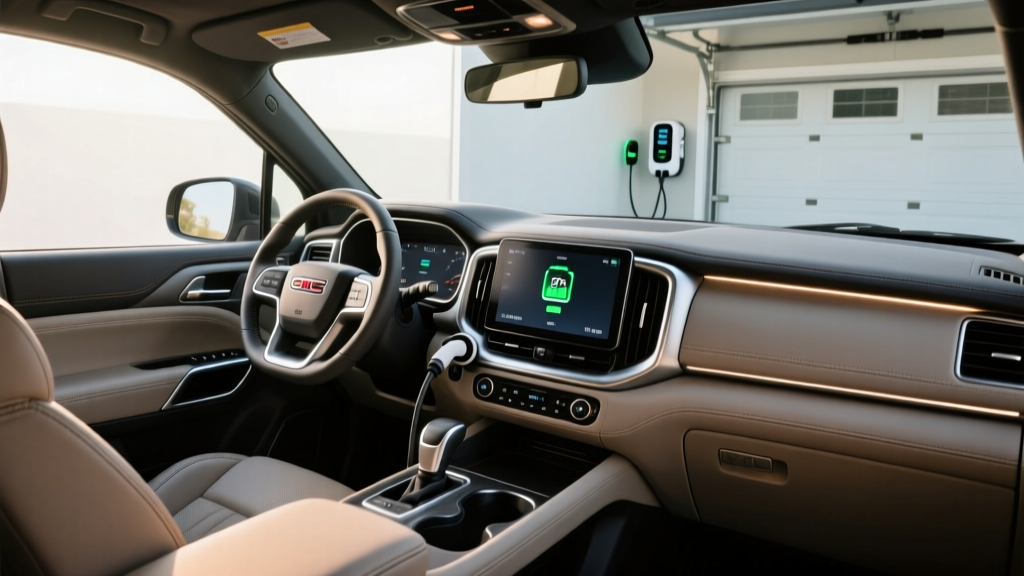
This is the section most buyers search for, and for good reason — the GMC Sierra EV interior is where GM has made its most aggressive design bets. The Denali Edition 1 centers around a portrait-oriented 16.8-inch infotainment touchscreen paired with an 11-inch digital instrument cluster and an available 14-inch head-up display. That's three screens spanning the dash, all running GM's latest Ultifi software stack with native Google Built-In (Maps, Assistant, Play Store).
Materials and Build
Denali trims get open-pore wood, aluminum trim, and available full-leather seating with contrast stitching. The Elevation trim uses a more durable synthetic leather with cloth inserts — honestly a better pick for truck-duty use with kids and dogs. Fit and finish on pre-production and early-delivery units has been strong, though some early owners have reported minor wind noise around the A-pillars at highway speed — worth checking on a test drive.
Storage That Actually Solves Problems
The Sierra EV's party piece is the eTrunk — a front trunk large enough to swallow a full-size carry-on suitcase or, as GMC demonstrated, a 7-foot step ladder. With ~10.7 cubic feet of lockable, weather-sealed volume, it's one of the most practical frunks on any EV. Combined with the MultiPro Tailgate and available MultiPro MidGate (which extends the 5'11" bed into the cabin for items up to ~11 feet long), the Sierra EV solves cargo problems that traditional pickups can't.
Passenger Dimensions
| Dimension | Measurement |
|---|---|
| Front Legroom | 45.2 in |
| Rear Legroom | 43.4 in |
| Front Headroom | 42.5 in |
| Bed Length | 5 ft 11 in (9 ft 7 in w/ MidGate open) |
| eTrunk Volume | 10.7 cu ft |
| Max Payload | ~1,800 lbs |
| Max Towing (w/ Max Trailering Pkg) | 12,500 lbs |
Notable Drawbacks
Not every interior decision lands. The Denali's glossy black console trim is a fingerprint magnet. The steering-wheel-mounted drive selector takes a week to build muscle memory. And while the 16.8-inch screen is impressive, many physical climate and volume controls have been absorbed into the touchscreen — a frustration for gloved winter use or quick adjustments while towing. The rear seat, while spacious, doesn't fold completely flat, limiting in-cabin cargo flexibility compared to the Rivian R1T's Gear Tunnel.
Performance: 754 HP, 4.5 Seconds, and AWD Standard
| Spec | Elevation | Denali Edition 1 |
|---|---|---|
| Drivetrain | Dual-Motor AWD | Dual-Motor AWD |
| Horsepower | 510 hp | 754 hp (Widemax mode) |
| Torque | 610 lb-ft | 785 lb-ft |
| 0–60 mph | ~5.0 sec | ~4.5 sec |
| Top Speed | ~112 mph | ~112 mph |
Every Sierra EV comes with dual-motor AWD. The Denali Edition 1's 754 hp in Widemax mode makes it one of the quickest full-size pickups ever sold — quicker than a Rivian R1T Dual-Motor and only slightly behind the Cybertruck Beast. But the more impressive number for daily driving is the instant torque at low speeds: merging onto a highway with a bed full of lumber requires no downshift, no lag, no drama.
Ride quality benefits from the available Adaptive Air Ride suspension, which lowers the truck ~1.5 inches at highway speed for efficiency and raises it ~2 inches for ground clearance on rough terrain. It's a noticeable improvement over the coil-spring Elevation trim, particularly when the bed is empty.
Driver Assistance: Super Cruise, Not Self-Driving
The Sierra EV offers GM's Super Cruise on over 750,000 miles of compatible divided highways in the U.S. and Canada. It's one of the best Level 2 systems available — genuinely hands-free on mapped roads, with smooth lane-keeping and natural-feeling automatic lane changes on Denali trims. Trailering-capable Super Cruise is also available, maintaining hands-free operation even with a trailer connected — a first in the segment.
Pricing, Trims, and Federal Tax Credit Eligibility
| Trim | Base MSRP | Est. As-Tested | §30D Credit Eligible? |
|---|---|---|---|
| Elevation (Std Range) | ~$64,900 | $68,000–$74,000 | Yes, up to $7,500* |
| AT4 (Max Range) | ~$84,900 | $89,000–$96,000 | Yes, up to $7,500* |
| Denali Edition 1 (Max Range) | ~$99,495 | $102,000+ | Yes, up to $7,500* |
*Pricing reflects 2025/2026 model-year MSRPs before destination. Final §30D eligibility depends on battery-sourcing, critical-mineral content, buyer AGI, and MSRP caps. See IRS.gov §30D guidelines.
Tax Credit Checklist (§30D — 2026 Rules)
- MSRP Cap: Pickup trucks/vans must be under $80,000 MSRP. The Elevation qualifies; the AT4 and Denali Edition 1 may exceed the cap depending on options — confirm with your dealer before purchase.
- Buyer Income Cap: AGI must not exceed $150,000 (single), $225,000 (head of household), or $300,000 (joint).
- Battery Sourcing: Partial credit ($3,750) requires critical-mineral compliance; full $7,500 requires both critical-mineral AND battery-component sourcing from U.S. or FTA-partner countries. GM sources Ultium cells from U.S. plants (Lansing, Orion), but critical-mineral supply chains shift — verify the specific VIN on fueleconomy.gov.
- Point-of-Sale Transfer: Eligible buyers can apply the credit as a down-payment reduction at the dealer rather than waiting for tax filing.
- One Vehicle Per 3 Years: You cannot claim a new-EV credit if you've claimed one in the prior 36 months.
Warranty and Long-Term Battery Confidence
| Coverage | Term |
|---|---|
| Bumper-to-Bumper | 3 years / 36,000 mi |
| Powertrain | 5 years / 60,000 mi |
| Battery & Electric Components | 8 years / 100,000 mi |
| Battery Capacity Retention Threshold | Below 70% of original capacity |
GM's 8-year/100,000-mile battery warranty is industry-standard and matches Ford, Rivian, and Tesla. The 70% retention threshold means GMC will replace or repair the pack if it degrades below that level within the warranty window. Based on Ultium chemistry data from the Cadillac Lyriq and Hummer EV (which share the platform), real-world degradation after 3 years and 45,000 miles has averaged 6–9% — well within the warranty margin. For a 440-mile pack, that's still ~400 miles of range after three years of typical use.
Sierra EV vs. the Competition
| Attribute | GMC Sierra EV Denali | Ford F-150 Lightning | Rivian R1T Tri-Motor | Tesla Cybertruck AWD |
|---|---|---|---|---|
| EPA Range | 440 mi | 320 mi (Ext Range) | 420 mi (Max Pack) | 340 mi |
| Max DC Charge | 350 kW | 150 kW | 220 kW | 250 kW |
| 0–60 mph | 4.5 sec | 3.8 sec | ~3.0 sec | 4.1 sec |
| Max Tow | 12,500 lbs | 10,000 lbs | 11,000 lbs | 11,000 lbs |
| Starting MSRP | $64,900 | $54,995 | $89,900 | $79,990 |
| Frunk | 10.7 cu ft | 14.1 cu ft | 11.0 cu ft | None |
Choose the F-150 Lightning if: Budget is the priority and you want the most proven platform with the largest frunk.
Choose the Rivian R1T if: Off-road capability and adventure features (Gear Tunnel, Camp Kitchen) outweigh highway range.
Choose the Cybertruck if: You want stainless-steel styling, 48-volt architecture, and don't mind polarizing design and limited service centers.
Pros, Cons, and Bottom Line
Pros
- Class-leading 440-mile EPA range (Max Range pack)
- 350 kW DC charging — fastest in the segment
- Massive, practical eTrunk and MultiPro MidGate
- Super Cruise with trailering capability
- 19.2 kW onboard charger for fast home replenishment
- Quiet, refined on-road ride with air suspension
Cons
- Top trims push past $100K — luxury-SUV territory
- Crew-cab only; no regular or extended cab options
- Touchscreen-heavy climate controls frustrate in winter
- Off-road capability trails Rivian R1T and Cybertruck
- NACS adapter required for Supercharger access (not native)
- Real-world towing range drops sharply (~50%)
Frequently Asked Questions
What is the real-world range of the GMC Sierra EV?
The Max Range pack delivers an EPA-estimated 440 miles, but expect 350–380 miles at highway speeds, 290–320 miles in freezing temperatures, and roughly 180–200 miles when towing a 5,000-lb trailer. Standard-range models realistically return 230–260 highway miles.
How fast does the Sierra EV charge at home and on the road?
On a 350 kW DC fast charger, the Max Range pack hits 10–80% in approximately 35 minutes. At home on a 48A Level 2 charger, it adds about 25 miles per hour (~11.5 kW). An 80A hardwired setup adds ~42 miles per hour at 19.2 kW.
Does the GMC Sierra EV qualify for the $7,500 federal tax credit?
The Elevation trim (under $80K MSRP) generally qualifies, pending buyer income limits and battery-sourcing compliance. Higher trims may exceed the $80,000 MSRP cap for trucks — confirm the specific VIN on fueleconomy.gov before purchase. Always consult a tax professional for your personal situation.
Is the Sierra EV worth it vs. the F-150 Lightning?
If range and premium interior quality are priorities, the Sierra EV's 440-mile pack and Denali cabin are a clear step up. If budget matters more, the Lightning undercuts by $10,000+ and offers a larger frunk with a more proven production track record.
Can the Sierra EV tow a camper or boat?
Yes — up to 12,500 lbs with the Max Trailering Package. Super Cruise remains available while towing on mapped highways. Just plan charging stops every 150–180 miles when trailering, as towing roughly halves effective range.
Is Super Cruise actually self-driving?
No. Super Cruise is SAE Level 2 — hands-free on compatible highways, but you must remain attentive and ready to take over. It does not handle city streets, unmapped roads, or adverse weather autonomously.
For the latest Sierra EV configuration data and official specs, visit GMC's official Sierra EV page. For safety ratings as they become available, check NHTSA.gov and IIHS.org.