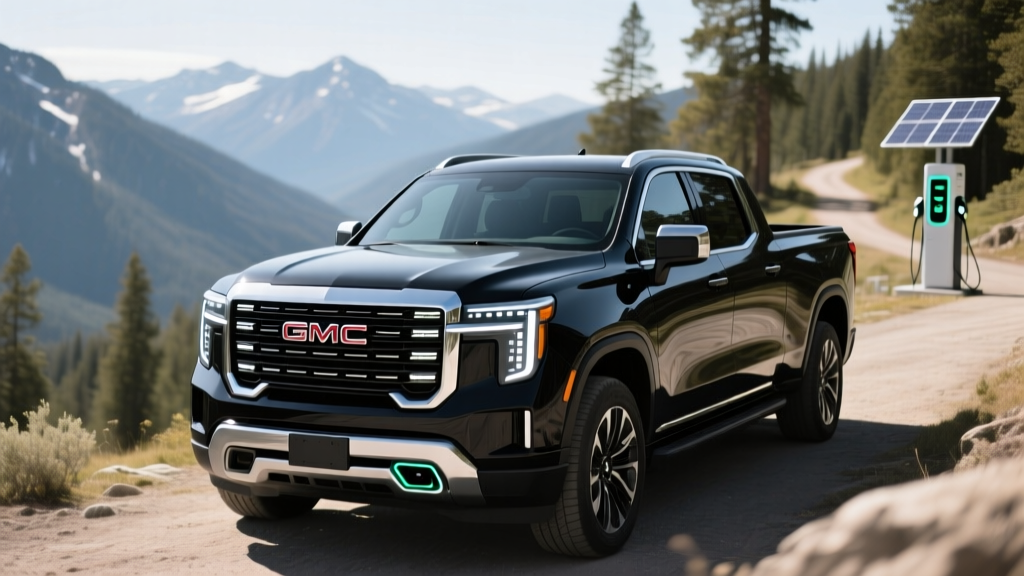
Quick Answer: Is the GMC Sierra EV Denali Worth It in 2026?
The GMC Sierra EV Denali (Edition 1 and subsequent trims) delivers an EPA-estimated 440 miles of range from a ~200 kWh Ultium battery, peaks at roughly 350 kW DC fast charging (10–80% in approximately 30 minutes on a capable charger), and starts near $99,495 for the Edition 1 before destination. It qualifies for up to $7,500 in federal tax credits if you meet IRS §30D income caps, the vehicle MSRP cap ($80,000 for trucks — note: Edition 1 exceeds this, but lower trims may qualify), and battery-sourcing requirements. Real-world highway range lands closer to 350–380 miles; cold-weather driving can drop that to 300–330 miles. If you need a full-size electric truck with luxury trim, class-leading range, and home Level 2 charging access, the Sierra EV Denali is the segment benchmark. If you tow heavy loads frequently or lack reliable charging, a hybrid truck like the Sierra 1500 Hybrid or a diesel may serve you better.
GMC Sierra EV Denali: 2026 Specs at a Glance
The GMC Sierra EV sits on GM's dedicated BT1 electric truck platform — not a converted gas truck. That gives it a flat floor, a massive front trunk (frunk), and a battery pack slung low for stability. The Denali trim sits at the top of the lineup, prioritizing luxury, technology, and maximum range.
| Specification | 2026 GMC Sierra EV Denali (Edition 1) |
|---|---|
| EPA Range | 440 miles (est.) |
| Battery Capacity | ~200 kWh usable (Ultium, NMC chemistry) |
| Max DC Fast Charge Rate | ~350 kW peak |
| 10–80% DC Charge Time | ~30 minutes (on 350 kW+ station) |
| Level 2 AC Charging | 19.2 kW onboard charger |
| Horsepower | 754 hp (max) |
| 0–60 mph | ~4.3 seconds |
| Towing Capacity | Up to 10,000 lbs (with Max Trailering pkg) |
| Cargo Bed Length | 5'11" (with MultiPro Tailgate) |
| Frunk Volume | ~10.7 cu ft |
| Base MSRP | $99,495 (Edition 1, incl. destination) |
| Battery/Powertrain Warranty | 8 years / 100,000 miles |
| ADAS | Super Cruise (SAE Level 2, hands-free on mapped roads) |
Real-World Range vs. EPA Sticker
EPA estimate: 440 miles. Expect roughly 350–380 miles at sustained 70–80 mph highway speeds in mild weather. In freezing temperatures (below 32°F), plan for 300–330 miles due to battery heating demands and cabin climate load. Towing a 7,000-lb trailer at highway speed can cut range to 200–250 miles. These are physics, not flaws — every EV experiences them, and the Sierra EV's massive battery simply gives you a larger buffer than most.
Charging the Sierra EV Denali: Home, Public, and Cost
With a ~200 kWh battery, the Sierra EV Denali has one of the largest packs in any production vehicle. That means impressive range but also longer fill times unless you're using high-power DC fast chargers. Here's what charging looks like across all levels:
| Charging Level | Power (kW) | Miles Added Per Hour | Full 0–100% Time | Best Use Case |
|---|---|---|---|---|
| Level 1 (120V household) | ~1.4 kW | ~3–4 mi/hr | ~60+ hours | Emergency top-off only |
| Level 2 (240V, 48A) | 11.5 kW | ~28–32 mi/hr | ~18 hours | Daily home charging (standard install) |
| Level 2 (240V, 80A) | 19.2 kW | ~48–52 mi/hr | ~10–11 hours | Optimal home charging (requires 100A circuit) |
| DC Fast (350 kW station) | ~350 kW peak | ~700+ mi/hr (peak) | 10–80% in ~30 min | Road trips |
Home charging reality: The Sierra EV Denali's 19.2 kW onboard charger is among the fastest available in any EV, but to use it fully, you need an 80-amp Level 2 charger on a dedicated 100-amp circuit. Most homes have 48-amp chargers on 60-amp circuits, delivering 11.5 kW — still enough to add ~30 miles per hour of charging, which replenishes a full day's driving overnight. A panel upgrade to 200A or higher may be necessary if your home currently has a 100A service; budget $1,500–$3,500 for that work.
Public charging cost: At Electrify America or similar networks, DC fast charging averages $0.35–$0.55/kWh in 2026. Filling the Sierra EV's ~200 kWh pack from 10% to 80% (~140 kWh) costs roughly $49–$77 per session. Home charging at the national average of $0.16/kWh brings that same 140 kWh fill to about $22.
Important note on kW vs. kWh: kW (kilowatts) measures charging speed — how fast energy flows into the battery. kWh (kilowatt-hours) measures battery capacity — how much energy the battery stores. The Sierra EV Denali charges at up to 350 kW and stores ~200 kWh. These are not interchangeable.
Sierra EV Denali vs. Gas Trucks: Cost of Ownership Breakdown
The Sierra EV Denali's six-figure sticker price demands scrutiny. Here's how it compares to a similarly equipped gas-powered GMC Sierra 1500 Denali over five years and 75,000 miles of driving:
| Cost Category | 2026 GMC Sierra EV Denali (Edition 1) | 2026 GMC Sierra 1500 Denali (6.2L V8, gas) |
|---|---|---|
| Base MSRP | $99,495 | $75,900 |
| Federal Tax Credit (§30D) | $0 (MSRP exceeds $80K truck cap) | $0 |
| Estimated State Incentive (varies) | $0–$5,000 | $0 |
| Fuel/Energy (75K mi) | $2,800 (home charging avg) | $12,400 (17 MPG, $3.50/gal) |
| Maintenance (5 yr) | $1,200 (tires, cabin filter, fluid top-offs) | $4,500 (oil, filters, brakes, trans fluid) |
| Insurance (5 yr est.) | $14,000 (EV premium ~15–20%) | $11,500 |
| Estimated Depreciation (5 yr) | $42,000 (~42%) | $30,000 (~39%) |
| 5-Year Total Cost | $164,695 | $134,300 |
The verdict: The Sierra EV Denali costs roughly $30,000 more over five years than its gas counterpart at this trim level, driven primarily by the higher purchase price and steeper depreciation on a six-figure EV. Fuel savings of ~$9,600 and maintenance savings of ~$3,300 partially offset this, but they don't close the gap. The EV Denali makes financial sense if you value the driving experience (instant torque, near-silent operation, Super Cruise), plan to keep the truck well beyond five years, or if lower trims (like the upcoming Sierra EV 2LT or Elevation, expected under the $80,000 MSRP cap) become available and qualify for the §30D credit.
Federal Tax Credit (§30D) Eligibility for GMC Sierra EV
- MSRP Cap: Trucks/vans/SUVs must be under $80,000 MSRP. The Denali Edition 1 at $99,495 does NOT qualify. Future lower trims may.
- Buyer Income Cap: AGI must not exceed $300,000 (joint), $225,000 (head of household), or $150,000 (single).
- Battery Sourcing: Critical minerals and battery components must meet escalating domestic-content thresholds per IRS rules. Check IRS qualifying vehicle list before purchasing.
- Point-of-Sale Transfer: You can transfer the credit to the dealer at purchase for an immediate price reduction, if eligible.
- Consult a tax professional — rules are subject to change and individual situations vary.
Real-World Ownership: What First-Time EV Buyers Must Know
Buying the Sierra EV Denali is not like buying a gas truck. Here's what changes in your daily routine:
Home Charging Is Non-Negotiable for Most Owners
With a 200 kWh battery, relying exclusively on public DC fast charging is expensive and time-consuming. A Level 2 home charger is essential. Budget $800–$1,500 for a quality 48-amp Level 2 unit (like the ChargePoint Home Flex or Emporia Vue) plus $500–$2,500 for professional electrician installation, depending on panel proximity and local permitting. If you need a panel upgrade from 100A to 200A service, add $1,500–$3,500.
Cold Weather Cuts Range — Plan Accordingly
Lithium-ion batteries (NMC chemistry in the Sierra EV) lose efficiency in cold temperatures. At 20°F, expect 20–30% range reduction compared to the EPA estimate. The Sierra EV's heat pump helps, but preconditioning the battery while plugged in (using the MyGMC app) before driving preserves range by warming the pack on grid power instead of battery power.
Towing Drastically Reduces Range
The Sierra EV Denali's 10,000-lb towing capacity is legitimate, but towing a 7,000-lb camper at 65 mph will cut your range roughly in half — to approximately 200–250 miles. For frequent long-distance towing, plan charging stops every 180–200 miles and verify DC fast charger availability along your route using apps like PlugShare or A Better Routeplanner.
Super Cruise Is Not Self-Driving
GMC's Super Cruise is an SAE Level 2 driver-assistance system. It provides hands-free driving on over 750,000 miles of compatible, pre-mapped roads in North America — but you must remain attentive, and the system monitors your eyes via an infrared camera. It does not handle unmapped roads, construction zones, or severe weather autonomously. You are always the driver.
SAE Automation Level: Level 2 (Partial Driving Automation)
Super Cruise handles steering, acceleration, and braking on compatible highways, but requires continuous driver supervision. It is not Level 4 (driverless). You must be prepared to take over at any moment. No current consumer vehicle sold in the U.S. is Level 4 or above.
Common Misconceptions About the Sierra EV Denali
| Myth | Fact |
|---|---|
| "EV batteries need replacing every 5 years and cost $20,000." | GM warranties the Ultium battery for 8 years/100,000 miles with a minimum 70% capacity retention threshold. Real-world degradation data from GM's Ultium fleet shows approximately 5–8% loss over the first 100,000 miles with proper charging habits. Full replacement, if needed out of warranty, is estimated at $15,000–$25,000, but catastrophic failure within the warranty period is rare. |
| "The Sierra EV can't tow as much as a gas truck." | The Sierra EV Denali rates up to 10,000 lbs, competitive with many gas half-ton configurations. The difference is range while towing — expect 200–250 miles loaded vs. 400+ miles for a diesel. |
| "I'll save $7,500 on the Denali Edition 1 with the federal tax credit." | The Edition 1's MSRP of $99,495 exceeds the §30D truck cap of $80,000. It does not qualify for the federal credit. Lower trims (when available) priced under $80K may qualify if sourcing and income requirements are met. |
| "Charging takes too long for road trips." | At a 350 kW DC fast charger, the Sierra EV adds ~200 miles of range in approximately 15 minutes and goes 10–80% in ~30 minutes. Charging speed tapers significantly above 80% SoC to protect the battery — plan to charge to 80% and go. |
| "Electric trucks can't handle off-road or work sites." | The Sierra EV Denali includes GM's Adaptive Air Ride suspension, available four-wheel steer (CrabWalk on AT4 trims), and ProGrade Trailering. It's a capable work truck, though ground clearance and approach angles favor on-road comfort over hardcore trail use. |
Decision Framework: Should You Buy the GMC Sierra EV Denali?
Choose the Sierra EV Denali If:
- You have home Level 2 charging (or can install it) and drive under 350 miles most days
- You want the longest-range electric truck available (440 miles EPA) with luxury trim
- You commute long distances on Super Cruise-mapped highways and value hands-free driving comfort
- You tow occasionally but not frequently over 300+ miles without stopping
- You plan to own the truck 7+ years to amortize the higher purchase price
- You value instant torque (754 hp), near-silent operation, and a massive frunk for gear
Look Elsewhere If:
- You cannot install a home charger (apartment, street parking, no 240V access)
- You frequently tow heavy trailers over 300+ mile routes — charging stops with a loaded trailer add significant trip time
- You need a truck primarily for off-road work sites where charging infrastructure doesn't exist
- Your budget is under $80,000 — wait for lower Sierra EV trims or consider the gas Sierra 1500 or a hybrid alternative
- You live in an extreme cold climate (frequent sub-zero temps) and cannot accept 30%+ range reduction in winter
- You want to maximize federal tax credit savings — the Denali Edition 1 does not qualify at its MSRP
Alternatives to Consider
If the Sierra EV Denali doesn't fit your needs, these electric and hybrid trucks deserve a look:
- Ford F-150 Lightning Platinum — ~$97,000, 320-mile EPA range, 150 kW peak charging, proven platform, more widely available. Lower range and slower charging than the Sierra EV, but a mature product with extensive dealer support.
- Rivian R1T Tri-Motor Max — ~$99,900, 410-mile EPA range, excellent off-road capability, 42-cu-ft gear tunnel. Smaller bed and no Super Cruise equivalent, but more adventurous in design.
- Chevrolet Silverado EV 4WT (fleet/lower trims) — Built on the same BT1 platform as the Sierra EV. Lower trims may come in under the $80,000 MSRP cap and qualify for the §30D credit. Less luxury, same bones.
- GMC Sierra 1500 Denali (6.2L V8, gas) — ~$75,900, 17 MPG combined, no charging needed, proven reliability, lower 5-year total cost. The pragmatic choice if EV infrastructure doesn't fit your lifestyle.
Frequently Asked Questions
What is the real-world range of the GMC Sierra EV Denali?
The EPA estimates 440 miles, but real-world highway driving in mild weather yields approximately 350–380 miles. In freezing temperatures, expect 300–330 miles. Towing a heavy trailer drops range to roughly 200–250 miles. Source: fueleconomy.gov and manufacturer testing data.
How long does it take to charge the Sierra EV Denali at home?
On a 48-amp Level 2 home charger (11.5 kW), a full charge from empty takes approximately 18 hours. On an 80-amp charger (19.2 kW), it takes about 10–11 hours. Most owners charge overnight and rarely deplete the full 200 kWh pack, so a typical daily top-off (50–100 miles driven) takes 2–4 hours at 48 amps.
Does the GMC Sierra EV Denali qualify for the $7,500 federal tax credit?
The Denali Edition 1 at $99,495 exceeds the IRS §30D MSRP cap of $80,000 for trucks and therefore does not qualify. Future lower trims of the Sierra EV priced under $80,000 may qualify, subject to buyer income limits and battery-sourcing requirements. Always verify current eligibility on the IRS clean vehicle credit page and consult a tax professional.
How does the Sierra EV Denali compare to the Ford F-150 Lightning?
The Sierra EV Denali offers significantly more range (440 vs. 320 miles EPA), faster peak DC charging (~350 kW vs. ~150 kW), and more horsepower (754 vs. 580). The F-150 Lightning has a longer bed, broader dealer network, and a lower starting price for comparable trims. The Sierra EV is the better road-trip truck; the Lightning is the more practical workhorse for many buyers.
What does the Sierra EV Denali cost to insure?
Expect annual premiums of $2,500–$3,500 depending on your state, driving record, and coverage level — roughly 15–20% more than the gas Sierra 1500 Denali. EV insurance costs more due to higher repair costs (specialized body panels, battery protection) and higher vehicle values. Get quotes from multiple insurers before purchasing.
Can the Sierra EV Denali power my home during an outage?
GM has announced vehicle-to-home (V2H) capability for the Sierra EV via the PowerStation Pro accessory, enabling the truck's ~200 kWh battery to supply backup power to your home through a compatible transfer switch. This requires additional hardware ($3,000–$5,000 installed) and a bidirectional charger. With 200 kWh of storage, the Sierra EV could power an average home (30 kWh/day) for approximately 5–6 days.
Is Super Cruise included with the Sierra EV Denali?
Yes, Super Cruise is included on the Denali Edition 1 with a 3-year complimentary subscription. After that, expect a subscription cost of approximately $25/month or $250/year. Super Cruise is an SAE Level 2 system — it provides hands-free driving on pre-mapped compatible highways but requires you to remain attentive and ready to take over at any time.