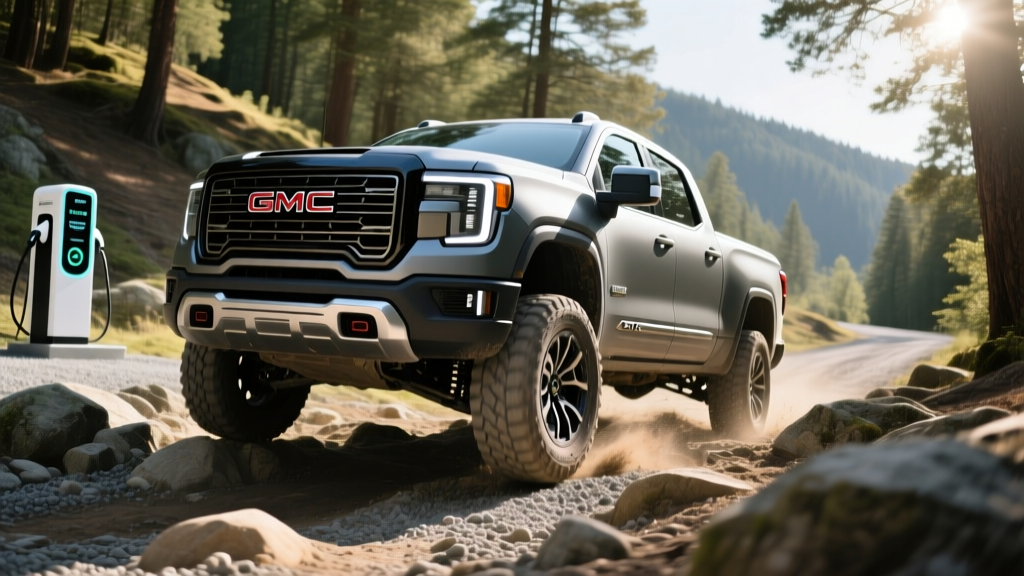
The GMC Sierra EV AT4X is General Motors' answer to a question few automakers have dared to tackle: Can a full-size electric pickup be a genuine off-road rig while delivering the range and towing capability truck buyers demand? Built on GM's Ultium platform and positioned as the most rugged Sierra EV variant, the AT4X targets the intersection of trail capability and zero-tailpipe-emission daily driving.
We've spent time with the specs, cross-referenced EPA data, and analyzed real-world ownership scenarios to give you the unvarnished numbers that matter. Here's everything you need to know before putting down a deposit.
Range and Efficiency: What the EPA Says vs. the Real World
The 2026 GMC Sierra EV AT4X carries an EPA-estimated range of approximately 390 miles on a full charge when equipped with the larger Ultium battery pack. That figure applies to the AT4X's specific trim configuration, which includes all-terrain tires and off-road suspension tuning that introduce slight aerodynamic and rolling-resistance penalties compared to the road-oriented Denali Edition 1.
EPA Sticker: ~390 miles
Highway (70 mph, moderate temps): Expect 320–350 miles. Full-size trucks suffer significant aero drag at speed.
Cold Weather (below 32°F): Plan for 260–310 miles. Battery chemistry resistance and cabin heating cut range 20–30%.
Towing (5,000+ lb trailer): Range can drop to 150–200 miles depending on trailer profile and terrain.
The AT4X's efficiency is rated at approximately 56 MPGe combined, which translates to roughly 60 kWh per 100 miles in mixed driving. For a truck of this mass and frontal area, that's competitive with the Rivian R1T and Ford F-150 Lightning, though none of these vehicles will match the efficiency of a sedan or crossover. If your commute is mostly city driving with regenerative braking opportunities, you'll skew closer to — or slightly above — the EPA number. Sustained highway driving is where the Sierra EV AT4X drinks electrons fastest.
Battery, Chemistry, and the Ultium Architecture
The Sierra EV AT4X uses GM's Ultium battery platform with a usable capacity of approximately 200 kWh in its largest available pack configuration. GM has deployed both NMC (nickel manganese cobalt) and LFP (lithium iron phosphate) chemistries across the Ultium family depending on the model and pack size. For the Sierra EV in its long-range configuration, NMC chemistry is used, which offers higher energy density — critical for fitting 200+ kWh into a truck platform without excessive weight penalty.
| Specification | Value |
|---|---|
| EPA Range (est.) | ~390 miles |
| Battery (usable) | ~200 kWh, NMC |
| Drivetrain | Dual-motor AWD (e4WD) |
| Horsepower | ~655 hp (max output) |
| 0–60 mph | ~4.5 seconds (est.) |
| Max DC Fast Charge | 350 kW |
| 10–80% DC Charge Time | ~35 minutes |
| Level 2 Home Charging | 11.5 kW / ~19 mi/hr |
| Max Towing (est.) | ~10,000 lbs |
| MPGe (combined) | ~56 MPGe |
| Base MSRP (AT4X) | ~$102,000 |
NMC cells deliver more range per kilogram but come with trade-offs: they are more sensitive to sustained high-state-of-charge storage and fast-charge heat. For longevity, GM's battery management system maintains a buffer at the top and bottom of the pack. If you plan to charge to 100% nightly, consider that LFP packs tolerate this better — but LFP isn't available in the Sierra EV's largest pack option as of the 2026 model year.
Charging Speed: DC Fast, Level 2, and What to Expect
The Sierra EV AT4X supports up to 350 kW peak DC fast charging on compatible CCS stations (and NACS via GM's adapter, as GM has adopted the Tesla North American Charging Standard for 2025+ models). On an Electrify America or Tesla Supercharger V4 station capable of delivering that power, the truck can recover significant range quickly — but peak rate is not sustained rate.
| Charging Level | Power | Rate / Time |
|---|---|---|
| Level 1 (120V outlet) | ~1.4 kW | ~2–3 miles per hour |
| Level 2 (240V, 48A) | 11.5 kW | ~19 miles per hour |
| DC Fast Charge (peak) | Up to 350 kW | 10–80% in ~35 min |
| DC Fast Charge (sustained avg.) | ~150–200 kW | 80–100% adds 25–30 min more |
Here's the charging-curve reality: the Sierra EV AT4X will hit its 350 kW peak only at a low state of charge (roughly 10–25% SoC) and at an optimal battery temperature. As the pack fills past 50%, the charge rate tapers. By 80%, you're likely pulling under 100 kW. This is normal for large NMC packs and is managed by the vehicle's thermal preconditioning system. If you navigate to a fast charger using the built-in route planner, the truck will precondition the battery to accept higher rates upon arrival — always use this feature for the fastest sessions.
For home charging, a Level 2 wallbox at 11.5 kW (48 amps on a 240V/60A circuit) adds roughly 19 miles of range per hour. A full charge from 10% to 100% takes approximately 10–12 hours — practical for overnight replenishment. Installation typically requires a 60-amp dedicated circuit; if your electrical panel is at capacity, budget $1,500–$3,000 for a panel upgrade on top of the $500–$1,200 charger and $800–$2,000 electrician labor. Always consult a licensed electrician for your specific setup.
Off-Road Hardware: What Makes the AT4X Different
The AT4X badge isn't just an appearance package. GMC equips this trim with:
- Multimatic DSSV (Dynamic Suspensions Spool Valve) dampers — the same hardware found on the Colorado ZR2, providing exceptional wheel articulation and damping control on rough terrain
- Front and rear electronic locking differentials — critical for low-traction situations where one wheel loses grip
- 35-inch all-terrain tires on specific 18-inch wheels (more sidewall for rock crawling and trail compliance)
- Increased ground clearance — approximately 11.6 inches, competitive with the Raptor and TRX in the ICE world
- Underbody skid plates protecting the battery enclosure, front motor, and rear differential
- Terrain Mode selector with specific calibrations for mud, sand, rock, and snow
The dual-motor AWD system (which GMC calls e4WD) provides independent torque control front and rear. Unlike a mechanical transfer case, the electric motors can vector torque instantly without the lag of a traditional system. In practice, this means the AT4X can crawl over obstacles with precise low-speed control while also launching like a performance sedan on pavement.
The tradeoff? All of this hardware adds weight and rolling resistance, which is why the AT4X's range is lower than the Denali trim. If you never leave pavement, the Denali is the more efficient buy. If trail capability is a priority, the AT4X justifies its range penalty.
Performance, Towing, and Practical Dimensions
With approximately 655 horsepower available in its top output mode, the Sierra EV AT4X is far more powerful than any off-road truck strictly needs. The estimated 0–60 mph time of around 4.5 seconds is sports-car territory in a vehicle that weighs over 9,000 pounds. GM's Watts Link rear suspension and independent front suspension help manage that mass on-road, but physics is physics — you'll feel the weight in corners and during emergency braking.
Towing capacity is estimated at up to 10,000 pounds when properly equipped. The Sierra EV's available MultiPro Tailgate and integrated trailer brake controller are practical touches. However, towing at or near max capacity will severely impact range — expect a 50–60% reduction. If you tow frequently over long distances, plan your charging stops carefully and understand that DC fast charging with a trailer attached is awkward at most current stations.
Interior dimensions are generous. The Sierra EV crew cab offers approximately 45 inches of front legroom and 43 inches of rear legroom, with rear-seat passengers benefiting from the flat floor (no transmission tunnel). The bed is approximately 5 feet 11 inches in length (shorter than a traditional 6.5-foot bed), but the available MultiPro Midgate allows you to fold down the partition between cab and bed, extending usable load length to over 9 feet with the tailgate down. Cargo volume behind the rear seats is competitive with other full-size crew cabs.
The frunk (front trunk) is a notable omission on the Sierra EV — unlike the F-150 Lightning, GM chose not to include a front cargo area, citing structural and crash-engineering decisions for the Ultium platform. If front cargo storage is a priority, the Lightning wins this category.
Pricing, Tax Credits, and Ownership Cost
The 2026 GMC Sierra EV AT4X carries a base MSRP of approximately $102,000, with options and packages pushing well-equipped examples to $110,000 or more. This positions the AT4X as a premium offering — more expensive than a base F-150 Lightning Lariat but in line with the Rivian R1T Adventure with the Max Pack and the Ford F-150 Lightning Platinum.
| Item | Amount |
|---|---|
| Base MSRP (AT4X) | ~$102,000 |
| Federal Tax Credit (§30D) | Up to $7,500 (if eligible) |
| Effective Price (with full credit) | ~$94,500 |
- MSRP Cap: Trucks, SUVs, and vans must have an MSRP at or below $80,000 to qualify. The Sierra EV AT4X at ~$102,000 exceeds this cap and is NOT eligible for the new-vehicle §30D credit.
- Income Caps: AGI limits apply — $300K joint, $225K head of household, $150K single.
- Battery Sourcing: Critical minerals and battery component requirements must be met (phased thresholds through 2026).
- Point-of-Sale Transfer: Eligible buyers can transfer the credit to the dealer for an upfront price reduction.
Source: IRS Clean Vehicle Credits. Consult a tax professional for your specific eligibility.
This is a critical detail many buyers miss: the Sierra EV AT4X does not qualify for the $7,500 federal new-vehicle tax credit because its MSRP exceeds the $80,000 cap for trucks. Lower-priced Sierra EV trims (such as certain Elevation configurations) may fall under the cap, but the AT4X and Denali are ineligible. Some states offer their own EV incentives that have no MSRP cap — check your state's energy office or DMV for local programs.
On the ownership-cost side, electricity for home charging at $0.14/kWh (national average) works out to roughly $0.084 per mile — significantly cheaper than a comparable gas-powered Sierra AT4X at $0.22–$0.28 per mile. Over 15,000 miles annually, that's a fuel savings of approximately $2,000–$3,000 per year. However, insurance premiums for a $100K+ electric truck run 15–25% higher than comparable ICE trucks, and tire replacement for 35-inch all-terrains is costly.
Technology, Driver Assistance, and Interior
The Sierra EV AT4X features GMC's latest infotainment system on a 16.8-inch diagonal touchscreen with an 11-inch digital instrument cluster. Wireless Apple CarPlay and Android Auto are standard. The truck also includes:
- Super Cruise (available): GM's hands-off, eyes-on Level 2 driver-assistance system for mapped divided highways. This is a legitimately impressive system for long highway commutes, but it is NOT autonomous driving — you must remain attentive and the system operates only on compatible roads.
- Trail camera system with up to four views, including an underbody camera for obstacle awareness
- ProGrade Trailering System with trailer light test, tire pressure monitoring integration, and hitch guidance
- Over-the-air updates for powertrain calibration, infotainment, and ADAS features
- Power Station Pro (available): Vehicle-to-load (V2L) capability allowing the truck to power tools, appliances, or even a home circuit during outages
Interior materials in the AT4X are rugged but not luxurious — think durable synthetic seat fabrics, rubberized floor surfaces, and matte-finish trim that won't show scratches from trail use. If you want premium leather and open-pore wood, the Denali trim is your truck. The AT4X interior is purposeful, not plush.
Warranty Coverage
GMC backs the Sierra EV with:
- Battery: 8 years / 100,000 miles (whichever comes first), with a capacity retention threshold — if the pack drops below a specified percentage of original capacity (typically 60–70% depending on the warranty language), GM will repair or replace it.
- Powertrain (electric motors, power electronics): 8 years / 100,000 miles
- Bumper-to-bumper: 3 years / 36,000 miles
- Corrosion: 6 years / 100,000 miles
The 8-year/100,000-mile battery warranty is industry-standard and matches Ford, Rivian, and most competitors. For a truck that may see hard off-road use, the underbody protection and skid plate coverage are worth confirming with your dealer — damage from trail obstacles may not be covered under standard warranty terms.
GMC Sierra EV AT4X vs. Key Competitors
| Spec | GMC Sierra EV AT4X | Rivian R1T (Tri Motor) | Ford F-150 Lightning (Platinum) |
|---|---|---|---|
| EPA Range | ~390 mi | ~380 mi (Max Pack) | ~320 mi |
| Battery | ~200 kWh NMC | ~149 kWh (Max) | ~131 kWh (Extended) |
| Peak DC Charge | 350 kW | ~220 kW | ~150 kW |
| 0–60 mph | ~4.5s | ~3.0s | ~3.8s |
| Horsepower | ~655 hp | ~850 hp | ~580 hp |
| Ground Clearance | ~11.6 in | ~14.9 in (max) | ~8.9 in |
| Locking Diffs | Front + Rear | Quad-motor torque vectoring | None (e-AWD) |
| Starting MSRP | ~$102,000 | ~$99,900 | ~$96,875 |
| Federal Tax Credit | No (over MSRP cap) | No (over MSRP cap) | No (over MSRP cap) |
- You want the longest EPA range among off-road-capable electric trucks
- Super Cruise hands-free highway driving is important to you
- You value the MultiPro Midgate for hauling long items
- You prefer a traditional truck dealer network for service
- Ground clearance and approach/departure angles are your top off-road priority
- You want quad-motor torque vectoring for the ultimate crawl control
- You value Rivian's adventure-focused community and software experience
- You want a frunk (Mega Power Frunk with 14.1 cu ft of storage)
- You're budget-conscious and want the lowest starting price among full-size electric trucks
- Pro Power Onboard for job-site power is a priority
Pros, Cons, and Final Verdict
- Class-leading EPA range (~390 miles) for an off-road truck
- 350 kW DC fast charging — among the fastest in the pickup segment
- Multimatic DSSV dampers and dual locking diffs are serious off-road hardware
- MultiPro Midgate extends bed utility beyond the physical bed length
- Super Cruise for hands-free highway driving reduces long-commute fatigue
- Strong towing capacity (~10,000 lbs) with integrated trailering tech
- $102,000+ MSRP exceeds the federal tax credit cap — no $7,500 credit
- No frunk — a missed opportunity for a truck this size
- Real-world range drops sharply when towing (plan for 150–200 mi)
- Curb weight over 9,000 lbs affects handling dynamics and tire wear
- Off-road tires and suspension add road noise on pavement
- Charging infrastructure for trucks with trailers remains limited
The 2026 GMC Sierra EV AT4X is a compelling, if expensive, proposition. It delivers more EPA range than any competitor in the off-road electric truck category, charges at speeds that minimize road-trip downtime, and carries genuine trail hardware that goes beyond an appearance package. The multimatic dampers and locking differentials are not marketing gimmicks — they're the same components that have proven themselves on the Colorado ZR2 in punishing off-road competition.
But at $102,000 before options, with no federal tax credit to soften the blow, this is a truck for buyers who have both the budget and the use case to justify it. If you regularly tow, regularly leave pavement, and regularly drive long distances, the AT4X is arguably the most capable vehicle built for that exact combination. If you mostly commute on pavement and rarely tow, a lower Sierra EV trim or an F-150 Lightning will serve you just as well at a significantly lower cost.
Frequently Asked Questions
What is the real-world range of the GMC Sierra EV AT4X?
The EPA estimates approximately 390 miles, but real-world results vary significantly. Expect 320–350 miles in warm-weather highway driving, 260–310 miles in cold weather, and as little as 150–200 miles when towing a heavy trailer. The large battery helps, but the truck's weight, aerodynamics, and all-terrain tires all work against efficiency at speed.
How fast does the Sierra EV AT4X charge at home and on the road?
At home on a Level 2 charger (11.5 kW), you'll gain about 19 miles of range per hour — a full overnight charge from near-empty takes roughly 10–12 hours. On a 350 kW DC fast charger, a 10–80% session takes approximately 35 minutes, though sustained rates average lower due to charge-curve taper. Always use the navigation-based battery preconditioning for the fastest DC sessions.
Does the GMC Sierra EV AT4X qualify for the $7,500 federal EV tax credit?
No. Under current IRS §30D rules, trucks must have an MSRP at or below $80,000 to qualify for the new-vehicle credit. The AT4X starts around $102,000, well above the cap. Some state-level incentives may still apply — check your state's energy office. The IRS Clean Vehicle Credits page has the full eligibility details.
Is the Sierra EV AT4X worth buying over the Rivian R1T or F-150 Lightning?
It depends on your priorities. The AT4X wins on EPA range (390 mi vs. ~380 for the R1T Max Pack and ~320 for the Lightning Extended Range). The Rivian R1T wins on ground clearance (14.9 in vs. 11.6 in) and peak acceleration. The F-150 Lightning wins on price and offers a frunk the Sierra lacks. If range and Super Cruise matter most, the AT4X is the strongest pick. If hardcore rock crawling is your focus, the R1T's adjustable air suspension and quad-motor setup have the edge.
What's the battery warranty on the Sierra EV AT4X?
GMC provides an 8-year/100,000-mile warranty on the Ultium battery pack and electric powertrain components. If the battery degrades below a specified capacity retention threshold within that period, GM covers repair or replacement. This matches the industry standard set by Ford, Hyundai, and most other EV manufacturers. See GMC.com for the full warranty booklet details.
Can the Sierra EV AT4X power my home during an outage?
When equipped with the available Power Station Pro (V2L/V2H capability) and a compatible home energy management system, the Sierra EV can supply power to home circuits during an outage. The 200 kWh battery holds enough energy to run essential home loads (refrigerator, lights, furnace fan, well pump) for multiple days. This requires professional installation of a bidirectional charger or transfer switch — consult a licensed electrician.