GMC Hummer EV Supertruck Review: Range, Off-Road Prowess & Real-World Performance
The GMC Hummer EV Supertruck is one of the most audacious electric vehicles ever built. Weighing over 9,000 pounds and producing up to 1,000 horsepower, this battery-electric pickup redefines what an EV can do when size, power, and technology collide. But beyond the headline-grabbing Watts to Freedom launch mode and the attention-commanding design, how does the Hummer EV actually perform in daily life? In this comprehensive review, we examine real-world range, charging speeds, off-road capability, interior technology, driving dynamics, and the true cost of ownership to help you decide whether this electric supertruck deserves a spot in your garage.
If you are exploring the broader electric truck landscape, be sure to check out our best electric pickup trucks roundup and our EV truck comparison guide for side-by-side analysis of every major contender.
Vehicle Overview: What Is the GMC Hummer EV Supertruck?
The GMC Hummer EV Supertruck is a full-size, body-on-frame electric pickup truck built on General Motors' dedicated BT1 electric platform. It shares underpinnings with the Chevrolet Silverado EV and the Cadillac Escalade IQ, but the Hummer EV stands apart with its extreme proportions, removable roof panels, and a suite of off-road hardware that few competitors can match.
Available in multiple trims — including the 2X and the top-tier 3X — the Hummer EV offers dual-motor and tri-motor powertrain configurations. The tri-motor setup, branded as the e4WD system, delivers a staggering 1,000 horsepower and 12,000 lb-ft of wheel torque (as measured at the wheels, not the motor output shaft). GMC's official specifications list the 2X dual-motor variant at 625 horsepower, which is still more than enough to move this behemoth with genuine urgency.
The truck rides on an adaptive air suspension system that can raise the ride height by nearly six inches for off-road duty, and it features four-wheel steering that enables the celebrated CrabWalk diagonal-drive mode and dramatically reduces the turning radius on pavement. The Infinity Roof with removable transparent panels adds an open-air element that no other electric truck currently offers.
| Specification | 2X (Dual Motor) | 3X (Tri-Motor) |
|---|---|---|
| Horsepower | 625 hp | 1,000 hp |
| Wheel Torque | 7,400 lb-ft | 12,000 lb-ft |
| EPA Estimated Range | ~314 miles | ~329 miles |
| Battery Capacity (Usable) | ~212 kWh | ~212 kWh |
| Max DC Fast Charging | 350 kW (800V capable) | 350 kW (800V capable) |
| 0-60 mph | ~4.5 seconds | ~3.0 seconds |
| Towing Capacity | 7,500 lbs | 7,500 lbs |
| Ground Clearance (Max) | 15.9 inches | 15.9 inches |
| Curb Weight | ~9,046 lbs | ~9,640 lbs |
| Water Fording Depth | 32 inches | 32 inches |
Real-World Range and Efficiency
The GMC Hummer EV's EPA-estimated range sits between approximately 314 and 329 miles depending on the trim and wheel configuration. On paper, those numbers look respectable for any full-size truck, but context is essential. The Hummer EV carries a massive 212 kWh (usable) Ultium battery pack — one of the largest ever fitted to a production vehicle. That enormous battery is needed to move a truck that tips the scales at over 9,000 pounds in its lightest configuration.
In independent real-world highway testing conducted by outlets such as Edmunds and MotorTrend, the Hummer EV has returned range figures somewhat below the EPA estimate, typically between 260 and 290 miles at sustained highway speeds of 70-75 mph. This discrepancy is common among large, heavy EVs, as aerodynamic drag and rolling resistance compound at higher speeds. Efficiency hovers around 47-50 MPGe in mixed driving, which is considerably lower than more aerodynamic electric trucks like the Rivian R1T or the Ford F-150 Lightning.
For daily commuting and around-town driving, the Hummer EV's range is more than adequate. Most owners will find that a full charge easily covers a week of typical use. However, road-trippers should plan charging stops more carefully than they would in a lighter EV. Towing significantly reduces range — expect a 40-50 percent reduction when pulling a heavy trailer, bringing effective range down to roughly 150-180 miles under load.
If range anxiety is a primary concern, our longest-range electric vehicles list highlights EVs that stretch every kilowatt-hour further.
Charging Speed and Infrastructure
One of the Hummer EV's most impressive technical achievements is its 800-volt architecture, which enables DC fast-charging at rates up to 350 kW on compatible chargers. GMC claims the truck can add approximately 100 miles of range in about 10 minutes under ideal conditions. In practice, independent tests have confirmed peak charging rates near 300-320 kW at high-quality 350 kW stations, with the charging curve tapering as the battery fills past 50 percent state of charge.
A full charge from 10 to 80 percent takes roughly 30-40 minutes at a 350 kW DC fast charger. That is a remarkable achievement given the sheer size of the battery pack. However, finding chargers that can consistently deliver 350 kW remains a challenge in many regions. At more common 150 kW chargers, a 10-80 percent session stretches to about 60-75 minutes.
For Level 2 home charging, the Hummer EV supports up to 11.5 kW on a 240-volt connection. Charging from empty to full on a standard Level 2 home charger takes approximately 19-20 hours. Most owners will plug in nightly and rarely need a full charge from zero, making home charging practical for daily use. GMC also offers the Power Station Pro feature, which allows the truck's battery to serve as a backup power source for your home — delivering up to 12 kW of continuous power during outages.
For a closer look at how charging infrastructure is evolving, read our guide to EV charging networks compared.
Interior Technology and Cabin Quality
Step inside the Hummer EV and you are greeted by a 13.4-inch diagonal infotainment touchscreen running GMC's latest Ultifi software platform, paired with a 12.3-inch digital instrument cluster. The interface is responsive, the graphics are crisp, and the system supports wireless Apple CarPlay and Android Auto. An available head-up display projects navigation and speed information onto the windshield, which is particularly useful given the truck's towering hood line that can obscure the road immediately ahead.
The cabin materials are a mix of premium and utilitarian. The upper dashboard and door panels feature soft-touch materials and attractive stitching, but some lower surfaces use harder plastics that feel out of place in a vehicle with a six-figure price tag. The available Edition 1 and 3X trims add premium leather seating, suede headliners, and unique badging that elevate the experience.
The Hummer EV's 18-camera UltraVision system is one of the most comprehensive camera suites in any vehicle, providing views underneath the truck (essential for off-road navigation), trailer hitch alignment assistance, and a virtual bird's-eye view. The camera system is invaluable given the truck's massive dimensions — at nearly 18 feet long and over 7 feet wide (excluding mirrors), parking lot maneuvers demand all the help you can get.
Storage is generous, with a massive front trunk (e-trunk) that is large enough to hold a full-size spare tire or several bags of gear. The rear MultiPro Tailgate offers six different configurations, including a load stop, a step, and a full-width work surface. The Infinity Roof panels store neatly in a dedicated bag in the truck bed, though the process of removing and reinstalling them requires some effort and ideally a second pair of hands.
For more on tech-forward electric trucks, explore our best electric pickup trucks guide for detailed technology breakdowns across the segment.
Driving Dynamics and Off-Road Performance
Driving the Hummer EV is a surreal experience. The sheer force of acceleration in the 3X tri-motor variant is genuinely shocking — a vehicle this heavy has no right to hit 60 mph in roughly three seconds. The Watts to Freedom (WTF) launch mode haptically vibrates the seats, dims the cabin lighting, and plays a dramatic sound effect before unleashing the full powertrain. It is theatrical, absurd, and undeniably fun.
On paved roads, the adaptive air suspension and four-wheel steering transform the Hummer EV from an intimidating giant into a surprisingly composed cruiser. The four-wheel steering system can turn the rear wheels up to 10 degrees in the same direction as the front wheels at highway speeds, enhancing lane-change stability, or in the opposite direction at low speeds to shrink the turning circle to roughly 37 feet — comparable to a mid-size sedan. The steering is light and numb by sports-truck standards, but it is precise enough for confident highway driving.
Ride quality is excellent thanks to the air suspension, which soaks up expansion joints and potholes with minimal fuss. However, the truck's mass is always present. You feel the weight during hard braking (stopping distances from 60 mph are longer than lighter competitors) and during quick directional changes. This is a truck that rewards smooth, deliberate inputs rather than aggressive driving.
Off-Road Capability
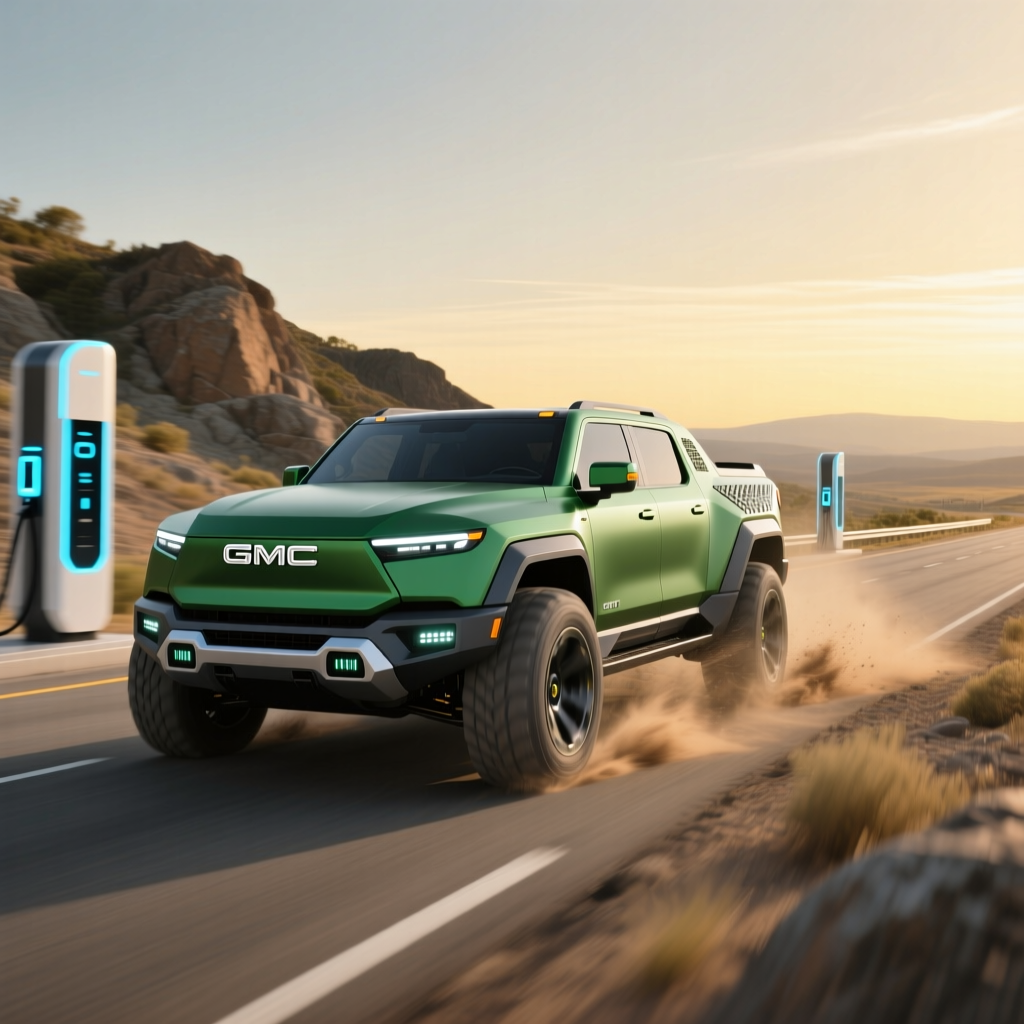
The Hummer EV was engineered from the outset as an off-road machine, and it delivers on that promise spectacularly. The Extract Mode raises the air suspension by approximately 5.8 inches, providing up to 15.9 inches of ground clearance — more than a Ford Bronco Raptor or a Jeep Wrangler Rubicon. Approach, departure, and breakover angles are all best-in-class for electric trucks.
The 3X trim includes front and rear electronic locking differentials, underbody armor plating, and the torque-vectoring capability of the tri-motor setup, which can send precise amounts of torque to individual wheels. The CrabWalk feature — where the front and rear wheels turn in the same direction — allows the truck to move diagonally, which is invaluable for navigating tight trails, avoiding obstacles, and sliding sideways around off-camber sections.
Water fording depth is rated at 32 inches, and the sealed battery pack and electric motors eliminate the risk of hydro-lock that plagues internal combustion engines in deep water. On rocky terrain, the Hummer EV's low-speed torque control is extraordinarily precise, allowing inch-perfect crawling over boulders without the jerky power delivery that sometimes accompanies traditional off-road drivetrains.
Independent off-road evaluations by Four Wheeler and other publications have praised the Hummer EV's trail capability, noting that it rivals purpose-built off-road vehicles while offering a silent, emission-free experience. The main limitation is the truck's width and weight — narrow trails and soft sand can be challenging for a vehicle that weighs nearly five tons.
For more off-road-capable EVs, check out our best electric SUVs for off-road adventures roundup.
Ownership Costs and Value
The GMC Hummer EV Supertruck commands a premium price. The 2X dual-motor trim starts in the mid-$90,000 range, while the fully loaded 3X tri-motor variant pushes well past $105,000 before options. Edition 1 models, which include the full suite of available features, have been priced above $110,000. At these price points, the Hummer EV competes with luxury trucks like the Rivian R1T Quad-Motor and the Tesla Cybertruck Cyberbeast, as well as high-end traditional pickups.
Operating costs, however, tell a different story. Electricity is significantly cheaper than gasoline on a per-mile basis, and the Hummer EV eliminates oil changes, transmission fluid services, and many of the maintenance items associated with internal combustion engines. GMC estimates that owners can save thousands of dollars in fuel costs over five years of typical driving compared to a similarly powerful gas truck like the Ram TRX or the Ford F-150 Raptor R.
Insurance costs are elevated due to the truck's price, weight, and repair complexity. Expect annual premiums to be higher than average for the electric truck segment. Depreciation is another wild card — early data suggests that large, expensive EVs can experience steeper depreciation curves than mainstream models, though this varies by market conditions and incentives.
The Hummer EV qualifies for varying federal and state incentives depending on current regulations and the buyer's tax situation. It is worth consulting the latest fueleconomy.gov database and your tax professional to determine eligibility. GMC's battery warranty covers the Ultium pack for 8 years or 100,000 miles, providing peace of mind for long-term ownership.
For a broader look at total cost of ownership across electric trucks, visit our EV truck ownership cost comparison.
Pros and Cons
Pros
- Extraordinary acceleration and powertrain performance, especially in the 3X tri-motor configuration
- Class-leading off-road capability with Extract Mode, locking differentials, and CrabWalk
- 800V architecture enables ultra-fast 350 kW DC charging
- Four-wheel steering provides an impressively tight turning radius and enhanced highway stability
- Comprehensive camera system with underbody views for trail navigation
- Removable Infinity Roof panels for open-air driving
- Vehicle-to-home backup power capability
- Spacious cabin with generous front and rear seating
Cons
- Extremely heavy, which hurts efficiency and increases tire and brake wear
- Real-world highway range falls below EPA estimates
- Very large dimensions make urban driving and parking challenging
- Premium pricing puts it out of reach for many buyers
- Some interior materials do not match the six-figure price tag
- Limited visibility due to the tall hood and thick pillars
- Towing significantly reduces range
- High insurance and potential depreciation costs
Frequently Asked Questions
What is the real-world range of the GMC Hummer EV Supertruck?
The EPA rates the Hummer EV at approximately 314 to 329 miles depending on trim. In real-world highway testing at speeds of 70-75 mph, independent reviewers have recorded between 260 and 290 miles on a full charge. City and mixed driving tend to yield results closer to the EPA estimates, thanks to regenerative braking recovering energy during stop-and-go traffic. Towing a heavy trailer can cut range nearly in half.
How fast does the GMC Hummer EV charge?
With its 800-volt architecture, the Hummer EV can accept up to 350 kW at compatible DC fast chargers. Under ideal conditions, GMC states the truck can add roughly 100 miles of range in about 10 minutes. A 10-to-80-percent charge takes approximately 30-40 minutes at a 350 kW station and about 60-75 minutes at a 150 kW station. Level 2 home charging at 11.5 kW requires about 19-20 hours for a full charge from empty.
Is the GMC Hummer EV good off-road?
Absolutely. The Hummer EV is one of the most capable off-road vehicles on the market, electric or otherwise. With Extract Mode providing nearly 16 inches of ground clearance, front and rear locking differentials, underbody armor, 32 inches of water fording, and the unique CrabWalk diagonal-drive mode, it excels on rocky trails, through deep mud, and over technical terrain. The instant, precise torque delivery of the electric motors gives it an advantage over combustion-powered trucks in low-speed crawling situations.
How much does it cost to own a GMC Hummer EV Supertruck?
Purchase prices range from the mid-$90,000s for the 2X trim to over $110,000 for a fully optioned 3X. Operating costs are lower than comparable gas trucks due to cheaper electricity and reduced maintenance requirements. However, insurance premiums are above average, and buyers should factor in potential depreciation and tire replacement costs (the large, heavy-duty tires are expensive). Federal and state incentives may help offset the purchase price depending on eligibility.
How does the GMC Hummer EV compare to the Rivian R1T and Ford F-150 Lightning?
The Hummer EV is larger, heavier, and more powerful than both the Rivian R1T and the Ford F-150 Lightning. It offers more off-road hardware and a more dramatic driving experience, but it is less efficient, more expensive, and harder to park. The Rivian R1T is more agile and tech-forward with a more refined interior, while the F-150 Lightning is more practical and affordable. The best choice depends on your priorities — the Hummer EV wins on sheer presence and off-road extremity, while the R1T and Lightning are better suited to daily life. For a detailed breakdown, see our complete EV truck comparison guide.
Final Verdict
The GMC Hummer EV Supertruck is not a rational purchase — and that is precisely the point. It exists to prove that electric vehicles can be massive, outrageous, and wildly capable without burning a drop of fuel. Its real-world range, while not class-leading in efficiency, is sufficient for most use cases. Its off-road performance is genuinely world-class. Its charging speed is among the fastest available in any EV. And its ability to silence an entire trail with nothing but the sound of tires on rock is an experience no gas truck can replicate.
If you need a practical, efficient daily driver, the Hummer EV is overkill in every conceivable dimension. But if you want an electric truck that commands attention, conquers any terrain you point it at, and delivers supercar-rivaling acceleration in a package that can tow a boat and ford a stream, the Hummer EV Supertruck stands alone. For more electric truck reviews and buying advice, browse our full electric vehicles section at Auto Edge View.