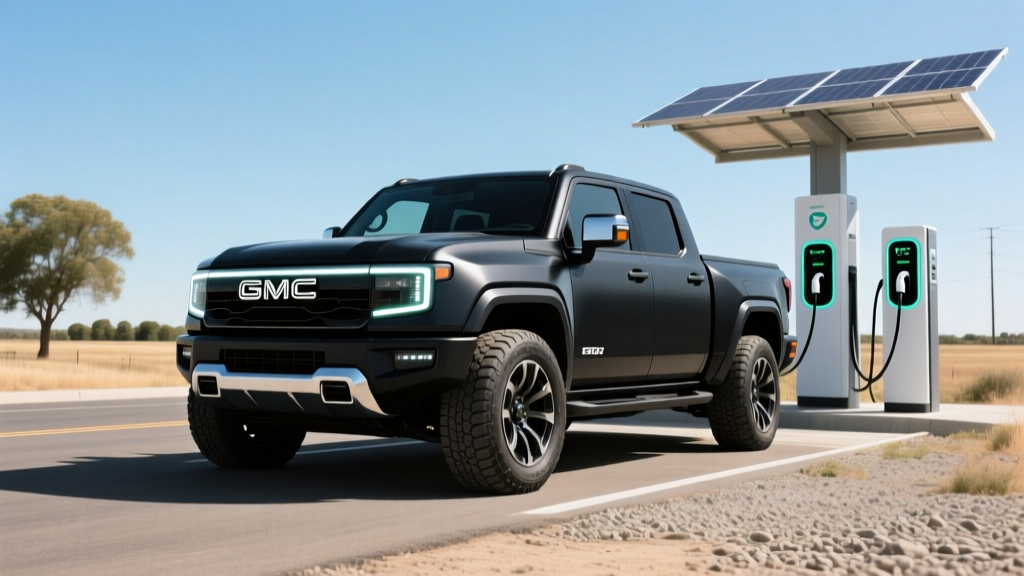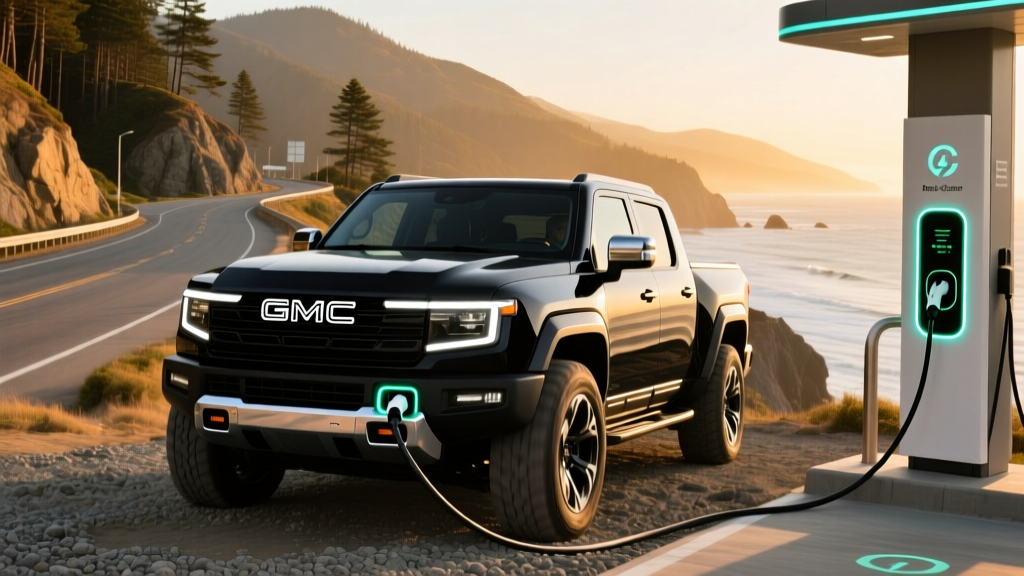
The GMC Hummer EV Pickup 3X is the most extreme electric vehicle on sale today — a 9,000-pound, tri-motor supertruck that can crab-walk diagonally, extract its roof panels, and hit 60 mph in roughly three seconds. It's also one of the most expensive, largest, and least efficient EVs you can buy. If you're researching the GMC Hummer EV Pickup 3X as a potential purchase, this review breaks down the exact numbers that matter: real-world range versus the EPA sticker, actual charging speeds on DC fast chargers and at home, true ownership costs after federal tax credits, and whether this electric behemoth makes sense versus rivals like the Rivian R1T and Ford F-150 Lightning.
Range, Battery, and Real-World Efficiency
| Spec | GMC Hummer EV Pickup 3X |
|---|---|
| EPA Estimated Range | 314 miles |
| Battery Capacity (Usable) | ~212.7 kWh (Ultium, NMC) |
| Battery Chemistry | NMC (Nickel Manganese Cobalt) |
| Battery Architecture | Double-stacked, 24 modules |
| MPGe (Combined) | 47 MPGe |
| kWh per 100 Miles | ~72 kWh/100 mi |
| Drivetrain | Tri-motor AWD (e4WD) |
| Horsepower | 830 hp |
| Torque | 1,200 lb-ft |
| 0-60 mph | ~3.0 seconds (Watts to Freedom mode) |
| Curb Weight | ~9,063 lbs |
The EPA rates the Hummer EV Pickup 3X at 314 miles. In real-world highway driving at 70-75 mph, expect closer to 250-275 miles due to the truck's massive frontal area and 9,000-pound weight. In freezing temperatures (below 30°F), range can drop to 200-230 miles without preconditioning. City and low-speed driving is where the Hummer recovers energy through regen braking, often exceeding the EPA estimate. This is a physics story: moving 4.5 tons of truck requires enormous energy, and aerodynamic drag punishes you at highway speeds.
The Hummer EV's 212.7 kWh usable battery is roughly double the capacity of a Tesla Model S or Ford F-150 Lightning Extended Range. GMC uses GM's Ultium platform with NMC (nickel manganese cobalt) pouch cells arranged in a double-stack configuration — 24 modules total. NMC chemistry delivers higher energy density than LFP (lithium iron phosphate), which is necessary given the truck's weight, but it also means you'll want to follow the 20-80% daily charging guideline to minimize long-term degradation. The battery pack alone weighs an estimated 2,900 pounds.
Efficiency is frankly poor at 47 MPGe combined, or roughly 72 kWh per 100 miles, per fueleconomy.gov. For context, the Rivian R1T Dual-Motor achieves 70 MPGe and the F-150 Lightning Extended Range hits 66 MPGe. You're paying for capability and spectacle, not efficiency.
Charging Speed: DC Fast Charging and Home Level 2
| Charging Level | Power / Rate | Speed | Notes |
|---|---|---|---|
| Level 1 (120V) | ~1.4 kW | ~2-3 miles/hour | Emergency/trickle only |
| Level 2 (240V, 48A) | 11.5 kW | ~16-18 miles/hour | Full charge: ~18-20 hours |
| Level 2 (240V, 80A) | 19.2 kW | ~27-30 miles/hour | Requires compatible charger + 100A circuit |
| DC Fast Charge (Peak) | Up to 350 kW (capable) | 10-80% in ~35-40 min | On 350 kW CCS station; real-world sustained ~200-210 kW average |
| DC Fast Charge (Typical 150 kW) | ~150 kW sustained | 10-80% in ~55-65 min | Most common public charger speed |
The Hummer EV Pickup 3X supports DC fast charging at up to 350 kW on capable CCS1 stations. In practice, the massive 212.7 kWh battery means even at high charge rates, a 10-80% session takes roughly 35-40 minutes on a 350 kW charger. The charge curve is relatively flat through the mid-SoC range — you'll see sustained rates around 200-210 kW for much of the session before tapering above 80%. This is actually an advantage of the enormous battery: it can absorb high power for longer without hitting cell-level limits.
At home on a standard 240V/48A Level 2 charger (11.5 kW), plan on 18-20 hours for a full 0-100% charge. That's impractical for daily full charges, but most owners will charge from 20-80% overnight in roughly 11-12 hours. If your electrical panel supports it, upgrading to an 80A Level 2 charger (19.2 kW) cuts that to about 7-8 hours for a 20-80% session — highly recommended for Hummer EV owners. Factor in a potential panel upgrade cost of $1,500-$3,000 if your home has a 100A service; the Hummer's appetite for electricity demands a robust 200A panel.
One charging advantage: the Hummer EV supports energy export via GM's PowerStation Pro, enabling V2H (vehicle-to-home) capability. In a power outage, the 212.7 kWh battery can run an average home for several days — a genuine benefit that partially justifies the massive pack.
Performance, Capability, and Driving Dynamics
The 3X trim means three motors: one front, two rear, producing a combined 830 horsepower and 1,200 lb-ft of torque. Engage Watts to Freedom (WTF) mode — which lowers the suspension, preconditions the battery, and activates haptic seat feedback — and the Hummer EV launches to 60 mph in approximately 3.0 seconds. That's supercar territory in a vehicle with the curb weight of two Honda Civics.
Beyond straight-line speed, the 3X's signature capability is CrabWalk: the rear wheels steer up to 10 degrees in the same direction as the fronts, allowing the truck to move diagonally — useful on tight off-road trails and an undeniable party trick. The four-wheel steering system also reduces the turning circle to a surprisingly manageable 37.1 feet at low speeds (rear wheels steer opposite the fronts), though that's still large by passenger-car standards.
The adaptive air suspension offers up to 5.8 inches of travel, with an Extract Mode that raises the ride height nearly 6 inches for extreme off-road obstacles. Approach, departure, and breakover angles are competitive with serious off-road trucks. Underbody armor, skid plates, and 35-inch Goodyear Wrangler Territory tires come standard on the 3X.
Towing: The Hummer EV Pickup is rated to tow up to 7,500 pounds. However, towing near max capacity will slash range by 40-50%, meaning real-world towing range drops to roughly 140-170 miles. Plan charging stops accordingly.
Interior, Cargo, and Technology
The cabin seats five and is dominated by a 13.4-inch diagonal infotainment touchscreen running GM's Ultifi software platform, paired with a 12.3-inch driver instrument cluster. Wireless Apple CarPlay and Android Auto are standard. The interface is responsive, though the sheer number of configurable drive modes and off-road displays takes a learning curve.
Cargo dimensions:
- Bed length: 5 feet (standard)
- Bed volume: ~41.5 cu ft
- Frunk (front trunk): ~81.8 cu ft — one of the largest frunks in any vehicle, with a powered MultiPro tailgate and drain plug for use as a cooler
- Roof panels: Removable, stored in the frunk in a dedicated bag
- Rear-seat legroom: ~38.9 inches
The Infinity Roof with removable modular sky panels is a standout. Pop them out and you have an open-air experience unlike any other full-size truck. The panels store neatly in the frunk.
Driver assistance: The Hummer EV comes with GM's Super Cruise on compatible mapped highways — a genuine hands-off (eyes-on) Level 2 system that works on over 750,000 miles of divided highways in North America. Super Cruise is one of the most polished Level 2 systems available, with attentive driver monitoring via an infrared camera on the steering column. Note: this is SAE Level 2 automation — the driver must remain alert and ready to take over at all times.
Pricing, Trims, and Federal Tax Credit Eligibility
| Trim / Configuration | Base MSRP (2025/2026) | Federal Tax Credit (§30D) | Effective Price |
|---|---|---|---|
| 2X (Dual-Motor) | ~$99,900 | Not eligible (MSRP cap) | ~$99,900 |
| 3X (Tri-Motor) | ~$104,900 | Not eligible (MSRP cap) | ~$104,900 |
| Edition 1 (3X, loaded) | ~$112,100 | Not eligible (MSRP cap) | ~$112,100 |
Here's the hard truth on tax credits: the GMC Hummer EV Pickup does not qualify for the $7,500 federal §30D EV tax credit. Under current IRS rules, pickup trucks must have an MSRP at or below $80,000 to be eligible. Every Hummer EV Pickup trim exceeds that cap by a wide margin. There is no workaround — the MSRP cap is statutory, per IRS guidelines on clean vehicle credits.
Additionally, buyer income caps apply to the credit ($150,000 single / $300,000 joint filer AGI), and battery component and critical mineral sourcing requirements must be met. But none of that matters here — the MSRP alone disqualifies the Hummer EV Pickup.
State incentives may still apply depending on your jurisdiction. Some states offer rebates or HOV lane access regardless of MSRP. Check your state's energy office or DMV for current programs.
Warranty and Long-Term Ownership
| Coverage | Term |
|---|---|
| Battery (capacity retention ≥70%) | 8 years / 100,000 miles |
| Powertrain | 5 years / 60,000 miles |
| Bumper-to-Bumper | 3 years / 36,000 miles |
| Roadside Assistance | 5 years / 60,000 miles |
GM's 8-year/100,000-mile battery warranty guarantees the Ultium pack will retain at least 70% of its original capacity. With a 212.7 kWh pack, 70% retention still leaves ~149 kWh usable — enough for roughly 220 miles of real-world range. Given the Hummer's price, the powertrain warranty at 5 years/60,000 miles feels modest; Rivian offers 8 years/175,000 miles on the R1T's drive system.
Insurance costs are significant. Expect annual premiums in the $3,500-$5,500 range depending on your profile and location. Repair costs after collisions are high due to the specialized aluminum and steel structure, air suspension, and tri-motor powertrain.
GMC Hummer EV Pickup 3X vs. Key Competitors
| Spec | GMC Hummer EV 3X | Rivian R1T Tri-Motor | Ford F-150 Lightning Platinum |
|---|---|---|---|
| EPA Range | 314 mi | ~328 mi (Max Pack) | 300 mi (Extended Range) |
| Battery | 212.7 kWh (NMC) | ~149 kWh (NMC) | 131 kWh (NMC) |
| Horsepower | 830 hp | 850 hp | 580 hp |
| 0-60 mph | ~3.0 sec | ~3.0 sec | ~3.8 sec |
| Max DC Charging | 350 kW | 220 kW | 150 kW |
| Towing Capacity | 7,500 lbs | 11,000 lbs | 10,000 lbs |
| Base Price | $104,900 | ~$115,000 (Tri) | ~$98,000 |
| Federal Tax Credit | Not eligible | Not eligible | Not eligible |
| Unique Feature | CrabWalk / Infinity Roof | Gear Tunnel / Camp Kitchen | Pro Power Onboard / Mega Frunk |
- You want maximum presence, off-road spectacle, and supercar acceleration in a truck
- CrabWalk, removable roof panels, and V2H energy export are genuinely useful to you
- Budget is not your primary constraint and you accept high running costs
- You have access to a 350 kW DC fast charger or can install 80A Level 2 at home
- You prioritize towing capacity (11,000 lbs) and the innovative Gear Tunnel
- You want a more car-like driving experience in a smaller, lighter package
- You value Rivian's adventure-oriented software and over-the-air update cadence
- You want a proven full-size work truck platform with the lowest entry price
- Pro Power Onboard (up to 9.6 kW export) is a jobsite necessity
- You need a dealer network for commercial fleet servicing
Pros and Cons
- 830 hp and 3.0-second 0-60 — absurd performance for a 9,000-lb truck
- CrabWalk four-wheel steering is genuinely useful off-road
- 81.8 cu-ft frunk is class-leading
- Super Cruise hands-free driving on 750,000+ miles of highway
- Infinity Roof with removable panels — unique open-air experience
- V2H energy export can power a home during outages
- 350 kW DC fast-charge capability (on compatible stations)
- Air suspension with Extract Mode for serious off-road clearance
- 47 MPGe combined — worst efficiency of any mainstream EV
- ~9,063-lb curb weight accelerates tire wear and increases stopping distances
- Does not qualify for the $7,500 federal tax credit (MSRP cap)
- 18-20 hour home charge on standard Level 2 is impractical without 80A upgrade
- Highway range drops to 250-275 miles; towing range drops to ~150 miles
- 5-foot bed is short for a full-size truck
- Insurance premiums $3,500-$5,500+ annually
- Width (86.7 inches w/o mirrors) makes parking garages and drive-throughs challenging
Who Should Buy the GMC Hummer EV Pickup 3X?
This truck is built for a specific buyer: someone who wants the most extreme, most capable, most attention-grabbing electric vehicle available and has the budget and infrastructure to support it. It's a poor choice as a daily commuter in dense urban areas (its width and weight are liabilities in tight spaces), and its efficiency makes it an expensive road-trip companion if your route lacks 350 kW chargers.
It's a strong fit if you have a large garage or driveway with 200A electrical service, access to fast DC charging, and a genuine need for off-road capability combined with open-air driving. The V2H backup power feature is a legitimate differentiator for homeowners in areas with unreliable grids. As a weekend adventure vehicle or a statement piece that happens to be electric, the Hummer EV 3X has no equal.
Frequently Asked Questions
What is the real-world range of the GMC Hummer EV Pickup 3X?
The EPA rates it at 314 miles. In real-world highway driving at 70-75 mph, expect 250-275 miles. In cold weather below 30°F, range can drop to 200-230 miles without battery preconditioning. City driving with regenerative braking can sometimes exceed the EPA estimate.
How fast does the Hummer EV Pickup 3X charge?
On a 350 kW DC fast charger, 10-80% takes approximately 35-40 minutes with sustained rates around 200-210 kW. On a typical 150 kW public charger, expect 55-65 minutes for 10-80%. At home on a 48A Level 2 charger (11.5 kW), a full charge takes 18-20 hours; upgrading to 80A (19.2 kW) reduces a 20-80% session to about 7-8 hours.
Does the GMC Hummer EV qualify for the federal EV tax credit?
No. Under current IRS §30D rules, pickup trucks must have an MSRP of $80,000 or less. The Hummer EV Pickup starts at approximately $99,900 for the 2X and $104,900 for the 3X, well above the cap. No trim qualifies for the $7,500 credit regardless of buyer income or battery sourcing.
How much does the Hummer EV Pickup 3X cost?
The 3X trim starts at approximately $104,900 before destination charges. Well-optioned examples with the Extreme Off-Road package and premium interior can reach $115,000-$120,000. Since the federal tax credit doesn't apply, the MSRP is effectively your starting cost before state incentives, taxes, and registration.
Is the Hummer EV Pickup 3X worth buying over the Rivian R1T or F-150 Lightning?
It depends on priorities. The Hummer EV wins on spectacle, off-road tech (CrabWalk, Extract Mode), open-air driving, and V2H capability. The Rivian R1T offers better towing (11,000 lbs), the Gear Tunnel, and a more refined on-road experience. The F-150 Lightning provides the lowest price, Pro Power Onboard, and a proven commercial platform. None of these trucks qualify for the federal credit at current pricing.
What is CrabWalk and is it actually useful?
CrabWalk uses four-wheel steering to angle the rear wheels up to 10 degrees in the same direction as the fronts, letting the truck move diagonally. It's genuinely helpful on narrow off-road trails where you need to navigate around obstacles without a multi-point turn. On pavement at low speeds, it's more of a novelty.
How much does it cost to charge the Hummer EV at home?
At the US average residential electricity rate of ~$0.17/kWh, a full 212.7 kWh charge costs roughly $36. For a typical 20-80% daily charge (~128 kWh), expect about $22. That's significantly more than charging a smaller EV, but still less than fueling a comparable gas truck with 12-14 MPG at $3.50/gallon.