Quick Verdict: A Supersized EV With a Supersized Cabin
The GMC Hummer EV is the automotive equivalent of a statement piece. At over 18 feet long and tipping the scales above 9,000 pounds (pickup) or 8,600 pounds (SUV), it dwarfs every other electric vehicle on the road — and its cabin matches that exterior bravado. But beyond the GMC Hummer EV interior spectacle — removable roof panels, a 13.4-inch infotainment display, and an available 18-motor seat massage system — there is a legitimate, engineering-dense EV underneath. Built on GM's Ultium platform with up to a 24-module double-stacked battery pack, the Hummer EV delivers real range, serious off-road capability via available four-wheel steering (CrabWalk), and DC fast charging up to 350 kW.
This review breaks down what matters most: the interior space and tech, real-world range, charging speeds, pricing after federal tax credits, and whether this mega-EV justifies its six-figure reality for daily driving.
GMC Hummer EV Interior: Dimensions, Tech, and Livability
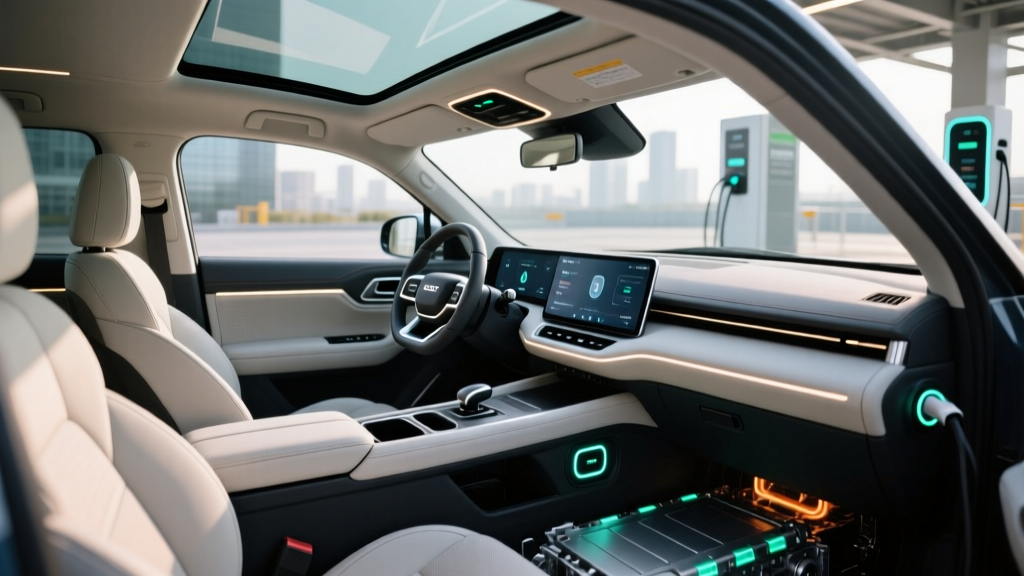
The GMC Hummer EV interior is designed to impress on first contact. The pickup variant (SUT) and the SUV share the same dashboard architecture, but cargo and passenger volumes diverge meaningfully.
Cabin Space and Cargo Volume
Front-row occupants get 42.5 inches of legroom in both body styles, with 38.9 inches in the second row (SUV) or 37.3 inches (pickup). Headroom is generous at 41.2 inches up front, aided by the available Infinity Roof system with removable transparent panels that store in the frunk.
Cargo capacity tells a split story:
- Hummer EV SUV: 35.9 cu ft behind the second row; 81.8 cu ft with the rear seats folded. A small powered frunk adds roughly 5 cu ft of secure front storage.
- Hummer EV Pickup (SUT): A 5-foot bed with the MultiPro tailgate and available eTrunk (front trunk) providing 11.4 cu ft of lockable space — enough for large charging cables or a full set of recovery gear.
Materials are premium but utilitarian: synthetic leather is standard, with available semi-aniline leather on the 3X trim. The flat floor (a benefit of the skateboard Ultium architecture) makes the rear seat feel more open than its dimensions suggest, though the high floor height — necessitated by the massive 24-module battery pack — means a step-up entry that shorter passengers will notice.
Infotainment and Standout Tech
The centerpiece is a 13.4-inch diagonal touchscreen running GM's latest Ultifi-based software, paired with a 12.3-inch digital instrument cluster. Wireless Apple CarPlay and Android Auto are standard. An available 14-speaker Bose audio system with head-restraint speakers is a highlight on long drives.
Unique tech features include:
- UltraVision: Up to 18 camera views, including underbody cameras for off-road trail navigation.
- CrabWalk: Four-wheel steering that angles all four wheels up to 10 degrees, allowing diagonal movement — useful in tight trail situations and genuinely novel in a production vehicle.
- Extract Mode: Uses the adaptive air suspension to raise the body up to 14.9 inches of ground clearance for obstacle clearance.
- Super Cruise: GM's Level 2 hands-free driver-assistance system, available on over 400,000 miles of mapped highways (see our NHTSA notes on Level 2 limitations below).
Range, Efficiency, and Real-World Expectations
The Hummer EV's range depends heavily on body style and trim. The pickup's larger 24-module pack delivers more miles, while the SUV's 20-module pack trades range for a slightly lower price and shorter wheelbase.
| Spec | Pickup 3X (24-mod) | SUV 3X (20-mod) | SUV 2X (20-mod) |
|---|---|---|---|
| EPA Range | 381 mi | 314 mi | 314 mi |
| Battery (usable) | ~212 kWh (NMC) | ~170 kWh (NMC) | ~170 kWh (NMC) |
| MPGe (combined) | 47 MPGe | 52 MPGe | 52 MPGe |
| Efficiency (kWh/100mi) | ~72 | ~65 | ~65 |
| 0–60 mph | ~3.0 sec (Watts to Freedom) | ~3.5 sec | ~3.5 sec |
| Horsepower | 1,000 hp (tri-motor) | 830 hp (tri-motor) | 655 hp (dual-motor) |
| Drivetrain | AWD (tri-motor) | AWD (tri-motor) | AWD (dual-motor) |
Charging Speed: DC Fast, Level 2, and the 24-Module Reality
The Hummer EV's massive battery pack is both its greatest asset (range, power) and its charging bottleneck. More kWh to fill means longer sessions, even at high power.
| Charging Level | Power / Rate | Pickup 3X (212 kWh) | SUV 2X/3X (170 kWh) |
|---|---|---|---|
| DC Fast Charge (peak) | Up to 350 kW | 10–80% in ~35 min | 10–80% in ~28 min |
| DC Sustained (avg) | ~150–200 kW avg | Taper above 80% SoC | Taper above 80% SoC |
| Level 2 Home (240V) | 11.5 kW (48A) | ~18 hrs (0–100%) | ~14.5 hrs (0–100%) |
| Level 2 Miles/Hour | ~16 mi/hr (pickup) | — | ~19 mi/hr (SUV) |
| Level 1 (120V) | ~1.4 kW | ~2–3 mi/hr | ~3 mi/hr |
Charging-curve reality: The Hummer EV peaks near 350 kW only briefly at low state-of-charge (typically 10–25% SoC) on a 350 kW-rated station. As the pack fills, the charge rate tapers progressively — a physical necessity to protect NMC cells from thermal stress. A typical 10–80% session on a 350 kW Electrify America or Tesla Supercharger (via NACS adapter) averages closer to 150–200 kW sustained. Plan road-trip stops for 35–45 minutes including the walk-around stretch.
Home charging practicality: With an 11.5 kW Level 2 onboard charger, a full 0–100% recharge on the pickup takes roughly 18 hours. This is not a problem for daily driving (most owners use 20–30% per day and top up overnight), but it means you cannot fully recharge from empty in a single night. A GM-approved 48-amp Level 2 wallbox on a 60-amp dedicated circuit is strongly recommended — budget $1,200–$2,500 for equipment and electrician installation depending on panel proximity.
Pricing, Trims, and Federal Tax Credit Eligibility
The Hummer EV is a premium, low-volume vehicle, and its pricing reflects that. For the 2026 model year, GMC offers the pickup and SUV across three main trims:
| Trim | Body | Base MSRP | §30D Credit Eligible? |
|---|---|---|---|
| 2X | SUV | ~$99,745 | ❌ Exceeds $80K SUV cap |
| 3X | SUV | ~$106,095 | ❌ Exceeds $80K SUV cap |
| 2X | Pickup | ~$106,095 | ❌ Exceeds $80K truck cap |
| 3X | Pickup | ~$119,495 | ❌ Exceeds $80K truck cap |
Warranty and Long-Term Ownership
GMC backs the Hummer EV with:
- Battery & Powertrain: 8 years / 100,000 miles (whichever comes first), with GM warranting the Ultium pack to retain at least 60% of original capacity during the coverage period.
- Bumper-to-Bumper: 3 years / 36,000 miles.
- Corrosion: 6 years / 100,000 miles.
The 24-module NMC pack in the Pickup 3X is among the largest in any production EV. NMC chemistry offers high energy density but is more susceptible to calendar degradation than LFP. Best practices: avoid sustained 100% SoC storage, use Level 2 charging for daily needs, and limit DC fast charging to road trips. GM's Ultium thermal management system (active liquid cooling/heating) is robust, and early real-world data from 2022–2024 model-year owners shows degradation in line with expectations — approximately 5–8% capacity loss over the first 60,000 miles.
Pros, Cons, and Who Should Buy
Pros
- Class-leading 381-mile EPA range (pickup 3X)
- 1,000 hp tri-motor performance; 0–60 in ~3.0 sec
- CrabWalk four-wheel steering — genuinely useful off-road
- Massive, premium interior with Infinity Roof
- Super Cruise hands-free driving on mapped highways
- 350 kW DC fast-charge capability
- Air suspension with up to 14.9 inches ground clearance
Cons
- Base MSRP near $100K; no federal tax credit eligibility
- Efficiency of 65–72 kWh/100mi is extremely high (costly to charge)
- 18-hour Level 2 home charge from empty (pickup)
- Over 9,000 lbs — limits parking-garage and bridge access
- Real-world highway range drops significantly below EPA
- Very wide (86+ inches) — challenging in urban lanes
- No third-row seating in SUV variant
Who Is the Hummer EV For?
Choose the Hummer EV if: You want an off-road-capable, statement-making EV with serious towing (7,500 lbs pickup), you have reliable home Level 2 charging, you drive in areas where Super Cruise is mapped, and your budget accommodates $100K+ without a tax-credit offset.
Look elsewhere if: Efficiency and low operating cost are priorities (consider the Rivian R1S or Tesla Model X), you need three rows of seating (Kia EV9 or Rivian R1S), you rely on public fast-charging in cold climates (longer sessions due to pack size), or you need the federal credit to make the math work.
Hummer EV vs. Key Competitors
The Hummer EV occupies a niche, but it isn't without rivals in the large, premium electric truck/SUV space:
- Rivian R1T / R1S (Tri-Motor): More efficient (~2.0 kWh/mi vs. Hummer's ~2.5–2.9), lighter, qualifies for the tax credit on select trims (MSRP under $80K SUV cap), and offers three rows in the R1S. Less raw power and no CrabWalk.
- Tesla Cybertruck (Cyberbeast): Faster 0–60 (2.6 sec), more efficient, and lower starting price, but polarizing design, smaller bed, and no Super Cruise equivalent with hands-free on non-mapped roads.
- Ford F-150 Lightning (Platinum): Far more affordable (~$65K–$97K), more practical daily driver, lower towing, less power, and qualifies for the §30D credit on eligible trims.
Frequently Asked Questions
What is the real-world range of the GMC Hummer EV?
The Pickup 3X achieves an EPA-rated 381 miles, but expect 290–320 miles on sustained highway driving and 230–260 miles in freezing weather. The SUV's 314-mile EPA rating yields roughly 240–270 real-world highway miles. High speed, cold temperatures, and heavy cargo all reduce range significantly on a vehicle this heavy.
How fast does the Hummer EV charge at home and on the road?
On a 350 kW DC fast charger, the Pickup 3X charges 10–80% in approximately 35 minutes (SUV: ~28 minutes). At home on a 48-amp Level 2 charger (11.5 kW), a full charge takes roughly 18 hours for the pickup and 14.5 hours for the SUV. Level 1 (120V) trickle charging adds only 2–3 miles per hour — not practical for daily use.
Does the GMC Hummer EV qualify for the federal EV tax credit?
No. Under current IRS §30D rules, all Hummer EV trims exceed the $80,000 MSRP cap for both trucks and SUVs, making them ineligible for the up-to-$7,500 federal new-vehicle credit regardless of buyer income or battery sourcing.
How much does it cost to charge the Hummer EV?
At the national average electricity rate of ~$0.16/kWh, fully charging the Pickup 3X's ~212 kWh pack costs approximately $34 at home. On DC fast chargers averaging $0.40–$0.50/kWh, an 80% top-up costs $68–$85. Efficiency of ~72 kWh/100mi means fuel cost per mile is roughly $0.11 at home and $0.29–$0.36 on public chargers — comparable to or exceeding a 20 MPG gas truck at $3.50/gallon.
Is the GMC Hummer EV interior practical for families?
The cabin is spacious for two rows with 42.5 inches of front legroom, but the SUV lacks a third row, limiting it to five passengers. The high floor (from the massive battery) creates a step-up entry. Cargo space is generous in the pickup bed (5-foot) and SUV rear (35.9 cu ft), and the Infinity Roof panels add an open-air experience. It works well for families of four who prioritize off-road capability and tech, but larger families should consider the Rivian R1S or Kia EV9.
Is the Hummer EV worth buying over the Rivian R1T or Tesla Cybertruck?
The Hummer EV wins on raw presence, CrabWalk uniqueness, and maximum range (381 mi EPA). The Rivian R1T is more efficient, lighter, tax-credit eligible, and more practical daily. The Cybertruck is faster and cheaper but more polarizing. If you value capability theater, off-road novelty, and don't need the tax credit, the Hummer EV delivers. If efficiency and value matter more, the Rivian is the stronger all-around pick.