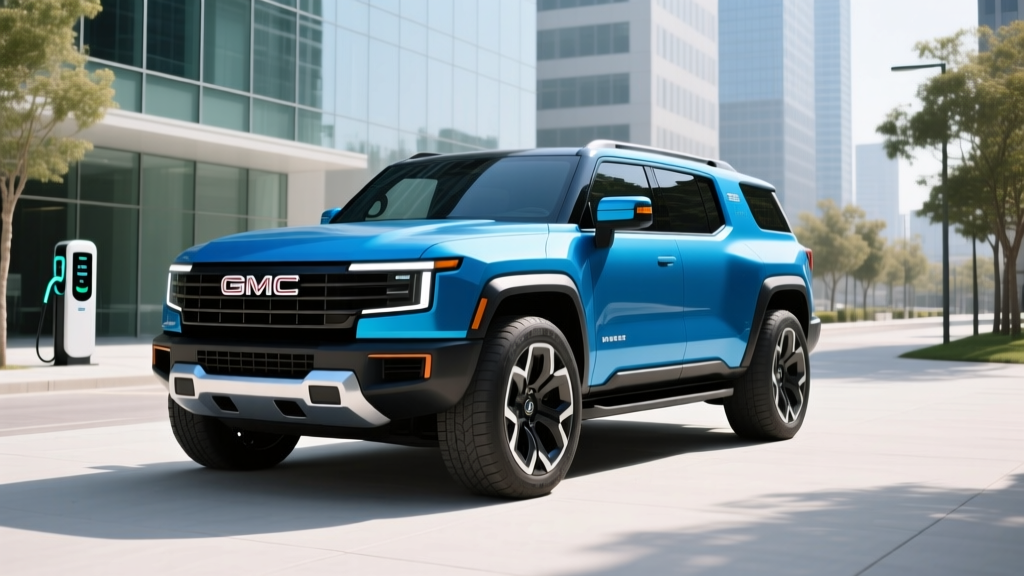
The GMC Hummer EV is the largest, heaviest, and most physically imposing electric vehicle on the road. Whether you are evaluating garage fitment, payload for towing, or simply trying to understand what living with a 10,000-pound electric supertruck actually looks like, the numbers tell the full story. This review covers every critical Hummer EV dimension alongside range, charging, performance, pricing, and tax-credit eligibility for the 2026 model year.
Hummer EV Dimensions and Exterior Size
Before anything else, let's address the keyword on your mind: just how big is this thing? The Hummer EV Pickup stretches 216.8 inches long, sits 86.7 inches wide (excluding mirrors), and stands 81.1 inches tall on the standard air suspension. Curb weight lands between 9,046 and 9,640 pounds depending on trim and equipment. That is roughly the mass of two Honda Civics stacked on top of each other.
| Measurement | Specification |
|---|---|
| Overall Length | 216.8 in |
| Overall Width (no mirrors) | 86.7 in |
| Overall Width (mirrors out) | 96.5 in |
| Overall Height | 81.1 in |
| Wheelbase | 135.6 in |
| Ground Clearance (max) | 15.9 in (Extract Mode) |
| Bed Length | 60.0 in (5 ft) |
| Curb Weight | 9,046 – 9,640 lbs |
| GVWR | ~10,400 lbs |
Garage and parking reality check: A standard two-car garage door opening is typically 84 inches wide — the Hummer EV's body alone is 86.7 inches, and with mirrors extended it reaches 96.5 inches. You will need a single-bay-wide clearance or an oversized door. Many residential garages with 7-foot ceiling heights will also be too short if the Hummer is on its tallest suspension setting. Measure before you buy.
The Hummer EV SUV variant is shorter at 196.8 inches overall and drops the pickup bed for a traditional enclosed cargo area, but width and weight remain nearly identical.
Battery, Range, and Real-World Efficiency
The Hummer EV uses a massive 24-module Ultium battery pack with approximately 212 kWh of usable capacity (gross capacity is higher). The chemistry is NMC (nickel manganese cobalt), chosen for its high energy density — necessary to move a vehicle of this mass. LFP chemistry would add even more weight, which is why GM reserved it for lighter Ultium-platform vehicles like the base Equinox EV.
EPA Estimated Range: 314 miles (Pickup 2X trim, 35-inch tires)
Real-World Highway: Expect 240–270 miles at 70+ mph sustained
Real-World Cold Weather (below 30°F): Expect 200–230 miles
Efficiency: 47 MPGe combined / ~72 kWh per 100 miles
Source: fueleconomy.gov
The EPA figure of 314 miles applies primarily to the 2X trim with the smaller 35-inch tires. The 3X and Edition 1 trims with 37-inch tires and the more powerful tri-motor setup see range drop to approximately 292–314 miles depending on configuration. The Hummer EV SUV, being shorter and lighter, gains a modest range advantage of roughly 10–15 miles in equivalent trims.
At 72 kWh per 100 miles, the Hummer EV is among the least efficient EVs sold in the United States. For context, a Tesla Model Y uses roughly 28 kWh/100 mi — meaning the Hummer consumes about 2.5 times the energy per mile. This matters for charging cost and time, not just range.
Charging Speed: DC Fast Charge and Home Level 2
GM equips the Hummer EV with an 800-volt architecture capable of accepting up to 350 kW peak DC fast-charge power at compatible V3-class chargers (such as Electrify America's 350 kW stalls). However, peak rate is not sustained rate. The massive 212 kWh pack means the charge curve tapers progressively above 60% state of charge to protect cell longevity.
| Charging Level | Power | Speed / Time |
|---|---|---|
| Level 1 (120V household) | ~1.4 kW | ~2 miles per hour |
| Level 2 (240V, 48A home charger) | 11.5 kW | ~16 miles per hour |
| Level 2 (240V, 80A — max onboard) | 19.2 kW | ~27 miles per hour |
| DC Fast Charge (peak) | 350 kW | ~100 miles in 10 min (at peak) |
| DC Fast Charge 10–80% | Variable | ~34 minutes (350 kW station) |
Home charging reality: With a 212 kWh battery, a full Level 2 charge at 11.5 kW (the most common home setup using a 60A circuit) takes roughly 18–19 hours from near-empty. Most owners will plug in nightly and rarely deplete below 20%, making a daily top-up manageable. If your daily driving is under 50 miles, an overnight session at 11.5 kW replenishes what you used. For higher-mileage days, the 19.2 kW onboard charger option (requires an 80A/100A circuit) cuts full-charge time to about 11 hours.
DC fast charging caveat: The 34-minute 10–80% figure assumes a 350 kW charger with no power-sharing, a preconditioned battery (the Hummer EV's nav-routed preconditioning handles this), and moderate ambient temperatures. In winter or at power-shared stalls, expect 40–50 minutes for the same session.
Performance: Watts to Freedom and Drivetrain
The headline performance feature is GMC's Watts to Freedom (WTF) mode — a launch-control sequence that lowers the air suspension, haptics pulse through the seat, and the tri-motor drivetrain unleashes its full output. The result: a 0–60 mph time of approximately 3.0 seconds in the Edition 1 / 3X tri-motor configuration, producing an estimated 1,000 horsepower and 12,000 lb-ft of wheel torque (GM's measurement at the wheels, not the motor — a marketing distinction worth noting).
| Trim / Motor Config | Horsepower | 0–60 mph | Drivetrain |
|---|---|---|---|
| 2X (Dual Motor) | 625 hp | ~4.5 sec | AWD |
| 3X (Tri-Motor) | 830 hp | ~3.5 sec | AWD |
| Edition 1 / 3X with WTF | ~1,000 hp | ~3.0 sec | AWD |
All Hummer EV configurations are all-wheel drive. The tri-motor setup places one motor on the front axle and two on the rear, enabling torque vectoring across the rear wheels. This is not just a straight-line performer — the available 4-wheel steer (crabbing diagonally at low speeds) and adaptive air suspension make it surprisingly capable on trails, if not exactly nimble on tight switchbacks.
Towing capacity is rated at 7,500 pounds for the pickup. Payload capacity sits around 1,300 pounds — modest for a truck this size, a consequence of the battery pack's enormous weight consuming most of the GVWR.
Interior Space, Cargo, and Practical Dimensions
Inside, the Hummer EV offers generous passenger space across both rows. Front legroom measures approximately 45.6 inches, while rear-seat passengers get about 38.9 inches — enough for adults on longer trips. The cabin width means three-across seating is genuinely comfortable, not a compromise.
Cargo capacity depends on the body style:
- Pickup bed: 60.0 inches long (5 feet), with the available Infinity Roof removed, the bed can accommodate wider items. The powered MultiPro tailgate offers six configurations.
- Front trunk (frunk): Approximately 11.3 cubic feet — useful for charging cables, a small cooler, or groceries, though the space is partially occupied by power electronics.
- SUV cargo area: Approximately 81.8 cubic feet behind the front seats with the second row folded, significantly more enclosed space than the pickup bed.
The removable Infinity Roof panels (stored in a dedicated bag in the bed or cargo area) transform the cabin into an open-air experience. Reinstallation takes two people roughly 15 minutes.
Pricing, Trims, and Federal Tax Credit Eligibility
The Hummer EV's pricing reflects its positioning as GMC's halo vehicle. For the 2026 model year, MSRP figures by trim are as follows:
| Trim | Base MSRP | Motor Config | Key Features |
|---|---|---|---|
| 2X | ~$98,845 | Dual Motor | Air suspension, Super Cruise, 35-in tires |
| 3X | ~$106,445 | Tri-Motor | 4-Wheel Steer, adaptive dampers, 37-in tires |
| Edition 1 | ~$112,595 | Tri-Motor (WTF) | All 3X features + extreme off-road pkg, limited build |
Note: Destination charges add approximately $1,995. Options like the Extreme Off-Road Package can add $10,000–$15,000.
Does the Hummer EV Qualify for the Federal EV Tax Credit?
Under IRS §30D rules, the Hummer EV faces a significant eligibility hurdle: the MSRP cap for trucks is $80,000. Every current Hummer EV trim exceeds this threshold. As a result, the Hummer EV does not qualify for the $7,500 federal tax credit under §30D.
Buyers who want a partial offset should investigate:
- State and local incentives: Some states (California, Colorado, New York, among others) offer separate rebates that do not have the same MSRP caps. Check your state's energy or DMV website for current programs.
- Commercial clean vehicle credit (§45W): If purchased through a business entity for business use, the Hummer EV may qualify for up to $7,500 (vehicles under 14,000 lbs GVWR) or up to $40,000 (over 14,000 lbs) under the commercial credit. Consult a tax professional.
- Utility rebates: Some electric utilities offer $500–$1,500 rebates for EV purchases or home charger installations.
5-Year Estimated Ownership Cost
Electricity costs for the Hummer EV are substantial given its 72 kWh/100 mi consumption. At a national average residential rate of $0.16/kWh, charging at home costs approximately $11.52 per 100 miles. Over 15,000 miles per year, that is roughly $1,728 annually in electricity. Compare this to a gas truck averaging 17 MPG at $3.50/gallon: about $3,088 per year in fuel. The EV still saves on energy, but the gap is narrower than with more efficient EVs.
Insurance premiums for the Hummer EV typically run $3,500–$5,000 per year depending on location, driving record, and coverage — among the highest in the EV segment due to repair costs and vehicle value.
Battery Warranty, Degradation, and Longevity
GM covers the Hummer EV's Ultium battery pack with an 8-year / 100,000-mile warranty (whichever comes first), guaranteeing that the pack will retain at least 60% of its original capacity during that period. This is the standard federal mandate for EV battery warranties.
Real-world NMC degradation data from the broader Ultium fleet (and GM's earlier Bolt EV/EUV packs) suggests a typical loss of 8–12% capacity over the first 100,000 miles under normal use. The Hummer EV's large pack has a built-in buffer above and below the usable range that helps mask early degradation. Expect approximately 88–92% state of health at the 100,000-mile mark under moderate climates and charging habits.
Longevity tips: Avoid routinely charging to 100% on DC fast chargers. Set daily charging limits to 80–90% for regular use. Precondition the battery before fast-charging sessions (the onboard nav does this automatically when you route to a charger). In extreme heat, park in shade when possible to reduce thermal load on the pack.
Technology, Driver Assistance, and Standout Features
The Hummer EV's cabin centers on a 13.4-inch infotainment touchscreen running GM's latest Ultifi software platform with Google Built-In (Maps, Assistant, Play Store). A 12.3-inch digital instrument cluster faces the driver. Wireless Apple CarPlay and Android Auto are standard.
Super Cruise: GM's hands-free Level 2 driver-assistance system is included and operational on over 750,000 miles of mapped highways in the US and Canada. Super Cruise handles steering, acceleration, and braking on compatible roads while monitoring driver attention via an infrared camera on the steering column. It is not autonomous — SAE Level 2 requires continuous driver supervision.
Unique features that set the Hummer EV apart:
- CrabWalk: 4-wheel steering allows the rear wheels to turn up to 10 degrees in the same direction as the fronts, letting the vehicle move diagonally — useful for tight trail obstacles.
- Extract Mode: Air suspension raises the vehicle 6 inches above standard ride height for 15.9 inches of ground clearance, fording up to 32 inches of water.
- UltraVision: Up to 18 camera views, including underbody cameras for rock-crawling visibility.
- Infinity Roof: Removable modular roof panels for open-air driving.
- Power Station Pro (available): Vehicle-to-load (V2L) capability providing up to 3.6 kW of 120V/240V AC power — enough to run power tools at a job site or keep essential appliances running during an outage.
Notable drawbacks:
- The sheer width makes urban driving and narrow parking structures stressful.
- Energy consumption is very high — road trips require more frequent charging stops than most EVs.
- Rear visibility in the pickup is limited; the camera-based rearview mirror is essential.
- Infotainment learning curve is steep given the number of configurable screens and modes.
- Tire replacement for 37-inch all-terrain tires runs $400–$600 per corner.
Who Should Buy the Hummer EV?
Buy the Hummer EV if:
- You need a full-size electric truck with serious off-road capability and don't mind the size.
- You want a statement vehicle with supercar acceleration and trail-credible ground clearance.
- You can charge at home (Level 2) and your daily commute is under 150 miles.
- You value V2L power output for job sites or emergency backup.
- You live in a dense urban area with tight streets and parking garages.
- You prioritize efficiency and low charging costs — a Rivian R1T, Ford F-150 Lightning, or Tesla Cybertruck will use significantly less energy per mile.
- You need the federal $7,500 tax credit — the Hummer EV's MSRP exceeds the $80K truck cap.
- You regularly tow more than 7,500 lbs or need payload over 1,300 lbs.
Pros and Cons at a Glance
- 314-mile EPA range despite enormous mass
- 350 kW DC fast-charge capability
- 3.0-second 0–60 in tri-motor WTF mode
- Best-in-class off-road tech (CrabWalk, Extract Mode)
- Super Cruise hands-free highway driving
- V2L power output for job site / backup use
- Removable Infinity Roof panels
- Too wide for many garages and parking structures
- 72 kWh/100 mi — very high energy consumption
- No federal §30D tax credit (MSRP exceeds $80K cap)
- Insurance costs among the highest for any EV
- 18+ hour full charge on standard Level 2
- 1,300-lb payload is low for a full-size truck
- 37-inch tire replacement is expensive
Frequently Asked Questions
What are the exact Hummer EV dimensions?
The Hummer EV Pickup measures 216.8 inches long, 86.7 inches wide (without mirrors), and 81.1 inches tall, with a 135.6-inch wheelbase. The SUV variant is 196.8 inches long. Curb weight ranges from 9,046 to 9,640 pounds. Ground clearance reaches 15.9 inches in Extract Mode.
What is the real-world range of the Hummer EV?
The EPA rates the Hummer EV Pickup at up to 314 miles (2X trim, 35-inch tires). In real-world highway driving at 70+ mph, expect 240–270 miles. In cold weather below 30°F, range drops to approximately 200–230 miles due to battery resistance and cabin heating demands.
How fast does the Hummer EV charge?
On a 350 kW DC fast charger, the Hummer EV can add roughly 100 miles of range in 10 minutes at peak rate, with a 10–80% session taking approximately 34 minutes. At home on a 240V Level 2 charger at 11.5 kW, expect about 16 miles of range per hour — a full charge takes 18+ hours from near-empty.
Does the Hummer EV qualify for the federal EV tax credit?
No. Under current IRS §30D rules, the federal tax credit for trucks is capped at vehicles with an MSRP of $80,000 or less. All Hummer EV trims exceed this threshold, starting around $98,845. State incentives or the commercial §45W credit may partially offset the cost — consult a tax professional.
Is the Hummer EV worth buying vs. the Rivian R1T or F-150 Lightning?
It depends on your priority. The Hummer EV wins on off-road capability, acceleration, and sheer presence. The Rivian R1T is more efficient (~35 kWh/100 mi vs 72), lighter, more practical for daily use, and starts at a lower price. The Ford F-150 Lightning offers better payload, lower pricing, and a more conventional truck footprint. If you want a luxury electric off-roader and budget is secondary, the Hummer EV is unmatched. If you need a work truck or value efficiency, the R1T or Lightning are stronger choices.
Will the Hummer EV fit in my garage?
Measure carefully. At 86.7 inches wide (body only) and 81.1 inches tall, the Hummer EV will not fit through a standard 84-inch-wide single garage door. You need at minimum an 8-foot-wide door opening and an 8-foot ceiling height. Length at 216.8 inches (over 18 feet) also requires a deep garage bay.
What is the Hummer EV's battery warranty?
GM provides an 8-year / 100,000-mile battery and powertrain warranty, guaranteeing at least 60% capacity retention. The bumper-to-bumper limited warranty covers 3 years / 36,000 miles.