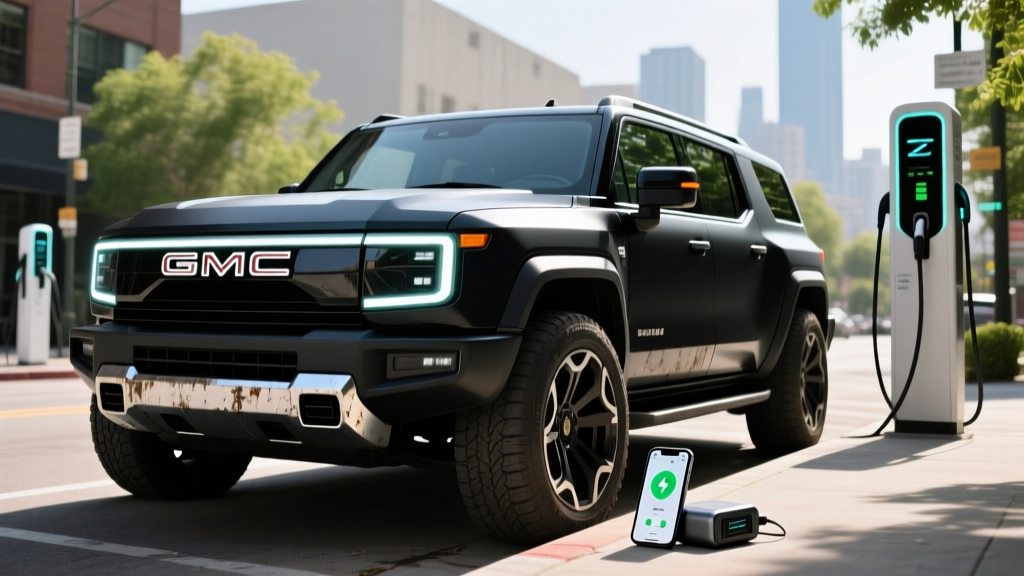
Bottom line on the 2025 GMC Hummer EV: With an EPA-estimated 314 miles of range (3X trim, 24-module pack), up to 1,000 horsepower, and a peak DC fast-charge rate of 350 kW, the electric Hummer is a legitimate full-size truck — but its $96,550+ starting price, 4,700-lb curb weight, and ~2.0 kWh/mi highway consumption make it one of the most expensive EVs to fuel on the road. Budget roughly $1,100–$1,500/year in electricity at public fast-charger rates, or $450–$650/year on home Level 2. It does not qualify for the federal §30D new EV tax credit due to MSRP caps ($80,000 truck limit) and battery-sourcing rules. Buy it if you need extreme capability and can charge at home; skip it if efficiency or tax incentives are priorities.
2025 Hummer EV at a Glance: Specs That Matter
| Spec | 3X Pickup (24-module) | 2X Pickup (20-module) |
|---|---|---|
| EPA Range | 314 mi | ~303 mi |
| Battery (usable) | ~212 kWh, NMC | ~170 kWh, NMC |
| Peak DC Fast Charge | 350 kW (800V architecture) | 350 kW (800V) |
| 10–80% DC Charge | ~35 min (curve-dependent) | ~30 min |
| Level 2 Rate | 11.5 kW (48A) | 11.5 kW (48A) |
| MPGe (combined) | 47 MPGe | 50 MPGe |
| Horsepower | 830 hp (Watts to Freedom: 1,000 hp) | 625 hp |
| 0–60 mph | ~3.0 sec (WTF mode) | ~4.5 sec |
| Towing Capacity | 7,500 lbs | 7,500 lbs |
| Base MSRP | $104,650 | $96,550 |
| Federal Tax Credit (§30D) | Not eligible | Not eligible |
| Battery/Powertrain Warranty | 8 yr / 100,000 mi | 8 yr / 100,000 mi |
The 24-module Ultium pack in the 3X is the largest battery in any production passenger vehicle. That 212 kWh usable capacity (NMC chemistry) is what enables 314 EPA miles despite the Hummer's brutal aerodynamics and 4,700-lb weight. However, EPA fueleconomy.gov data shows a combined 47 MPGe — translating to roughly 2.0–2.2 kWh per mile in real-world highway driving at 70+ mph.
Real-world range reality: EPA 314 miles on the 3X is achievable around town at moderate speeds. Expect ~240–265 miles on the highway at 75 mph in fair weather, and ~190–220 miles in freezing temperatures (the Ultium pack's active thermal management helps, but physics wins on cold-soak and cabin heat). Towing near max capacity? Budget 130–160 miles between charges.
Charging the Hummer EV: Home and Public Realities
GMC uses the CCS1 connector for 2025 models (with NACS adoption coming for future model years via adapter). The 800-voltage architecture enables 350 kW peak charging — but the charge curve is where the story gets nuanced.
| Level | Power (kW) | Connector | Miles of Range Added Per Hour | Full Charge Time (3X, 212 kWh) |
|---|---|---|---|---|
| Level 1 (120V household) | ~1.4 kW | J1772 | ~2–3 mi/hr | ~150+ hours (impractical) |
| Level 2 (240V home) | 11.5 kW | J1772 | ~18–22 mi/hr | ~18–20 hours |
| DC Fast (peak) | 350 kW | CCS1 | N/A (burst rate) | 10–80% in ~35 min |
The charge-curve catch: The Hummer EV peaks near 350 kW only between roughly 10–25% State of Charge (SoC). From 25–50% it tapers to ~250 kW, 50–80% drops further to ~150–175 kW, and above 80% it slows to under 50 kW to protect the NMC cells. A "35-minute 10–80%" figure assumes a 350 kW-capable station with no thermal throttling. At a typical 150 kW Electrify America or EVgo stall, expect 10–80% in 55–65 minutes.
Home charging is non-negotiable for Hummer EV ownership. With a 212 kWh battery, Level 1 is effectively useless (adding only ~50 miles overnight). You need a hardwired 60-amp Level 2 circuit (delivering 11.5 kW / 48 amps continuous) to recover roughly 200 miles overnight. Installation cost: typically $1,200–$3,500 depending on panel proximity, with a potential $2,000–$5,000 panel upgrade if your home has a 100-amp service. Consult a licensed electrician for final specs — the Hummer's sustained 11.5 kW draw is among the highest of any home-chargeable EV.
Cost of Ownership: Hummer EV vs. Gas Hummer H2/H3 Legacy
The last gas Hummer H3 (2010) returned roughly 14 MPG combined. Let's compare a hypothetical modern full-size gas truck at 16 MPG combined against the Hummer EV 3X over 5 years / 75,000 miles.
| Cost Factor (5 yr / 75k mi) | Hummer EV 3X | Gas Full-Size Truck (16 MPG) |
|---|---|---|
| Purchase Price (base) | $104,650 | $65,000 |
| Federal Tax Credit | $0 (MSRP cap + sourcing) | $0 |
| Fuel/Energy Cost | $4,200 (home L2) / $9,750 (public DC) | $16,400 ($3.50/gal) |
| Maintenance | ~$1,800 (no oil, fewer brakes via regen) | ~$4,500 |
| Insurance (avg) | ~$14,000 ($2,800/yr) | ~$9,500 ($1,900/yr) |
| Estimated Depreciation | ~$52,000 (50%) | ~$30,000 (46%) |
| 5-Year Total Cost | $172,450–$178,000 | $125,400 |
The verdict: The Hummer EV saves $7,000–$12,000 in fuel and maintenance over 5 years, but gives it all back — and then some — in higher purchase price, steeper insurance premiums, and heavier depreciation on a six-figure vehicle. This is not an EV you buy to save money. It's an EV you buy for instant torque, CrabWalk, Extract Mode, and the experience of driving a 9,000-lb-GVWR electric supertruck that hits 60 in 3 seconds.
Tax Credit Reality: Why the Hummer EV Doesn't Qualify
The IRS §30D clean vehicle credit imposes three hard barriers for the 2025 Hummer EV:
- MSRP cap: Trucks must be under $80,000. The Hummer EV starts at $96,550 — well over the limit across all trims.
- Critical mineral & battery component sourcing: Even if MSRP qualified, the Ultium pack's supply chain (sourcing from South Korea and other non-FTA partners for some components) does not fully meet 2025 thresholds.
- Buyer income caps: AGI limits of $150K single / $300K joint — relevant to most Hummer EV buyers regardless.
Some buyers attempt to route purchases through the commercial clean vehicle credit (§45W), which has no MSRP cap — but this requires business use and entity registration. Consult a tax professional before structuring a purchase around this strategy.
Common Misconceptions — Myth vs. Fact
| Myth | Fact |
|---|---|
| "The Hummer EV gets 350 miles per charge." | EPA is 314 mi (3X). Highway and cold weather reduce this to 190–265 mi depending on conditions. |
| "It charges in 12 minutes like a Tesla." | Peak 350 kW is brief. 10–80% takes ~35 min at a best-case 350 kW station; more like 55–65 min at typical 150 kW chargers. |
| "It qualifies for the $7,500 federal tax credit." | It does not. MSRP exceeds the $80,000 truck cap by ~$17K+. |
| "It's bad for the environment because of its size." | Lifetime emissions depend on your grid. On a clean grid (hydro, nuclear, wind/solar-heavy), it still beats a 14-MPG gas Hummer by 40–60% over 150K miles, even accounting for battery manufacturing. |
| "I can charge it on a regular wall outlet." | Level 1 adds ~2–3 miles per hour. You'd need 70+ hours for a full charge. A 60-amp Level 2 circuit is effectively required. |
Decision Framework: Should You Buy the 2025 Hummer EV?
Buy the Hummer EV 3X if:
- You have home Level 2 charging (or can install a 60A circuit)
- You want a sub-4-second supertruck with serious off-road chops (CrabWalk, adaptive air suspension, Extract Mode)
- You drive mostly in urban/suburban areas where 314 EPA miles covers 4–6 days of commuting
- Budget is flexible: $105K+ purchase, ~$2,800/yr insurance, potential $3K+ charger install
Buy the 2X (or wait) if:
- You want 625 hp and ~303 mi range at a $8,100 discount
- You don't need Watts to Freedom mode or the full 24-module pack
Skip the Hummer EV if:
- You rely exclusively on public charging (costs approach $2,000/yr and 35-min stops add up)
- You live in an apartment or lack dedicated parking with electrical access
- Federal tax credit eligibility is a dealbreaker — consider the Rivian R1T, Ford F-150 Lightning, or Chevy Silverado EV, some trims of which may qualify depending on sourcing and MSRP
- You tow frequently at max capacity (range drops to 130–160 mi)
First-Time EV Buyer Checklist for the Hummer
- Verify your electrical panel: A 200-amp service is strongly recommended. A 100-amp panel will likely need upgrading ($2,000–$5,000).
- Test your daily route math: If your round-trip commute exceeds 120 miles, plan for mid-day or frequent DC fast charging.
- Factor in insurance early: Get quotes before ordering. High-value, high-horsepower EVs often carry premiums 40–60% above equivalent gas trucks.
- Understand NMC degradation: The Ultium pack is warrantied for 8 years / 100,000 miles at 60%+ capacity retention per GMC's official specifications. Expect ~8–12% degradation over 100K miles with typical use. Avoid habitual 100% charges and frequent DC fast charging from very low SoC.
- Download PlugShare and A Better Routeplanner: Map road trips before you take them. CCS1 coverage is strong but not universal in rural corridors.
- Consider the used market: Depreciation is steep on six-figure EVs. A 1–2 year old Hummer EV can be found for 30–40% below original MSRP — but verify battery State of Health (SoH) via OBD-II scan before purchase.
Frequently Asked Questions
Is the 2025 Hummer EV a good daily driver?
Yes, if you can charge at home. Its 314-mile EPA range covers most commutes for 4–6 days between charges, and the ride quality on the adaptive air suspension is surprisingly refined for a 4,700-lb truck. The footprint, however, is enormous (217 inches long, 86 inches wide with mirrors) — verify your garage and parking situation before committing.
How does the Hummer EV compare to the Rivian R1T or Tesla Cybertruck?
The Hummer EV is heavier, less efficient (~47 MPGe vs. R1T's ~70+ MPGe), and more expensive. It trades efficiency for sheer capability: 1,000 hp in WTF mode, 37-inch tires available, and CrabWalk. The R1T is the smarter daily-driver truck; the Cyberbeat offers stainless-steel novelty and better efficiency. The Hummer is the excess-maximizer's choice.
What's the real cost to charge a Hummer EV at home vs. public chargers?
At the US average residential rate of ~$0.16/kWh, a full 212 kWh charge costs ~$34 (3X). At public DC fast chargers averaging $0.40–$0.55/kWh, that same charge runs $85–$116. Over 15,000 miles/year, home charging costs ~$500–$650; exclusive public DC charging costs ~$1,500–$2,000.
Will the Hummer EV qualify for any incentives in 2025 or 2026?
Federal §30D is off the table due to MSRP caps. Some states (California, Colorado, Massachusetts) offer separate rebates that may apply — check your state energy office or the Alternative Fuels Data Center for current local incentives. Utility companies may also offer off-peak charging rebates or Level 2 installation credits.
How does cold weather affect Hummer EV range?
Expect 25–40% range loss in sustained sub-freezing temperatures (20°F and below). The Ultium pack's active thermal management and available heat pump mitigate this, but the sheer energy demand of heating a cabin that large plus battery conditioning is substantial. Preconditioning while plugged in is essential to preserve range.