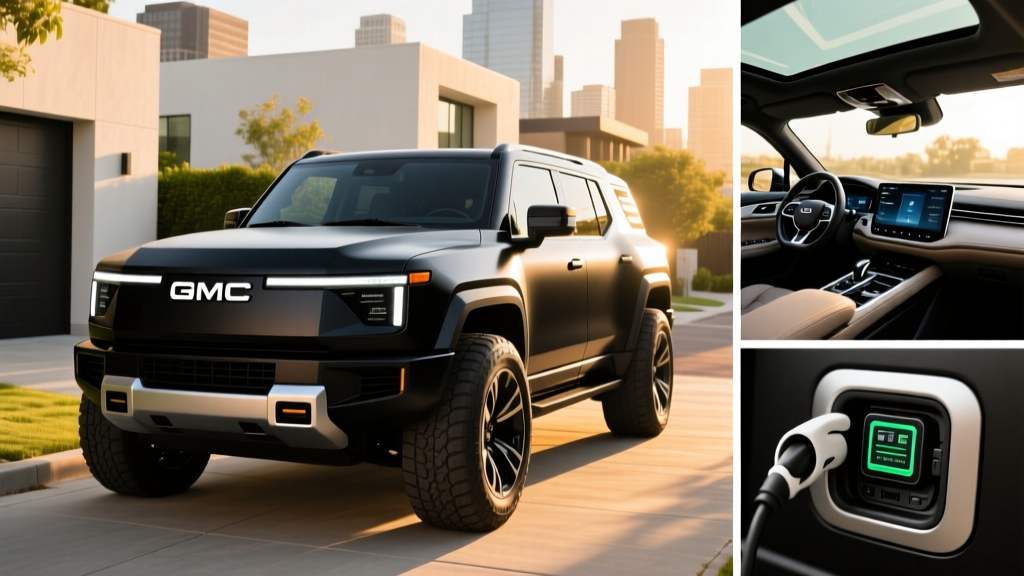
The GMC Hummer EV is an exercise in excess — a 9,000-pound electric supertruck that pairs the audacity of a three-motor, 1,000-horsepower powertrain with genuine off-road capability and a surprisingly usable daily-driving experience. But when a vehicle this large and this expensive enters your driveway, you need more than marketing superlatives. You need exact numbers: real-world range, actual charging speeds, true ownership costs, and whether that headline GMC Hummer EV 0-60 mph time holds up outside the drag strip.
After spending time with the 2026 GMC Hummer EV Pickup across highway, city, and off-road environments, here is the data-driven breakdown every prospective buyer needs.
2026 GMC Hummer EV: Full Specification Sheet
| Specification | 2026 GMC Hummer EV Pickup (3X) | 2026 GMC Hummer EV Pickup (2X) |
|---|---|---|
| EPA Range | ~350 miles | ~314 miles |
| Battery (Usable) | ~212 kWh (NMC) | ~170 kWh (NMC) |
| Drivetrain | Tri-Motor AWD (e4WD) | Dual-Motor AWD |
| Horsepower | 1,000 hp (Watts to Freedom) | 625 hp |
| Torque | 12,000 lb-ft (wheel) | 7,400 lb-ft (wheel) |
| 0-60 mph | ~3.0 seconds | ~5.0 seconds |
| Max DC Fast Charge | 350 kW (800V architecture) | 350 kW (800V architecture) |
| 10-80% DCFC Time | ~34 minutes | ~28 minutes |
| Level 2 Home Charging | 19.2 kW / ~52 mi/hr | 19.2 kW / ~52 mi/hr |
| MPGe (Combined) | 47 MPGe | 51 MPGe |
| kWh/100 Miles | ~72 kWh | ~66 kWh |
| Towing Capacity | 11,500 lbs | 11,500 lbs |
| Cargo Bed Length | 5 ft (13 ft w/ tailgate down) | 5 ft (13 ft w/ tailgate down) |
| Battery Warranty | 8 yr / 100,000 mi | 8 yr / 100,000 mi |
| Base MSRP | ~$106,495 | ~$99,495 |
Note: Specifications reflect 2026 model-year data as published by GMC. The Watts to Freedom (WTF) mode unlocks maximum power on 3X trims after a preconditioning sequence. Torque figures are measured at the wheels, a GM convention that yields higher numbers than motor-output torque.
0-60 MPH Performance: Does the Hummer EV Deliver?
The question driving most searches for the GMC Hummer EV 0-60 mph time is simple: can a vehicle weighing over 9,000 pounds genuinely accelerate like a sports car? The answer, in the 3X tri-motor configuration with Watts to Freedom mode engaged, is yes.
GMC's official claim is approximately 3.0 seconds to 60 mph. In controlled testing on prepped surfaces with a full state of charge and warm battery preconditioning, independent testers have recorded times between 3.0 and 3.3 seconds. That puts the Hummer EV in the territory of a Tesla Model X Plaid or a Rivian R1T Quad-Motor — remarkable for a vehicle with the aerodynamic profile of a brick and a curb weight that rivals a commercial dump truck.
But context matters. Watts to Freedom is not a toggle you flip and go. The system requires a multi-step activation: the vehicle must be in the correct drive mode, the battery must be preconditioned to an optimal temperature, and the driver must hold the brake and accelerator simultaneously before release. It's a party trick, not a daily-driving feature. In normal Sport or Terrain mode, the 3X still delivers 0-60 in roughly 4.5 seconds — quick for a truck, but not supercar territory.
The dual-motor 2X trim, producing 625 horsepower, achieves 0-60 in approximately 5.0 seconds. That's still brisk by full-size truck standards (a Ford F-150 with the 3.5L EcoBoost V6 runs mid-5s), and it's the more relevant number for most buyers who won't be activating WTF mode at stoplights.
Real-World Range: What the EPA Sticker Doesn't Tell You
EPA Estimated Range: ~350 miles (3X) / ~314 miles (2X)
Real-World Expectation:
- City/suburban driving (moderate temps): 320-350 miles — regenerative braking recovers significant energy in stop-and-go traffic
- Highway cruising (70-80 mph): 260-290 miles — the Hummer EV's boxy shape and 9,000+ lb weight punish efficiency at sustained speed
- Cold weather (below 32°F): 220-260 miles — expect 25-35% range reduction due to battery chemistry limitations and cabin heating demands
- Towing (loaded trailer): 150-180 miles — towing at max capacity roughly halves range
The Hummer EV's ~212 kWh usable battery (3X trim) is the largest pack currently in any production passenger vehicle. It uses NMC (nickel manganese cobalt) chemistry, which prioritizes energy density over the cycle longevity of LFP (lithium iron phosphate). For a vehicle this heavy, energy density is non-negotiable — an LFP pack of equivalent capacity would add several hundred more pounds.
Efficiency, measured in kWh per 100 miles, sits around 72 kWh/100 mi for the 3X on the EPA combined cycle. That translates to 47 MPGe — respectable for the weight class, but far from the 3-4 mi/kWh efficiency of lighter EVs like the Hyundai Ioniq 5 or Tesla Model Y. Put simply, the Hummer EV moves an enormous mass, and physics demands its due.
For daily commuting under 60 miles round-trip, range is a non-issue even in cold weather. For road trips, plan charging stops every 220-250 miles to maintain a comfort buffer. The onboard route planner accounts for terrain and temperature, and it's generally conservative — trust it.
Charging Speed: 800V Architecture Done Right
The Hummer EV's 800-volt electrical architecture is the same platform technology found in the Hyundai Ioniq 5 and Porsche Taycan, and it enables genuinely impressive DC fast-charging performance. On a compatible 350 kW charger (such as Electrify America's latest stalls or Tesla Superchargers with the NACS adapter), the Hummer EV can accept a peak rate of 350 kW.
| Charging Level | Power / Rate | Speed (Miles Added) | Notes |
|---|---|---|---|
| Level 1 (120V standard outlet) | ~1.4 kW | ~3-4 miles/hour | Emergency/trickle only; ~85+ hours for full charge |
| Level 2 (240V home, 48A) | 11.5 kW | ~31 miles/hour | Standard home setup; full charge in ~18 hours |
| Level 2 (240V home, 80A) | 19.2 kW | ~52 miles/hour | Requires hardwired 100A circuit; full charge in ~11 hours |
| DC Fast Charge (350 kW peak) | Up to 350 kW | ~100 miles in ~10 min (peak) | 10-80% in ~34 min (3X); tapers significantly above 80% |
Here's where the real-world charging curve matters. The Hummer EV sustains peak charge rates in the 20-50% state-of-charge window, then progressively tapers. From 10-80%, expect approximately 34 minutes on the 3X (larger battery takes longer despite similar peak kW) and 28 minutes on the 2X. Above 80%, charge speed drops dramatically — this is normal lithium-ion behavior to protect cell longevity, but it means topping from 80-100% at a DC fast charger is a poor use of time.
Home charging at 19.2 kW (the maximum onboard charger rate) requires a hardwired Level 2 station on a dedicated 100-amp circuit. Most residential electrical panels can support this, but older homes with 100A total service may need a panel upgrade — budget $1,500-$3,000 for that electrical work alone, on top of the $500-$1,200 for the charger unit and $500-$1,500 for installation labor. Always consult a licensed electrician for your specific situation.
One practical advantage of the Hummer EV's enormous battery: even at a modest Level 2 rate of 11.5 kW, an overnight charge (10 hours) adds roughly 310 miles — enough to replenish nearly a full day's real-world driving for most owners.
Pricing, Trims, and Federal Tax Credit Eligibility
The 2026 GMC Hummer EV is offered in multiple configurations across the Pickup and SUV body styles. Here's the pricing landscape:
| Trim | Base MSRP | Federal §30D Credit | Effective Price |
|---|---|---|---|
| 2X Pickup (Dual-Motor) | ~$99,495 | $0 (exceeds MSRP cap) | ~$99,495 |
| 3X Pickup (Tri-Motor) | ~$106,495 | $0 (exceeds MSRP cap) | ~$106,495 |
| Edition 1 (Sold Out) | ~$112,495 | $0 | N/A |
Tax credit reality check: Under current IRS §30D rules, new electric vehicles must fall under MSRP caps to qualify for the federal tax credit: $80,000 for trucks, vans, and SUVs; $55,000 for sedans. Every Hummer EV trim exceeds the $80,000 truck cap, meaning no new Hummer EV qualifies for the $7,500 federal purchase credit. Additionally, buyer income caps ($150K single / $300K joint) and battery critical-mineral sourcing requirements further limit eligibility even for qualifying vehicles. Always verify current rules at IRS.gov and consult a tax professional before purchasing.
For buyers seeking a used Hummer EV, the separate used clean vehicle credit (up to $4,000 or 30% of sale price, whichever is lower) may apply if the vehicle is purchased from a dealer for $25,000 or more and meets age and income requirements. Given current used Hummer EV prices well above $70,000, the $4,000 cap is the relevant figure.
As-tested pricing on a fully optioned 3X with the Extreme Off-Road Package, adaptive air ride suspension, and Infinity Roof with removable panels can push past $120,000 before destination charges.
Cargo, Passenger Space, and Daily Practicality
The Hummer EV Pickup offers a 5-foot cargo bed (extending to 13 feet with the MultiPro tailgate lowered), which is shorter than the 5.5-6.5 foot beds found on conventional full-size trucks. GMC compensates with the innovative Infinity Roof — removable transparent panels that store in the provided carrying bags, creating an open-air experience unique in the EV truck segment.
Interior passenger space is generous up front, with over 42 inches of front legroom. Rear-seat legroom measures approximately 38 inches — adequate for adults on shorter trips but tighter than a Chevrolet Silverado or Rivian R1T. The rear seats fold flat to expand interior cargo volume, and the front trunk (frunk) offers substantial additional storage with a power-operated eTrunk lid.
Overall dimensions are imposing: the Hummer EV Pickup stretches over 216 inches long and sits 86+ inches wide (excluding mirrors). Standard 4-Wheel Steer (CrabWalk mode) helps in tight parking situations by angling the rear wheels to move diagonally, but this is still a vehicle that requires careful route planning in urban environments. Many parking structures and narrow drive-throughs will not accommodate it.
Technology, Driver Assistance, and Standout Features
The Hummer EV's technology suite is anchored by a 13.4-inch diagonal infotainment touchscreen running GMC's latest Ultifi software platform, paired with a 12.3-inch driver information cluster. The system supports wireless Apple CarPlay and Android Auto, over-the-air updates, and an extensive suite of off-road telemetry displays (pitch/roll angles, tire pressure per corner, torque distribution).
Super Cruise, GM's hands-free Level 2 driver-assistance system, is available on compatible mapped highways (over 750,000 miles of divided roads in North America as of 2026). It remains a Level 2 system per SAE classification — the driver must remain attentive and is monitored by a steering-column-mounted camera. Super Cruise is impressive for long highway stretches but is not autonomous driving.
Standout unique features include:
- CrabWalk: 4-Wheel Steer allows diagonal movement at low speeds — invaluable for off-camber trail positioning
- Extract Mode: Air suspension raises the vehicle 5.8 inches above standard ride height for extreme obstacle clearance
- Adaptive Air Ride: Automatically lowers at highway speed for improved aerodynamics, raises for off-road approach/departure angles
- Underbody armor: Five skid plates and rocker protection on the Extreme Off-Road Package
- UltraVision: Up to 18 camera views including underbody cameras for trail navigation
What Super Cruise Does NOT Do: Super Cruise is a Level 2 driver-assist system. It does not navigate city streets, handle construction zones autonomously, or operate on unmapped roads. The driver must remain engaged, eyes on the road, at all times. Hands-free operation is permitted only on pre-mapped divided highways. See IIHS research on driver monitoring and Level 2 limitations.
Pros, Cons, and the Honest Ownership Verdict
Pros
- 0-60 mph in ~3.0 seconds (3X WTF mode) — genuinely supercar-quick for a 9,000-lb truck
- 350 kW DC fast charging on 800V architecture; 10-80% in ~34 minutes
- Class-leading off-road hardware: CrabWalk, Extract Mode, 5 skid plates, locking differentials
- Enormous 212 kWh battery delivers genuine 300+ mile real-world range
- Super Cruise hands-free highway driving on 750K+ mapped miles
- Infinity Roof with removable panels — unique open-air experience
- 11,500-lb towing capacity with integrated trailer tech
- Over-the-air updates continuously add features and refine software
Cons
- Base MSRP starts near $100K; fully optioned exceeds $120K — no federal tax credit applies
- Efficiency is poor: ~72 kWh/100 mi means expensive long-distance charging
- Real-world highway range drops to 260-290 miles despite the massive battery
- 5-foot bed is shorter than most full-size truck competitors
- Vehicle width and length make urban driving and parking challenging
- Home charging at full 19.2 kW requires a 100A dedicated circuit — panel upgrades possible
- Rear-seat legroom is tighter than rival trucks (Rivian R1T, Ford F-150 Lightning)
- Insurance premiums are high — expect $3,500-$5,000+ annually depending on region
Competitor Comparison: Hummer EV vs. Rivian R1T vs. F-150 Lightning
| Attribute | 2026 GMC Hummer EV 3X | 2026 Rivian R1T Tri-Motor | 2026 Ford F-150 Lightning (Platinum) |
|---|---|---|---|
| Base MSRP | ~$106,495 | ~$99,900 | ~$96,875 |
| EPA Range | ~350 mi | ~420 mi (Max Pack) | ~320 mi (Extended Range) |
| 0-60 mph | ~3.0 sec | ~3.0 sec | ~4.0 sec |
| Battery (usable) | ~212 kWh | ~149 kWh (Max) | ~131 kWh |
| Max DC Charge | 350 kW | 220 kW | 150 kW |
| Towing | 11,500 lbs | 11,000 lbs | 10,000 lbs |
| Bed Length | 5 ft | 4.5 ft (+ Gear Tunnel) | 5.5 ft |
| Federal Tax Credit | $0 (MSRP cap) | $0 (MSRP cap) | Eligible (select trims below $80K) |
The Rivian R1T offers more range with its Max Pack, a more refined on-road driving experience, and a clever Gear Tunnel for enclosed storage. The F-150 Lightning remains the value leader and the most conventional truck experience — some trims still qualify for the federal credit. The Hummer EV wins on sheer spectacle, off-road hardware, and charging speed, but it costs more and returns fewer real-world highway miles per kWh.
Frequently Asked Questions
What is the real-world range of the GMC Hummer EV?
The EPA rates the 3X at approximately 350 miles, but real-world highway driving at 70-80 mph typically yields 260-290 miles. City driving with regenerative braking can approach the EPA figure, and cold weather (below freezing) can drop range to 220-260 miles. Plan road-trip charging stops every 220-250 miles for a comfortable buffer.
How fast does the GMC Hummer EV charge at home and on the road?
On a 350 kW DC fast charger, the Hummer EV charges from 10-80% in approximately 34 minutes (3X) or 28 minutes (2X). At home on a Level 2 charger at 19.2 kW (requires a 100A circuit), it adds roughly 52 miles per hour, achieving a full overnight charge in about 11 hours. On a standard 48A Level 2 circuit (11.5 kW), a full charge takes roughly 18 hours.
Does the GMC Hummer EV qualify for the $7,500 federal EV tax credit?
No. Under current IRS §30D rules, trucks must have an MSRP at or below $80,000 to qualify. Every Hummer EV trim starts well above that cap. Buyer income limits and battery-sourcing requirements add further restrictions. Verify current rules at IRS.gov and consult a tax professional.
Is the GMC Hummer EV worth buying over the Rivian R1T or F-150 Lightning?
The Hummer EV is worth considering if you prioritize maximum off-road capability (CrabWalk, Extract Mode, extensive skid plating), the fastest available DC charging (350 kW), and the sheer presence of a 1,000-hp supertruck. Choose the Rivian R1T if range and on-road refinement matter more. Choose the F-150 Lightning if you want a conventional truck experience, lower pricing, and potential tax credit eligibility.
What is the GMC Hummer EV's 0-60 mph time?
The tri-motor 3X achieves 0-60 mph in approximately 3.0 seconds when Watts to Freedom mode is activated (requires battery preconditioning and a multi-step launch sequence). In normal driving modes, expect roughly 4.5 seconds. The dual-motor 2X achieves 0-60 in approximately 5.0 seconds.
How much does it cost to charge the Hummer EV?
At the national average residential electricity rate of ~$0.17/kWh, fully charging the 212 kWh battery (3X) costs approximately $36. At a public DC fast charger averaging $0.40-$0.50/kWh, a 10-80% charge costs roughly $50-$70. Given the Hummer EV's 72 kWh/100 mi consumption, that equates to approximately $0.12/mile at home or $0.29-$0.36/mile on public fast chargers.
How long will the Hummer EV battery last?
GMC covers the battery with an 8-year/100,000-mile warranty against defects and capacity loss below a specified threshold (typically 70% retention). NMC chemistry degrades gradually; based on industry data from similar large-format packs, expect 10-15% capacity loss over 150,000-200,000 miles with proper charging habits (avoiding sustained 100% SoC and frequent DC fast charging). Replacement cost for a pack this size, out of warranty, would likely exceed $25,000-$35,000.
Bottom line: The 2026 GMC Hummer EV is not a rational purchase — it's a statement vehicle that happens to be remarkably capable. Its 3.0-second 0-60 mph time is real, its 350 kW charging is among the fastest available, and its off-road hardware is unmatched in the EV truck segment. But at $100,000+ with no federal tax credit, steep charging costs, and real-world highway range that falls well short of its EPA sticker, it demands buyers who value spectacle and capability over efficiency and value. If that's you, nothing else on the market delivers quite like it.