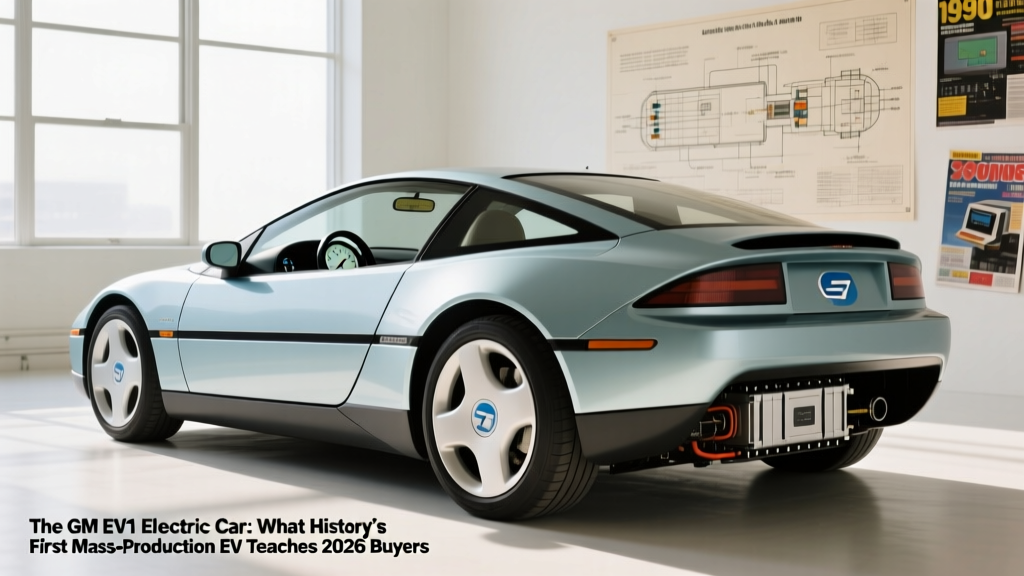
Quick Answer: The GM EV1 was General Motors' first mass-production electric car, produced from 1996 to 1999 and leased (never sold) to roughly 1,117 drivers in California and Arizona. It offered 60–160 miles of range depending on battery chemistry (lead-acid vs. nickel-metal hydride), weighed about 3,000 lbs, and was famously recalled and crushed by GM in the early 2000s. You cannot buy a GM EV1 today. However, the engineering lessons from the EV1 — battery chemistry trade-offs, charging infrastructure gaps, and the importance of battery ownership rights — directly shaped every modern EV on the road in 2026, from the Chevy Equinox EV to the Cadillac Lyriq.
Why the GM EV1 Still Matters to Modern EV Buyers
If you've searched for electric car GM EV1, you've likely seen the documentary Who Killed the Electric Car? or encountered the EV1 in automotive history discussions. The EV1 wasn't just a science experiment — it was the first purpose-built, mass-production battery-electric vehicle from a major automaker, arriving decades before the Nissan Leaf (2010) or Tesla Model S (2012).
For today's EV shoppers evaluating 2026 models with 300+ mile EPA ranges and 200+ kW DC fast charging, the EV1's specifications look almost quaint. But understanding its trajectory — from a 60-mile lead-acid range to a 160-mile NiMH pack, from inductive paddle charging to the eventual recall — illuminates exactly why modern EV buyers should care about battery chemistry, charging standards, and ownership terms.
The EV1 also serves as the most dramatic cautionary tale in EV history: GM built a car that early adopters loved, then destroyed nearly every unit. That outcome directly influenced today's battery warranty standards, right-to-repair debates, and the federal incentive structure under IRS §30D clean vehicle credits that help protect consumer investment in electrification.
GM EV1 Specifications: What the Numbers Actually Were
The EV1 went through two major production generations, and the spec differences between them map almost perfectly onto the battery-chemistry decisions modern buyers still face.
| Spec | Gen 1 (1996–1997) | Gen 2 (1999) |
|---|---|---|
| Battery Chemistry | Lead-Acid (Delco) | NiMH (Ovonic / Panasonic) |
| Battery Capacity | ~16.5 kWh (usable ~13.2 kWh) | ~26.4 kWh (usable ~22 kWh) |
| EPA-Equivalent Range | ~60 miles | ~100–160 miles (depending on driving) |
| Curb Weight | ~2,970 lbs | ~3,086 lbs |
| Motor Output | 102 kW (137 hp) | 102 kW (137 hp) |
| 0–60 mph | ~8.0 seconds | ~8.0 seconds |
| Top Speed | 80 mph (electronically limited) | 80 mph (electronically limited) |
| Charging Method | GM Magne Charge (inductive paddle) | GM Magne Charge (inductive paddle) |
| Charge Time (full) | ~5.5–6 hours (Level 2 equivalent) | ~5.5–6 hours (Level 2 equivalent) |
| Production Volume | ~660 units | ~457 units |
| Availability | Lease only ($399–$549/month) | Lease only ($399–$549/month) |
The jump from lead-acid to NiMH chemistry is the single most important data point here. Swapping battery chemistry nearly doubled usable energy (from ~13.2 kWh to ~22 kWh) and extended real-world range by 60–100%, all within a nearly identical vehicle platform. This is the same fundamental trade-off — energy density, cycle life, cost, and thermal behavior — that modern buyers weigh when choosing between LFP (lithium iron phosphate) and NMC (nickel manganese cobalt) batteries in 2026 vehicles like the Tesla Model 3 RWD vs. Long Range.
EV1 vs. a 2026 EV: The Generational Leap in Numbers
To put the EV1 in context for someone shopping today, here's how its best-case specifications compare against a mainstream 2026 EV — the Chevrolet Equinox EV 3RS, a direct GM descendant in spirit.
| Attribute | GM EV1 Gen 2 (1999) | 2026 Chevy Equinox EV 3RS |
|---|---|---|
| Battery Chemistry | NiMH | NMC (Ultium platform) |
| Usable Battery Capacity | ~22 kWh | ~85 kWh |
| EPA Range | ~100–160 mi (no EPA sticker existed) | 319 mi (EPA est.) |
| Real-World Highway Range | ~80–100 mi (70 mph, mild weather) | ~250–270 mi (70 mph, 65°F) |
| DC Fast Charge Peak | None (no DCFC capability) | ~190 kW peak |
| 10–80% DCFC Time | N/A | ~20 minutes |
| Level 2 AC Charge Rate | ~6.6 kW (inductive) | ~11.5 kW (J1772/NACS) |
| Horsepower | 137 hp | 288 hp (AWD) |
| 0–60 mph | ~8.0 sec | ~5.9 sec |
| Cargo Volume | ~10 cu ft (trunk) | ~26.4 cu ft (rear seats up) |
| Starting MSRP | N/A (lease only, ~$33,900 equivalent) | $43,900 (before incentives) |
| Federal Tax Credit | None available in 1999 | Up to $7,500 (§30D, eligibility varies) |
| Battery Warranty | None (leased, GM-owned) | 8 years / 100,000 miles |
The scale of progress is enormous. The Equinox EV carries nearly 4× the usable energy, delivers roughly 2× the real-world range, supports DC fast charging that the EV1 couldn't even conceptualize, and comes with a federally backed battery warranty that would have been unthinkable in 1999 — when GM retained full ownership of the EV1's battery and ultimately used that control to recall and destroy the fleet.
Real Costs Then and Now: EV Ownership Economics
The EV1 was never sold — it was leased at roughly $399–$549 per month with a $2,500 down payment, and GM covered all maintenance. Adjusted for inflation, that monthly cost is roughly $800–$1,100 in 2026 dollars, which is actually comparable to leasing a mid-tier EV today after applying point-of-sale incentives.
Here's how the operating costs of a modern EV compare to the gas-car baseline that EV1 drivers were trying to escape:
| Vehicle | Energy Source | Efficiency | Cost per Unit | Annual Cost |
|---|---|---|---|---|
| 2026 Chevy Equinox EV (home L2) | Electricity | 3.0 mi/kWh | $0.14/kWh (US avg.) | ~$560 |
| 2026 Chevy Equinox EV (public DCFC) | Electricity | 3.0 mi/kWh | $0.40/kWh (avg. public) | ~$1,600 |
| 2026 Toyota Camry (gas) | Gasoline | 32 MPG combined | $3.30/gal (US avg.) | ~$1,238 |
| GM EV1 (1999, home charging) | Electricity | ~4.5 mi/kWh (light vehicle) | $0.08/kWh (1999 avg.) | ~$213 (1999 dollars) |
The EV1's efficiency was actually remarkable for its era — its lightweight, aerodynamic design (drag coefficient of 0.19) meant it used less energy per mile than most modern EVs, which are significantly heavier. But range limitations meant EV1 drivers had to plan around 60–100 miles of usable range with zero public charging infrastructure, a constraint that modern buyers with 300+ mile vehicles and a growing EPA-rated charging network simply don't face.
For a 2026 buyer, the cost equation is straightforward:
- Home charging (Level 2): $500–$1,200 for equipment and electrician installation on a 240V/50A circuit; pays for itself in fuel savings within 1–2 years vs. gasoline.
- Maintenance: EVs eliminate oil changes, spark plugs, and exhaust system repairs. Expect ~$0.06/mile in maintenance vs. ~$0.10–$0.12/mile for a gas car (AAA data).
- Insurance: EV premiums run 15–25% higher on average due to repair costs and battery replacement risk — a real cost that the EV1's lease structure hid from its drivers.
- Tax credits: Under current IRS §30D rules, eligible buyers can receive up to $7,500 as a point-of-sale reduction, subject to MSRP caps ($55,000 for cars, $80,000 for SUVs/trucks), buyer income limits ($150K single / $300K joint), and battery critical-mineral sourcing requirements that change annually.
What the EV1's Demise Teaches First-Time EV Buyers
The most important lesson from the GM EV1 isn't technical — it's contractual. GM leased every EV1, retained ownership of the battery, and when the program ended in 2003, it recalled and crushed approximately 1,114 of the 1,117 vehicles despite lessees offering to buy them outright. The few surviving EV1s were donated to museums with disabled powertrains.
This outcome directly shaped modern EV ownership norms:
| EV1 Issue | Modern Equivalent | What to Check Before Buying |
|---|---|---|
| Lease-only, no purchase option | Some EV subscriptions and battery-leasing models (e.g., early Renault Zoe, Nio BaaS) | Confirm whether you own the battery or lease it; read the contract's end-of-term clause |
| No battery warranty (GM owned it) | Federal mandate: 8 yr / 100,000 mi minimum battery warranty | Check the capacity-retention threshold — most warranties guarantee 70% SoH; some are 65% |
| Proprietary inductive charging (Magne Charge) | NACS vs. CCS fragmentation in 2024–2025 (now largely resolved toward NACS) | Verify your vehicle's charge port matches the dominant networks in your area |
| No public charging existed | Charging deserts still exist in rural US corridors | Map your regular routes against AFDC charging station data; plan for DCFC gaps |
| Program cancellation without recourse | Model discontinuation (e.g., Chevy Bolt, 2023; revived 2025+) | Buy from a platform with high parts commonality (e.g., Ultium, Hyundai E-GMP) for long-term serviceability |
For first-time EV buyers, the actionable takeaway is this: always own your battery, always verify the warranty threshold, and always confirm charging compatibility before signing. The EV1's drivers learned these lessons the hard way — their cars were towed away.
Common EV1 Myths vs. Documented Facts
| Myth | Fact |
|---|---|
| "The EV1 had only 50 miles of range." | Gen 1 (lead-acid) achieved ~60 miles; Gen 2 (NiMH) reached 100–160 miles in real-world driving, depending on speed, climate, and terrain. |
| "GM killed the EV1 because it wasn't profitable." | GM cited insufficient demand, high production cost, and California's weakening ZEV mandate. Internal documents and the 2006 documentary Who Killed the Electric Car? present a more complex picture involving oil-industry lobbying, battery patent disputes (Ovonic/Chevron), and strategic pivoting to hydrogen fuel cells. |
| "Nobody wanted the EV1." | GM received ~5,000 expressions of interest but produced only ~1,117 units. Lessees were passionate advocates — many offered to purchase their vehicles at full cost before the recall. The waitlist was never fully served. |
| "The EV1 was slow." | 0–60 mph in ~8.0 seconds was competitive with a 1997 Honda Civic EX (~9.2 sec) and quicker than many compact cars of its era. Its 80 mph electronic limiter, not acceleration, was the real constraint. |
| "EV1 technology led directly to the Toyota Prius." | The Prius (1997, Japan) was a parallel development using NiMH batteries from Panasonic/Matsushita. GM's EV1 and Toyota's hybrid program shared battery-chemistry supply chains but not engineering lineage. |
Decision Framework: Should the EV1's History Influence Your 2026 EV Purchase?
If you're researching the EV1 for historical interest: The EV1's engineering was genuinely groundbreaking — its 0.19 drag coefficient, aluminum-and-composite construction, and regenerative braking system were decades ahead of their time. Visit the SAE International archives or the Petersen Automotive Museum (which holds one of the few surviving EV1s) for primary-source research.
If you're a first-time EV buyer inspired by the EV1's story: Channel that inspiration into a modern EV with strong buyer protections. Prioritize:
- Battery ownership: Buy, don't lease the battery. Confirm the purchase agreement includes the full battery pack.
- Warranty specifics: 8 years/100,000 miles is the federal minimum. Look for 70% State-of-Health (SoH) retention guarantees, not just "defect" coverage.
- Charging standard: In 2026, NACS (North American Charging Standard) has become the dominant connector for new vehicles. Tesla Superchargers now accept NACS-equipped non-Tesla EVs. Verify your model's port.
- Platform longevity: Choose vehicles on high-volume platforms (GM Ultium, Hyundai E-GMP, VW MEB, Tesla) for parts availability 10+ years out.
If you're comparing EVs to hybrids based on the EV1's limitations: The EV1's 60–160 mile range with no fast charging was a legitimate barrier. In 2026, that barrier is gone for most buyers. But if you lack home charging access, frequently drive 300+ mile corridors without reliable DCFC infrastructure, or live in extreme cold climates (where range drops 20–35%), a PHEV like the Toyota RAV4 Prime (42 mi electric-only, 38 MPG gas) may still be the pragmatic bridge. The EV1's story proves that pure EVs need infrastructure to succeed — and that infrastructure now exists for most, but not all, American drivers.
Frequently Asked Questions
Can I buy a GM EV1 today?
No. GM produced approximately 1,117 EV1s between 1996 and 1999, all via lease. The company recalled and destroyed nearly all of them by 2003. A handful survive in museums (Petersen, Smithsonian, Sloan) with disabled drivetrains. No road-legal, drivable EV1 is available for private purchase.
What battery did the GM EV1 use?
Generation 1 (1996–1997) used a Delco lead-acid battery pack with ~16.5 kWh total capacity. Generation 2 (1999) switched to an Ovonic nickel-metal hydride (NiMH) pack with ~26.4 kWh total capacity. The NiMH pack nearly doubled range but was entangled in a patent dispute between Ovonic Battery Company and Chevron, which acquired controlling rights to the patent — a factor cited in the EV1's discontinuation.
How did the EV1 charge?
The EV1 used GM's proprietary Magne Charge inductive paddle system — a large paddle inserted into a slot between the headlights. It charged at roughly 6.6 kW (Level 2 equivalent), taking about 5.5–6 hours for a full charge. There was no DC fast charging capability. The Magne Charge system was later abandoned in favor of the SAE J1772 conductive connector, which itself has now been largely superseded by NACS in 2025–2026.
Why did GM recall and crush the EV1?
GM cited multiple factors: low consumer demand (by GM's measurement), high manufacturing cost per unit, California's weakened Zero Emission Vehicle (ZEV) mandate (which reduced regulatory pressure), and a strategic pivot toward hydrogen fuel-cell research. Critics, including EV1 lessees and the filmmakers behind Who Killed the Electric Car? (2006), argue that oil-industry lobbying, the Ovonic/Chevron battery patent dispute, and internal corporate resistance to a vehicle that required no oil changes or dealership maintenance all played significant roles. The full truth likely involves all of these factors.
How does the EV1 compare to the first Tesla Roadster?
The 2008 Tesla Roadster arrived nine years after the final EV1 and represented a generational leap: 244-mile EPA range, 53 kWh lithium-ion battery (vs. 26.4 kWh NiMH), 0–60 mph in 3.7 seconds (vs. ~8.0 sec), and a purchase model (starting at ~$109,000) rather than lease-only. The Roadster proved that consumer demand for EVs existed when range exceeded 200 miles — a threshold the EV1 never reached. Tesla's approach also avoided the EV1's fatal flaw: GM retained ownership of the EV1 fleet, enabling recall and destruction.
What modern GM EV is the closest spiritual successor to the EV1?
The 2026 Chevrolet Equinox EV and Cadillac Lyriq both ride on GM's Ultium platform and represent the company's current mass-market EV strategy. The Equinox EV (319 mi EPA range, ~$43,900 MSRP, eligible for up to $7,500 in federal credits) is the closest analog to what the EV1 aimed to be: an accessible, efficient, purpose-built electric vehicle for everyday driving. Unlike the EV1, it's sold (not leased), carries an 8-year/100,000-mile battery warranty, and supports 190 kW DC fast charging — addressing every major limitation that doomed its predecessor.