Quick Answer: Is a GM EV Van Right for Your Business?
General Motors currently offers the BrightDrop Zevo 600 as its primary electric delivery van, with an EPA-estimated range of up to 250 miles, a 120 kWh Ultium battery pack, and DC fast charging from 10-80% in approximately 45 minutes at a peak rate of 150 kW. Pricing starts around $74,000 before potential federal tax incentives. The legacy gas-powered Chevy Express van remains available but has no confirmed fully electric successor for the 2026 model year. If your routes average under 180 miles per day with depot-based Level 2 charging, the BrightDrop Zevo 600 delivers meaningful fuel and maintenance savings over a gas Express 3500. For longer routes or areas without reliable charging infrastructure, the gas Express or a hybrid alternative may still be more practical.
What GM EV Vans Are Actually Available in 2026?
When buyers search for a "GM EV van," they're typically looking at two very different vehicles serving two different markets. Let's separate them clearly.
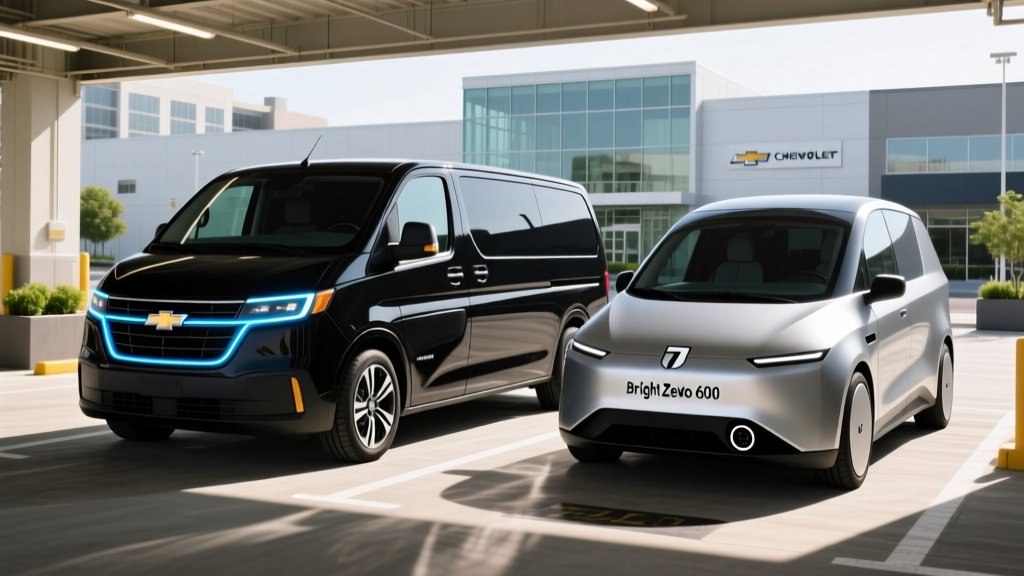
BrightDrop Zevo 600: Built by GM's commercial-delivery subsidiary BrightDrop (formerly BrightDrop Zevo), this is a purpose-built electric delivery van competing directly with the Rivian EDV (Amazon's delivery van), the Ford E-Transit, and the Mercedes-Benz eSprinter. It's aimed squarely at last-mile delivery fleets, logistics companies, and commercial operators. BrightDrop has secured contracts with FedEx, Walmart, and other major fleet buyers.
Chevy Express (Gas): The long-running Express 2500/3500 cargo and passenger van continues with its conventional 4.3L V6 and 6.6L V8 powertrains for 2026. GM has not announced a dedicated battery-electric replacement for the Express in the consumer/commercial market as of this writing. If you need a GM-branded electric van today, the BrightDrop is the answer. If you need a traditional GM van, the Express remains gas-only.
| Spec | BrightDrop Zevo 600 (EV) | Chevy Express 3500 Cargo (Gas) |
|---|---|---|
| Powertrain | Ultium BEV, single motor RWD4.3L V6 / 6.6L V8 | |
| Horsepower | ~300 hp (est.) | 276 hp (V6) / 401 hp (V8) |
| Battery / Tank | 120 kWh usable (NMC) | 31-gallon fuel tank |
| EPA Range | Up to 250 miles | ~400-450 miles |
| Payload Capacity | ~2,500 lbs | ~4,500 lbs |
| Cargo Volume | ~615 cu ft | ~284 cu ft (extended) |
| Peak DC Charge Rate | 150 kW | N/A |
| 10-80% DC Fast Charge | ~45 minutes | N/A |
| Starting MSRP | ~$74,000 | ~$41,000 |
| Federal Tax Credit | Up to $7,500 (§30D, if eligible) | None |
Range, Charging, and Real-World Fleet Practicality
The BrightDrop Zevo 600 carries GM's Ultium battery architecture with approximately 120 kWh of usable capacity using NMC (nickel-manganese-cobalt) chemistry, chosen for its higher energy density — critical in a large van where weight and volume matter.
The EPA-estimated 250-mile range assumes mixed city/highway driving at moderate temperatures. In real-world delivery operations, expect:
- Urban stop-and-go routes: 230-250 miles — regenerative braking recovers significant energy in frequent-stop patterns, making EVs highly efficient in city delivery.
- Highway-heavy routes at 70+ mph: 180-210 miles — aerodynamic drag on a large van body hits efficiency hard at sustained highway speeds.
- Cold weather (below 32°F): 160-190 miles — battery chemistry slows and cabin/cargo heating draws heavily from the pack. The Zevo 600 includes a heat pump to mitigate this, but a 25-35% range reduction in deep cold is typical for any BEV van.
Real-World Range Reality: EPA 250 miles. Plan for ~200 miles in mixed conditions, ~170 miles in winter or highway-dominant routes. If your daily routes exceed 170 miles, you'll need mid-day DC fast charging or to consider a gas alternative.
Charging Infrastructure: What Fleet Buyers Need
At a 150 kW DC fast charger (CCS connector), the Zevo 600 charges from 10-80% in roughly 45 minutes. Above 80% state of charge, the charge curve tapers significantly to protect battery health — expect a full 10-100% session to take over 70 minutes. For fleet operations, depot-based Level 2 charging is the standard model:
| Charging Level | Power (kW) | Miles Added Per Hour | Typical Use Case |
|---|---|---|---|
| Level 1 (120V) | ~1.4 kW | ~3-4 mi/hr | Emergency/trickle only |
| Level 2 (240V, 48A) | ~11.5 kW | ~28-32 mi/hr | Overnight depot charging (primary) |
| DC Fast Charge | Up to 150 kW | ~200+ mi/hr (peak) | Mid-day top-ups, route extensions |
For a fleet of five vans, plan on installing five Level 2 wall connectors (or a managed charging system that load-balances across fewer circuits). Commercial Level 2 installation typically runs $3,000-$7,000 per station depending on electrical panel capacity, conduit distance, and local permitting. A 30C Alternative Fuel Vehicle Refueling Property Credit may offset up to 30% of installation costs (max $100,000 for commercial property) — consult a tax professional for eligibility.
Total Cost of Ownership: EV Van vs Gas Van
The upfront price gap between the BrightDrop Zevo 600 (~$74,000) and a Chevy Express 3500 (~$41,000) is substantial — roughly $33,000. But fleet buyers think in total cost per mile over a vehicle's service life, typically 5-7 years and 100,000-150,000 miles for delivery vans.
| Cost Category | BrightDrop Zevo 600 (EV) | Chevy Express 3500 (Gas) |
|---|---|---|
| Purchase Price (MSRP) | $74,000 | $41,000 |
| Federal Tax Credit (§30D) | -$7,500 (if eligible) | $0 |
| Effective Purchase | $66,500 | $41,000 |
| Fuel/Energy (100k mi) | $4,800 ($0.14/kWh avg) | $17,500 ($3.50/gal, 14 MPG) |
| Maintenance (5 yr) | $2,500 | $6,500 |
| Insurance (5 yr est.) | $14,000 | $11,000 |
| Total 5-Year Cost | $87,800 | $76,000 |
| Cost Per Mile | $0.88 | $0.76 |
Key takeaways from this comparison:
- Fuel savings are real and significant. At commercial electricity rates of ~$0.14/kWh and the Express averaging 14 MPG combined, the Zevo saves roughly $12,700 in energy costs over 100,000 miles.
- Maintenance savings compound. No oil changes, no transmission fluid, no spark plugs, far less brake wear thanks to regenerative braking. Expect 60% lower scheduled maintenance costs.
- Insurance tends to run higher for EVs. Higher vehicle cost, specialized repair training, and battery replacement risk push premiums 15-30% above comparable gas vehicles.
- The break-even point depends on your mileage and electricity rate. At 25,000+ miles/year with access to low-cost depot charging ($0.10-$0.12/kWh), the Zevo 600 can break even with the Express in 4-5 years. At lower annual mileage or high commercial electricity rates, the payback stretches longer.
Federal Tax Credits and Fleet Incentives: What Applies in 2026
The BrightDrop Zevo 600 may qualify for the §30D Clean Vehicle Credit of up to $7,500, but eligibility is not automatic. Under current IRS rules, the credit splits into two $3,750 halves:
- $3,750 for battery components manufactured or assembled in North America (percentage thresholds increase annually).
- $3,750 for critical minerals sourced from the U.S. or free-trade-agreement partners.
Additional restrictions include:
- MSRP cap: Vans fall under the "other vehicles" category with an $80,000 MSRP ceiling. The Zevo 600 at ~$74,000 qualifies.
- Buyer income cap: Adjusted gross income must not exceed $150,000 (single) / $300,000 (joint) for personal purchases. Fleet/corporate purchases follow different rules under §45W (Commercial Clean Vehicle Credit).
- Point-of-sale transfer: Buyers can transfer the credit to the dealer at purchase, reducing the sale price directly rather than waiting for a tax refund.
- FPOC (Foreign Entity of Concern): Vehicles with battery components from designated foreign entities of concern are disqualified — verify current compliance status with your BrightDrop dealer.
For commercial fleet purchases, the §45W Commercial Clean Vehicle Credit may apply instead of §30D, with different rules for depreciable business property. Consult a tax professional familiar with fleet electrification incentives.
Decision Framework: Should Your Fleet Go Electric?
Choose the BrightDrop Zevo 600 (EV) If:
- Your daily routes average under 170 miles with predictable endpoints
- You have depot or warehouse space where Level 2 chargers can be installed
- Your operation is primarily urban or suburban stop-and-go delivery
- You plan to keep vehicles 5+ years (to capture full fuel/maintenance savings)
- Your fleet operates in a state or city with EV incentive programs or zero-emission mandates
- Your commercial electricity rate is under $0.18/kWh
Stick with the Chevy Express 3500 (Gas) If:
- Your daily routes regularly exceed 200 miles without return-to-base charging
- You operate in rural areas with sparse DC fast-charging infrastructure
- You need maximum payload capacity (Express 3500 offers ~4,500 lbs vs ~2,500 lbs)
- Your fleet turns over vehicles every 3 years or fewer (insufficient time to recoup EV premium)
- You tow frequently (the Express V8 handles heavy towing; the Zevo 600 is not rated for heavy trailer towing)
- Your operation faces extreme cold (sub-0°F) for extended periods
Common Misconceptions About GM EV Vans
| Myth | Fact |
|---|---|
| "The battery will need replacing in a few years at enormous cost." | GM warranties the Ultium battery for 8 years/100,000 miles against degradation below 70% capacity. Real-world fleet data from early Ultium vehicles shows approximately 5-8% degradation over 100,000 miles. Full replacement cost is estimated at $15,000-$20,000, but most fleets will retire the vehicle before this becomes necessary. |
| "Charging takes too long for commercial use." | Overnight Level 2 depot charging adds ~30 miles per hour — a 10-hour overnight session fully replenishes the 250-mile range. Most delivery fleets charge overnight and never need mid-day charging unless routes exceed planned range. |
| "EV vans can't handle heavy loads." | The Zevo 600 offers ~2,500 lbs payload and 615 cu ft of cargo volume — more than adequate for parcel delivery, catering, and service work. It's not a heavy-haul truck, but neither is the typical Express 2500 in practice. |
| "The electric grid can't support fleet charging." | Managed charging systems (like those from ChargePoint or EV Connect) stagger charge times across fleet vehicles, keeping total draw within your building's electrical capacity. Utility demand-response programs may also offer reduced commercial rates for off-peak charging. |
| "There's no GM electric van for consumers." | Correct — the BrightDrop is a commercial/fleet product. If you're a consumer looking for a GM electric people-hauler, the closest current options are the Chevy Equinox EV or Blazer EV (SUVs), or the Chevy Bolt EUV (discontinued after 2023, expected successor TBD). No consumer-focused GM electric minivan or passenger van exists for 2026. |
Battery Longevity, Warranty, and Replacement
The BrightDrop Zevo 600's Ultium battery pack uses NMC chemistry optimized for energy density and cycle life. GM provides an 8-year/100,000-mile battery warranty guaranteeing the pack retains at least 70% of its original capacity. For fleet applications averaging 25,000 miles per year, that warranty covers roughly 4 years of intensive use.
Real-world degradation factors for fleet vans:
- Daily DC fast charging accelerates degradation slightly vs Level 2 — fleets relying exclusively on overnight L2 charging typically see slower capacity loss.
- Operating in extreme heat (sustained above 95°F) stresses NMC cells more than moderate climates.
- Routinely charging to 100% and discharging to near 0% increases wear. Fleet management software can set charge limits at 85-90% for daily use, reserving full charges for longest-route days.
If a battery replacement is needed out of warranty, expect costs in the $15,000-$20,000 range for the pack plus labor. However, Ultium packs are designed with modular serviceability — individual modules can be replaced rather than the entire pack in some failure scenarios, potentially reducing costs.
First-Time EV Fleet Buyer Checklist
If your business is considering its first electric van, work through these items before signing a purchase order:
- Audit your routes. Pull GPS or telematics data for your current vans. What's the average and maximum daily mileage? If max daily miles exceed 200, identify which routes those are and whether mid-day charging is feasible.
- Assess your electrical infrastructure. Have a licensed electrician evaluate your depot's panel capacity. Adding five Level 2 chargers at 11.5 kW each requires ~57.5 kW of additional capacity — a 200-amp commercial panel may need upgrading. Factor $5,000-$25,000 for panel upgrades if needed.
- Check utility rates and programs. Contact your commercial electricity provider about EV-specific tariffs, demand charges, and off-peak incentives. Some utilities offer significantly reduced rates for overnight commercial EV charging.
- Model your total cost per mile. Use the cost table above as a starting point, but plug in your actual local fuel prices, electricity rates, annual mileage, and insurance quotes.
- Test the tax credit path. Confirm §30D or §45W eligibility with your tax advisor before purchase. Verify the specific VIN's battery sourcing compliance on the IRS qualifying vehicle list.
- Start with a pilot. Many fleets purchase one or two EV vans first, run them on representative routes for 3-6 months, and measure actual energy consumption, charging behavior, and driver feedback before committing to a full fleet transition.
Frequently Asked Questions
Does GM make a consumer electric van or minivan?
No. As of 2026, GM's only electric van offering is the BrightDrop Zevo 600, which is a commercial/fleet-focused delivery van. GM does not currently sell an electric minivan or passenger van for consumers. The closest GM electric vehicles for family hauling are the Chevy Equinox EV, Blazer EV, and the upcoming three-row electric SUVs on the Ultium platform.
How does the BrightDrop Zevo 600 compare to the Ford E-Transit?
The Ford E-Transit offers a lower starting price (~$55,000) and a smaller 68 kWh battery with an EPA range of approximately 126 miles — making it suited for shorter urban routes. The BrightDrop Zevo 600's 250-mile range and larger cargo volume make it better for longer or higher-volume routes, but at a significantly higher price. The Rivian EDV (built for Amazon) is not available to general fleet buyers. Choose the E-Transit for short, budget-conscious routes; choose the Zevo 600 for range and volume.
Can I charge a BrightDrop Zevo 600 at home?
Technically yes, using a 240V Level 2 home charger, but the BrightDrop is designed for commercial fleet depot charging. If you're an owner-operator or small business with a home-based fleet, a Level 2 home installation (requiring a 60-amp dedicated circuit) would add roughly 28-32 miles of range per hour — sufficient for overnight replenishment. Installation costs range from $1,500-$4,000 depending on your electrical panel's capacity and the distance from panel to charging location.
What happens if the BrightDrop runs out of charge on a route?
The same thing that happens when a gas van runs out of fuel — you need roadside assistance or a tow to the nearest charger. GM's Ultium platform includes robust range estimation that accounts for payload, terrain, and temperature, so unexpected range depletion is rare if routes are properly planned. Most fleet management platforms include real-time state-of-charge monitoring and low-battery alerts that dispatch can track.
Is the Chevy Express getting an electric version?
GM has not officially announced a battery-electric Chevy Express for the 2026 or 2027 model year. The Express continues with conventional gasoline V6 and V8 engines. Industry analysts expect GM to eventually introduce an Ultium-based electric full-size van under the Chevrolet brand, but no timeline or specs have been confirmed. For now, the BrightDrop Zevo line serves as GM's electric van offering.