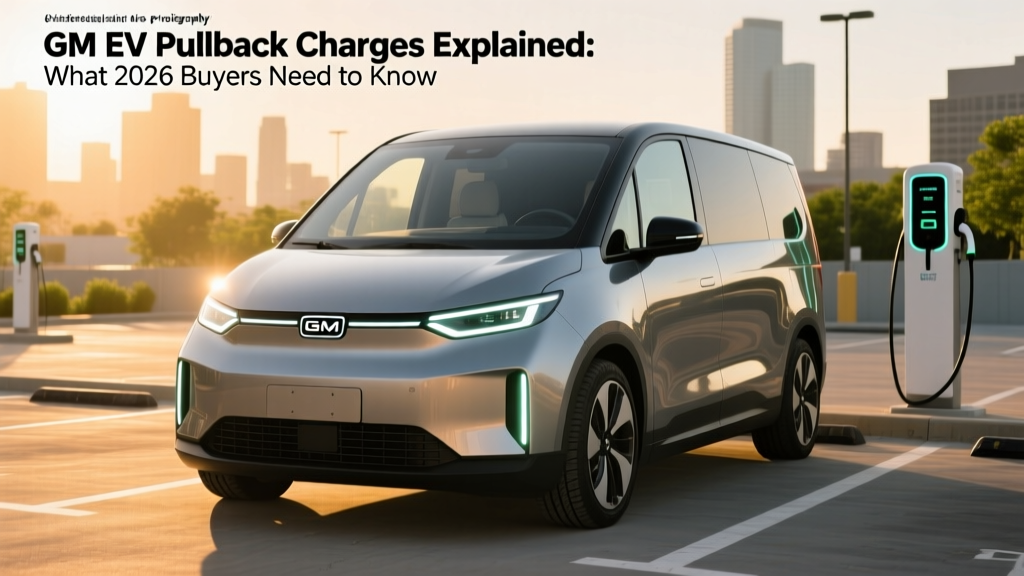
If you own or plan to buy a General Motors electric vehicle—such as the 2026 Chevrolet Equinox EV, Blazer EV, Cadillac Lyriq, or GMC Sierra EV—you may encounter what the EV community calls GM EV pullback charges. This refers to GM's battery-management system (BMS) intentionally limiting DC fast-charging speeds or capping daily charge levels to protect long-term battery health. In practice, this means your Equinox EV or Lyriq may charge slower at public DC fast chargers than the advertised peak kW, or the vehicle may recommend stopping at 80% State of Charge (SoC) for daily driving rather than filling to 100%.
The Quick Answer
GM EV pullback charges are not a fee or penalty. They are software-controlled charging limitations designed to reduce battery degradation. Expect real-world DC fast-charging speeds to taper significantly above 80% SoC, and plan daily charging around 80% to maximize your Ultium battery's lifespan. For road trips, 100% charges are fine—just don't make them a daily habit.
What Are GM EV Pullback Charges?
The term "pullback" in GM's EV ecosystem describes the deliberate reduction of charging power (measured in kW) as the battery fills. Every EV does this to some degree—it's basic electrochemistry. But GM's Ultium-platform vehicles (which use NMC-based lithium-ion pouch cells) exhibit a pronounced charging curve taper that has drawn attention from owners and reviewers alike.
Here's what's actually happening under the metal:
- Peak charge rate: The 2026 Chevy Equinox EV (85 kWh usable battery) advertises up to 150 kW peak DC fast charging. The Cadillac Lyriq (102 kWh usable) peaks at approximately 190 kW on a capable charger.
- The pullback zone: Once the battery reaches roughly 50-60% SoC, the BMS begins reducing charge power. By 80% SoC, you may see speeds drop to 40-60 kW. Above 90%, charging slows to a trickle—often under 20 kW.
- 10-80% charge time: For the Equinox EV 3RS (AWD), expect approximately 30 minutes from 10% to 80% on a 150+ kW charger. Pushing from 80% to 100% can add another 25-35 minutes.
- Thermal management: GM's liquid-cooled Ultium batteries precondition when you navigate to a DC fast charger, but in cold weather (below 32°F / 0°C), the pullback can start earlier and be more aggressive until the pack reaches optimal temperature.
This is not unique to GM. Tesla, Ford, Hyundai, and every other automaker manage charge curves to prevent lithium plating and excess heat generation. However, GM's approach has been characterized by some owners as more conservative, prioritizing battery longevity over maximum charging speed.
How Pullback Affects Real-World Charging Times
Marketing materials highlight peak kW, but sustained charging speed is what actually determines how long you sit at a station. Here's a realistic breakdown for popular 2026 GM Ultium EVs:
| Vehicle (2026) | Usable Battery | Peak DC kW | 10-80% Time | 80-100% Time | EPA Range |
|---|---|---|---|---|---|
| Chevy Equinox EV 3RS AWD | 85 kWh (NMC) | 150 kW | ~30 min | ~28 min | 315 mi (est. ~265 mi highway) |
| Chevy Blazer EV RS AWD | 102 kWh (NMC) | 190 kW | ~28 min | ~30 min | 324 mi (est. ~270 mi highway) |
| Cadillac Lyriq AWD | 102 kWh (NMC) | 190 kW | ~27 min | ~32 min | 314 mi (est. ~260 mi highway) |
| GMC Sierra EV Denali Edition 1 | ~200 kWh (NMC) | 350 kW | ~22 min | ~35 min | 440 mi (est. ~360 mi highway) |
Key insight: The 80-100% leg often takes as long as—or longer than—the 10-80% leg. This is the pullback effect in action. For road trips, the smartest strategy is charging to 80% and moving on, rather than waiting for a full battery.
Real-World Range Reality
EPA estimates assume mixed driving at moderate temperatures. On a 75 mph highway run in 40°F weather, expect your Equinox EV to deliver roughly 230-250 miles before needing a charge—about 20-25% below the sticker. Plan charging stops accordingly, and always use fueleconomy.gov to verify official figures.
GM EV Ownership Costs vs. Gas: The Real Math
Understanding pullback charges matters because it affects how you use public DC fast charging—and public charging costs significantly more than home Level 2 charging. Let's compare a 2026 Chevy Equinox EV 3RS ($43,400 MSRP before incentives) against a comparable gas-powered Chevy Equinox AWD ($31,900 MSRP).
| Cost Factor (5-Year / 75,000 mi) | Equinox EV 3RS AWD | Gas Equinox AWD (25 MPG) |
|---|---|---|
| Purchase Price (after est. §30D credit) | $35,900* | $31,900 |
| Fuel / Energy (80% home L2, 20% DCFC) | $4,125 | $9,375 (at $3.50/gal) |
| Maintenance (oil, filters, brakes, etc.) | $1,200 | $3,800 |
| Insurance (avg. EV premium ~15% higher) | $9,200 | $8,000 |
| Estimated 5-Year Total | $50,425 | $53,075 |
*§30D federal tax credit eligibility depends on MSRP caps ($55,000 for SUVs), buyer income limits ($150K single / $300K joint), and battery critical-mineral sourcing requirements. Verify current rules at IRS.gov and consult a tax professional. Point-of-sale transfer is available at participating dealers.
The EV wins on total cost over five years by roughly $2,650—but only if you charge mostly at home. If you rely exclusively on public DC fast charging (at $0.35-$0.50/kWh nationally), your energy cost jumps to $6,500-$8,500 over five years, erasing the advantage. Pullback charging means longer DCFC sessions, which on per-minute-billed networks can further increase costs.
Common Misconceptions About GM Pullback Charging
| Myth | Fact |
|---|---|
| "GM is secretly limiting my range." | Pullback affects charging speed, not driving range. Your 315-mile EPA estimate is still accessible—you just charge slower near 100%. |
| "I should always charge to 100% to get full range." | For daily driving, GM recommends 80% SoC to reduce NMC battery degradation. Reserve 100% for road trips. This extends long-term battery health. |
| "A 150 kW charger will charge my Equinox at 150 kW the whole time." | No EV sustains peak kW for a full session. The Equinox EV peaks near 150 kW only between roughly 10-40% SoC, then tapers. Average session speed is closer to 90-100 kW. |
| "Pullback means my battery is defective." | This is normal BMS behavior across all EV brands. GM's calibration leans conservative to protect the 8-year/100,000-mile battery warranty threshold (typically 70% capacity retention). |
| "Cold weather doesn't affect charging." | Below freezing, an unpreconditioned Ultium battery may limit DC fast charging to under 50 kW until the pack warms. Always use navigation to a charger to trigger preconditioning. |
First-Time GM EV Buyer: What You Must Know
If you're transitioning from a gas vehicle to a GM Ultium EV, these ownership realities will shape your daily experience:
Home Charging Is Non-Negotiable for Most Owners
Level 2 home charging (240V, typically 7.7 kW to 11.5 kW) is where 80%+ of EV charging happens. The Equinox EV's onboard charger accepts up to 11.5 kW on Level 2, adding roughly 34 miles of range per hour. A full overnight charge from 20% to 80% takes about 5-6 hours. If you live in an apartment without charging access or park on the street, an EV may not be practical yet—consider a PHEV like the upcoming Chevy Equinox PHEV instead.
Level 2 Installation Costs Vary Widely
Expect to pay $500-$2,500 for a quality Level 2 charger (such as the ChargePoint Home Flex or Emporia Vue) plus $800-$3,000 for electrician installation, depending on whether your electrical panel needs a 200-amp upgrade. Always get a quote from a licensed electrician before purchasing.
The §30D Tax Credit Is Not Guaranteed
For 2026, the federal EV tax credit under IRS §30D offers up to $7,500 for new EVs, but eligibility hinges on:
- Vehicle MSRP under $55,000 (SUVs/trucks) or $25,000 (sedans)
- Buyer AGI under $150,000 (single) or $300,000 (married filing jointly)
- Battery components and critical minerals meeting North American sourcing thresholds (these tighten annually)
- The specific trim and build date—some GM models may qualify for the full $7,500, a partial credit, or none at all depending on the month of manufacture
Always confirm eligibility with your dealer and a tax professional before signing.
Decision Framework: Is a GM EV Right for You?
Choose a GM Ultium EV If:
- You have access to Level 2 home charging (garage, driveway, or workplace)
- Your daily commute is under 100 miles round-trip
- You take road trips fewer than 6 times per year (and can plan DCFC stops)
- You want lower per-mile energy costs and reduced maintenance
- You qualify for the §30D tax credit, bringing effective purchase price closer to a gas equivalent
Consider a Hybrid or PHEV Instead If:
- You lack reliable home or workplace charging access
- You regularly drive 300+ miles between stops in rural areas or charging deserts
- You live in extreme cold (sustained sub-0°F winters) where range loss of 25-40% is common
- You need maximum towing capacity without range compromise (the Sierra EV tows up to 10,000 lbs but range drops significantly under load)
- Your budget cannot absorb higher upfront cost and insurance premiums
Wait or Look Elsewhere If:
- Fastest possible DC charging is your top priority (Hyundai Ioniq 5 peaks at 240 kW with a flatter charge curve; Tesla Model Y leverages the Supercharger network)
- You need a vehicle available today with guaranteed full $7,500 credit eligibility—sourcing rules change, and some trims may not qualify at all times
Frequently Asked Questions
Does GM's pullback charging void my battery warranty?
No. Pullback charging is the factory-default BMS behavior and is covered under GM's 8-year/100,000-mile battery warranty. In fact, following GM's recommendation to charge to 80% daily helps you stay within the warranty's capacity-retention threshold (typically 70% of original capacity).
Can I override the pullback and force maximum charging speed?
Not through any user-accessible setting. The BMS controls charge rates based on battery temperature, SoC, and cell-balancing needs. You can help by preconditioning the battery (navigate to a DC fast charger using the built-in nav) and avoiding charging in extreme heat without shade.
How does GM's charging compare to Tesla or Hyundai?
GM's Ultium vehicles charge competitively in the 10-80% window but taper more aggressively above 80% than some rivals. The Hyundai Ioniq 5 (800V architecture) can sustain higher power longer, achieving 10-80% in roughly 18 minutes on a 350 kW charger. Tesla's advantage lies in the Supercharger network's reliability, not necessarily faster peak speeds.
Will GM fix pullback charging with an OTA update?
GM has issued over-the-air updates that adjust charging profiles before, but significant changes to the charge curve are unlikely because they reflect fundamental battery chemistry limits. NMC cells degrade faster when charged rapidly at high SoC—no software update changes the physics.
What about the Chevy Bolt EV and Bolt EUV?
The original Bolt platform (65 kWh NMC battery, CCS connector, 55 kW peak DC charging) was discontinued after the 2023 model year. The upcoming next-generation Bolt, expected on the Ultium platform, has not yet been released. Specs remain preliminary and will likely feature faster charging.
How do I check my Ultium battery's State of Health?
The myChevrolet or myCadillac app provides battery health indicators. For a detailed State of Health (SoH) percentage, request a battery diagnostic report from your GM dealer. Third-party tools like Recurrent Auto also offer battery health tracking for enrolled vehicles.