Quick Answer: Which GM EV Should You Buy?
If you need an affordable daily commuter with 319 miles of EPA range starting around $33,000, the Chevrolet Equinox EV is GM's best value. Need more space and power? The Blazer EV offers up to 324 miles and a sportier drive. For truck utility, the Silverado EV delivers 400+ miles (Work Truck trim) with serious towing. Luxury buyers should look at the Cadillac Lyriq (314 miles, premium interior). All four ride on GM's Ultium platform with NMC battery chemistry and support DC fast charging up to 190+ kW. Federal §30D tax credit eligibility varies by trim and your income — check current IRS rules before assuming a flat $7,500.
The 2026 GM EV Lineup at a Glance
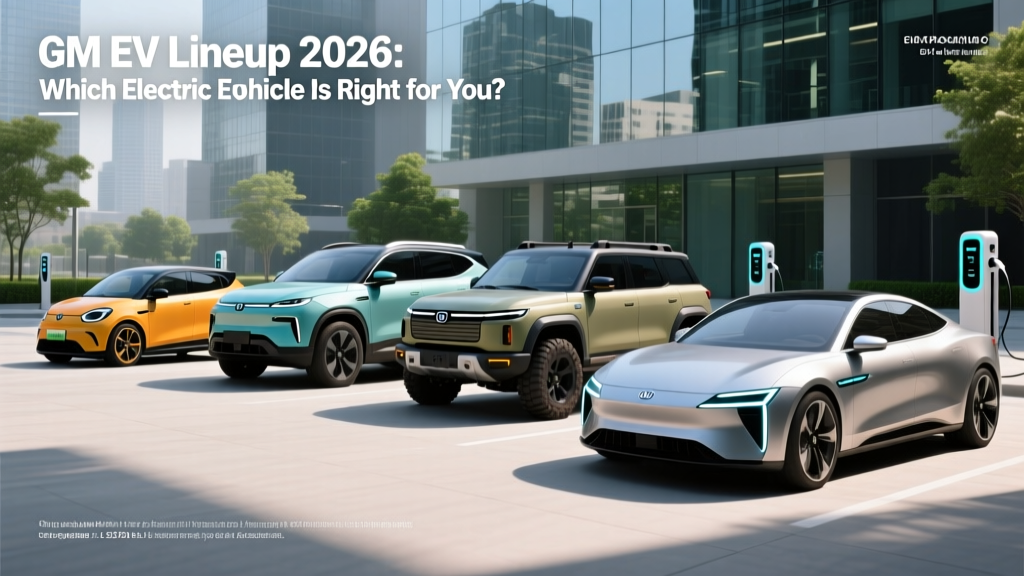
General Motors has committed more aggressively to battery-electric vehicles than any legacy American automaker, retiring the Bolt EV and Bolt EUV after 2023 and rebuilding its portfolio on the modular Ultium platform. As of the 2026 model year, GM sells four primary consumer EVs in the United States, spanning a $33,000–$65,000+ price range. Here is how they stack up on the numbers that matter.
| Spec | Equinox EV | Blazer EV | Silverado EV | Cadillac Lyriq |
|---|---|---|---|---|
| EPA Range (max) | 319 mi | 324 mi | 440 mi (3WT) | 314 mi |
| Battery (usable) | ~85 kWh NMC | ~102 kWh NMC | ~200 kWh NMC (Max) | ~102 kWh NMC |
| Peak DC Fast Charge | 150 kW | 190 kW | 350 kW (Max Range) | 190 kW |
| 10–80% DCFC Time | ~32 min | ~28 min | ~20 min (350 kW) | ~28 min |
| Level 2 Rate | 11.5 kW | 11.5 kW | 11.5 kW | 19.2 kW |
| 0–60 mph | ~7.5 sec | ~4.0 sec (SS AWD) | ~4.5 sec (4WT) | ~4.6 sec (AWD) |
| Horsepower | 213–288 hp | 288–557 hp | 510–754 hp | 340–500 hp |
| Starting MSRP | ~$33,000 | ~$44,600 | ~$55,000 (WT) | ~$58,500 |
| Battery Warranty | 8 yr / 100k mi | 8 yr / 100k mi | 8 yr / 100k mi | 8 yr / 100k mi |
All ranges above reflect the highest available trim/configuration. Real-world highway driving at 70–80 mph typically reduces EPA range by 10–15%. In freezing temperatures (below 25°F), expect an additional 20–30% reduction unless you precondition the battery while plugged in. The Silverado EV's 440-mile figure applies to the 3WT Max Range fleet-oriented trim; consumer-available trims like the RST and Trail Boss typically deliver 350–400 miles EPA.
GM EV vs. Gas and Hybrid: The Real Cost Comparison
The sticker price of a GM EV is typically higher than a comparable gas-powered SUV or truck, but total cost of ownership tells a different story over five years — especially if you can charge at home on residential electricity rates.
| Cost Factor (5-Year) | Equinox EV LT2 (~$38k) | Chevrolet Equinox Gas AWD (~$30k) | Toyota RAV4 Hybrid (~$35k) |
|---|---|---|---|
| Purchase Price (after est. credit) | ~$30,500* | $30,000 | $35,000 |
| Fuel / Electricity (75k miles) | ~$3,400 (home charging) | ~$9,400 (28 MPG, $3.50/gal) | ~$6,500 (40 MPG, $3.50/gal) |
| Maintenance (5 yr) | ~$1,200 | ~$4,200 | ~$3,800 |
| Insurance (est. avg) | ~$9,500 | ~$7,800 | ~$8,000 |
| Est. 5-Year Total | ~$44,600 | ~$51,400 | ~$53,300 |
*Federal §30D credit eligibility depends on your modified adjusted gross income, the vehicle's MSRP cap, battery component sourcing, and critical-mineral requirements. Always verify current rules at IRS.gov and consult a tax professional. Point-of-sale transfer is available at participating dealers, reducing your out-of-pocket cost at purchase.
The Equinox EV's fuel savings are dramatic — roughly $6,000 less than the gas version over five years at 15,000 miles/year. Maintenance savings come from eliminating oil changes, transmission fluid, spark plugs, and exhaust system repairs. Regenerative braking significantly extends brake pad life; many EV owners report original pads at 80,000+ miles.
However, insurance premiums for GM EVs run 15–25% higher than gas equivalents, driven by higher repair costs for battery-adjacent collision damage and specialized parts. Get quotes before committing.
Charging Reality: Home, Public, and What You Need to Know
The single biggest factor in GM EV ownership satisfaction is home charging access. Without it, you will rely on public infrastructure that varies wildly in reliability.
Home Charging Setup
Every 2026 GM EV comes with a dual-level charge cord that handles 120V Level 1 (roughly 1.4 kW, adding ~3–4 miles of range per hour) and 240V Level 2 via a NEMA 14-50 outlet. For daily driving, Level 1 is sufficient only if you drive fewer than 30 miles per day and can plug in for 12+ hours overnight.
For real convenience, a dedicated Level 2 wall connector is the standard recommendation. GM's Ultium Charge 48-amp wall unit delivers up to 11.5 kW, adding approximately 34–40 miles of range per hour — enough to fully replenish any GM EV overnight. Expect a professional installation to cost between $800 and $2,500 depending on your electrical panel's capacity and the run distance from panel to garage. A 200-amp panel is usually sufficient; older homes with 100-amp service may need a $2,000–$4,000 panel upgrade.
The Cadillac Lyriq stands out with available 19.2 kW Level 2 acceptance — roughly 50% faster home charging than the rest of the lineup, provided your home charger supports it.
Public DC Fast Charging
GM EVs use the NACS (North American Charging Standard) connector as of the 2025 model year, granting native access to Tesla Supercharger stations (V3 at 150 kW and V4 at up to 250+ kW). This was a pivotal move: the Supercharger network remains the most reliable public charging infrastructure in the U.S., with over 25,000 stalls nationwide.
GM EVs can also use Electrify America, EVgo, and other CCS-equipped networks via a NACS-to-CCS adapter (included with some models, available separately for others). The Silverado EV with the Max Range pack supports up to 350 kW peak on compatible chargers — but sustained charging is far more important than peak. Expect the Silverado EV to hold above 200 kW through roughly 40% SoC before tapering, making a 10–80% session possible in roughly 20 minutes at a 350 kW station.
For the Equinox EV at 150 kW peak, the charge curve tapers more aggressively above 60% SoC. Plan for roughly 32 minutes for a 10–80% session at a capable station, and understand that arriving at 5% vs. 15% SoC can shave 3–5 minutes off your stop.
Federal Tax Credit and Incentive Eligibility for GM EVs
The §30D Clean Vehicle Credit remains a major purchase incentive, but qualification is not automatic. Here is what determines whether a specific GM EV trim qualifies for up to $7,500:
- Buyer income caps: AGI must not exceed $300,000 (joint), $225,000 (head of household), or $150,000 (single) for the year of delivery or the prior year — whichever is lower.
- MSRP caps: Vans, SUVs, and pickup trucks are capped at $80,000 MSRP. All current GM consumer EVs fall under this threshold.
- Battery component sourcing: A percentage of battery components must be manufactured or assembled in North America. This threshold increases annually. GM's North American battery production (via Ultium Cells LLC plants in Ohio, Tennessee, and Michigan) positions its vehicles well, but verify per-trim eligibility.
- Critical minerals: A percentage of critical minerals must be sourced from the U.S. or free-trade-agreement countries. This requirement also tightens annually.
- Point-of-sale transfer: You can transfer the credit to the dealer at purchase, reducing your out-of-pocket cost immediately rather than waiting for a tax refund.
The credit is split into two halves — $3,750 for battery components and $3,750 for critical minerals. Some GM trims may qualify for the full $7,500, others for $3,750, depending on the specific battery pack's supply chain. Always check the latest eligibility list at fueleconomy.gov for the exact trim and model year you are considering.
Common GM EV Misconceptions — Fact vs. Fiction
| Myth | Fact |
|---|---|
| "GM EVs use the same battery as the recalled Bolt." | The Ultium platform uses an entirely different NMC pouch-cell architecture developed with LG Energy Solution. The Bolt's fire-risk issue was specific to its older battery pack design and manufacturing defects. Ultium batteries include enhanced thermal propagation barriers and real-time cell monitoring. |
| "The battery will need replacing in 5 years." | GM warranties Ultium batteries for 8 years / 100,000 miles against capacity loss below 70%. Industry degradation data for NMC pouch cells shows typical capacity retention of 85–90% after 100,000 miles when DC fast charging is not the sole charging method. Battery replacement, if ever needed out of warranty, currently costs $12,000–$20,000 depending on pack size. |
| "You can't tow with an EV truck." | The Silverado EV 4WT is rated for up to 10,000 lbs towing; the RST First Edition targets 10,000+ lbs. However, towing at max capacity will reduce range by 40–50%. A 400-mile Silverado EV may deliver only 200–240 miles while towing 8,000 lbs at highway speed. Plan charging stops accordingly. |
| "GM's Super Cruise is self-driving." | Super Cruise is an SAE Level 2 driver-assistance system. It handles steering, acceleration, and braking on pre-mapped divided highways (over 750,000 miles of compatible roads in the U.S. and Canada), but the driver must remain attentive. A camera monitors your eyes, and the system will disengage with escalating alerts if you look away. It is not autonomous — you are the driver. |
| "All GM EVs qualify for the full $7,500 tax credit." | Eligibility depends on battery sourcing, your income, and the vehicle's MSRP. Some trims may qualify for only $3,750 or none at all based on the current-year critical-mineral and component requirements. Verify before purchasing. |
Decision Framework: Which GM EV Fits Your Life?
Choose Based on Your Real Driving Pattern
Choose the Equinox EV if: You drive under 250 miles most days, want the lowest entry price in GM's lineup, primarily commute and run errands, and value efficiency (3.0–3.3 kWh/mile) over performance. The LT2 trim at ~$38,000 before incentives is the sweet spot with heated seats, a heat pump, and the full 319-mile range.
Choose the Blazer EV if: You want a midsize SUV with more cargo room (43.8 cu ft behind the second row), available AWD with 288 hp (or 557 hp in the SS), and a sportier driving feel. The 2LT AWD at ~$48,000 balances range (279 mi AWD) and features well.
Choose the Silverado EV if: You need truck utility — a 5-foot-11-inch bed, available Multi-Flex tailgate, up to 10,000-lb towing, and maximum range for long work trips. The 4WT fleet trim offers 440 miles at a lower price point; the consumer RST and Trail Boss trims trade some range for off-road capability and luxury features. Budget $60,000–$90,000 depending on configuration.
Choose the Cadillac Lyriq if: You want a luxury midsize crossover with a 33-inch LED display, available 19.2 kW home charging, a premium sound system, and Super Cruise standard on most trims. The Tech Luxury AWD at ~$62,000 delivers 307 miles and 500 hp. Expect higher insurance and maintenance costs vs. the Chevy lineup, offset by a more refined ride and interior.
Key Ownership Considerations Before You Buy
Home charging is non-negotiable for most buyers. If you live in an apartment, condo, or street-parking situation without reliable overnight charging access, an EV will require weekly public charging sessions of 25–40 minutes. This is viable but adds friction. Confirm your charging plan before signing.
Cold climate buyers: GM's Ultium vehicles include a heat pump (standard on most trims), which significantly improves winter efficiency compared to resistive cabin heaters. Still, expect 20–30% range loss in sustained sub-25°F weather. Preconditioning while plugged in recovers much of this loss — always enable it via the MyChevrolet or myCadillac app before departure.
Resale value uncertainty: EV depreciation has been steep in recent years, with some models losing 40–50% of value in the first three years. GM EVs are not immune. If you plan to trade in within 3–4 years, factor this into your cost calculation. Leasing may offer protection against depreciation risk while still allowing point-of-sale credit transfer in many cases.
Frequently Asked Questions
What is the cheapest GM EV available in 2026?
The Chevrolet Equinox EV LT starts around $33,000 MSRP. With the full $7,500 federal tax credit (if eligible), your effective cost drops to approximately $25,500 — making it one of the most affordable long-range EVs on the market. The discontinued Bolt EV was cheaper but is no longer in production; a next-generation Bolt on the Ultium platform has been announced but is not yet on sale.
Can I use Tesla Superchargers with a GM EV?
Yes. Starting with the 2025 model year, GM EVs are equipped with the NACS connector natively, providing direct access to Tesla's Supercharger network without an adapter. For older CCS-equipped stations (Electrify America, EVgo), GM provides or sells a NACS-to-CCS adapter.
How long does a GM Ultium battery last?
GM warranties the Ultium battery for 8 years or 100,000 miles, whichever comes first, against defects and capacity loss below 70% of original capacity. Real-world data from similar NMC pouch-cell architectures suggests 85–92% capacity retention at 100,000 miles under mixed charging habits. To maximize longevity, avoid routinely charging to 100% or letting the battery sit below 10% for extended periods. Daily charging to 80–90% is optimal for NMC chemistry.
Is Super Cruise available on all GM EVs?
Super Cruise is standard or available on the Cadillac Lyriq, Blazer EV (higher trims), and Silverado EV. It is not currently offered on the Equinox EV, which instead features GM's Enhanced Automatic Emergency Braking and Adaptive Cruise Control as part of the Chevy Safety Assist suite. Super Cruise requires a subscription after the initial trial period (typically 3 years), currently priced at approximately $25/month or $250/year.
How much does it cost to charge a GM EV at home?
At the U.S. average residential electricity rate of ~$0.17/kWh, fully charging the Equinox EV's ~85 kWh battery costs roughly $14.50, yielding about 319 miles of range — approximately $0.045 per mile. Compare that to a gas SUV at 28 MPG with $3.50/gallon fuel: $0.125 per mile. Home charging saves roughly $0.08 per mile, or $1,200 per year at 15,000 miles. Public DC fast charging is more expensive, typically $0.30–$0.50/kWh, narrowing or eliminating the savings advantage for frequent road-trippers who cannot charge at home.