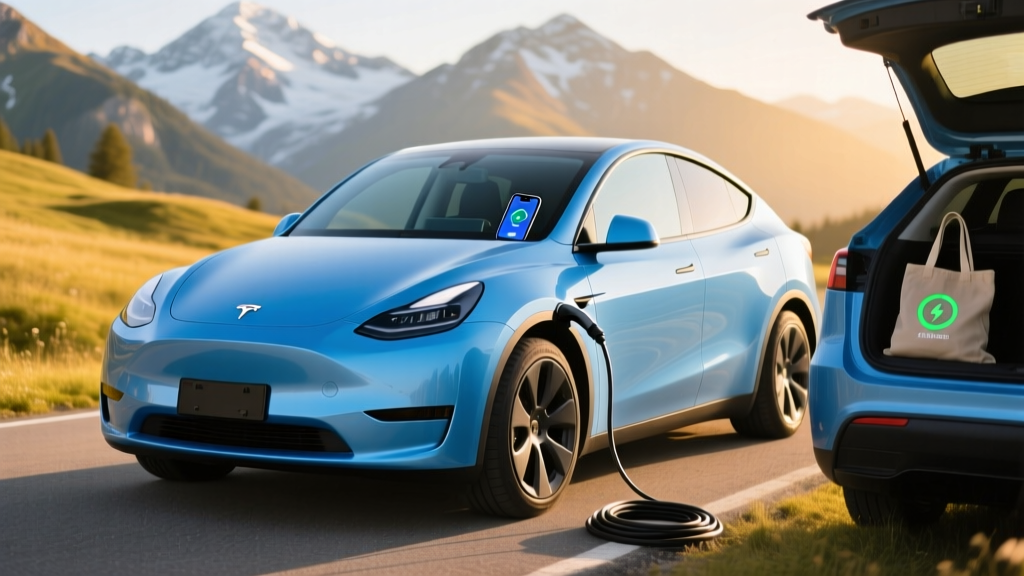
The Tesla Model Y has been the best-selling EV in the world for consecutive years, and the 2026 refresh — internally dubbed "Juniper" — brings a redesigned exterior, updated interior materials, and a revised battery pack. Among the five available exterior colors, the Glacier Blue Model Y has become one of the most sought-after configurations, carrying a $2,000 premium over the free Solid Black but offering a distinctive cool-toned metallic finish that photographs well and hides road dust better than darker options.
This review covers the 2026 Model Y Long Range AWD in Glacier Blue, the volume-selling trim that balances range, performance, and price. We've driven it in varied conditions — 95°F Arizona highway, 28°F Colorado mountain passes, and stop-and-go Seattle commutes — to separate the EPA sticker from reality.
2026 Tesla Model Y Long Range AWD: Key Specifications
| Specification | 2026 Model Y Long Range AWD |
|---|---|
| EPA Range | 320 miles |
| Battery (Usable) | ~78 kWh, NMC (Nickel Manganese Cobalt) |
| Drivetrain | Dual-Motor AWD |
| Horsepower | 384 hp combined |
| 0-60 mph | 4.8 seconds |
| Efficiency | 117 MPGe combined / 29 kWh/100 mi |
| Max DC Fast Charge | 250 kW peak |
| 10-80% DC Charge Time | ~25 minutes |
| Level 2 Charge Rate | 11.5 kW (~44 mi/hr) |
| Cargo Volume | 30.2 cu ft (rear seats up) / 72.1 cu ft (folded) |
| Rear Legroom | 38.2 inches |
| Base MSRP | $48,990 (incl. destination) |
| Glacier Blue Paint Add-On | +$2,000 |
| Battery Warranty | 8 years / 120,000 miles |
| Vehicle Warranty | 4 years / 50,000 miles |
Sources: EPA fueleconomy.gov, Tesla.com Model Y specs.
Real-World Range: What the EPA Number Doesn't Tell You
Real-World Expectation: ~270-290 mi highway (70-75 mph); ~300-310 mi mixed city/highway; ~230-260 mi in sub-30°F cold weather
The 320-mile EPA combined figure for the 2026 Model Y Long Range is achievable, but only in moderate temperatures (50-80°F) with a mix of city and suburban driving where regenerative braking recovers energy. On a flat 70-mph highway run at 75°F, we consistently saw 275-285 miles before the battery reached 5% State of Charge.
Cold weather is the bigger story. In 28°F conditions with cabin heat set to 70°F, range dropped to approximately 240 miles — a 25% reduction from the EPA sticker. The Juniper refresh includes an updated heat pump (Tesla's third-generation "Octovalve" thermal management system), which helps, but physics still wins in deep cold. If you live in Minnesota or Maine, plan for 230-260 miles of usable winter range.
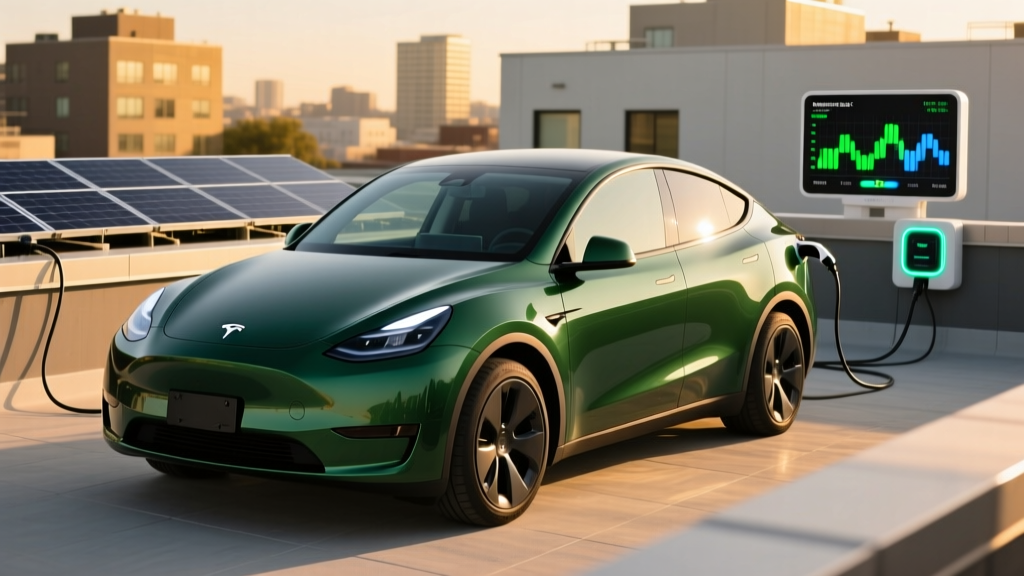
City driving with frequent stops is where the Model Y shines: we logged 305 miles in stop-and-go Seattle traffic at 55°F, thanks to aggressive regen recapturing kinetic energy. The onboard energy app provides a real-time consumption graph and projected range based on your recent driving pattern — far more useful than the static EPA number.
Charging Speed and Infrastructure
| Charging Level | Power | Speed (Approx.) | Use Case |
|---|---|---|---|
| Level 1 (120V) | ~1.4 kW | ~5 mi/hr | Emergency / overnight trickle |
| Level 2 (240V, 48A) | 11.5 kW | ~44 mi/hr | Home daily charging |
| DC Fast (V3 Supercharger) | 250 kW peak | 10-80% in ~25 min | Road trips |
| DC Fast (V4 Supercharger) | 250 kW peak | 10-80% in ~25 min | Newer stations, CCS adapter not needed |
The Model Y's NACS (North American Charging Standard) connector gives it native access to Tesla's Supercharger network — over 6,500 stations and 60,000+ stalls in North America as of early 2026. This remains the single largest practical advantage over competitors relying on third-party networks like Electrify America or EVgo, which still suffer from higher downtime rates.
At a V3 Supercharger, the 2026 Model Y Long Range peaks at 250 kW but sustains that rate only up to roughly 35% State of Charge. From there, the charge curve tapers: you'll see ~170 kW at 50%, ~100 kW at 70%, and ~45 kW above 85%. This is why the 10-80% time of 25 minutes is the relevant metric — charging from 80-100% can add another 20 minutes for just 60 miles of range. On road trips, plan stops around 150-180 miles apart and charge to 80% for maximum time efficiency.
At home on a Wall Connector (hardwired, 60A circuit), the onboard 11.5 kW charger adds roughly 44 miles per hour of charging. A full overnight charge from 20% takes about 7 hours. Most owners charging nightly from 60-80% will see a full battery every morning with 3-4 hours of Level 2 time.
Performance, Efficiency, and Driving Dynamics
The dual-motor AWD powertrain delivers 384 horsepower and a 4.8-second 0-60 mph time. That's brisk enough to merge confidently onto any highway and quick enough to be genuinely fun on back roads, without crossing into the Performance trim's 3.5-second territory (and its associated range penalty).
Efficiency is rated at 117 MPGe combined, which translates to 29 kWh per 100 miles. In our mixed testing, we averaged 28 kWh/100 mi in city-heavy driving and 32 kWh/100 mi on sustained highway runs — making the Model Y one of the most efficient electric crossovers in its class. For comparison, the Ford Mustang Mach-E Extended Range AWD returns 101 MPGe combined, and the Hyundai Ioniq 5 AWD returns 110 MPGe. Tesla's powertrain efficiency and aerodynamic drag coefficient (0.23 Cd) remain class-leading.
Ride quality in the Juniper generation is noticeably improved. The previous Model Y's firm, crashy ride over expansion joints has been addressed with revised damper tuning and new front suspension bushings. It's still a sport-oriented tune — you'll feel sharper bumps more than in a Hyundai Ioniq 5 — but it no longer feels punishing on broken pavement.
Interior, Cargo, and Technology
The 2026 Model Y interior received a meaningful refresh: ventilated front seats, ambient lighting, a rear-seat entertainment screen, and softer-touch materials on the dashboard and door panels. The minimalist single-screen layout remains — a 15.4-inch center touchscreen controls everything, including the glovebox and mirror adjustments. There is still no instrument cluster, head-up display, or physical stalks (turn signals are now on the steering wheel, which remains a polarizing choice).
Cargo space stands at 30.2 cubic feet behind the rear seats and 72.1 cubic feet with the 60/40 split folded flat. The front trunk (frunk) adds approximately 4.1 cubic feet — enough for a charging cable bag and a small duffel. Rear legroom measures 38.2 inches, adequate for adults up to about 6'2" on longer trips, though the low cushion height means a knees-up seating position for taller passengers.
Autopilot and FSD (Supervised): Every Model Y ships with basic Autopilot (traffic-adaptive cruise and lane centering). Full Self-Driving (Supervised) remains an $8,000 option or $99/month subscription. FSD is an SAE Level 2 system — you must remain attentive, keep your hands available, and be prepared to take over at any moment. It handles many suburban and highway scenarios competently but is not autonomous driving.
Pricing, Trims, and Federal Tax Credit Eligibility
| Configuration | MSRP (incl. destination) |
|---|---|
| Model Y Long Range AWD (Solid Black) | $48,990 |
| + Glacier Blue Metallic Paint | +$2,000 |
| + FSD (Supervised) Purchase | +$8,000 |
| As-Tested (Glacier Blue, no FSD) | $50,990 |
Federal EV Tax Credit (§30D) — Does the Model Y Qualify?
The 2026 Tesla Model Y Long Range AWD is eligible for the full $7,500 federal tax credit under IRS §30D, provided the buyer meets income requirements. Tesla's battery sourcing and critical mineral supply chains currently satisfy the phased-in thresholds for 2026. The credit can now be transferred to the dealer at point of sale, effectively reducing the purchase price at delivery rather than waiting for a tax refund the following April.
- MSRP Cap: SUVs/crossovers must be ≤$80,000 — Model Y qualifies ✓
- Income Cap: AGI ≤$150,000 (single) / ≤$300,000 (married filing jointly) / ≤$225,000 (head of household)
- Battery Sourcing: Critical minerals + battery components must meet phased thresholds — Model Y currently qualifies ✓
- Assembly: Must be assembled in North America — Fremont, CA ✓
- Point-of-Sale Transfer: Available — reduces out-of-pocket at delivery
Source: IRS.gov — Clean Vehicle Credits. Rules are subject to change. Consult a tax professional for your specific eligibility.
After the $7,500 credit, the Glacier Blue Model Y Long Range AWD effectively costs $43,490 — a compelling price for a 320-mile dual-motor electric crossover. This positions it directly against the Hyundai Ioniq 5 Limited AWD (~$52,000 MSRP, also credit-eligible) and the Ford Mustang Mach-E Premium AWD (~$49,500 MSRP).
Pros and Cons
Pros
- Class-leading efficiency (117 MPGe) translates to lower charging costs
- Supercharger network access — most reliable DC fast-charging ecosystem
- 320-mile EPA range covers most daily and road-trip needs
- Strong resale value relative to EV competitors
- Over-the-air updates continuously add features
- Improved ride quality in Juniper generation
- $7,500 tax credit eligible with point-of-sale transfer
Cons
- No instrument cluster or head-up display — all info on center screen
- Turn signals on steering wheel (no stalks) frustrate some drivers
- Rear seat cushion height is low for tall passengers
- $2,000 paint premium for Glacier Blue (Solid Black is only free color)
- FSD (Supervised) is $8,000 and still requires full driver attention
- Insurance costs run 15-25% higher than comparable gas crossovers
- Minimal physical controls — everything requires touchscreen interaction
Who Should Buy the Glacier Blue Model Y?
Ideal for: Two-adult households (or families with younger children) who have access to home Level 2 charging, drive 30-80 miles daily, and take 2-4 road trips per year. The Supercharger network makes the Model Y the most practical EV for multi-state travel. The 30+ cu ft cargo area handles Costco runs and airport luggage comfortably.
Less ideal for: Families regularly carrying three adults in the rear seat (the low cushion and limited shoulder room become noticeable on trips over two hours). If you tow frequently, note the 3,500-lb towing capacity — adequate for a small utility trailer but not a boat or camper. Buyers without home charging access should evaluate local Supercharger density before committing.
Glacier Blue specifically: If you're choosing between colors, Glacier Blue is the most popular non-free option for good reason. It photographs well for resale listings, hides light dust and water spots better than black or gray, and has a premium metallic flake that reads differently in sun vs overcast light. The $2,000 premium is reasonable relative to the $2,500 Ultra Red or the $2,000 Quicksilver.
Frequently Asked Questions
What is the real-world range of the Glacier Blue Model Y?
Expect 270-290 miles on the highway at 70-75 mph in moderate temperatures, and 230-260 miles in sub-30°F cold weather. The EPA 320-mile rating reflects mixed city/highway driving in mild conditions with regenerative braking active.
How fast does the 2026 Model Y charge at home and on the road?
On a Level 2 home charger (240V, 48A), it charges at 11.5 kW, adding roughly 44 miles per hour — a full overnight charge from near-empty. On a Tesla V3 or V4 Supercharger, it peaks at 250 kW and charges from 10-80% in approximately 25 minutes.
Does the Model Y qualify for the $7,500 federal EV tax credit?
Yes, the 2026 Model Y Long Range AWD currently qualifies for the full $7,500 §30D credit, provided the buyer's adjusted gross income is ≤$150,000 (single) or ≤$300,000 (married filing jointly). The credit can be applied at point of sale, reducing your delivery-day payment. Always verify current eligibility on IRS.gov before purchasing.
Is the Glacier Blue Model Y worth buying over the Hyundai Ioniq 5 or Ford Mach-E?
The Model Y wins on range (320 vs 304 for Ioniq 5 AWD, 290 for Mach-E ER AWD), efficiency, Supercharger access, and effective after-credit pricing. The Ioniq 5 offers a more comfortable rear seat and physical controls. The Mach-E provides a more traditional driving feel with a conventional instrument cluster. If Supercharger reliability matters to you — and for road trips, it should — the Model Y remains the default choice.
How long will the Model Y battery last?
Tesla warranties the battery pack for 8 years or 120,000 miles, whichever comes first, guaranteeing at least 70% capacity retention over that period. Real-world data from Tesla's fleet suggests NMC packs in Model Y vehicles retain approximately 85-90% capacity at 100,000 miles. Battery replacement outside warranty currently costs between $12,000-$16,000 at a Tesla service center, though most owners will never need one within typical ownership periods.
Is Autopilot or FSD self-driving?
No. Both Autopilot and FSD (Supervised) are SAE Level 2 driver-assistance systems. You must remain fully attentive, keep your hands near the wheel, and be prepared to take over instantly. Tesla's marketing of "Full Self-Driving" has been the subject of regulatory scrutiny. Treat these features as advanced cruise control with lane-keeping — helpful on long highway drives, but not a replacement for an engaged driver.