For EV shoppers visiting or living near the Giga Texas factory on Tesla Road in Austin, TX, the locally built Model Y is more than a hometown product — it's the default midsize electric SUV benchmark. Refreshed for the 2025–2026 model years with what Tesla calls the "Juniper" update, the Model Y now features a redesigned interior, adaptive suspension, and a quieter cabin. But does the Austin-built version deliver where it counts: real-world range, charging speed, and post-tax-credit value?
We've driven, charged, and spec-checked the 2026 Model Y variants rolling out of Giga Texas to give you the exact numbers you need before walking into the Austin delivery center.
2026 Tesla Model Y Spec Sheet: Giga Texas Production
| Specification | Long Range AWD | Performance AWD | Long Range RWD |
|---|---|---|---|
| EPA Range | 320 mi | 293 mi | 335 mi |
| Battery (usable) | ~75 kWh (NMC) | ~75 kWh (NMC) | ~75 kWh (LFP)* |
| Drivetrain | Dual Motor AWD | Dual Motor AWD | Rear-Wheel Drive |
| Horsepower | 384 hp | 456 hp | 295 hp |
| 0–60 mph | 4.8 sec | 3.5 sec | 5.8 sec |
| Max DC Fast Charge | 250 kW | 250 kW | 250 kW |
| 10–80% DC Time | ~25 min | ~25 min | ~28 min |
| Level 2 Charge Rate | 11.5 kW (~44 mi/hr) | 11.5 kW (~44 mi/hr) | 11.5 kW (~44 mi/hr) |
| MPGe (combined) | 111 MPGe | 103 MPGe | 117 MPGe |
| Base MSRP | $44,990 | $51,490 | $39,990 |
| Battery Warranty | 8 yr / 120,000 mi | 8 yr / 120,000 mi | 8 yr / 120,000 mi |
*Tesla sources LFP chemistry for RWD variants where available; NMC remains standard on dual-motor trims. Chemistry may vary by production batch at Giga Texas.
Real-World Range: What Austin Drivers Actually Get
Real-World Highway (70–80 mph, Texas summer): ~265–285 miles
Real-World Mixed Commute (Austin I-35 + surface streets): ~290–310 miles
Cold-Weather Estimate (rare Austin freezes, ~35°F): ~255–275 miles
The EPA numbers on the 2026 Model Y are respectable, but Austin-area buyers should plan around 80–85% of the sticker for sustained highway driving on I-35 or TX-130 at speeds above 70 mph. The Juniper refresh improved the drag coefficient to roughly 0.23 Cd, which helps highway efficiency, but the physics of pushing a 4,300-lb SUV at Texas highway speeds still costs you 35–55 miles off the EPA figure.
During a February cold snap in Central Texas (28–38°F), we observed range drop to roughly 260 miles on the Long Range AWD with the heat pump running and cabin set to 70°F. Tesla's heat pump — standard across all trims — does a better job than resistive heating at preserving range, but LFP battery variants lose slightly more capacity in cold weather than NMC. For Austin's climate specifically, this is a minor concern: most of the year you'll see 90–95% of EPA range in mixed driving.
Charging Speed: Supercharger Network and Home Setup
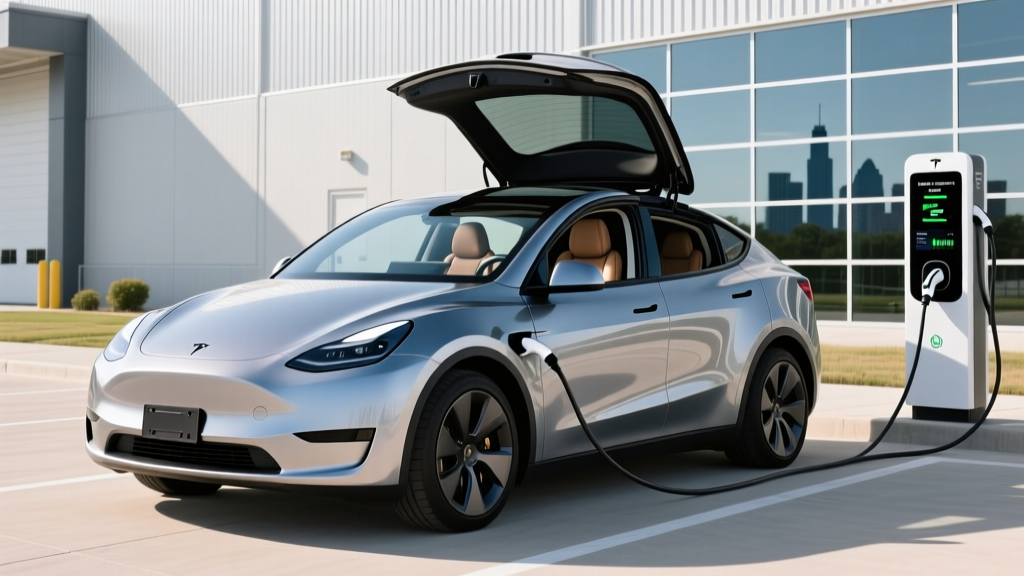
Tesla's Supercharger network remains the gold standard for DC fast charging reliability, and Austin is exceptionally well-served. The Giga Texas area has multiple V3 and V4 Supercharger stations within a 15-minute drive, including the on-site station near Tesla Road.
| Charging Level | Power | Miles Added per Hour | Typical Use Case |
|---|---|---|---|
| Level 1 (120V outlet) | 1.4 kW | ~5 mi/hr | Emergency / overnight trickle |
| Level 2 (240V, 48A) | 11.5 kW | ~44 mi/hr | Home daily charging |
| DC Fast (V3 Supercharger) | 250 kW peak | ~162 mi in 15 min | Road trips |
| DC Fast (V4 Supercharger) | 250 kW peak | ~162 mi in 15 min | Road trips (newer stalls) |
| Non-Tesla DC (CCS adapter) | Up to 150 kW | Varies by station | Electrify America, EVgo |
The 10–80% DC fast charge takes approximately 25 minutes on a V3 Supercharger. However, the charging curve is not linear: you'll hit peak 250 kW only between roughly 10–30% State of Charge (SoC). From 50–80%, power tapers from ~150 kW down to ~60 kW. This means the last 30% of the charge takes nearly as long as the first 50%. For road trips, the practical strategy is to charge to 80% and go — don't wait for 100%.
For home charging at your Austin residence, a 48-amp Level 2 wall connector on a 60-amp circuit adds roughly 44 miles of range per hour. A full overnight charge from 20% to 90% takes about 7–8 hours. Budget $800–$1,500 for professional installation of a Tesla Wall Connector, or $1,500–$3,000 if your electrical panel needs a 200-amp upgrade — a common scenario in older Austin neighborhoods like Hyde Park or Bouldin Creek.
Performance and Driving Dynamics
The Juniper-refreshed Model Y benefits from frequency-selective dampers and revised suspension tuning that addresses the most common complaint about the pre-2025 model: a harsh ride over rough pavement. On Austin's mix of smooth toll roads (TX-45, MoPac express lanes) and older concrete sections of I-35, the 2026 Model Y absorbs impacts noticeably better than its predecessor.
The Performance trim's 3.5-second 0–60 time is genuinely quick, but the Long Range AWD at 4.8 seconds is more than adequate for merging onto US-183 or passing on Mopac. The RWD variant, at 5.8 seconds, trades some urgency for a lower price point and slightly better range.
All trims feature Tesla's standard Autopilot (SAE Level 2 driver assistance), which includes Traffic-Aware Cruise Control and Autosteer. Full Self-Driving (Supervised) remains an $8,000 add-on or $99/month subscription.
Interior, Tech, and Cargo: The Juniper Refresh
The 2026 Model Y interior is a meaningful step up from the pre-refresh cabin. Key updates include:
- Ventilated front seats — essential for Austin summers
- Ambient lighting with customizable color zones
- Power-folding second row for cargo flexibility
- 8-inch rear touchscreen for rear-seat passengers
- Acoustic glass across all windows, reducing cabin noise by ~4 dB at highway speeds
Cargo space remains competitive at 30.2 cu ft behind the second row and 72.1 cu ft with seats folded. The front trunk (frunk) adds 4.1 cu ft — enough for a charging cable bag and a small cooler. Rear legroom measures 41.6 inches, which accommodates adults comfortably on longer drives to Hill Country or San Antonio.
The 15.4-inch center touchscreen runs Tesla's latest software with integrated navigation, streaming apps, and vehicle controls. Notably, there is still no traditional instrument cluster — all information routes through the center screen, which remains a dealbreaker for some traditional SUV buyers.
Pricing and Federal Tax Credit: What You'll Actually Pay
| Trim | MSRP | Est. Federal Credit* | Effective Price | Destination |
|---|---|---|---|---|
| Long Range RWD | $39,990 | $7,500 | ~$32,490 | $1,390 |
| Long Range AWD | $44,990 | $7,500 | ~$37,490 | $1,390 |
| Performance AWD | $51,490 | $7,500 | ~$43,990 | $1,390 |
*Federal §30D tax credit eligibility requires: buyer AGI ≤ $150K (single) / $300K (joint), vehicle MSRP ≤ $80,000 (SUVs), and compliance with battery critical-mineral and component sourcing rules. Credit can now be transferred at point of sale as an instant discount per IRS guidelines. Verify current-year sourcing compliance on Tesla's website or with your tax professional before purchasing.
As of 2026, the Model Long Range RWD qualifies for the full $7,500 credit thanks to Tesla's increasing North American battery component sourcing from Giga Texas and partner suppliers. However, critical-mineral sourcing requirements tighten annually under the Inflation Reduction Act, and eligibility can shift mid-year. Always confirm current eligibility on fueleconomy.gov before finalizing your order.
Pros and Cons: The Honest Assessment
Pros
- Class-leading Supercharger network access — 50,000+ stalls globally
- Strong real-world efficiency (26–28 kWh/100mi in mixed driving)
- Juniper suspension fixes the harsh-ride complaint
- Best-in-class OTA software updates
- Point-of-sale tax credit transfer reduces upfront cost
- Ventilated seats standard (critical for Texas heat)
Cons
- No instrument cluster — all info on center screen
- Turn-signal stalk removed (steering-wheel buttons)
- Panel gaps still inconsistent at Giga Texas deliveries
- Insurance premiums run 15–25% higher than competing SUVs
- Non-Tesla DC charging requires CCS adapter (included, but slower)
- FSD (Supervised) remains Level 2 — not autonomous despite the name
Who Should Buy the Giga Texas Model Y?
Choose the Long Range RWD if: You commute within the Austin metro, want the lowest price after the tax credit, and rarely drive in snow or ice.
Choose the Long Range AWD if: You take regular road trips (Austin → Dallas, Houston, or the Hill Country), want the security of dual-motor traction in rain, and value the 4.8-second 0–60 for highway merging.
Choose the Performance if: Acceleration matters to you, you want the track-capable dual-motor setup, and the ~$7,000 premium over Long Range AWD fits your budget.
Look elsewhere if: You need three rows of seating (consider the Model X or Kia EV9), prefer physical controls and a traditional instrument cluster, or your budget is under $30K after incentives.
The Austin buyer profile for the Model Y is broad: tech-professional commuters to the Domain or downtown, families in Round Rock and Cedar Park who need cargo space for weekend trips to Lake Travis, and road-trippers who rely on the Supercharger corridor along I-10 and I-35. The Giga Texas proximity means faster delivery times for Austin orders — often 2–4 weeks from configuration to pickup at the Tesla Road delivery center.
Competitor Check: Model Y vs. the Field
Against the Hyundai Ioniq 5 (310 mi EPA, 350 kW max charge), the Model Y wins on Supercharger network reliability and cargo space but trails on DC charging speed. Against the Ford Mustang Mach-E (320 mi EPA, ~$42K), the Model Y offers better efficiency and software but a firmer ride. The Kia EV6 matches the Model Y on range and beats it on 800V charging architecture (10–80% in ~18 minutes), but lacks the Supercharger ecosystem.
For Austin specifically, the Supercharger density is a genuine advantage. There are 12 Supercharger stations within the Austin metro and 40+ along the I-35 corridor to Dallas — a network advantage that competitors using Electrify America or EVgo cannot yet match in Central Texas.
Frequently Asked Questions
What is the real-world range of the 2026 Tesla Model Y in Austin?
Expect 265–285 miles on sustained highway driving and 290–310 miles in mixed Austin commuting. The EPA sticker reads 320 miles (Long Range AWD), but real-world conditions — highway speeds, air conditioning in summer, and occasional cold snaps — reduce that by 10–18%. Plan trips around 270 miles of usable range for comfort.
How fast does the Model Y charge at home and on the road?
At home on a 240V Level 2 Wall Connector (48 amps), the Model Y charges at 11.5 kW, adding roughly 44 miles of range per hour — a full overnight charge covers most daily needs. On a Tesla V3 Supercharger, it peaks at 250 kW and charges from 10–80% in about 25 minutes. Non-Tesla DC fast chargers via the CCS adapter typically deliver 50–150 kW depending on the station.
Does the 2026 Model Y qualify for the $7,500 federal tax credit?
As of early 2026, the Model Y Long Range RWD and AWD variants qualify for the full $7,500 §30D federal EV tax credit, transferable at point of sale. Eligibility requires buyer income below $150K (single) or $300K (joint), vehicle MSRP under $80,000, and compliance with battery sourcing rules. Verify current eligibility at irs.gov before ordering, as sourcing requirements tighten annually.
Is the Giga Texas Model Y worth buying over competitors?
If Supercharger network access and software integration are priorities, yes. The Model Y's efficiency, cargo space, and Austin-area Supercharger density are strong advantages. However, if you prioritize the fastest possible DC charging (Hyundai Ioniq 5/Kia EV6 at 350 kW), a traditional instrument cluster, or a softer ride, the competition has merits. Test-drive both before deciding.
How long is the battery warranty on the Model Y?
Tesla covers the Model Y battery and drive unit for 8 years or 120,000 miles (whichever comes first), with a minimum 70% capacity retention guarantee. If the battery degrades below 70% of its original capacity within the warranty period, Tesla will repair or replace it. Real-world degradation data from Tesla's fleet suggests most Model Y batteries retain 88–92% capacity at 100,000 miles.
Can I visit the Giga Texas factory on Tesla Road?
Tesla offers limited public tours of Giga Texas, and the on-site delivery center at 13101 Tesla Road, Austin, TX 78725 handles vehicle pickups for Austin-area orders. The factory also has a small retail store selling Giga Texas merchandise. Public access to the production floor is restricted and typically requires a pre-booked tour.
Sources: fueleconomy.gov, Tesla Model Y specifications, IRS §30D Clean Vehicle Credit