Germany's 2026 EV Subsidy Program: The Basics
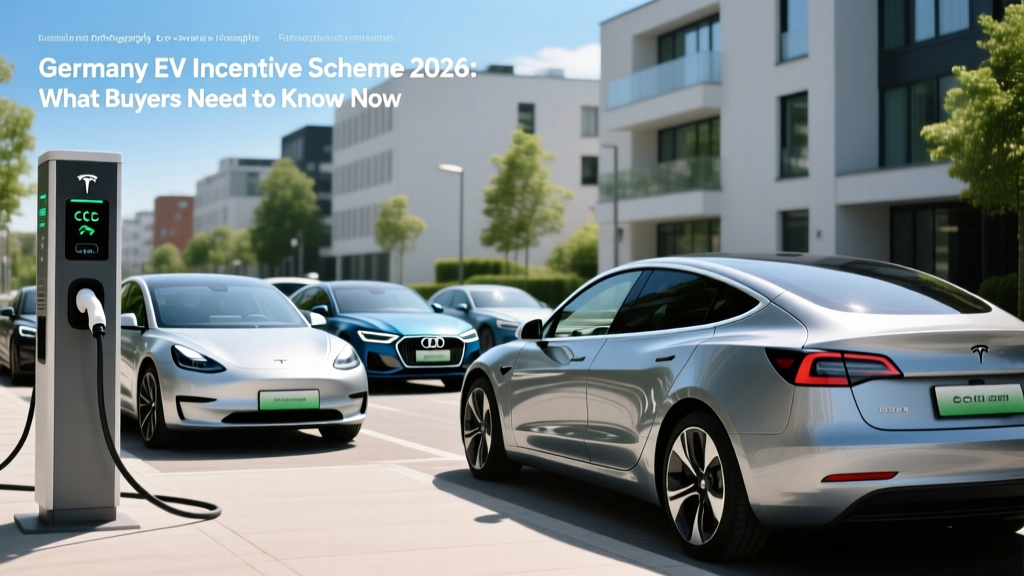
Germany's electric vehicle incentive landscape has shifted dramatically since the abrupt end of the Umweltbonus in December 2023. For 2026, the federal government has reintroduced a targeted subsidy program aimed at middle-income buyers purchasing new battery-electric vehicles (BEVs). Unlike the previous scheme that offered up to €6,750 across all income brackets, the 2026 program caps benefits at €6,000 and restricts eligibility based on household income and vehicle price.
The current German EV subsidy—officially part of the "Klimaschutzprogramm 2026"—provides tiered support:
- Full subsidy (€6,000): Households with taxable income under €45,000 purchasing BEVs under €40,000 net list price
- Partial subsidy (€4,500): Households earning €45,000–€80,000 purchasing BEVs under €45,000
- Reduced subsidy (€3,000): Households earning €80,000–€120,000 purchasing BEVs under €50,000
- No subsidy: Households above €120,000 or vehicles exceeding €50,000 net price
Plug-in hybrids (PHEVs) remain excluded from the 2026 program, continuing the policy shift that began in 2023. Only pure battery-electric vehicles and hydrogen fuel-cell models qualify.
How Germany's 2026 EV Incentive Compares to US Federal Tax Credits
For US buyers researching international incentive structures, Germany's approach differs fundamentally from the IRS Section 30D Clean Vehicle Credit. While Germany offers direct purchase subsidies applied at point-of-sale, the US system operates as a non-refundable tax credit claimed when filing federal returns (or transferred to dealers for point-of-sale reduction under 2024+ rules).
US Federal EV Tax Credit (IRS §30D) — 2026 Requirements:
- Maximum credit: $7,500 for new qualifying vehicles
- Income caps: Modified AGI under $150,000 (single), $225,000 (head of household), $300,000 (married filing jointly)
- MSRP limits: Vans/SUVs/pickups under $80,000; sedans/other under $55,000
- Battery sourcing: Critical minerals and battery components must meet phased-in domestic/free-trade-partner thresholds (100% critical minerals, 100% components by 2029)
- Point-of-sale transfer: Buyers can transfer credit to dealer for immediate price reduction
- Used EV credit: Up to $4,000 or 30% of sale price (whichever is lower) for qualifying pre-owned EVs under $25,000
The key distinction: Germany's income-based tiering explicitly targets affordability for lower-earning households, while the US system focuses on supply-chain reshoring through battery-sourcing mandates. Both programs exclude luxury-priced vehicles, but Germany's €50,000 cap (roughly $54,000 USD) affects a broader range of mainstream EVs than America's $55,000 sedan threshold.
Real-World 5-Year Ownership Cost: German vs US EV Buyers
Subsidies only tell part of the ownership equation. Let's model a realistic 5-year total cost of ownership (TCO) for a mid-range EV in both markets, using the Volkswagen ID.4 Pro (a popular choice in both regions) as our baseline:
| Cost Category | Germany (with €6,000 subsidy) | US (with $7,500 credit) |
|---|---|---|
| Purchase Price (after incentive) | €34,950 (~$37,800) | $35,500 |
| Charging (75,000 miles/120,000 km) | €3,750 ($4,050) | $3,900 |
| Insurance (5 years) | €6,250 ($6,750) | $8,500 |
| Maintenance | €1,200 ($1,300) | $1,400 |
| Depreciation (estimated resale) | €15,000 ($16,200) | $17,000 |
| Total 5-Year Cost | €61,150 (~$66,100) | $66,300 |
This model assumes 15,000 miles (24,000 km) annually, home charging at average residential electricity rates (€0.30/kWh in Germany, $0.16/kWh in US), and standard comprehensive insurance. German buyers face higher electricity costs but benefit from lower insurance premiums and slightly better residual values due to stronger domestic EV demand.
Charging Costs: Germany vs US Electricity Rates
Cost Per Mile Calculation (2026)
Germany: Residential electricity averages €0.30/kWh. VW ID.4 efficiency: 3.2 miles/kWh (EPA equivalent). Cost per mile: €0.094 (~$0.10/mile)
US: Residential electricity averages $0.16/kWh. Same efficiency. Cost per mile: $0.05/mile
Gasoline comparison (US): 25 MPG combined at $3.50/gallon = $0.14/mile
Gasoline comparison (Germany): 25 MPG at €1.80/liter (€6.82/gallon) = $0.27/mile
German EV owners save significantly more per mile versus gasoline than US drivers, primarily because European fuel prices are roughly double American costs. Even with electricity rates nearly twice as high, German EV charging still delivers a 63% per-mile savings over gasoline, compared to 64% savings in the US.
Public DC fast charging skews these calculations. In Germany, providers like Ionity and EnBW charge €0.49–€0.79/kWh for high-power charging, while US networks like Electrify America and EVgo average $0.48–$0.65/kWh. Frequent road-trippers relying on public fast charging will see their per-mile costs rise substantially in both markets.
Maintenance Savings: Where EVs Shine
| Service Item | Gasoline Vehicle | Battery-Electric Vehicle |
|---|---|---|
| Oil Changes | $180–$300/year | $0 |
| Brake Pads/Rotors | $400–$800 every 40k miles | $400–$800 every 80k+ miles (regen braking reduces wear) |
| Transmission Fluid | $150–$250 every 60k miles | $0 (single-speed reduction gear) |
| Coolant Flush | $100–$150 every 50k miles | $100–$150 every 100k miles |
| Air Filters | $50–$100 every 20k miles | $50–$100 every 30k miles (cabin filter only) |
| Estimated Annual Cost | $600–$1,000 | $200–$350 |
The maintenance advantage compounds over ownership. A 5-year EV owner typically saves $2,000–$3,500 versus a gasoline counterpart. However, this assumes no major battery issues—and while battery failures remain rare under warranty (8 years/100,000 miles is standard), out-of-warranty replacements cost $10,000–$20,000 depending on pack size and chemistry.
The Insurance Reality: Why EVs Cost More to Insure
Both German and US EV owners face insurance premiums 15–25% higher than equivalent gasoline vehicles. In the US, average annual EV insurance runs $2,800–$3,500 depending on state, driver profile, and vehicle model. Germany's statutory insurance framework produces lower absolute costs (€1,000–€1,500 annually), but the EV premium persists.
Why the higher rates?
- Repair costs: EV battery packs and high-voltage components require specialized technician training and equipment. Even minor collisions can trigger battery safety protocols that total vehicles.
- Parts availability: EV-specific components (inverter, onboard charger, thermal management system) have longer lead times and fewer aftermarket options.
- Vehicle weight: EVs are 15–25% heavier than gas equivalents due to battery mass, increasing collision energy and tire wear.
- Total-loss frequency: Insurers report higher total-loss rates for EVs after battery-damaging incidents, as replacement packs often exceed vehicle residual value.
German insurers like Allianz and HUK-Coburg have begun offering EV-specific policies with battery-inclusive coverage, while US providers (Geico, Progressive, State Farm) are still calibrating risk models. Shop quotes aggressively—the spread between insurers for the same EV can exceed $800/year.
Depreciation Trends: Do EVs Hold Value?
EV depreciation has stabilized since the 2022–2023 price wars and Tesla's aggressive cuts. Current 5-year residual values for mainstream EVs (VW ID.4, Hyundai Ioniq 5, Ford Mustang Mach-E) average 45–55% of original MSRP, compared to 50–60% for gasoline equivalents.
Factors affecting EV resale:
- Battery health: Vehicles with documented battery State of Health (SoH) above 85% command premiums. Pre-purchase battery diagnostics are now standard at major used-car retailers.
- Charging standard: NACS-equipped vehicles (Tesla and post-2025 adopters) show stronger residuals than CCS-only models in the US market, reflecting Supercharger network access value.
- Range obsolescence: Sub-200-mile EVs depreciate faster as 300+ mile models become standard.
- Incentive changes: When subsidies end or tighten (as in Germany's 2023 Umweltbonus termination), used EV demand spikes temporarily, then normalizes.
German EVs hold value slightly better than US counterparts due to stronger domestic demand, limited new-vehicle supply chains, and cultural preference for certified pre-owned programs. However, luxury EVs (Porsche Taycan, Mercedes EQS) depreciate 55–65% in both markets over 5 years—comparable to luxury gasoline sedans.
State, Local, and Utility Incentives (US Buyers)
Beyond the federal §30D credit, US buyers should research:
- State rebates: California (CVRP: up to $7,000 for income-qualified buyers), Colorado (up to $5,000 tax credit), Massachusetts (MOR-EV: up to $3,500)
- Utility programs: Many electric cooperatives and municipal utilities offer $500–$1,500 rebates for EV purchase plus Level 2 charger installation
- HOV access: States like California, Colorado, and Virginia grant solo carpool-lane access to qualifying EVs—a non-monetary but time-saving benefit
- Local incentives vary dramatically by jurisdiction. Always check official state energy office websites and your utility's EV program page for current offerings.
Frequently Asked Questions
How much does it really cost to own an EV over 5 years?
For a mainstream EV like the VW ID.4 or Hyundai Ioniq 5, expect total 5-year ownership costs of $60,000–$70,000 in the US (after federal tax credit) or €55,000–€65,000 in Germany (with 2026 subsidy). This includes purchase price, charging, insurance, maintenance, and depreciation. EVs cost more upfront but save $4,000–$8,000 in fuel and maintenance over 5 years versus gasoline equivalents.
Do I qualify for the US federal EV tax credit?
You may qualify for up to $7,500 if your modified adjusted gross income is under $150,000 (single) or $300,000 (married filing jointly), the vehicle MSRP is under $55,000 (sedans) or $80,000 (SUVs/trucks), and the battery meets critical-mineral and component-sourcing requirements. Rules tighten annually through 2032. Check the IRS Clean Vehicle Credits page and fueleconomy.gov for current qualifying models.
How much do I save on fuel and maintenance?
Average annual savings: $1,200–$1,800 on fuel (assuming 15,000 miles/year, home charging at $0.16/kWh, and gasoline at $3.50/gallon) plus $400–$700 on maintenance (no oil changes, reduced brake wear from regenerative braking). Over 5 years, total savings typically reach $8,000–$12,500, partially offset by higher insurance premiums ($2,000–$4,000 additional).
Are EVs more expensive to insure?
Yes, typically 15–25% more than gasoline equivalents. Average US EV insurance: $2,800–$3,500/year versus $2,200–$2,800 for gas vehicles. Higher repair costs, specialized parts, battery-damage total-loss risk, and vehicle weight all contribute. Always compare quotes from multiple insurers—spreads can exceed $800/year for the same model.
How well do EVs hold their value?
Mainstream EVs retain 45–55% of MSRP after 5 years, slightly below gasoline equivalents (50–60%). Battery health documentation, NACS charging compatibility, and 300+ mile range support better residuals. Luxury EVs depreciate similarly to luxury gas sedans (55–65% loss). German EVs hold marginally better value due to stronger domestic demand.
Is Germany's 2026 EV subsidy available to non-German residents?
No. The Klimaschutzprogramm subsidy requires German residency, vehicle registration in Germany, and proof of income through German tax filings. International buyers cannot access this incentive. US residents should focus on federal §30D credits plus state-specific programs.