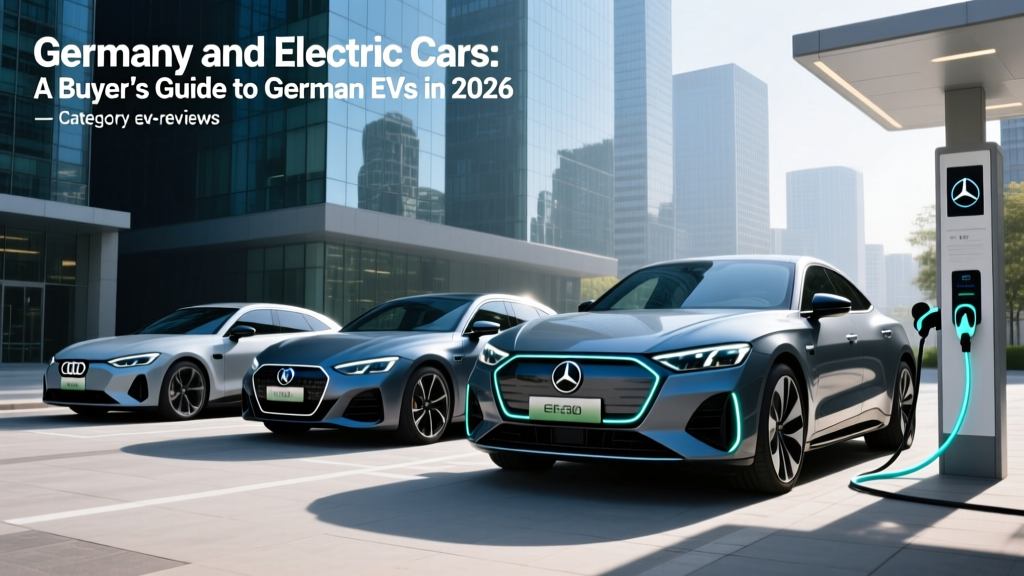
Quick Answer: German automakers — Volkswagen, BMW, Mercedes-Benz, Audi, and Porsche — offer over 20 EV models for sale in the US for 2026. Prices range from roughly $39,000 (VW ID.4) to over $200,000 (Porsche Taycan Turbo GT). Range spans 240–340 EPA miles depending on model and trim. Most use NMC battery chemistry and CCS1 or NACS connectors. Federal tax credit eligibility (§30D) is limited: only certain models assembled in North America or meeting specific battery-sourcing thresholds qualify, which excludes many Germany-built EVs from the full $7,500 credit.
Why Germany Matters in the EV Market
Germany is the world's fourth-largest auto market and home to brands that have defined luxury and performance driving for a century. When it comes to Germany and electric cars, the country's manufacturers have pivoted aggressively since 2020, investing over €100 billion collectively in electrification. Volkswagen Group alone committed €89 billion to EV and software development through 2028.
For US buyers, German EVs occupy a specific niche: they tend to emphasize driving dynamics, build quality, and highway stability — traits honed on the Autobahn — over the software-first approach of Tesla or the value proposition of Hyundai/Kia. The tradeoff is often higher pricing and, in some cases, slower DC fast-charging speeds than Korean competitors.
Current German EV Lineup: Specs That Matter
Here are the key German EVs available in the US for the 2026 model year, with the numbers buyers actually need:
| Model | EPA Range | Battery (kWh) | Peak DC Charge (kW) | 10–80% Time | 0–60 mph | Base MSRP |
|---|---|---|---|---|---|---|
| VW ID.4 (RWD) | 291 mi | 82 kWh usable, NMC | 175 kW | ~29 min | 7.7 sec | $39,735 |
| VW ID.4 (AWD Pro S) | 263 mi | 82 kWh usable, NMC | 175 kW | ~29 min | 5.4 sec | $46,235 |
| BMW i4 eDrive40 | 307 mi | 81.5 kWh usable, NMC | 205 kW | ~31 min | 5.5 sec | $57,900 |
| BMW iX xDrive50 | 324 mi | 105.2 kWh usable, NMC | 195 kW | ~35 min | 4.4 sec | $87,250 |
| Mercedes EQB 300 4MATIC | 245 mi | 68 kWh usable, NMC | 100 kW | ~32 min | 7.7 sec | $52,750 |
| Audi Q4 e-tron (Premium) | 265 mi | 82 kWh usable, NMC | 175 kW | ~28 min | 7.9 sec | $49,800 |
| Porsche Taycan (RWD) | 318 mi | 105 kWh usable, NMC | 320 kW | ~18 min | 4.5 sec | $99,400 |
Real-world range caveat: Expect 10–15% less than EPA figures during sustained highway driving at 70+ mph, and 20–30% loss in sub-freezing temperatures. The ID.4's 291-mile EPA rating translates to roughly 250 miles on a 75-mph highway run in 40°F weather. The Taycan's new 105 kWh Performance Battery Plus delivers class-leading efficiency but still tapers noticeably above 80% SoC during DC fast charging.
German EVs vs. Gas and Hybrid Alternatives
German automakers still sell plenty of gas and plug-in hybrid models. Here's how a representative German EV stacks up against its ICE and PHEV siblings on total cost over five years and 75,000 miles:
| Cost Factor | BMW i4 eDrive40 (EV) | BMW 430i Gran Coupe (Gas) | BMW 330e xDrive (PHEV) |
|---|---|---|---|
| Base MSRP | $57,900 | $48,300 | $46,700 |
| Fuel/Energy (75k mi) | ~$3,200 (at $0.14/kWh) | ~$9,750 (at $3.50/gal, 28 MPG) | ~$5,800 (mixed) |
| Maintenance (5 yr) | ~$1,200 | ~$3,800 | ~$3,200 |
| Insurance (avg 5 yr) | ~$12,500 | ~$10,200 | ~$10,800 |
| Federal Tax Credit | $0 (built in Germany)* | $0 | $0* |
| 5-Year Total | ~$74,800 | ~$72,050 | ~$66,500 |
*The BMW i4 is assembled in Munich, Germany. Under current IRS §30D rules, the final assembly must occur in North America to qualify for the new clean vehicle credit. Verify eligibility at fueleconomy.gov before purchasing.
The i4's energy cost advantage is substantial — roughly $6,500 less than gas over five years — but the higher MSRP and insurance premiums narrow the gap. The PHEV 330e offers a middle ground with ~22 miles of electric-only range (EPA-rated) before the gas engine kicks in, though it still requires oil changes and transmission maintenance.
Tax Credits, Incentives, and the Germany Problem
This is where buying a German-built EV gets complicated. The federal §30D credit of up to $7,500 requires:
- Final assembly in North America — This eliminates most vehicles built in German factories (Munich, Zwickau, Sindelfingen, Ingolstadt)
- MSRP caps: $80,000 for SUVs/pickups/vans; $55,000 for sedans
- Buyer income caps: $150,000 single / $300,000 married filing jointly (AGI)
- Battery component and critical mineral sourcing thresholds that increase annually
- Point-of-sale transfer option available — dealer applies credit at purchase, reducing out-of-pocket
Which German-brand EVs DO qualify? Vehicles assembled in North American plants may qualify. For 2026, this includes select configurations of models built at VW's Chattanooga, Tennessee plant or BMW's Spartanburg, South Carolina facility. Always verify on the IRS's official list before committing. State-level incentives vary — California, Colorado, and New York offer additional rebates that don't carry the same assembly restrictions.
Charging German EVs: Connectors and Speeds
As of 2025–2026, most German automakers have committed to adopting the North American Charging Standard (NACS) for new models. However, many 2024–2025 model-year German EVs still ship with CCS1 ports. Here's what that means practically:
| Brand | 2026 Connector | Tesla Supercharger Access | Adapter Needed? |
|---|---|---|---|
| Volkswagen (ID.4) | NACS (2025+ models) | Native | No (2025+); CCS-to-NACS adapter for 2024 |
| BMW (i4, iX) | CCS1 (transitioning to NACS) | Via adapter | Yes — BMW-provided CCS-to-NACS adapter |
| Mercedes (EQB, EQE) | NACS (2025+ models) | Native | No (2025+) |
| Audi (Q4 e-tron, e-tron GT) | NACS (2025+ models) | Native | No (2025+) |
| Porsche (Taycan) | NACS (2025+ models) | Native | No (2025+) |
Charging curve reality: The Porsche Taycan's 800-volt architecture allows a peak 320 kW charge rate, but that peak is sustained only from roughly 10–40% SoC. Above 60%, the rate drops to ~150 kW, and above 80% it falls below 50 kW. This is normal physics — lithium-ion batteries accept charge more slowly at higher states of charge to prevent degradation. Plan DC fast charging stops to 80% for optimal time efficiency.
Home charging (Level 2): All German EVs accept Level 2 AC charging at 9.6–11 kW (48A circuit recommended). A full overnight charge from 20% to 100% takes 7–10 hours depending on battery size. Installation costs for a home Level 2 charger range from $500–$2,500 depending on panel capacity and conduit runs. Budget for a 200-amp panel upgrade ($1,500–$3,000) if your home has an older 100-amp service.
Common Misconceptions About German EVs
| Myth | Fact |
|---|---|
| "German EVs don't qualify for any tax credits" | Some do — it depends on the specific model year, assembly location, and battery sourcing. VW ID.4 models from Chattanooga have qualified in prior years. Always check the current IRS list. |
| "BMW and Mercedes EVs are just converted gas cars" | The BMW iX and Mercedes EQE use dedicated EV platforms (or heavily modified architectures). The i4 shares a platform with the gas 4 Series but was engineered for EV from the start, with a flat battery pack and optimized weight distribution. |
| "German EVs charge slower than Tesla" | Partially true at peak: most German EVs peak at 175–205 kW vs. Tesla's 250 kW V3 Supercharger. But the Porsche Taycan at 320 kW exceeds Tesla's V3 peak. Sustained average charging speed matters more than peak — and here, 800V platforms (Taycan, e-tron GT) close the gap significantly. |
| "You can't take a German EV on a road trip" | With NACS adoption and adapter availability, BMW, VW, Audi, Mercedes, and Porsche owners can now access Tesla's 25,000+ Supercharger network in addition to Electrify America, EVgo, and ChargePoint. A 300-mile trip requires one 20–30 minute stop — manageable with route planning. |
| "Battery replacement will cost $20,000+" | All German EVs carry 8-year/100,000-mile battery warranties with capacity retention thresholds (typically 70%). Real-world degradation data shows most NMC packs lose 8–12% capacity over 100,000 miles. Full replacement is rare; module-level repair is increasingly available. |
Decision Framework: Should You Buy a German EV?
Choose a German EV if:
- You prioritize driving dynamics, ride quality, and cabin materials over software features
- You drive frequently at highway speeds (German EVs excel at high-speed stability and efficiency)
- You can charge at home (Level 2) and your daily commute is under 200 miles
- You're buying a luxury-tier vehicle and the $50,000+ price point fits your budget
- You value brand heritage and dealer service infrastructure
Look elsewhere if:
- The $7,500 federal tax credit is essential to your purchase math — many German-built models don't qualify, making a Tesla Model Y, Hyundai Ioniq 5, or Ford Mustang Mach-E significantly cheaper after incentives
- You want the fastest DC charging speeds in the mainstream segment — Hyundai/Kia's E-GMP platform (Ioniq 5, EV6) charges at up to 240 kW with a flatter curve than most German competitors under $80,000
- You need three-row seating at an affordable price — the VW ID.4 is five-seat only, and no German brand offers a sub-$60,000 three-row EV (the VW ID.Buzz starts at ~$59,995)
- Public charging access is your primary concern and you live in a region with sparse Electrify America or Supercharger coverage
Frequently Asked Questions
Are German EVs reliable compared to Tesla or Hyundai?
Reliability data is still maturing for most EV platforms. IIHS crash-test ratings for German EVs are generally excellent (the ID.4 and i4 earn Top Safety Pick+). Long-term reliability surveys from Consumer Reports show mixed results — VW's ID.4 has had software-related complaints, while the Porsche Taycan scores well. Tesla's build quality remains inconsistent, and Hyundai/Kia offer the strongest warranty coverage (10-year/100,000-mile powertrain).
Can I use Tesla Superchargers with a German EV?
Yes, with caveats. 2025+ model-year German EVs with native NACS ports can use Tesla Superchargers directly. Older CCS1-equipped models require a manufacturer-provided or third-party CCS-to-NACS adapter. Always confirm adapter availability with your dealer before purchase.
What's the cheapest German EV available in the US?
The 2026 VW ID.4 Standard at $39,735 is the most affordable German-brand EV sold new in the United States. With any applicable state incentives (not federal, due to assembly location), out-of-pocket cost can drop to approximately $35,000–$37,000 depending on your state.
Do German EVs lose value faster than other EVs?
Depreciation is steep for most EVs — industry data shows 40–50% value loss over three years. German luxury EVs (BMW iX, Mercedes EQE) tend to depreciate more aggressively than mainstream models due to high initial MSRPs and rapidly evolving competition. The ID.4 holds value closer to segment average. Factor depreciation into your total cost calculation, especially if you plan to sell within 3–4 years.
What battery chemistry do German EVs use?
Nearly all German EVs use NMC (nickel manganese cobalt) lithium-ion chemistry, which offers higher energy density than LFP (lithium iron phosphate) but slightly faster degradation over time. Tesla and some Chinese-market vehicles use LFP. For German EVs, the 8-year/100,000-mile warranty with a 70% capacity retention guarantee provides adequate protection. Daily charging to 80% (rather than 100%) extends NMC battery life significantly.