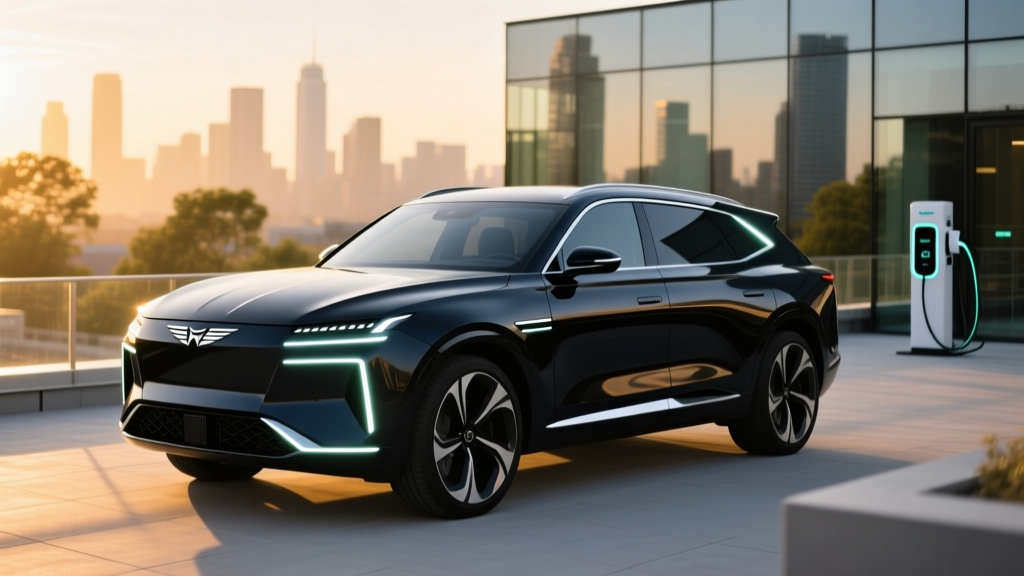
Quick Verdict: Is the Genesis GV80 Electric Worth It?
The 2026 Genesis GV80 Electric is a luxury midsize SUV built on Hyundai Motor Group's E-GMP platform, targeting buyers who want premium materials and a refined ride without the Tesla aesthetic. Expect an EPA-estimated range around 280–300 miles from an ~84 kWh (usable) NMC battery, peak DC fast charging near 240 kW (10–80% in roughly 20 minutes), and a starting MSRP in the low-to-mid $70,000 range before incentives. It competes directly with the BMW iX, Audi Q8 e-tron, and Mercedes EQE SUV. The GV80 Electric makes sense if you prioritize cabin luxury, ride comfort, and 800V charging architecture — but its real-world highway range and federal tax credit eligibility require careful verification before signing.
Range, Battery, and Efficiency: Beyond the EPA Sticker
The GV80 Electric uses a dual-motor all-wheel-drive layout producing approximately 365 horsepower and 516 lb-ft of torque, powered by an 84 kWh (usable) nickel-manganese-cobalt (NMC) lithium-ion battery pack. Genesis targets an EPA-estimated range of approximately 280–300 miles depending on wheel size and trim — a competitive figure for the luxury SUV segment, though not class-leading.
Real-World Range Expectations
EPA Estimate: ~280–300 miles
Highway (70–75 mph): Expect 230–260 miles — luxury SUVs with tall profiles and wide tires lose efficiency at speed.
Cold Weather (below 30°F): Range can drop 20–30%, yielding roughly 195–240 miles depending on cabin heating demand and whether the heat pump is active.
Mixed Commute (city/suburban): Closest to EPA sticker, potentially 270–290 miles with regenerative braking recuperating energy in stop-and-go traffic.
Efficiency should land in the neighborhood of 85–95 MPGe combined (roughly 35–40 kWh/100mi), which is respectable for a 5,000+ lb luxury vehicle but trails the more aerodynamic BMW iX xDrive50. The GV80 Electric's boxy, upright styling — a design strength aesthetically — creates a larger frontal area that hurts highway efficiency.
| Spec | Value |
|---|---|
| Battery (usable) | ~84 kWh, NMC chemistry |
| EPA Range | ~280–300 miles (est.) |
| Drivetrain | Dual-motor AWD |
| Horsepower | ~365 hp |
| Torque | ~516 lb-ft |
| 0–60 mph | ~4.9 seconds (est.) |
| Max DC Charge Rate | ~240 kW (800V architecture) |
| 10–80% DC Fast Charge | ~20 minutes |
| Level 2 Charge Rate | ~10.9 kW ( onboard charger) |
| Towing Capacity | ~3,500 lbs (est.) |
| Base MSRP | ~$72,000–$78,000 (est.) |
| Battery Warranty | 10 years / 100,000 miles |
Charging Speed and Infrastructure: The 800V Advantage
The GV80 Electric inherits Hyundai Motor Group's 800V electrical architecture — the same system that makes the Ioniq 5 and EV6 among the fastest-charging vehicles in their classes. This is a genuine competitive advantage over 400V rivals like the Audi Q8 e-tron and Mercedes EQE SUV, which typically peak at 150–170 kW.
| Level | Power | Speed (Approx.) | Use Case |
|---|---|---|---|
| Level 1 (120V) | ~1.4 kW | ~4–5 miles/hour | Emergency / overnight trickle |
| Level 2 (240V) | ~10.9 kW | ~30–35 miles/hour | Home / workplace daily charging |
| DC Fast Charge | Up to ~240 kW | 10–80% in ~20 min | Road trips, public fast chargers |
Charging curve reality: The 240 kW peak is not sustained across the entire session. Expect peak rates between 10–50% State of Charge (SoC), with a significant taper above 80%. A 10–80% session at a capable 350 kW station (like Electrify America or EVgo) should complete in roughly 20 minutes, but an 80–100% top-off can add another 15–20 minutes due to cell-balancing protocols. Plan road-trip stops around the 10–80% window for maximum efficiency.
The GV80 Electric ships with a NACS (North American Charging Standard) connector for the 2026 model year, granting native access to Tesla's Supercharger network — now the largest and most reliable DC fast-charging network in the U.S. with over 25,000 stalls. This eliminates the adapter dependency that plagued early CCS-equipped vehicles.
EV vs. Gas GV80: Cost and Experience Comparison
The gasoline Genesis GV80 (3.5T V6 AWD) starts around $65,000–$70,000 and delivers roughly 18 city / 23 highway / 20 combined MPG. Let's break down how the electric variant compares over a 5-year, 60,000-mile ownership period.
| Category | GV80 Electric | GV80 3.5T Gas |
|---|---|---|
| Purchase Price (est.) | $75,000 | $68,000 |
| Federal Tax Credit (§30D) | $0–$7,500* | $0 |
| Fuel/Energy Cost | $3,600–$5,400** | $9,000–$10,800*** |
| Maintenance (5 yr) | $1,200–$1,800 | $3,500–$4,500 |
| Insurance (est. avg/yr) | $2,400–$3,000 | $2,000–$2,600 |
| Estimated Depreciation | 45–55% | 40–50% |
| Total 5-Yr Cost (est.) | $95,000–$115,000 | $95,000–$110,000 |
*Tax credit eligibility depends on battery sourcing, buyer income, and MSRP caps under IRS §30D rules. Luxury EVs frequently fail the battery-component or critical-minerals requirements. Verify current eligibility before purchase.
**Assumes $0.12–$0.18/kWh average (home + public mix), 35 kWh/100mi.
***Assumes $3.50–$4.20/gallon, 20 MPG combined.
The electric GV80 recoups its higher purchase price primarily through fuel savings (~$4,000–$6,000 over 5 years) and reduced maintenance (~$2,000 savings — no oil changes, fewer brake replacements due to regen braking). However, higher insurance premiums and potentially steeper depreciation partially offset these gains. The financial case strengthens significantly if you qualify for the full $7,500 federal credit or applicable state incentives, and if you charge predominantly at home on off-peak electricity rates.
Federal Tax Credit and Incentive Eligibility
This is where luxury EV buyers frequently encounter disappointment. The federal §30D Clean Vehicle Credit offers up to $7,500, but the GV80 Electric must clear several hurdles:
- MSRP Cap: SUVs must be under $80,000 MSRP. The GV80 Electric's base trim should qualify, but higher trims or option packages may push it over the limit.
- Buyer Income Cap: Modified adjusted gross income must not exceed $300,000 (joint), $225,000 (head of household), or $150,000 (individual).
- Battery Sourcing: Battery components must be manufactured or assembled in North America, and critical minerals must be sourced from the U.S. or free-trade-agreement partners. Korean-manufactured battery cells (from SK On or LG) may face partial or full disqualification depending on current-year sourcing percentages.
- Point-of-Sale Transfer: As of 2024+, eligible buyers can transfer the credit to the dealer at purchase, reducing the out-of-pocket price immediately rather than waiting for tax filing.
Practical advice: Ask the dealer for the vehicle's IRS compliance documentation before committing. Do not assume the credit applies — verify it in writing. State-level incentives (California's CVRP, Colorado's innovative motor vehicle credit, etc.) may stack on top but vary by jurisdiction. Consult a tax professional for your specific situation.
Real-World Ownership: What First-Time EV Buyers Must Know
Home Charging Is Non-Negotiable for Most Owners
If you cannot install a Level 2 (240V) home charger, owning any luxury EV becomes significantly less convenient and more expensive. A 10.9 kW Level 2 charger adds roughly 30–35 miles per hour of charging, meaning an overnight session (8–10 hours) fully replenishes the battery. Budget $800–$2,500 for a quality Level 2 unit (ChargePoint Home Flex, Emporia Level 2, or Genesis-branded home charger) plus $500–$2,000 for professional electrical installation — potentially more if your panel requires a 200-amp upgrade.
Public-only charging is viable for some urban apartment dwellers, but at $0.35–$0.55/kWh for DC fast charging, your "fuel" costs can approach or exceed gasoline. Home charging at $0.10–$0.15/kWh is where the economic case for EVs truly works.
Cold-Weather and Climate Considerations
If you live in northern climates with sustained sub-freezing winters, plan for 20–30% range loss. The GV80 Electric's heat pump (standard on most E-GMP vehicles) mitigates cabin-heating energy draw compared to resistive heaters, but battery chemistry itself slows in cold temperatures, reducing both range and charge acceptance rates. Preconditioning the battery while plugged in — using the Genesis Connected Services app to warm the cabin and battery before departure — is essential for preserving range and enabling fast charging in cold weather.
Maintenance and Service Network
EVs eliminate oil changes, spark plugs, transmission fluid, and exhaust-system repairs. Expect to replace cabin air filters, wiper blades, brake fluid (less frequently thanks to regen), and tires. Luxury EV tires wear faster due to vehicle weight and instant torque — budget $1,200–$1,800 for a set of premium all-season or touring tires every 30,000–40,000 miles. Genesis's dealer network is smaller than BMW's or Mercedes', which matters for service access in rural areas.
Common Misconceptions About the GV80 Electric
| Myth | Fact |
|---|---|
| "The battery will need replacing in 5 years." | NMC batteries in modern E-GMP vehicles are engineered for 1,000+ full charge cycles with ~80% capacity retention. The 10-year/100,000-mile battery warranty covers defects and excessive degradation. Real-world data from Hyundai/Kia E-GMP siblings shows minimal degradation in early years. |
| "It charges at 240 kW everywhere." | Peak 240 kW requires a 350 kW-capable DC fast charger. Many public stations deliver 50–150 kW. The 800V architecture still charges faster at lower-power stations than 400V competitors, but you won't see peak rates at a 50 kW CHAdeMO unit. |
| "The $7,500 tax credit is guaranteed." | Eligibility depends on battery sourcing, your income, and MSRP. Many Korean-built luxury EVs have faced partial or full credit disqualification under evolving IRS sourcing rules. Always verify before purchase. |
| "It's self-driving with Genesis Active Safety." | Genesis's Highway Driving Assist and navigation-based smart cruise control are SAE Level 2 systems — the driver must remain engaged, hands on or near the wheel, at all times. This is not autonomous driving. |
| "I'll save money no matter what." | Without home charging, with high insurance premiums, and without the tax credit, total ownership cost can match or exceed the gas GV80. Run the numbers for your specific situation. |
Decision Framework: Should You Buy the GV80 Electric?
Choose the GV80 Electric If:
- You have reliable Level 2 home charging (garage or driveway with a 240V circuit).
- You value a quiet, torque-rich, refined driving experience and premium interior materials over sporty handling dynamics.
- Your daily driving is under 200 miles round-trip, with occasional road trips where 20-minute DC fast-charge stops are acceptable.
- You live in or near a metro area with NACS/Tesla Supercharger or Electrify America coverage for road trips.
- You qualify for the §30D tax credit or applicable state incentives, bringing the effective price closer to the gas GV80.
Choose the Gas GV80 or a PHEV Alternative If:
- You lack home charging access and would rely entirely on public infrastructure.
- You regularly drive 300+ miles in a single day through charging-sparse regions (rural Mountain West, parts of the Midwest).
- You tow frequently — EV towing range drops dramatically, often by 40–50%.
- You plan to keep the vehicle 10+ years and are risk-averse about out-of-warranty battery replacement costs ($15,000–$25,000 estimated).
- You want maximum cargo and passenger space — the GV80 Electric's battery pack slightly reduces underfloor storage compared to the gas variant.
Frequently Asked Questions
What is the real-world range of the Genesis GV80 Electric?
While the EPA estimate is approximately 280–300 miles, real-world highway driving at 70–75 mph typically yields 230–260 miles. In cold weather (below 30°F), expect 195–240 miles. City and suburban driving with regenerative braking comes closest to the EPA sticker.
How long does it take to charge the GV80 Electric at home?
On a Level 2 (240V, ~10.9 kW) home charger, a full 0–100% charge takes approximately 8–9 hours. Most owners plug in overnight and wake to a full battery every morning. On a standard 120V outlet (Level 1), a full charge takes 60+ hours — useful only for emergency trickle charging.
Does the GV80 Electric qualify for the $7,500 federal tax credit?
It depends. The vehicle must meet battery-sourcing and critical-minerals requirements under IRS §30D, the MSRP must be under $80,000, and the buyer must fall under income caps. Korean-manufactured battery cells have faced sourcing challenges under current rules. Confirm eligibility with the dealer and your tax professional before purchasing.
Is the GV80 Electric self-driving?
No. Genesis's Highway Driving Assist, lane-centering, and adaptive cruise control are SAE Level 2 driver-assistance systems. The driver must remain fully engaged and supervise the vehicle at all times. No consumer vehicle sold today is self-driving — only commercial robotaxi services like Waymo operate at Level 4 in geofenced areas.
How does the GV80 Electric compare to the BMW iX and Audi Q8 e-tron?
The GV80 Electric competes on interior luxury, ride comfort, and 800V fast-charging speed. The BMW iX xDrive50 offers slightly more range (~300–320 miles EPA) and a more driver-focused cabin. The Audi Q8 e-tron charges more slowly (400V, ~170 kW peak) but offers a traditional luxury aesthetic. Test-drive all three — the Genesis typically undercuts on price while matching or exceeding material quality.
What happens if the battery degrades or fails?
Genesis covers the high-voltage battery for 10 years or 100,000 miles against defects and excessive capacity loss (typically defined as falling below 70% State of Health). Out-of-warranty replacement costs are estimated at $15,000–$25,000, though prices are expected to decline as battery manufacturing scales. Real-world E-GMP battery degradation data from the Ioniq 5 and EV6 suggests minimal loss in the first 5 years under normal use.