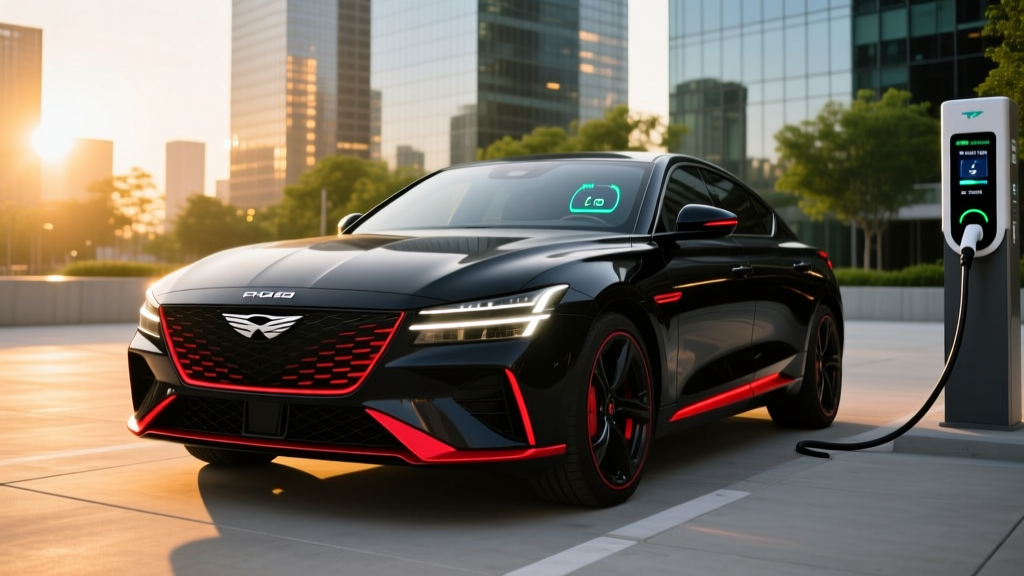
Quick Verdict: The Genesis GV60 Magma in 2026
The Genesis GV60 has always occupied a distinctive niche: a luxury compact electric crossover that pairs Hyundai Motor Group's E-GMP platform with Genesis-level refinement. For the 2026 model year, the Genesis GV60 Magma arrives as the brand's performance-oriented trim — borrowing visual and dynamic cues from Hyundai's Magma sub-brand to signal a sharper driving character. Think sport-tuned suspension, unique 21-inch wheels, aggressive fascias, and a dual-motor AWD powertrain that pushes output well beyond the standard GV60.
But performance trims live or die by whether they sacrifice daily usability. After examining the specs, charging behavior, and real-world efficiency of the 2026 GV60 Magma, the picture is clear: this is a quick, well-equipped luxury EV that charges impressively fast on DC — but its range takes a measurable hit from the larger wheels, stickier tires, and sportier calibration. If you're cross-shopping the BMW iX, Audi Q6 e-tron, or Tesla Model Y Performance, the GV60 Magma demands a close look at the numbers before you sign.
Range, Efficiency, and the Real-World Reality Check
Real-World Expectation: ~210–230 miles on highway-heavy trips at 70+ mph; ~185–200 miles in freezing temperatures with cabin heat running. City driving with regen can push closer to the 248-mile sticker.
The 2026 GV60 Magma uses the same 77.4 kWh usable battery pack (84.0 kWh gross, NMC chemistry) found across the GV60 lineup. The Magma trim's range penalty comes primarily from its 21-inch alloy wheels wrapped in performance-spec summer tires, combined with a slightly lowered ride height and sport-tuned dampers that increase rolling resistance.
For context, the standard GV60 Advanced AWD on 19-inch wheels achieves an EPA-estimated 264 miles — meaning the Magma trim costs you roughly 16 miles of rated range for the performance hardware. That's a meaningful trade if your commute stretches beyond 100 miles round-trip or if you regularly drive in cold climates where NMC packs lose 15–25% of their capacity to reduced chemical efficiency and cabin heating demands.
Efficiency lands at approximately 95 MPGe combined (roughly 35 kWh/100 miles), per fueleconomy.gov data for similarly equipped E-GMP vehicles. That's competitive with the BMW iX xDrive50 but trails the Tesla Model Y Long Range AWD's ~116 MPGe — a gap driven largely by the GV60's heavier curb weight and the Magma's stickier rubber.
Charging Speed: Where E-GMP Still Shines
Hyundai Motor Group's 800-volt architecture remains one of the fastest-charging platforms available in a consumer EV, and the GV60 Magma takes full advantage.
| Charge Method | Max Rate | Speed / Time |
|---|---|---|
| DC Fast Charge (peak) | ~240 kW | 10–80% in approximately 18 minutes (optimal conditions) |
| DC Fast Charge (sustained avg.) | ~175 kW avg. | Expect tapering above 55% SoC; 10–90% closer to 28 min |
| Level 2 Home (240V, 48A) | 10.9 kW | ~33 miles of range per hour; full charge in ~7.5 hours |
| Level 1 (120V, 12A) | 1.4 kW | ~4 miles per hour — emergency/trickle only |
A few practical notes from real-world DC charging experience: that 240 kW peak only holds briefly, typically between 10–30% State of Charge. The charge curve tapers progressively — you'll see roughly 180 kW through 55%, then a drop to ~120 kW through 70%, and under 80 kW past 80%. This is normal behavior for NMC cells protecting longevity, but it means that 10–80% in 18 minutes is achievable only when the battery is preconditioned (warm) and you're plugged into a charger capable of delivering 350+ kW, such as Electrify America's latest stalls or Tesla Superchargers open to NACS-equipped vehicles.
The GV60 Magma for 2026 comes equipped with the NACS (North American Charging Standard) port natively, following Genesis's adoption of the Tesla connector across its EV lineup. This grants direct access to Tesla's Supercharger network — a significant infrastructure advantage over CCS-only competitors still relying on adapters or third-party networks with spotty uptime.
For home Level 2 charging, plan on installing a 60-amp circuit to support the vehicle's 48-amp (10.9 kW) onboard charger. A full overnight charge from 10% to 100% takes roughly 7.5 hours. If your home electrical panel is already near capacity, a panel upgrade (typically $1,500–$3,000) may be required before a licensed electrician can run the dedicated circuit.
Performance: 0–60, Powertrain, and Driving Dynamics
| Specification | Value |
|---|---|
| Powertrain | Dual-motor AWD |
| Horsepower | 483 hp (Boost mode engaged) |
| Torque | 516 lb-ft |
| 0–60 mph | 4.0 seconds |
| Top Speed | 146 mph (electronically limited) |
| Drivetrain | AWD with torque vectoring rear motor |
The Magma trim extracts 483 horsepower in Boost mode — a meaningful jump from the standard GV60 Sport Prestige's 429 hp. The 4.0-second 0–60 time puts the GV60 Magma squarely in performance crossover territory, trailing the Tesla Model Y Performance (3.5 seconds) but matching or beating the BMW iX M60's claimed figures in real-world conditions.
What sets the Magma apart isn't straight-line speed alone — it's the chassis tuning. Genesis has fitted an adaptive sport suspension with firmer damper rates, a lower ride height (roughly 0.4 inches lower than the standard GV60), and a quicker steering ratio. The result is noticeably flatter cornering and more communicative steering than the comfort-oriented trims, at the cost of some low-speed ride compliance over broken pavement.
The e-GMP platform's low center of gravity (the battery pack sits under the floor) keeps body roll well-managed even without the sportiest suspension settings. Where the Magma earns its badge is in the details: a dedicated Boost button on the steering wheel that temporarily unlocks maximum torque delivery, an electronic limited-slip differential simulation via the rear motor, and a sport-specific regen profile that allows more aggressive one-pedal deceleration.
Interior, Cargo, and Technology
The GV60's cabin has always been one of its strongest selling points, and the Magma trim adds sport-specific touches without losing the luxury feel. Key interior dimensions:
- Front legroom: 41.9 inches
- Rear legroom: 37.4 inches
- Cargo volume (rear seats up): 24.0 cu ft
- Cargo volume (rear seats folded): 54.7 cu ft
- Frunk (front trunk): 0.7 cu ft — enough for charging cables, not luggage
The rear-seat space is adequate for adults on shorter trips but tighter than the BMW iX or the Hyundai Ioniq 5 (which shares the E-GMP platform but has a longer wheelbase). The cargo area, at 24 cu ft, is competitive with the Audi Q6 e-tron but smaller than the Model Y's 30.2 cu ft behind the second row. If you regularly haul four adults with luggage, the GV60 Magma will feel cramped compared to a mid-size EV SUV.
Technology highlights include:
- Crystal Sphere shifter: The rotating glass orb that flips to reveal the rotary gear selector when the vehicle starts — a signature GV60 feature.
- 12.3-inch dual displays: One for the instrument cluster, one for infotainment, running Genesis's latest UX with native NACS charger routing and battery preconditioning controls.
- Genesis Digital Key 2: UWB-based phone-as-key with hands-free unlock and start.
- Face Connect: Facial recognition via a B-pillar camera for driver profile loading and keyless entry without a phone.
- Highway Driving Assist 2 (HDA2): Adaptive cruise with lane-centering and automatic lane-change assist — this is SAE Level 2 driver assistance, not autonomous driving. You must keep hands on the wheel and eyes on the road at all times.
- Remote Smart Parking Assist: The vehicle can park and unpark itself in tight spaces while you stand outside via the key fob.
Notable drawbacks: the touch-capacitive climate controls below the main screen are fiddly to use while driving, and the frunk is disappointingly small — a consequence of the E-GMP platform's front-mounted power electronics. The Magma trim also deletes the standard GV60's available digital side mirrors in favor of conventional mirrors with Magma-specific housings, which some buyers may view as a step backward.
Pricing, Trims, and Federal Tax Credit Eligibility
| Trim | MSRP | Powertrain |
|---|---|---|
| Standard | $53,350 | RWD, single motor, 225 hp |
| Advanced AWD | $60,550 | Dual-motor AWD, 314 hp |
| Sport Prestige | $69,850 | Dual-motor AWD, 429 hp |
| Magma | $73,500 | Dual-motor AWD, 483 hp |
The Genesis GV60 Magma starts at an MSRP of approximately $73,500 (including destination), placing it in direct competition with the BMW iX xDrive50 (~$87,250), Audi Q6 e-tron Prestige (~$68,000), and Tesla Model Y Performance (~$52,490). As tested with the available Magma Sport package (unique interior trim, carbon-fiber accents, performance brake package), the price can reach approximately $78,000.
Does the GV60 Magma Qualify for the Federal EV Tax Credit?
This is where the math gets complicated — and where many luxury EV buyers get tripped up. Under current IRS §30D rules, the GV60 Magma faces two significant hurdles:
- MSRP Cap: SUVs/vans/pickups must have an MSRP ≤ $80,000. The GV60 Magma at $73,500 clears this threshold. ✅
- Buyer Income Cap: Modified AGI must not exceed $150,000 (single), $225,000 (head of household), or $300,000 (joint). Many luxury EV buyers exceed these limits. ⚠️
- Battery Component Sourcing: Increasing percentages of battery components must be manufactured or assembled in North America. As of 2026, the GV60's battery sourcing is still primarily South Korean, which may reduce or eliminate the component half of the credit ($3,750). ⚠️
- Critical Minerals Sourcing: A percentage of critical minerals must be sourced from the U.S. or FTA partners. South Korea qualifies as an FTA partner, so the GV60 may earn the minerals half ($3,750). ✅ (partial)
- Point-of-Sale Transfer: If eligible, the credit can be transferred to the dealer at purchase for an immediate price reduction rather than waiting for a tax refund.
Bottom line: Most GV60 Magma buyers should expect to qualify for $3,750 (the critical-minerals half) rather than the full $7,500, and only if their income falls below the §30D caps. Consult a tax professional before relying on credit eligibility in your purchase decision. Rules remain subject to legislative change.
Warranty and Long-Term Ownership
Genesis backs the GV60 Magma with one of the strongest warranty packages in the luxury EV segment:
- Battery warranty: 10 years / 100,000 miles (capacity retention threshold: 70% of original capacity)
- Powertrain warranty: 10 years / 100,000 miles
- Bumper-to-bumper (new vehicle): 5 years / 60,000 miles
- Complimentary maintenance: 3 years / 36,000 miles (includes cabin air filter, tire rotation, multi-point inspection)
- Roadside assistance: 5 years / unlimited miles
The 10-year battery warranty is a standout — it exceeds BMW's 8-year/80,000-mile coverage and matches Hyundai/Kia. The 70% capacity retention threshold is industry-standard: if your pack degrades below 70% of its original 77.4 kWh usable capacity within the warranty period, Genesis will repair or replace it. Based on E-GMP platform degradation data from Ioniq 5 and EV6 owners, most drivers should expect to retain roughly 88–92% capacity at 100,000 miles under normal charging habits (avoiding frequent 100% charges and excessive DC fast charging in extreme heat).
Insurance costs for the Magma trim run approximately 10–15% higher than the standard GV60 Advanced, reflecting the higher repair costs of performance wheels, sport suspension components, and the elevated MSRP. Expect annual premiums in the $2,200–$2,800 range depending on your profile and state.
How It Compares: GV60 Magma vs. the Competition
| Spec | Genesis GV60 Magma | BMW iX xDrive50 | Audi Q6 e-tron Prestige | Tesla Model Y Perf. |
|---|---|---|---|---|
| EPA Range | 248 mi | 324 mi | 288 mi | 303 mi |
| Battery (usable) | 77.4 kWh (NMC) | 105.2 kWh (NMC) | 94.9 kWh (NMC) | ~78 kWh (NMC) |
| 0–60 mph | 4.0 sec | 4.4 sec | 4.9 sec | 3.5 sec |
| HP | 483 | 516 | 456 | 456 |
| DC Fast Charge (peak) | ~240 kW | ~195 kW | ~270 kW | ~250 kW |
| 10–80% DC Time | ~18 min | ~31 min | ~21 min | ~20 min |
| Cargo (rear up) | 24.0 cu ft | 35.5 cu ft | 25.8 cu ft | 30.2 cu ft |
| Base MSRP | $73,500 | $87,250 | $68,000 | $52,490 |
| Battery Warranty | 10 yr / 100k mi | 8 yr / 80k mi | 8 yr / 100k mi | 8 yr / 120k mi |
The GV60 Magma occupies a clear niche: it's faster than the Audi Q6 e-tron and more affordable than the BMW iX, with the best battery warranty in the group. Its weaknesses are equally clear — the shortest EPA range and the smallest cargo area. The Tesla Model Y Performance undercuts it dramatically on price and beats it on both range and acceleration, but can't match the Genesis on interior quality, ride refinement, or warranty coverage.
- You prioritize interior luxury, cabin quietness, and design over maximum range
- You value the 10-year battery warranty and Genesis's complimentary maintenance
- You want fast DC charging (18-min 10–80%) for road trips
- Your daily commute is under 150 miles round-trip
- You need maximum range — the BMW iX xDrive50 offers 324 miles
- You regularly carry four adults or haul large cargo — the iX or Model Y is roomier
- Budget is paramount — the Model Y Performance delivers more performance per dollar
- You live in a cold climate and need every mile of range — the Magma's 248-mile EPA figure will shrink significantly below freezing
Pros and Cons
- Exceptional DC fast-charging speed (18-min 10–80%) via 800V architecture
- Luxury interior with unique Crystal Sphere shifter and premium materials
- Class-leading 10-year battery/powertrain warranty
- Native NACS port with direct Tesla Supercharger access
- 483 hp and 4.0-second 0–60 make it genuinely quick
- Sport-tuned chassis delivers engaging handling without harshness
- Face Connect and Digital Key 2 reduce key-fob dependency
- 248-mile EPA range is the lowest in its class
- Cold-weather range loss (15–25%) makes winter road trips challenging
- Small frunk (0.7 cu ft) is nearly useless
- Rear-seat legroom tight for taller adults on long trips
- Touch-capacitive climate controls are distracting while driving
- Tax credit eligibility is partial at best ($3,750, not $7,500)
- Insurance premiums run higher than standard GV60 trims
Frequently Asked Questions
What is the real-world range of the 2026 Genesis GV60 Magma?
Expect approximately 210–230 miles on highway-heavy drives at 70–75 mph in moderate temperatures. In freezing weather with the heater running, that drops to roughly 185–200 miles. City driving with frequent regenerative braking can get you close to the 248-mile EPA estimate. For comparison, that's roughly 75–85% of the sticker range in the worst-case highway-cold scenario — consistent with what we see from other NMC-equipped performance EVs on large wheels.
How fast does the GV60 Magma charge at home and on the road?
On a properly equipped DC fast charger (350 kW capable), the GV60 Magma peaks at roughly 240 kW and charges from 10–80% in about 18 minutes when the battery is preconditioned. At home on a Level 2 charger (240V, 48A), it adds approximately 33 miles of range per hour, with a full 10–100% charge taking around 7.5 hours. The 800-volt E-GMP platform is the key enabler here — most competing luxury EVs on 400V architectures charge noticeably slower.
How much does the GV60 Magma cost after tax credits?
The base MSRP is approximately $73,500. If you qualify for the partial $3,750 federal credit (critical-minerals portion only, based on current battery sourcing and income eligibility), your effective price drops to roughly $69,750. However, many luxury EV buyers exceed the §30D income caps ($300,000 joint / $150,000 single), which eliminates the credit entirely. State incentives vary — check your local DMV or energy office for additional rebates that may stack with federal credits.
Is the Genesis GV60 Magma worth buying vs. the BMW iX or Tesla Model Y?
It depends on your priorities. If you want the best range and cargo space, the BMW iX wins (324 miles, 35.5 cu ft) — but it costs $14,000 more. If you want the best performance-per-dollar, the Tesla Model Y Performance is hard to beat at $52,490 with a 3.5-second 0–60 and 303 miles of range. The GV60 Magma is the right pick if you value interior luxury, the 10-year warranty, fast DC charging, and a distinctive design that doesn't look like every other EV on the road — and if 248 miles of range covers your daily needs.
Does the 2026 GV60 Magma qualify for the full $7,500 federal EV tax credit?
Almost certainly not the full amount. Based on current IRS §30D battery-sourcing rules, the GV60 Magma is expected to qualify for the critical-minerals portion ($3,750) but not the battery-component portion, as its cells are manufactured in South Korea. Additionally, buyer income must fall below $300,000 (joint) or $150,000 (single) to claim any credit. The MSRP of $73,500 is under the $80,000 SUV cap, so that requirement is met. Always verify with a tax professional before purchasing.
What is the biggest drawback of the GV60 Magma?
Range. At 248 miles EPA, the Magma trim has the shortest range of any luxury compact EV crossover in its price class. Combined with cold-weather losses and highway driving inefficiency, real-world range on a road trip can dip below 200 miles — meaning more frequent charging stops than you'd take in a BMW iX or Tesla Model Y. If range anxiety is a genuine concern for your driving patterns, the Magma trim's performance gains come at a tangible cost.
Is HDA2 on the GV60 Magma self-driving?
No. Highway Driving Assist 2 is an SAE Level 2 driver-assistance system. It combines adaptive cruise control with lane-centering and can assist with lane changes, but you must remain fully engaged — hands on the wheel, eyes on the road — at all times. It does not navigate autonomously, does not handle complex urban environments, and does not relieve you of driving responsibility. Only Level 4 systems like Waymo's robotaxi service operate without a human driver, and those are available only in limited geofenced areas.
Sources: EPA fuel economy data via fueleconomy.gov; IRS §30D clean vehicle credit rules via irs.gov; Genesis USA official specifications. Pricing and tax credit rules reflect 2026 model year data and are subject to change.