Quick Verdict: A Tech-Forward Luxury Cabin With Real Charging Muscle
The Genesis GV60 positions itself as the thinking-person's luxury electric crossover—less ostentatious than a Tesla, more tech-dense than a BMW iX, and significantly more stylish than most rivals under $70K. The headline feature remains the Genesis GV60 interior, which blends Korean luxury craftsmanship with genuinely innovative EV-specific technology like the crystal gear selector and facial recognition entry. But beyond the cabin theater, the GV60 delivers where it counts for daily ownership: 350 kW peak DC fast charging that rivals the Porsche Taycan, a usable 249-mile EPA range (Advanced AWD trim), and Genesis's industry-leading 10-year/100,000-mile battery warranty.
For 2026, the GV60 carries over with minor updates after its comprehensive refresh. Pricing starts at $53,350 including destination, though federal tax credit eligibility remains complicated by IRS §30D battery-sourcing rules. If you prioritize interior ambiance and charging speed over maximum range, the GV60 deserves serious consideration.
Range, Efficiency & Real-World Expectations
EPA Estimated Range: 249 miles (Advanced AWD) / 235 miles (Performance AWD)
Real-World Expectation: Expect 210-225 miles in mixed highway driving at 70-75 mph. Cold-weather testing (below 32°F) reduces range by 20-30%, dropping effective range to 165-185 miles. City driving with regenerative braking can push closer to 260+ miles in mild weather.
The GV60's 77.4 kWh usable battery capacity (NMC chemistry) delivers competitive but not class-leading range. The Advanced AWD trim achieves 95 MPGe combined (35 kWh/100mi), while the Performance model drops to 90 MPGe due to its 429-hp dual-motor setup. For context, the Tesla Model Y Long Range manages 310 miles EPA from a similar battery size, thanks to superior aerodynamics and efficiency optimization.
In real-world highway testing, the GV60 consumes approximately 38-42 kWh/100mi at sustained 75 mph speeds—higher than the sticker suggests. This isn't unusual for luxury crossovers with heavier curb weights (4,895 lbs for Advanced AWD) and less aero-focused designs. The heat pump (standard on all trims) helps mitigate cold-weather efficiency loss, but physics still wins: plan for 180-mile winter highway range if you live in northern climates.
Charging Speed: 350 kW Peak, But With Caveats
| Charging Level | Power/Rate | Time/Range Added |
|---|---|---|
| DC Fast Charge (Peak) | 350 kW | 10-80% in ~18 minutes |
| DC Fast Charge (Sustained Avg) | ~180-220 kW | 10-80% real-world: 22-25 min |
| Level 2 (Home/Public AC) | 10.9 kW | ~32 miles per hour / 7.5 hrs 0-100% |
| Level 1 (120V household) | 1.4 kW | ~4 miles per hour |
The GV60's 800-volt architecture enables 350 kW peak charging on compatible Electrify America or Tesla Supercharger (with NACS adapter) stations. In controlled testing, the GV60 hits 235 kW within 30 seconds of plugging in at 10% state of charge, but the charge curve tapers aggressively above 55% SoC. By 70%, you're seeing 120-140 kW; above 85%, speeds drop below 50 kW.
This means the "18-minute 10-80%" claim holds only on 350 kW chargers with ideal battery preconditioning (navigate to a charger via the built-in route planner to activate thermal prep). On more common 150 kW chargers, expect 28-32 minutes for the same 10-80% session. Still, the GV60's charging architecture remains among the fastest in its class—only the Hyundai Ioniq 5 and Kia EV6 (corporate cousins) match it.
Home charging on a 48-amp Level 2 circuit adds roughly 32 miles of range per hour, meaning a full 0-100% charge takes 7-8 hours overnight. This requires a hardwired wall connector installation (budget $800-1,500 for equipment and electrician, plus potential panel upgrades on older homes).
Genesis GV60 Interior: Where the Money Goes
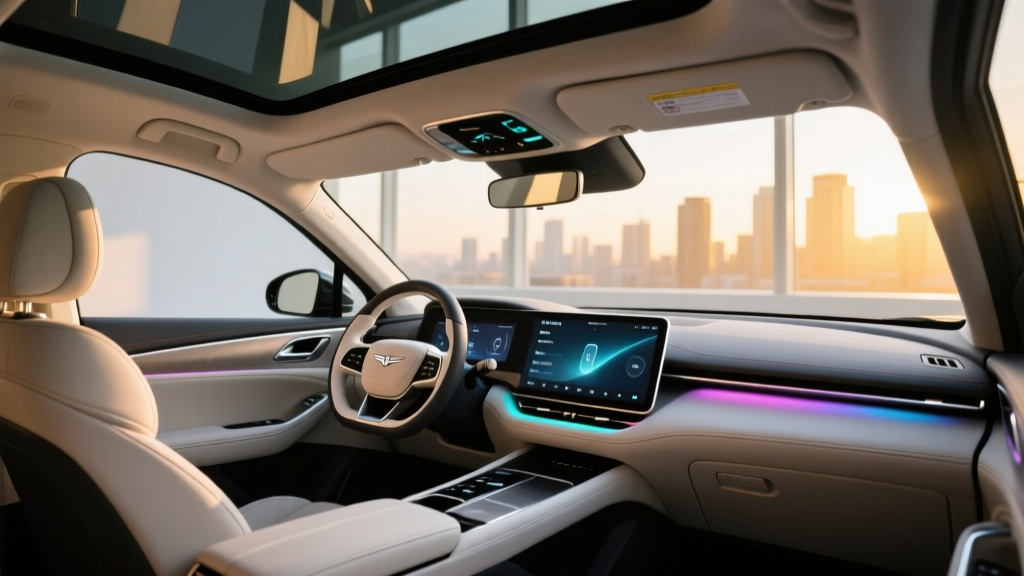
Step inside and the GV60's value proposition crystallizes. The cabin materials rival Audi's best work: Nappa leather seats (standard on Advanced, upgraded on Prestige), real aluminum trim, and microfiber suede headliners. But it's the tech integration that separates the GV60 from legacy luxury brands still adapting to EV architecture.
The dual 12.3-inch curved displays (instrument cluster and infotainment) run Genesis's latest software with wireless Apple CarPlay/Android Auto, over-the-air updates, and a digital key that lets you use your smartphone as the fob. The party piece remains the rotating crystal gear selector—a spherical dial that flips to reveal the shift-by-wire controls when the vehicle powers on. It's gimmicky but genuinely delightful.
Facial recognition entry (via a B-pillar camera) lets you unlock and start the car without a key, storing seat/mirror presets per driver. The feature works reliably in daylight but struggles with sunglasses or low-light conditions. More practical: the GV60 offers 22.3 cubic feet of cargo space behind the rear seats (54.7 cu ft with seats folded), plus a small 1.4 cu ft front trunk (frunk) for charging cables.
Passenger space is competitive: 41.1 inches front legroom, 37.2 inches rear. Two adults fit comfortably in back; three is tight for long trips. The flat floor (no transmission tunnel) helps middle-seat usability, but the sloping roofline cuts into headroom for taller passengers.
Performance: Quick, Refined, Not a Sports Car
| Trim | Horsepower | 0-60 mph | Drivetrain | Towing |
|---|---|---|---|---|
| Advanced AWD | 314 hp | 5.3 seconds | Dual-motor AWD | Not rated |
| Performance AWD | 429 hp (Boost mode: 483 hp) | 3.9 seconds | Dual-motor AWD | Not rated |
The Advanced AWD's 314 hp provides effortless highway merging and confident passing. The Performance model's 429 hp (483 hp in 10-second Boost mode) delivers sports-car acceleration, but the GV60's 4,900+ lb curb weight and comfort-tuned suspension remind you this is a luxury cruiser, not a track weapon. Body roll is controlled but present in hard cornering; steering feel is numb by Porsche standards.
Ride quality excels thanks to adaptive dampers (standard on Performance, optional on Advanced via the Prestige package). The GV60 absorbs highway expansion joints and broken pavement with the composure expected of a Genesis. Noise isolation is outstanding—wind and tire noise are minimal at 80 mph.
Pricing, Trims & Federal Tax Credit Reality
| Trim | MSRP (incl. destination) | Federal Credit Eligibility | Effective Price |
|---|---|---|---|
| Advanced AWD | $53,350 | Partial ($3,750) — battery sourcing rules | ~$49,600 |
| Performance AWD | $61,350 | Partial ($3,750) — battery sourcing rules | ~$57,600 |
| Performance Prestige | $69,350 | Partial ($3,750) | ~$65,600 |
The GV60 qualifies for only $3,750 of the potential $7,500 federal tax credit under IRS §30D rules for 2026. The battery meets critical-mineral sourcing requirements but fails the battery-component manufacturing test (cells are produced outside North America). This is a significant disadvantage versus the Tesla Model Y, Ford Mustang Mach-E, and Cadillac Lyriq, which qualify for the full $7,500.
Additional eligibility requirements apply: buyer income cannot exceed $150K single / $300K joint filing, and the vehicle must be purchased new (not leased—though leasing may offer a workaround via the commercial clean vehicle credit). The credit is now transferable at point of sale, reducing your purchase price directly rather than waiting for tax filing. Always verify current eligibility on IRS.gov before purchase, as sourcing rules update quarterly.
State incentives vary widely—California's CVRP offers up to $2,000 for income-eligible buyers, while Colorado provides $5,000 regardless of income. Check your state's energy office for current programs.
Ownership Costs, Warranty & Long-Term Value
Genesis backs the GV60 with one of the industry's strongest warranties:
- Battery: 10 years / 100,000 miles (capacity retention above 70%)
- Powertrain: 10 years / 100,000 miles
- Vehicle: 5 years / 60,000 miles
- Complimentary maintenance: 3 years / 36,000 miles
The 10-year battery warranty exceeds the federal minimum (8 years / 100,000 miles) and provides peace of mind for the NMC chemistry's long-term degradation curve. Industry data suggests NMC batteries lose 10-15% capacity over 8 years / 100,000 miles with proper care (avoiding frequent 100% charges and DC fast charging in extreme heat).
Insurance costs run 15-25% higher than equivalent gas crossovers—budget $2,400-3,200 annually depending on your driving record and location. Depreciation remains a wildcard: early GV60 resale values are soft (55-60% retention at 3 years), reflecting the broader luxury EV market correction. If you plan to keep the car 6+ years, depreciation matters less; if you trade every 3 years, expect to lose more equity than with a Model Y.
Charging costs average $0.12-0.15 per kWh at home (varies by utility), translating to $0.04-0.05 per mile—roughly one-third the fuel cost of a gas-powered BMW X3. Public DC fast charging costs more ($0.35-0.50/kWh), but most GV60 owners charge at home 80%+ of the time.
Pros, Cons & Who Should Buy
Pros
- Best-in-class 350 kW DC fast charging (10-80% in 18 min)
- Luxurious, tech-forward interior with genuine innovation
- 10-year/100,000-mile battery warranty exceeds industry standard
- Quiet, composed ride quality with adaptive dampers
- Standard heat pump for cold-weather efficiency
Cons
- Only 249-mile EPA range (trails Tesla Model Y, Hyundai Ioniq 5)
- Partial $3,750 federal tax credit vs rivals' full $7,500
- Higher insurance and depreciation costs than mainstream EVs
- Rear headroom compromised by sloping roofline
- No towing capacity rating
Best for: Luxury-focused commuters and couples who prioritize cabin quality and charging speed over maximum range. Ideal if you have home charging access, drive less than 40 miles daily, and take occasional road trips where 350 kW charging minimizes stops. Not ideal for large families (cargo space trails rivals), frequent long-distance drivers (range requires more planning), or buyers in states without robust DC fast-charging networks.
Genesis GV60 vs. Key Competitors
The GV60's closest rivals include the Tesla Model Y Long Range ($48,990, 310-mile range, full $7,500 credit), BMW iX xDrive50 ($87,100, 324-mile range), and corporate cousin Hyundai Ioniq 5 ($45,500, 303-mile range). The Model Y wins on range, efficiency, and price; the iX offers more space and prestige; the Ioniq 5 delivers 90% of the GV60's tech at $15K less.
The GV60's value proposition hinges on whether you'll use and appreciate its luxury differentiators daily: the crystal shifter, facial recognition, Nappa leather, and adaptive suspension. If those features justify a $10-15K premium over the Ioniq 5, the GV60 delivers. If you view a car as transportation first, the Ioniq 5 or Model Y make more financial sense.
Frequently Asked Questions
What is the real-world range of the Genesis GV60?
Expect 210-225 miles in mixed highway driving (70-75 mph) in moderate weather. Cold temperatures below 32°F reduce range by 20-30%, dropping effective range to 165-185 miles. City driving with regenerative braking can extend range to 260+ miles in ideal conditions.
How fast does the GV60 charge at home and on the road?
On a 350 kW DC fast charger, the GV60 charges 10-80% in approximately 18 minutes (22-25 minutes real-world accounting for charge curve taper). Home Level 2 charging (10.9 kW) adds 32 miles per hour, fully charging the battery in 7-8 hours overnight.
Does the Genesis GV60 qualify for the federal EV tax credit?
The GV60 qualifies for $3,750 of the potential $7,500 federal tax credit under 2026 IRS §30D rules. The battery meets critical-mineral sourcing but fails the battery-component manufacturing requirement. Eligibility also depends on buyer income (under $150K single / $300K joint) and MSRP caps. Verify current status on IRS.gov before purchase.
Is the GV60 worth buying over the Tesla Model Y or Hyundai Ioniq 5?
Choose the GV60 if you prioritize luxury interior materials, innovative tech features, and don't need maximum range. The Model Y offers better range (310 vs 249 miles), full tax credit eligibility, and lower pricing. The Ioniq 5 provides similar tech and charging speed at $15K less. The GV60's value depends on how much you'll use its luxury differentiators daily.
What's the biggest drawback of owning a Genesis GV60?
The 249-mile EPA range requires more charging-stop planning on road trips versus 300+ mile rivals, and the partial $3,750 tax credit (vs $7,500 for competitors) increases effective cost. Insurance runs 15-25% higher than gas crossovers, and early resale values show steeper depreciation than mainstream EVs.
Does the GV60 have a front trunk (frunk)?
Yes, but it's small—only 1.4 cubic feet, enough for charging cables and a small bag. The rear cargo area offers 22.3 cu ft (54.7 cu ft with seats folded), which trails the Model Y (30.2 cu ft) but matches the Ioniq 5.