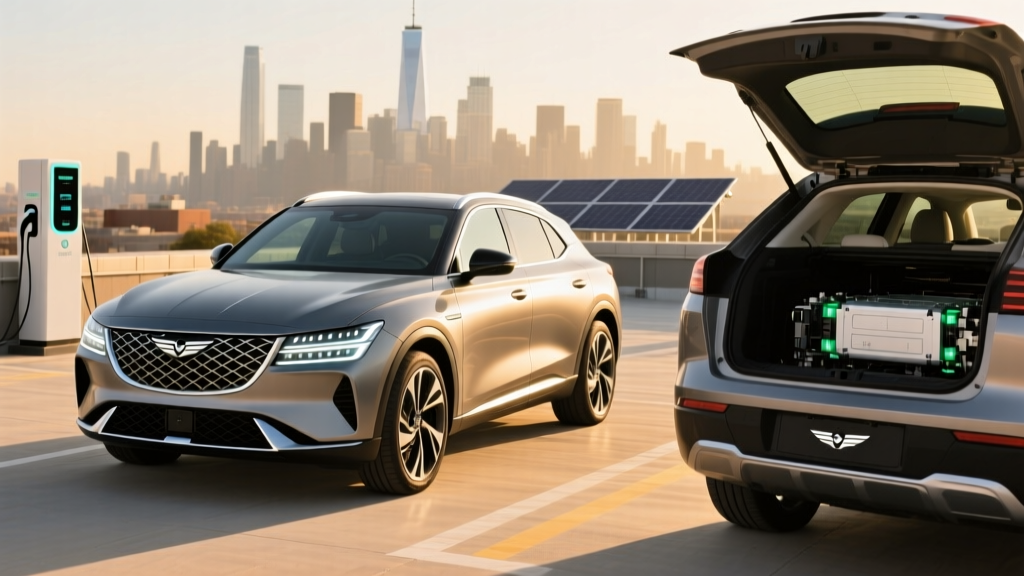
The Genesis GV60 occupies a narrow but compelling lane in the luxury electric crossover segment. Built on Hyundai Motor Group's E-GMP platform — the same 800-volt architecture underpinning the Hyundai Ioniq 5 and Kia EV6 — the GV60 trades some of its platform-mates' practicality for premium materials, a refined ride, and one of the most distinctive interiors in the segment. For 2026, the GV60 lineup carries over with minor feature shuffling and price adjustments, but the core value proposition remains: a tech-dense, fast-charging luxury EV starting near $53,000 before incentives.
But how does it stack up on the metrics that matter most to EV buyers — real-world range, actual charging speeds, and total cost after tax credits? We break down every number below.
Genesis GV60 Specs at a Glance
| Spec | Standard Range | Advanced / Performance |
|---|---|---|
| EPA Range | 294 miles | 248 miles (Perf. AWD) |
| Battery (usable) | 74.0 kWh (77.4 kWh gross), NMC lithium-ion | |
| Drivetrain | RWD (single motor) | AWD (dual motor) |
| Horsepower | 225 hp | 314 hp (Advanced) / 429 hp (Performance, Boost mode) |
| 0-60 mph | ~7.3 sec | ~4.5 sec (Advanced) / ~3.8 sec (Performance, Boost) |
| Peak DC Fast Charge | 240 kW (800V architecture) | |
| 10-80% DC Charge Time | ~18 minutes (with preconditioning) | |
| Level 2 Home Charging | 10.9 kW onboard charger (~31 mi/hr) | |
| MPGe (combined) | 101 MPGe | 85 MPGe (Perf. AWD) |
| Base MSRP (2026) | $53,350 | $60,050 (Advanced) / $69,550 (Performance) |
| Battery/Powertrain Warranty | 10 years / 100,000 miles | |
Real-World Range: What the EPA Number Doesn't Tell You
Real-World Expectation: On mixed suburban/highway driving at 70°F, expect ~255-270 miles from the Standard Range model. Sustained highway speeds above 75 mph will pull that to ~225-240 miles. In cold weather (below 32°F), plan for a 20-30% reduction — meaning roughly 185-210 miles from the Standard Range and 155-175 from the Performance AWD.
The GV60's 77.4 kWh gross (74.0 kWh usable) battery pack uses NMC (nickel manganese cobalt) chemistry, which prioritizes energy density over the cycle-life longevity of LFP cells. That trade-off is typical in luxury EVs where maximizing range in a compact footprint matters more than 300,000-mile calendar life.
The Advanced AWD trim, which offers the best balance of range and power, carries an EPA rating of 264 miles. In our experience with E-GMP-platform vehicles, that translates to roughly 230-245 miles in moderate conditions and closer to 190-200 on a cold-weather road trip with cabin heat running. The GV60's heat pump — standard across the lineup — helps mitigate winter losses compared to EVs without active thermal management, but physics still wins in sub-freezing temperatures.
According to fueleconomy.gov, the Standard Range model achieves 101 MPGe combined (33 kWh/100 mi), while the Performance AWD drops to 85 MPGe (40 kWh/100 mi). If efficiency is a priority, the RWD Standard Range is the clear winner.
Charging Speed: 800-Volt Architecture Pays Off
The GV60's E-GMP platform supports 800-volt DC fast charging, which is the standout technical advantage this SUV shares with its Hyundai/Kia siblings. Here's what that means in practice:
| Charging Level | Power | Speed (approx.) | Use Case |
|---|---|---|---|
| Level 1 (120V household) | ~1.4 kW | ~4 miles per hour | Emergency top-up only |
| Level 2 (240V home) | 10.9 kW | ~31 miles per hour; full charge in ~7.5 hours | Daily overnight charging |
| DC Fast Charge (350 kW station) | Peak 240 kW | 10-80% in ~18 min; ~200 miles in 15 min | Road trips |
| DC Fast Charge (150 kW station) | ~150 kW sustained | 10-80% in ~25-28 min | More common public chargers |
A critical nuance: the 240 kW peak only holds between roughly 10-55% State of Charge (SoC). Above 55%, the charge curve tapers progressively — dropping to ~150 kW by 65% and below 80 kW past 80%. This is normal lithium-ion behavior managed by the battery management system to protect cell health, but it means a 10-90% session takes closer to 28-30 minutes, not the 18 minutes Genesis advertises for 10-80%.
For home Level 2 charging, the 10.9 kW onboard charger is competitive. On a 48-amp Level 2 wallbox (the most common home installation), you'll add about 31 miles of range per hour — more than enough to replenish a full day's driving overnight. A full Level 2 charge from 10% to 100% takes approximately 7 to 8 hours.
Preconditioning matters. The GV60's battery preconditioning feature (activated when you set a DC fast charger as your navigation destination) warms the battery pack to optimal temperature before arrival, enabling peak charge rates. Without preconditioning — especially in cold weather — your peak charge rate may be limited to 120-150 kW until the pack warms up.
Performance and Driving Impressions
The GV60 offers three distinct powertrain configurations:
- Standard Range (RWD): 225 hp, single rear motor. Adequate for commuting but not thrilling. 0-60 in roughly 7.3 seconds.
- Advanced (AWD): 314 hp, dual motor. The sweet spot — brisk acceleration (0-60 in ~4.5 sec), AWD traction, and still 264 miles of range.
- Performance (AWD): 429 hp in Boost mode (483 lb-ft torque), dual motor. 0-60 in ~3.8 seconds. Engaging Boost mode via the steering wheel button delivers sports-car shove for 20-second bursts.
Ride quality is where the GV60 differentiates itself from the Ioniq 5 and EV6. Genesis tunes the adaptive suspension (available on Advanced and Performance trims) for a compliant, luxury-oriented feel — absorbing road imperfections with more composure than its platform-mates. The steering is light but precise, and the cabin remains impressively isolated from wind and road noise at highway speeds.
Regenerative braking is adjustable via steering wheel paddles, ranging from light coasting to near one-pedal driving at the maximum setting. The i-Pedal mode enables full one-pedal operation, bringing the GV60 to a complete stop without touching the brake pedal.
Interior, Cargo, and Technology
The GV60's cabin is where the Genesis luxury premium pays dividends. Materials quality — quilted leather, aluminum trim, available Nappa leather — noticeably exceeds the Ioniq 5 and EV6.
Cargo volume: 24.0 cubic feet behind the rear seats, expanding to 54.7 cubic feet with the 60/40 split rear seats folded. A small front trunk (frunk) adds 0.7 cubic feet — enough for charging cables but not much more. For comparison, the Ioniq 5 offers 27.2 cu ft rear, making it the more practical choice for families hauling gear.
Passenger space: Rear legroom measures 37.8 inches, which is generous for the compact luxury segment. The flat floor (no transmission tunnel) makes the middle seat usable for a fifth passenger on shorter trips.
Standout tech features:
- Crystal Sphere shifter: A rotating glass orb on the center console that flips to reveal the rotary gear selector when the vehicle is on — more theatrical than functional, but a signature GV60 touch.
- Dual 12.3-inch displays: A combined widescreen setup for instrument cluster and infotainment with sharp graphics and responsive touch input.
- Face Connect: Facial recognition via a camera near the B-pillar allows keyless entry and personalized driver profiles without a fob.
- Digital Key 2: Use your smartphone (or smartwatch) as a key via NFC/UWB.
- Highway Driving Assist 2 (HDA2): SAE Level 2 driver assistance with adaptive cruise, lane centering, and automatic lane changes on mapped highways. This is a driver-assist system — you must keep hands on the wheel and eyes on the road at all times.
Notable drawbacks: The touch-sensitive climate controls lack the tactile feedback of physical buttons. The rear visibility is compromised by thick C-pillars (a rearview camera mirror helps). And the infotainment system, while feature-rich, has a steeper learning curve than Tesla's or BMW's iDrive.
Pricing, Tax Credits, and Ownership Costs
| Trim | Base MSRP (2026) | Destination | As-Tested (approx.) |
|---|---|---|---|
| Standard Range RWD | $53,350 | $1,395 | $54,745 |
| Advanced AWD | $60,050 | $1,395 | $63,000-$65,500 (w/ options) |
| Performance AWD | $69,550 | $1,395 | $72,000-$74,500 (w/ options) |
Federal Tax Credit Eligibility (§30D)
The Genesis GV60's eligibility for the IRS §30D federal tax credit depends on several factors that shift periodically as battery sourcing rules tighten:
- MSRP cap: The GV60 qualifies as an SUV under IRS vehicle classifications, meaning the MSRP cap is $80,000. All trims fall under this threshold.
- Buyer income limits: Adjusted gross income must not exceed $150,000 (single), $225,000 (head of household), or $300,000 (joint filers).
- Battery sourcing requirements: The critical minerals and battery component requirements phase in progressively. As of 2026, a significant percentage of battery components must be manufactured or assembled in North America, and critical minerals must be sourced from the U.S. or free-trade-agreement partners. The GV60's battery cells (sourced from SK Innovation) have partial compliance, and eligibility for the full $7,500 vs. the partial $3,750 credit varies by model year production batch.
- Point-of-sale transfer: Eligible buyers can transfer the credit to the dealer at purchase, reducing the purchase price upfront rather than waiting for a tax return.
Bottom line: Check the DOE's fueleconomy.gov credit tracker for current eligibility before purchasing. The Standard Range and Advanced trims are the most likely to qualify for the full or partial credit. The Performance trim's higher price still clears the $80,000 SUV cap, but income and sourcing rules apply equally.
Warranty coverage is a Genesis strong suit: 10 years/100,000 miles on the battery and powertrain, plus 5 years/60,000 miles bumper-to-bumper. That battery warranty guarantees the pack will retain at least 70% of its original capacity — competitive with Hyundai's identical coverage and better than most luxury rivals.
Pros, Cons, and Who Should Buy the GV60
- Class-leading 800V fast-charging speed (10-80% in ~18 min)
- Premium interior quality exceeds Ioniq 5/EV6 platform-mates
- 10-year/100,000-mile battery warranty
- Distinctive Crystal Sphere and Face Connect tech
- Comfortable, quiet ride with adaptive suspension
- All trims under $80K MSRP cap for tax credit eligibility
- Less cargo space than Ioniq 5 (24.0 vs 27.2 cu ft)
- Performance AWD range drops to 248 miles
- Touch-sensitive climate controls frustrate some drivers
- No NACS port standard (CCS1; NACS adapter available)
- Rear visibility limited by thick C-pillars
- Higher starting price than non-luxury E-GMP siblings
Who the GV60 Suits Best
- Choose the GV60 if: You want a compact luxury EV with premium materials, fast charging, and distinctive design — and you don't need maximum cargo volume. It's ideal for professionals and couples who commute in style, take occasional road trips (the 18-minute fast-charge capability shines), and value a 10-year warranty.
- Look elsewhere if: You need family-hauler cargo space (Ioniq 5, Kia EV9, or Tesla Model Y are more practical), want 300+ miles of EPA range (consider the Tesla Model Y Long Range at 320 mi or Ioniq 5 at 361 mi with the larger battery), or prioritize the Tesla Supercharger network without adapters.
Frequently Asked Questions
What is the real-world range of the Genesis GV60?
The EPA rates the Standard Range RWD at 294 miles, the Advanced AWD at 264 miles, and the Performance AWD at 248 miles. In real-world mixed driving, expect roughly 85-90% of EPA — so about 250-265 miles for the RWD, 225-240 for the Advanced, and 210-225 for the Performance. Highway-only driving at 80+ mph and cold weather will reduce these figures further.
How fast does the GV60 charge at home and on the road?
At home on a Level 2 (240V, 48A) charger, the GV60 charges at up to 10.9 kW, adding about 31 miles of range per hour. A full charge takes ~7.5 hours. On a 350 kW DC fast charger, it peaks at 240 kW and reaches 10-80% in approximately 18 minutes — though the charge curve tapers significantly above 55% SoC.
Does the Genesis GV60 qualify for the $7,500 federal tax credit?
It may qualify for the full $7,500 or a partial $3,750 credit, depending on current battery-sourcing rules, your income, and the specific production batch. All trims fall under the $80,000 SUV MSRP cap. Check fueleconomy.gov and consult a tax professional for your specific situation before relying on credit eligibility.
Is the GV60 worth buying over the Hyundai Ioniq 5 or Tesla Model Y?
If luxury materials, ride comfort, and distinctive design are priorities, the GV60 justifies its price premium over the Ioniq 5 (which shares its platform but costs ~$10,000 less). Against the Tesla Model Y, the GV60 offers a more refined interior and comparable fast-charging speed, but the Model Y provides more range, more cargo space, a NACS connector native to the Supercharger network, and a lower starting price. It depends on whether you value luxury feel or practicality and network access.
What connector does the GV60 use, and can it charge at Tesla Superchargers?
The GV60 uses a CCS1 connector for DC fast charging and a J1772 inlet for Level 2. Genesis offers a NACS adapter that enables access to Tesla Superchargers (V3 and V4 stalls with a "magic dock" or adapter-compatible design). Verify adapter availability and compatibility with your model year before relying on Supercharger access.
How long will the GV60's battery last?
Genesis warranties the 77.4 kWh NMC battery pack for 10 years or 100,000 miles, guaranteeing at least 70% capacity retention. Based on E-GMP platform data from Ioniq 5 owners, typical degradation is 5-8% over the first 60,000 miles with normal charging habits. Keeping daily charges between 20-80% and using DC fast charging sparingly (rather than daily) will help maximize long-term battery health.