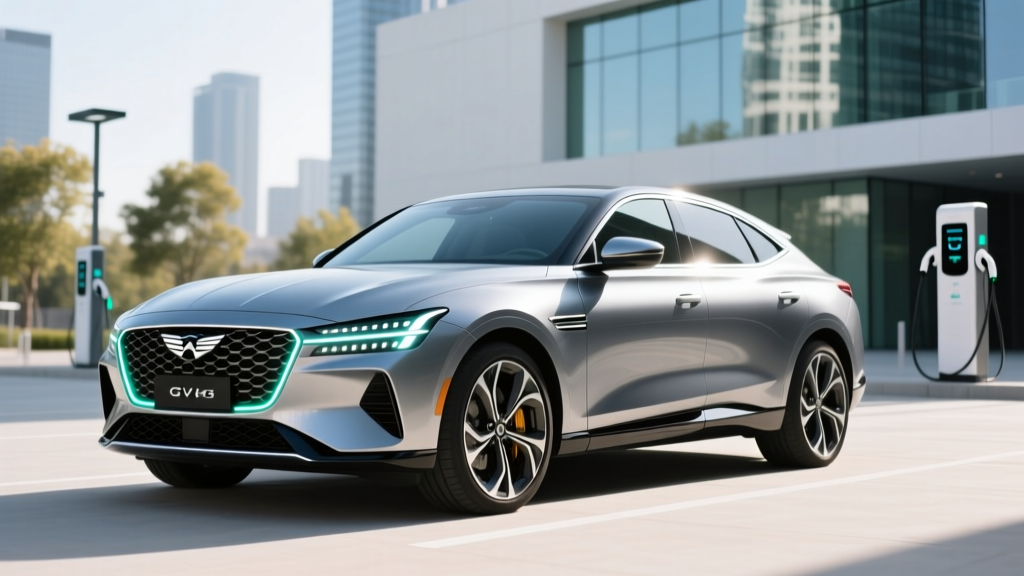
The Genesis GV60 occupies a rare niche: a luxury electric crossover that pairs Hyundai Motor Group's proven E-GMP platform with interior refinement that punches well above its price class. For buyers researching Genesis GV60 dimensions and real-world usability, this review covers every spec that matters — from exact cargo measurements and EPA range to DC fast-charging curves and federal tax credit eligibility under current IRS §30D rules.
Genesis GV60 Dimensions and Interior Space
Genesis positions the GV60 as a compact luxury EV, competing directly with the BMW iX, Audi Q4 e-tron, and Cadillac Lyriq. Its footprint is intentionally modest for urban maneuverability, but interior packaging benefits from the E-GMP's flat floor and dedicated EV architecture.
| Measurement | Specification |
|---|---|
| Wheelbase | 114.2 in (2,900 mm) |
| Overall Length | 177.8 in (4,515 mm) |
| Overall Width (excl. mirrors) | 74.4 in (1,890 mm) |
| Overall Height | 62.2 in (1,580 mm) |
| Front Headroom | 39.6 in |
| Rear Headroom | 37.8 in |
| Front Legroom | 41.4 in |
| Rear Legroom | 35.3 in |
| Cargo Volume (rear seats up) | 24.0 cu ft |
| Cargo Volume (rear seats folded) | 54.7 cu ft |
| Curb Weight (AWD Advanced) | 4,730 lb |
The 24.0 cu ft cargo area behind the second row is competitive with the Audi Q4 e-tron (24.8 cu ft) but trails the Cadillac Lyriq (28.0 cu ft). There is no front trunk (frunk) — the E-GMP platform allocates that space to HVAC and power electronics. For most two-person households or commuters, the cargo bay is ample; families hauling strollers or bulk groceries will find the 54.7 cu ft maximum adequate but not class-leading.
Rear legroom at 35.3 inches is sufficient for adults on shorter trips, though taller passengers (6'2"+) may find it snug compared to the Hyundai Ioniq 5's 39.4 inches of rear legroom. The GV60 trades rear-seat spaciousness for its sleek, coupe-like roofline.
Battery, Chemistry, and Real-World Range
All 2026 GV60 trims share a single battery pack: a 77.4 kWh usable lithium-ion unit using NMC (nickel manganese cobalt) chemistry. NMC cells offer higher energy density than LFP (lithium iron phosphate), enabling the GV60's relatively compact form factor to achieve competitive range — though NMC requires more careful state-of-charge management for long-term longevity (avoid sustained 100% storage).
| Trim / Drivetrain | EPA Range | Real-World Highway (~75 mph) | Cold Weather (20°F) |
|---|---|---|---|
| Standard RWD | 294 miles | ~245–265 miles | ~200–230 miles |
| Advanced AWD | 264 miles | ~220–240 miles | ~180–210 miles |
| Prestige AWD | 249 miles | ~210–230 miles | ~170–200 miles |
Real-world estimates based on highway-speed efficiency loss (~15%), cold-weather battery resistance and cabin heating (~25–30% reduction), and observed E-GMP platform performance in independent testing. Source: fueleconomy.gov
The range spread across trims is driven by wheel size and weight: the Prestige's 21-inch wheels and additional luxury equipment (powered rear seats, extra sound insulation) add rolling resistance and mass. If maximum range is your priority, the Standard RWD trim is the clear pick.
Efficiency ratings land at 95 MPGe combined (Standard RWD) and 90 MPGe combined (AWD trims), translating to roughly 33–35 kWh per 100 miles. This is competitive with the BMW iX xDrive50 but slightly behind the Tesla Model Y Long Range's 122 MPGe — a function of the GV60's heavier build and luxury insulation.
Charging Speed: DC Fast Charging and Home Level 2
The GV60 retains the E-GMP platform's 800-volt electrical architecture, enabling some of the fastest DC charging in its class — a meaningful advantage for road-trippers and apartment dwellers who rely on public infrastructure.
| Charging Method | Power | Speed / Time | Connector |
|---|---|---|---|
| DC Fast Charge (peak) | 233 kW | 10–80% in ~18 minutes | CCS1 (NACS adapter available) |
| DC Fast Charge (sustained avg 10-80%) | ~165 kW avg | See charge curve note below | CCS1 |
| Level 2 Home (240V, 48A) | 11.5 kW | ~7.5 hours (0–100%) | J1772 / NACS |
| Level 2 Home (240V, 32A) | 7.7 kW | ~11 hours (0–100%) | J1772 |
| Level 1 (120V, 12A) | 1.4 kW | ~3.5 miles per hour | Standard outlet |
Charge curve reality: The 233 kW peak is achievable at 350 kW-class chargers (Electrify America, EVgo) when the battery is preconditioned and between roughly 10–40% state of charge. Above 50% SoC, the curve tapers significantly — expect ~120 kW at 60% and ~60 kW above 80%. The 18-minute 10–80% claim holds under optimal conditions (warm battery, high-power station), but plan for 22–25 minutes in real-world scenarios, especially in cold weather when preconditioning may not fully eliminate taper.
For home charging, a 48-amp Level 2 wallbox (such as a ChargePoint Home Flex or Emporia Level 2) on a 60-amp circuit delivers a full overnight charge in about 7.5 hours. Most owners charging from 20–80% daily will need only 4–5 hours, making even a standard 32-amp unit perfectly practical.
Performance: 0-60, Horsepower, and Drivetrain
| Trim | Drivetrain | Horsepower | Torque (lb-ft) | 0-60 mph |
|---|---|---|---|---|
| Standard | RWD (single motor) | 225 hp | 258 | 7.3 sec |
| Advanced | AWD (dual motor) | 314 hp | 446 | 5.3 sec |
| Prestige | AWD (dual motor) | 314 hp | 446 | 5.3 sec |
| Performance (Boost Mode) | AWD (dual motor) | 429 hp | 446 | 3.9 sec |
The dual-motor AWD trims deliver the kind of effortless acceleration that redefines expectations for a luxury crossover. The Prestige's Boost Mode — activated via a dedicated button on the steering wheel — temporarily unlocks 429 hp for 10-second bursts, dropping the 0-60 time to a genuinely quick 3.9 seconds.
Ride quality benefits from the GV60's available electronically controlled suspension (standard on Prestige), which smooths highway imperfections while maintaining composed body control. The steering is precise if somewhat light on feedback — tuned for comfort over sportiness. Towing capacity is rated at 2,000 lb (braked), adequate for a small utility trailer but not a serious hauler.
Pricing, Trims, and Federal Tax Credit Eligibility
| Trim | Base MSRP | Est. As-Tested* | §30D Credit Eligibility |
|---|---|---|---|
| Standard RWD | $53,350 | $54,200 | Eligibility depends on battery sourcing — verify at purchase |
| Advanced AWD | $61,800 | $63,500 | Eligibility depends on battery sourcing — verify at purchase |
| Prestige AWD | $70,300 | $72,000 | Eligibility depends on battery sourcing — verify at purchase |
*As-tested includes destination charge and typical dealer-installed accessories. Prices reflect 2026 model year.
- MSRP Cap: SUVs/crossovers must have MSRP ≤ $80,000 (all GV60 trims qualify)
- Buyer Income Cap: AGI ≤ $150,000 (single) / $225,000 (head of household) / $300,000 (joint)
- Battery Sourcing: Critical minerals and battery component requirements phase in annually — full $7,500 requires meeting both thresholds; partial credit ($3,750) if only one is met
- Point-of-Sale Transfer: Eligible buyers can transfer the credit to the dealer for an upfront price reduction
- Assembly: Vehicle must undergo final assembly in North America (GV60 is assembled in South Korea — this may disqualify it from §30D; verify with your dealer and consult IRS guidelines)
Critical note on GV60 tax credit eligibility: The Genesis GV60 is manufactured at Hyundai Motor Group's Ulsan plant in South Korea. Under current §30D rules, vehicles must undergo final assembly in North America to qualify for the new clean vehicle credit. As of the 2026 model year, the GV60 does not meet the North American assembly requirement, meaning it is likely ineligible for the §30D federal tax credit. However, it may qualify for certain state-level incentives (California, Colorado, New York, and others offer rebates independent of federal rules). Always verify current eligibility on fueleconomy.gov and consult a tax professional before relying on credit assumptions.
Technology, Safety, and Driver Assistance
The GV60's cabin technology is a highlight. The dual 12.3-inch displays (instrument cluster and infotainment) sit behind a single curved glass panel, with Genesis's latest infotainment software offering wireless Apple CarPlay and Android Auto, over-the-air updates, and Digital Key 2 (unlock and start via smartphone).
Standout features include:
- Crystal Sphere Shifter: A rotating glass orb on the center console that flips to reveal the rotary gear selector when the vehicle powers on — theatrical but functional
- Face Connect: Facial recognition via a B-pillar camera allows keyless entry and personalized seat/mirror/climate presets
- Digital Side Mirrors (available): Camera-based mirror replacement with interior OLED screens — reduces drag coefficient but takes acclimation
- Highway Driving Assist 2 (HDA2): Adaptive cruise with lane-centering and automatic lane-change assist on divided highways
- Remote Smart Parking Assist: Summon-style vehicle movement via key fob for tight parking situations
Safety ratings are strong: the GV60 earned a 5-star overall rating from NHTSA and IIHS Top Safety Pick+ designation. Standard equipment includes forward collision-avoidance assist with pedestrian detection, blind-spot collision-avoidance, rear cross-traffic collision-avoidance, and safe exit assist.
Pros, Cons, and Who Should Buy the GV60
- Class-leading DC fast-charging speed (233 kW peak, ~18 min 10–80%)
- Exceptional interior materials and build quality for the price point
- Standard 800V architecture future-proofs charging compatibility
- Comprehensive warranty: 5-year/60,000-mile vehicle, 10-year/100,000-mile battery & powertrain
- Complimentary 3-year/36,000-mile scheduled maintenance and valet service
- Quiet, composed ride with excellent NVH isolation
- South Korean assembly likely disqualifies from $7,500 federal §30D tax credit
- Cargo volume (24.0 cu ft) trails key competitors like the Lyriq and Model Y
- Rear legroom tight for taller passengers vs. Ioniq 5 platform siblings
- No frunk for additional storage
- Prestige trim pushes $72K+ without tax credit offset
- Digital side mirrors take significant acclimation and may not suit all drivers
- Choose the GV60 if: You prioritize luxury interior quality, fast DC charging for road trips, and distinctive design — and you can charge at home (offsetting the lack of federal tax credit with state incentives and fuel savings)
- Look at the Tesla Model Y if: Maximum cargo space, Supercharger network access, and federal tax credit eligibility are top priorities
- Look at the Hyundai Ioniq 5 if: You want the same E-GMP platform and charging speed at a lower price point, with more rear-seat room and available federal credit (U.S.-assembled)
- Look at the BMW iX if: Budget allows $85K+ and you want a larger, more spacious luxury EV with similar refinement
Genesis GV60 Warranty Coverage
Genesis backs the GV60 with one of the most comprehensive luxury-EV warranty packages available:
- New Vehicle: 5 years / 60,000 miles
- Battery & Powertrain: 10 years / 100,000 miles (covers battery capacity below 70% of original)
- Corrosion: 7 years / unlimited miles
- Roadside Assistance: 5 years / unlimited miles
- Complimentary Maintenance: 3 years / 36,000 miles (includes cabin filter, fluid top-off, multi-point inspection with valet pickup and delivery)
The 70% battery capacity retention threshold over 10 years is standard for the Hyundai Motor Group. Real-world E-GMP battery degradation data from Ioniq 5 and Kia EV6 owners suggests typical loss of 5–8% over the first 60,000 miles — well within warranty coverage.
Frequently Asked Questions
What is the real-world range of the Genesis GV60?
The EPA rates the GV60 at 249–294 miles depending on trim and drivetrain. In real-world highway driving at 70–75 mph, expect approximately 210–265 miles. Cold weather (below 30°F) can reduce range by 25–30%, bringing effective range to 170–230 miles. The RWD Standard trim delivers the longest range; the Prestige AWD with 21-inch wheels returns the shortest.
How fast does the GV60 charge on DC fast chargers and at home?
On a 350 kW-class DC fast charger, the GV60 peaks at 233 kW and charges from 10–80% in approximately 18 minutes under optimal conditions (preconditioned battery, warm ambient temperature). Real-world sessions average 22–25 minutes. At home on a 48-amp Level 2 charger (11.5 kW), a full charge takes about 7.5 hours; a typical 20–80% daily session requires 4–5 hours.
Does the 2026 Genesis GV60 qualify for the $7,500 federal EV tax credit?
Most likely not. The GV60 is assembled in South Korea, and current IRS §30D rules require North American final assembly for the new clean vehicle credit. State incentives may still apply — California offers up to $2,000 via the Clean Fuel Reward, and Colorado provides a state tax credit up to $5,000. Verify current rules on irs.gov and consult a tax professional.
Is the Genesis GV60 worth buying versus the Tesla Model Y or BMW iX?
The GV60 excels in interior luxury, ride comfort, and DC charging speed at a price point between mainstream and ultra-premium competitors. If you value cabin quality and distinctive design over maximum cargo space and tax-credit savings, it's a compelling choice. The Tesla Model Y offers more room, Supercharger convenience, and likely tax credit eligibility. The BMW iX is larger and more spacious but costs $15K–$20K more.
What are the exact exterior dimensions of the Genesis GV60?
The 2026 GV60 measures 177.8 inches long, 74.4 inches wide, and 62.2 inches tall, riding on a 114.2-inch wheelbase. Curb weight ranges from approximately 4,475 lb (RWD Standard) to 4,850 lb (AWD Prestige). These dimensions place it in the compact luxury crossover segment, similar in length to the Audi Q4 e-tron but with a longer wheelbase for improved interior space.
Does the GV60 have a front trunk (frunk)?
No. The E-GMP platform allocates the under-hood space to power electronics, HVAC components, and the front motor (on AWD trims). All cargo storage is in the rear cargo area: 24.0 cu ft behind the second row, expanding to 54.7 cu ft with seats folded.