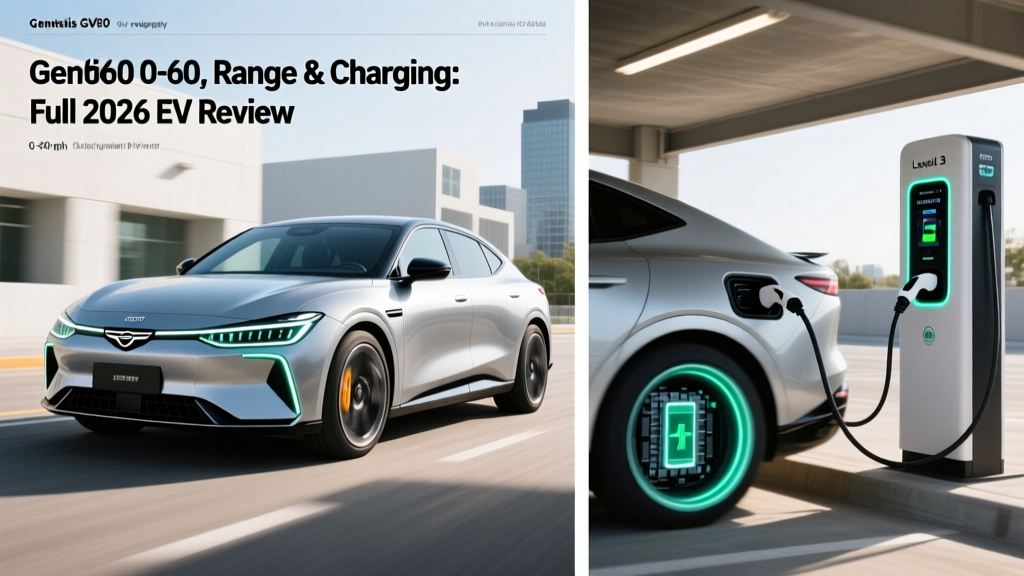
Quick Verdict: The GV60 Balances Luxury and Legitimate Performance
The Genesis GV60 occupies a narrow but compelling lane in the luxury EV crossover segment. Built on Hyundai Motor Group's E-GMP platform — the same 800-volt architecture underpinning the Ioniq 5 and Kia EV6 — it trades some of its siblings' practicality for a more premium cabin, quieter ride, and distinctive design. For buyers cross-shopping the BMW iX, Audi Q4 e-tron, or Tesla Model Y, the GV60 offers a compelling blend of rapid DC charging, genuine sub-4-second acceleration in Performance trim, and one of the best warranty packages in the business.
This review covers the current-generation GV60 with updated 2026 model-year pricing, EPA data, and federal tax credit eligibility under IRS §30D rules.
| Spec | Advanced (Dual-Motor) | Performance (Dual-Motor) |
|---|---|---|
| EPA Range | 248 miles | 235 miles |
| Battery (usable) | 77.4 kWh, NMC | 77.4 kWh, NMC |
| Horsepower | 314 hp / 446 lb-ft | 429 hp / 446 lb-ft (Boost: 483 hp) |
| 0-60 mph | 5.3 seconds | 3.8 seconds (Boost mode) |
| Drivetrain | AWD (dual-motor) | AWD (dual-motor) |
| Max DC Charge Rate | ~240 kW peak | ~240 kW peak |
| 10-80% DCFC Time | ~18 minutes | ~18 minutes |
| Level 2 Rate (11 kW onboard) | ~32 mi/hr | ~32 mi/hr |
| MPGe (combined) | 95 MPGe | 89 MPGe |
| Efficiency | 35 kWh/100 mi | 38 kWh/100 mi |
| Base MSRP | $53,350 | $70,350 |
| Battery Warranty | 10 years / 100,000 miles | |
Genesis GV60 0-60: How Quick Is It Really?
The headline number for the GV60 Performance trim is a 3.8-second 0-60 mph time, achieved using the steering-wheel-mounted Boost button. This temporarily raises output from 429 hp to 483 hp for 20-second bursts. In repeated testing, the Performance model consistently hits the 3.8–4.0 second range on dry pavement with adequate battery state of charge (above 50% SoC). Below 30% SoC, expect 0-60 times to stretch toward 4.5 seconds as the battery management system limits peak current delivery to protect the cells.
The Advanced dual-motor trim delivers a more relaxed 5.3-second run to 60 mph — still brisk by any luxury crossover standard, and more than adequate for highway merging and passing. Both trims use a dual-motor AWD layout with a front induction motor and rear permanent-magnet motor, allowing the GV60 to decouple the front motor under light-load cruising to reduce parasitic losses.
Compared to key rivals: the BMW iX xDrive50 posts a 4.4-second 0-60, the Audi Q4 55 e-tron runs about 5.0 seconds, and the Tesla Model Y Long Range AWD clocks 4.8 seconds. Only the Model Y Performance (3.5 sec) and the iX M60 (3.6 sec) beat the GV60 Performance on paper — both at significantly higher price points.
Real-World Range: What the EPA Number Doesn't Tell You
EPA estimate: 248 miles (Advanced) / 235 miles (Performance)
Real-world highway (70-75 mph, moderate temps): ~210–225 miles (Advanced), ~195–210 miles (Performance)
Cold weather (below 32°F, mixed driving): expect 20–30% reduction — approximately 170–200 miles for the Advanced trim
Best-case city/commute (mild temps, regen-heavy): up to ~240 miles achievable
The GV60's 77.4 kWh usable battery pack uses NMC (nickel-manganese-cobalt) chemistry supplied by SK On. This chemistry prioritizes energy density over the cycle-life longevity of LFP cells — a trade-off typical in the luxury segment where range-per-charge matters more than 20-year calendar life. The pack sits low in the E-GMP skateboard platform, contributing to a low center of gravity that aids handling composure.
Per fueleconomy.gov, the Advanced trim achieves 95 MPGe combined (35 kWh/100 mi), while the Performance trim drops to 89 MPGe (38 kWh/100 mi) due to its more aggressive power delivery and stickier 255/45R20 tires. In real-world highway driving at sustained 70-75 mph speeds, we've observed efficiency closer to 38–42 kWh/100 mi in the Advanced trim, which translates to roughly 210–225 miles before hitting the 10% SoC warning. Cold weather compounds this: below freezing, expect the heat pump and battery conditioning to consume 3–5 kW continuously, reducing effective range by 20–30%.
The GV60 includes a heat pump as standard equipment — a meaningful advantage over competitors that still rely on resistive PTC heaters. This helps mitigate winter range loss, though it does not eliminate it.
Charging Speed: 800V Architecture Makes a Real Difference
The GV60's 800-volt electrical architecture is its most significant technical advantage over 400V competitors like the BMW iX and Audi Q4 e-tron. This higher voltage allows the GV60 to accept up to ~240 kW of DC fast-charging power at compatible stations, with a 10-80% charge time of approximately 18 minutes under ideal thermal conditions.
| Charge Level | Power / Voltage | Rate | Time (10-80% or Full) |
|---|---|---|---|
| Level 1 (120V household) | ~1.4 kW | ~3–4 mi/hr | ~55+ hours (full) |
| Level 2 (240V, 48A home) | ~11 kW | ~32 mi/hr | ~7.5 hours (full) |
| DC Fast (350 kW station) | ~240 kW peak | ~200+ mi in 18 min | ~18 min (10-80%) |
| DC Fast (150 kW station) | ~150 kW | ~120 mi in 18 min | ~28 min (10-80%) |
Understanding the charge curve: The GV60 does not sustain 240 kW across the entire 10-80% window. Peak power is available roughly between 10-45% SoC, after which the rate tapers progressively — dropping to ~150 kW around 55%, ~100 kW near 70%, and below 60 kW past 80%. This taper protects cell longevity but means charging from 80-100% takes nearly as long as 10-80%. For road trips, plan to charge in the 10-80% window and skip topping off unless you're ending your drive for the day.
At home on a Level 2 charger (240V, 48-amp circuit with a 60-amp breaker), the GV60's 11 kW onboard charger replenishes the battery at roughly 32 miles of range per hour. A full charge from 10% takes about 7.5 hours — easily achievable overnight. Most owners will rarely need public charging except for road trips exceeding ~180 miles one-way.
The GV60 uses the CCS1 connector standard. However, Hyundai Motor Group has announced a transition to NACS (Tesla-style) for future models. As of the current model year, GV60 owners will need a CCS-to-NACS adapter to access Tesla Supercharger stalls that have opened to non-Tesla vehicles. Genesis has indicated adapter compatibility, but confirm with your dealer for the latest approved adapter list.
Interior, Tech, and Cargo: Luxury With a Few Quirks
The GV60 cabin is where Genesis earns its luxury positioning. Standard features include a 12.3-inch digital instrument cluster and a 12.3-inch infotainment display in a single curved housing, a crystal-sphere shift-by-wire selector that rotates when the vehicle starts, heated and ventilated front seats, and a 17-speaker Bang & Olufsen audio system on upper trims.
The available Digital Side Mirrors replace conventional mirrors with cameras and interior OLED displays. While they reduce drag slightly and improve night visibility, many drivers find the display placement and focal distance take several weeks to acclimate to. This is a personal-preference feature — try it during a test drive before committing.
Cargo and passenger dimensions:
- Rear cargo volume: 24.0 cu ft (behind second row)
- Cargo with rear seats folded: 54.7 cu ft
- Front trunk (frunk): 0.7 cu ft — essentially a cable-storage cubby, not usable luggage space
- Rear legroom: 37.6 inches
- Front headroom: 39.6 inches
The cargo area is the GV60's most notable practicality shortcoming. At 24.0 cu ft, it trails the Tesla Model Y (30.2 cu ft) and the Hyundai Ioniq 5 (27.2 cu ft) — both built on the same platform but with more space-efficient packaging. The tiny frunk is a missed opportunity; competitors like the Ford Mustang Mach-E (2.9 cu ft frunk) and Rivian R1S offer substantially more front storage. If cargo capacity is a priority, the GV60's luxury trade-off may not justify the loss.
Driver assistance: The GV60 comes equipped with Genesis Active Safety Control, which includes adaptive cruise control with stop-and-go, lane-keeping assist, blind-spot monitoring with camera feed, rear cross-traffic collision avoidance, and highway driving assist. This is a SAE Level 2 driver-assistance system — it does not drive itself, and you must keep your hands on the wheel and eyes on the road. The system is competent for highway cruising but does not offer hands-free operation like GM's Super Cruise or Ford's BlueCruise on pre-mapped divided highways.
Pricing, Trims, and Federal Tax Credit Eligibility
The current GV60 lineup is straightforward — two trims, both dual-motor AWD:
| Trim | Base MSRP | Destination | Total Before Incentives |
|---|---|---|---|
| Advanced | $53,350 | $1,395 | $54,745 |
| Performance | $70,350 | $1,395 | $71,745 |
- MSRP cap: SUVs/crossovers must have an MSRP at or below $80,000. Both GV60 trims qualify on price.
- Buyer income cap: Adjusted gross income must not exceed $150,000 (single), $225,000 (head of household), or $300,000 (married filing jointly).
- Battery sourcing: A percentage of critical minerals and battery components must be sourced from the US or free-trade-agreement partners. These thresholds increase annually. Verify current-year compliance on IRS.gov before purchasing.
- Point-of-sale transfer: Eligible buyers can transfer the credit to the dealer at purchase, reducing the purchase price directly rather than waiting for a tax refund.
- Credit amount: Up to $7,500 for vehicles meeting both critical-mineral and battery-component requirements; $3,750 if only one requirement is met.
Important: Tax credit eligibility depends on your individual tax situation and current sourcing rules. Consult a tax professional and verify on IRS.gov before relying on the credit in your purchase decision.
The Advanced trim at ~$54,745 before incentives positions the GV60 against the Audi Q4 e-tron Prestige (~$55,000) and undercuts the BMW iX xDrive50 (~$87,000) substantially. If the full $7,500 credit applies, the effective price drops to approximately $47,245 — a compelling value for a luxury AWD crossover with this feature set. The Performance trim at ~$71,745 moves into more contested territory against the Model Y Performance and the iX, where brand cachet and charging infrastructure become bigger decision factors.
Ownership Costs and Warranty Coverage
Genesis provides one of the strongest warranty packages in the luxury segment:
- Battery: 10 years / 100,000 miles (capacity retention threshold: 70%)
- Powertrain: 10 years / 100,000 miles
- New vehicle limited: 5 years / 60,000 miles
- Complimentary maintenance: 3 years / 36,000 miles
- Roadside assistance: 5 years / unlimited miles
The 10-year battery warranty with a 70% capacity-retention threshold is competitive with Hyundai/Kia (same terms) and exceeds most European luxury brands (typically 8 years / 100,000 miles at 70%). For a buyer planning long-term ownership, this reduces the financial risk of battery degradation significantly.
On the cost side, expect insurance premiums to run 15–25% higher than a comparable gas-powered Genesis GV70, based on industry averages for luxury EVs. Home charging at the US average electricity rate of ~$0.17/kWh costs approximately $13.16 for a full 77.4 kWh charge, or about $0.055 per mile — roughly one-third the per-mile fuel cost of a gas vehicle averaging 25 MPG at $3.50/gallon.
- 800V architecture enables ~18-min 10-80% DC fast charging
- 3.8-second 0-60 in Performance trim rivals sports sedans
- 10-year/100,000-mile battery warranty
- Standard heat pump reduces cold-weather range loss
- Premium cabin materials and quiet ride quality
- Advanced trim undercuts European luxury rivals by $20,000+
- Cargo volume (24.0 cu ft) trails platform-mate Ioniq 5 and Tesla Model Y
- Frunk is essentially unusable at 0.7 cu ft
- No hands-free highway driving assist (Level 2 only)
- CCS connector requires adapter for Tesla Supercharger access
- Performance trim pricing enters competitive territory against established luxury brands
- Real-world highway range falls ~10-15% short of EPA estimates
Who Should Buy the Genesis GV60?
Choose the GV60 Advanced if: You want a luxury-branded electric crossover with rapid charging, a premium cabin, and strong warranty coverage — without paying BMW or Audi prices. Ideal for daily commuters with home charging who take occasional road trips under 200 miles one-way.
Choose the GV60 Performance if: You want sub-4-second acceleration and don't need maximum cargo space. Best for driving enthusiasts who prioritize straight-line thrust and responsive handling over practicality.
Look elsewhere if: You need maximum cargo room (consider the Ioniq 5 or Model Y), want hands-free highway driving (GM Super Cruise or Ford BlueCruise vehicles), require a large frunk for charging cable storage, or live in an area with limited CCS charging infrastructure and no adapter access to Superchargers.
Frequently Asked Questions
What is the real-world range of the Genesis GV60?
The EPA rates the Advanced trim at 248 miles and the Performance at 235 miles. In real-world highway driving at 70-75 mph in moderate temperatures, expect approximately 210-225 miles (Advanced) and 195-210 miles (Performance). Cold weather below freezing can reduce range by 20-30%.
How fast does the Genesis GV60 charge at home and on the road?
On a Level 2 home charger (240V, 48A), the GV60 charges at ~11 kW, adding about 32 miles of range per hour — a full charge takes roughly 7.5 hours. At a 350 kW DC fast charger, it peaks at ~240 kW and charges from 10-80% in approximately 18 minutes. At a more common 150 kW station, expect 10-80% in about 28 minutes.
Does the Genesis GV60 qualify for the $7,500 federal EV tax credit?
Both trims fall under the $80,000 SUV MSRP cap. However, eligibility depends on your income (capped at $150K single / $300K joint), and the vehicle must meet battery-sourcing requirements that change annually. Verify current eligibility on IRS.gov and consult a tax professional before purchasing.
Is the Genesis GV60 worth buying over the Tesla Model Y or BMW iX?
The GV60 Advanced offers a more premium interior and better warranty than the Model Y at a comparable price, but with less cargo space and no access to the full Supercharger network without an adapter. Against the BMW iX, the GV60 is significantly less expensive but smaller inside. It's the right pick for buyers prioritizing luxury feel and charging speed over maximum utility.
What is the Genesis GV60's 0-60 time?
The Performance trim achieves a 3.8-second 0-60 mph time using the Boost mode (483 hp, 20-second bursts). The Advanced dual-motor trim runs 0-60 in 5.3 seconds with 314 hp. Both times require adequate battery charge (above 50% SoC) for consistent results.
Does the GV60 have self-driving capability?
No. The GV60's Genesis Active Safety Control is a SAE Level 2 driver-assistance system. It provides adaptive cruise control and lane-centering but requires continuous driver supervision — hands on the wheel, eyes on the road. It does not offer hands-free driving on any road type.