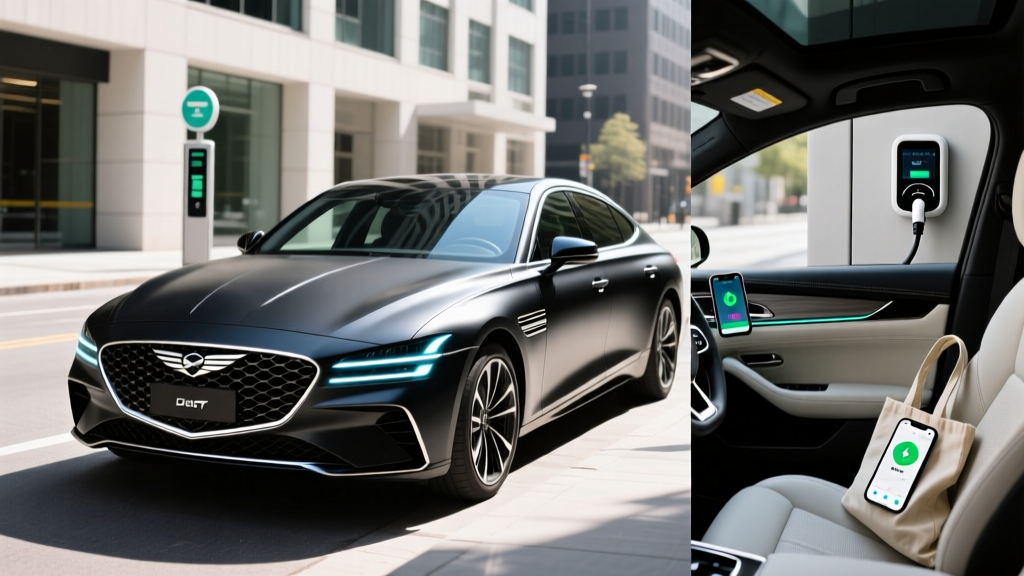
If you're considering the Genesis G80 Electrified, here's the quick answer: it's a luxury electric sedan with an EPA-estimated 282 miles of range, an 87.2 kWh battery, and peak DC fast charging at roughly 350 kW on compatible stations (10–80% in approximately 22 minutes). Starting MSRP hovers around $79,825 for the 2026 model year before incentives. It delivers near-silent refinement and strong real-world efficiency, but federal tax-credit eligibility under IRS §30D is constrained by battery-sourcing rules, and the $7,500 credit is not guaranteed for every buyer. If you have reliable home Level 2 charging and primarily drive in moderate climates, the G80 EV is a compelling luxury daily driver. If you regularly road-trip through charging deserts or face extreme winters, the gas G80 3.5T or a plug-in hybrid alternative may serve you better.
Quick Verdict: Is the Genesis G80 EV Right for You?
- Buy it if: You want a refined luxury EV sedan with 280+ miles of range, have home Level 2 charging, and value quiet, effortless acceleration over sporty dynamics.
- Skip it if: You need 350+ miles of range for frequent long road trips, lack consistent charging access, or want the latest Level 2+ driver-assist hardware.
- Key numbers: 282 mi EPA range | 87.2 kWh battery | ~350 kW peak DC | 0–60 in 4.9 sec | ~$79,825 MSRP
Genesis G80 EV Specs: Range, Battery, and Charging
The G80 Electrified is built on a modified version of the G80's internal-combustion platform, which means it retains the sedan's elegant proportions and interior volume while swapping the powertrain for dual electric motors and a floor-mounted battery pack. The usable battery capacity is approximately 87.2 kWh (NMC chemistry), feeding a dual-motor all-wheel-drive system producing 365 horsepower and 516 lb-ft of torque.
| Spec | Value |
|---|---|
| EPA Range | 282 miles |
| Battery (usable) | 87.2 kWh, NMC |
| Drivetrain | Dual-motor AWD |
| Horsepower / Torque | 365 hp / 516 lb-ft |
| 0–60 mph | 4.9 seconds |
| MPGe (combined) | 89 MPGe |
| Peak DC Fast Charge | ~350 kW (CCS via adapter or NACS on updated trims) |
| 10–80% DC Fast Charge | ~22 minutes (ideal conditions) |
| Level 2 Charge Rate | ~10.9 kW (approx. 9 hrs for full charge) |
| Base MSRP (2026) | ~$79,825 |
| Battery/Powertrain Warranty | 10 years / 100,000 miles |
Real-World Range vs. EPA Sticker
EPA: 282 miles. Expect closer to 240–260 miles in mixed highway driving at 70+ mph. In cold weather (below 30°F), plan for 200–230 miles of usable range before needing a charge. The G80 EV's heat pump helps mitigate winter losses compared to EVs without one, but battery chemistry still loses efficiency in the cold. On moderate-temperature city/suburban routes, some owners report matching or slightly exceeding the EPA figure thanks to regenerative braking.
Charging at Home and on the Road
Home charging is the backbone of G80 EV ownership. On a Level 2 (240V) home charger delivering 10.9 kW, a full 0–100% charge takes roughly 9 hours — practical for overnight replenishment. If you're installing a home Level 2 station, budget $500–$1,500 for the charger hardware (e.g., ChargePoint Home Flex, Emporia Vue) and $800–$2,500 for electrician labor and permitting, with the total potentially higher if your panel needs a 200-amp upgrade.
| Level | Power (kW) | Approx. Miles Added per Hour | Best For |
|---|---|---|---|
| Level 1 (120V) | ~1.4 kW | ~4–5 mi/hr | Emergency/overnight trickle |
| Level 2 (240V) | ~10.9 kW | ~32–36 mi/hr | Daily home charging |
| DC Fast (peak) | ~350 kW | ~180+ mi in 10 min (peak curve) | Road-trip stops |
On the road, the G80 Electrified can accept up to 350 kW on compatible CCS chargers (or NACS at Tesla Superchargers with the appropriate adapter, depending on your model year's port). However, peak rate is not sustained rate. The charging curve tapers significantly above 80% state of charge to protect the battery. Expect the 10–80% window to average around 180–220 kW on a 350 kW station, delivering that 10–80% fill in roughly 22 minutes under favorable conditions (battery preconditioned, moderate ambient temperature). On older 150 kW Electrify America or EVgo stations, plan for 30–35 minutes for the same 10–80% session.
Genesis G80 EV vs. Gas G80: Cost and Driving Comparison
The most common cross-shop is the gas-powered Genesis G80 3.5T, which starts around $58,000 and delivers 22 mpg combined (per fueleconomy.gov). Let's break down what five years of ownership looks like for both, assuming 12,000 miles/year, $3.50/gallon regular, and $0.14/kWh average home electricity.
| Cost Category | G80 Electrified (EV) | G80 3.5T (Gas) |
|---|---|---|
| Purchase Price (MSRP) | $79,825 | $58,000 |
| Federal Tax Credit (§30D)* | $0–$7,500 (see below) | $0 |
| Fuel/Energy (5 yrs, 60k mi) | $3,360 (home charging) | $9,545 (gasoline) |
| Maintenance (5 yrs) | ~$1,200 | ~$3,500 |
| Insurance (5 yrs est.) | ~$14,000 | ~$11,500 |
| Estimated Depreciation | ~$28,000 | ~$22,000 |
| 5-Year Total (approx.) | $100,385 – $92,885 | $104,545 |
*Federal §30D credit eligibility for the G80 Electrified depends on battery-component and critical-mineral sourcing requirements that shift annually. Check the latest rules at IRS.gov before purchasing. The luxury EV also exceeds the $55,000 sedan MSRP cap for new-vehicle credits, which may disqualify it from the full $7,500 depending on current-year guidance. Point-of-sale transfer is available if eligible.
The EV pulls ahead in operating costs — roughly $6,185 less in fuel and $2,300 less in maintenance over five years — but the higher purchase price, potentially steeper insurance premiums, and faster depreciation narrow the gap. If you qualify for the full credit, the math tips in the EV's favor. If you don't, the gas G80 3.5T is the cheaper path by a few thousand dollars over five years.
Federal Tax Credit and Incentive Reality
This is where many luxury EV buyers get tripped up. Under current IRS §30D rules, new clean-vehicle credits have multiple eligibility gates:
- MSRP cap for sedans: $55,000 — the G80 Electrified's ~$79,825 base price exceeds this threshold, which may disqualify it from the new-vehicle credit entirely.
- Buyer income limits: AGI must not exceed $300,000 (married filing jointly), $225,000 (head of household), or $150,000 (single).
- Battery sourcing: Increasing percentages of battery components and critical minerals must be sourced from the U.S. or free-trade-agreement countries; thresholds tighten each year.
- Point-of-sale transfer: If eligible, you can apply the credit as a down-payment reduction at the dealer rather than waiting for tax filing.
Given the MSRP cap, the G80 Electrified is unlikely to qualify for the federal new-vehicle credit as of current rules. However, state and local incentives may apply — check your state's energy office or your utility provider for rebates on the vehicle or home-charger installation. Some states offer $2,000–$5,000 in additional EV rebates that are not subject to the federal MSRP cap.
Myths vs. Facts: Common G80 EV Misconceptions
| Myth | Fact |
|---|---|
| "The G80 EV charges at 350 kW the entire session." | Peak rate of ~350 kW occurs only briefly at low SoC. The average 10–80% rate is closer to 180–220 kW due to charge-curve tapering. |
| "I'll get 282 miles no matter how I drive." | Highway speeds, cold weather, and hill climbing reduce range. Expect 200–260 miles in real-world conditions depending on climate and driving style. |
| "EVs cost more to insure, always." | EV insurance is typically 15–25% higher than equivalent gas cars due to repair costs, but shopping multiple carriers can narrow the gap. Some insurers offer EV-specific discounts. |
| "The battery will need replacing in 5 years." | Genesis warranties the battery for 10 years/100,000 miles. Industry data shows NMC batteries retaining 85–90% capacity at 100,000 miles with normal use. |
| "I can't road-trip in an EV." | With DC fast-charging networks expanding (Electrify America, EVgo, Tesla Superchargers via adapter), road trips are viable — but require 20–30 minute stops every 200–250 miles. |
First-Time EV Buyer Checklist
If the G80 Electrified is your first EV, these are the ownership realities that catch new buyers off guard:
- Home charging is essential. Relying solely on public charging is expensive ($0.30–$0.50/kWh at DC stations vs. $0.12–$0.16/kWh at home) and inconvenient. Confirm you can install a 240V Level 2 charger before purchasing.
- Preconditioning matters. Use the G80's route-based battery preconditioning when navigating to a DC fast charger. A cold battery charges significantly slower — preconditioning warms it to optimal temperature, shaving minutes off your stop.
- Tire wear accelerates. EVs are heavier and deliver instant torque, wearing tires 20–30% faster than gas equivalents. Budget $1,200–$1,800 for a set of EV-rated touring tires every 30,000–40,000 miles.
- Regenerative braking changes your driving. The G80 EV offers adjustable regen levels. Max regen enables near one-pedal driving in city traffic, reducing brake wear to near zero.
- Software updates can change the car. Over-the-air updates may alter range estimates, charging behavior, or infotainment features. Stay current but read release notes.
Decision Framework: Should You Buy the Genesis G80 EV?
Choose the Genesis G80 Electrified If:
- You have a garage or driveway where a Level 2 (240V) charger can be installed.
- Your daily commute is under 80 miles round-trip, with occasional 200+ mile road trips.
- You value a silent, smooth luxury sedan experience over aggressive sport-sedan dynamics.
- You live in a moderate climate or have access to preconditioning and garage parking in winter.
- You want a 10-year/100,000-mile battery warranty for long-term peace of mind.
Consider the Gas G80 3.5T or a PHEV Alternative If:
- You lack reliable home charging and your area has sparse public DC infrastructure.
- You regularly drive 300+ miles between stops in rural or charging-desert regions.
- You live in an extreme-cold climate (frequent sub-10°F temps) where range loss exceeds 30%.
- You want a lower purchase price and simpler ownership without charging logistics.
- You need the latest Level 2+ hands-free driving tech (the G80 EV's Highway Driving Assist is capable but not class-leading vs. GM Super Cruise or Ford BlueCruise).
Driver-Assist Note
The Genesis G80 Electrified comes with Highway Driving Assist, which is a SAE Level 2 driver-assistance system. It provides lane-centering and adaptive cruise control on highways, but you must keep your hands on the wheel and eyes on the road at all times. This is not autonomous or self-driving. Only Level 4 services like Waymo operate without a human driver, and those are limited to specific geofenced areas.
Frequently Asked Questions
Does the Genesis G80 EV qualify for the $7,500 federal tax credit?
Under current IRS §30D rules, likely not. The new-vehicle credit has a $55,000 MSRP cap for sedans, and the G80 Electrified's ~$79,825 starting price exceeds it. Always verify the latest eligibility on IRS.gov before making a purchase decision, as rules can shift.
How long does it take to charge the G80 EV at home?
On a Level 2 (240V, ~10.9 kW) home charger, a full 0–100% charge takes approximately 9 hours. Most owners plug in overnight and wake up to a full battery. Level 1 (standard 120V outlet) adds only about 4–5 miles per hour and is not practical as a primary charging method for a vehicle with an 87.2 kWh battery.
What's the real-world range in winter?
In temperatures below 30°F, expect the G80 EV's range to drop to approximately 200–230 miles from the EPA-estimated 282 miles. The heat pump helps, but cold temperatures increase battery internal resistance and cabin-heating energy draw. Garage parking and preconditioning while plugged in can recover 10–20 miles of that loss.
Can I use Tesla Superchargers with the G80 EV?
Newer model-year Genesis EVs are transitioning to the NACS (North American Charging Standard) connector. If your G80 EV has a CCS port, you can use a CCS-to-NACS adapter at Tesla Superchargers — Genesis has indicated adapter compatibility for certain models. Check your specific vehicle's compatibility before relying on the Tesla network.
How does maintenance compare to the gas G80?
Significantly cheaper. The G80 EV eliminates oil changes, transmission fluid, spark plugs, and exhaust-system maintenance. You'll still need cabin-air-filter replacements, brake-fluid checks, coolant top-offs, and tire rotations. Expect roughly $200–$300/year in scheduled maintenance versus $600–$900/year for the gas G80 3.5T.
Is the G80 EV a good road-trip car?
It's capable but requires planning. With 200–250 real-world miles between stops and 22-minute DC fast-charge sessions, you'll stop more often than in the gas G80. On well-served corridors (I-5, I-95, I-80), Electrify America and EVgo stations make this manageable. In rural areas with sparse charging infrastructure, the gas G80 or a plug-in hybrid remains the more practical choice.