Quick Answer: Is the Genesis G80 Electric Worth Buying?
The 2026 Genesis G80 Electric delivers an EPA-estimated 282 miles of range from its 87.2 kWh battery, with peak DC fast charging at 350 kW (10-80% in roughly 22 minutes). Starting at approximately $80,000, it qualifies for the full $7,500 federal tax credit under current IRS §30D rules (subject to income and MSRP caps), bringing effective pricing closer to $72,500. Compared to the gas G80 2.5T, you save roughly $1,800-$2,400 annually on fuel but pay $6,000-$10,000 more upfront. It's a strong choice if you have home Level 2 charging, drive under 300 miles daily, and value a quiet luxury sedan over SUV practicality.
Genesis G80 Electric: Core Specs at a Glance
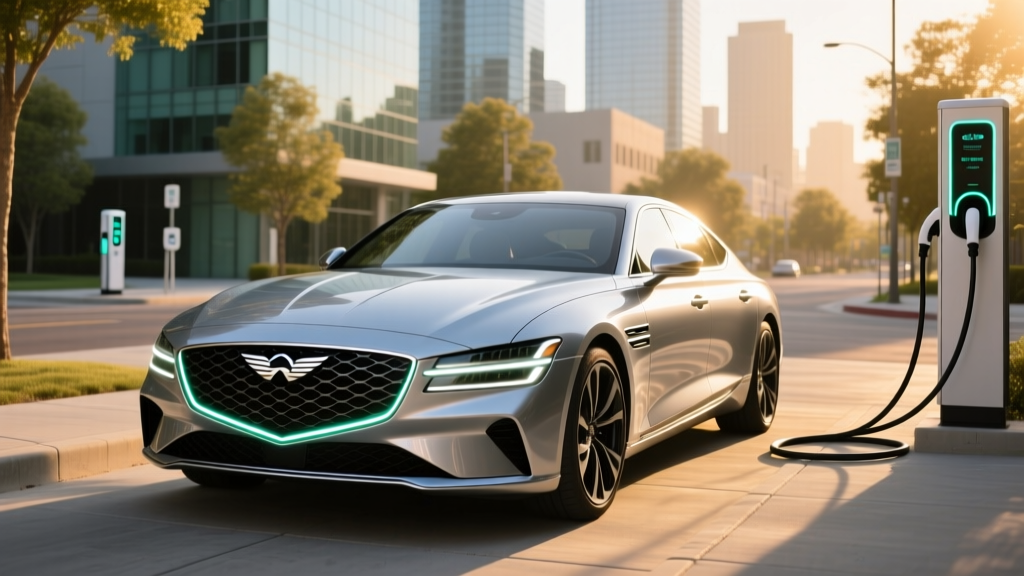
The G80 Electric is Genesis's battery-electric flagship sedan, built on a modified version of the third-generation G80 platform. Unlike ground-up EV architectures (such as Hyundai's E-GMP underpinning the Ioniq 5), the G80 Electric adapts an existing chassis, which means no frunk and slightly less interior packaging efficiency — but the trade-off is a genuinely premium cabin that rivals the Mercedes EQE and BMW i5.
| Specification | 2026 G80 Electric |
|---|---|
| EPA Range | 282 miles |
| Battery Capacity (usable) | 87.2 kWh (NMC chemistry) |
| Drivetrain | Dual-motor AWD |
| Horsepower / Torque | 365 hp / 516 lb-ft |
| 0-60 mph | 4.9 seconds |
| Peak DC Fast Charge Rate | 350 kW (800V architecture) |
| 10-80% DC Fast Charge Time | ~22 minutes |
| Level 2 AC Charge Rate | 10.9 kW |
| Level 2 Full Charge Time (0-100%) | ~8.5 hours |
| MPGe (combined) | 91 MPGe |
| EPA Efficiency | 37 kWh/100 mi |
| Base MSRP (Advanced trim) | ~$80,000 |
| Battery/Powertrain Warranty | 10 years / 100,000 miles |
| Connector | CCS1 (with NACS adapter available) |
Real-World Range: What to Actually Expect
The EPA rates the G80 Electric at 282 miles. In real-world highway driving at 70-75 mph, expect approximately 240-260 miles in mild weather. In freezing temperatures (below 30°F), range can drop to 200-220 miles due to battery chemistry limitations and cabin heating demands. The G80 Electric includes a heat pump, which helps mitigate cold-weather losses compared to resistive heating, but physics still applies — plan conservatively for road trips in winter.
Charging Speed and Infrastructure Reality
The G80 Electric's 800-volt architecture is its charging ace. On a 350 kW DC fast charger (such as Electrify America's latest stalls), it peaks near 350 kW and sustains over 200 kW through roughly 60% state of charge before tapering. A 10-80% session takes about 22 minutes under ideal conditions. However, most public chargers deliver 150 kW or less, where you'll see 10-80% times closer to 30-35 minutes.
| Charging Level | Power (kW) | Miles Added per Hour | Typical Use Case |
|---|---|---|---|
| Level 1 (120V outlet) | 1.4 kW | ~4 mi/hr | Emergency/trickle only |
| Level 2 (240V home) | 10.9 kW | ~30 mi/hr | Overnight home charging |
| DC Fast (150 kW) | 150 kW | ~200+ mi in 30 min | Road trip stops |
| DC Fast (350 kW) | 350 kW peak | ~180 mi in 18 min | Fastest public charging |
kW vs kWh — the distinction matters: kW (kilowatts) measures power — how fast energy flows into the battery. kWh (kilowatt-hours) measures energy capacity — the total amount stored. Think of kW as the flow rate of a hose and kWh as the size of the bucket. The G80's 87.2 kWh battery (bucket) can accept up to 350 kW of flow rate at peak.
Charge curve reality: The G80 Electric does not sustain 350 kW for the entire session. Like all EVs, charging speed tapers significantly above 80% state of charge to protect battery longevity. Charging from 80-100% can take nearly as long as 10-80%. For daily use, set your charge limit to 80% and only charge to 100% before long trips.
Cost of Ownership: G80 Electric vs Gas G80
The most common question from luxury sedan shoppers: does going electric actually save money? Here's a data-driven comparison between the G80 Electric and the gas-powered G80 2.5T AWD over five years.
| Cost Category | G80 Electric | G80 2.5T AWD (Gas) |
|---|---|---|
| Base MSRP | ~$80,000 | ~$58,000 |
| Federal Tax Credit (§30D) | -$7,500 (if eligible) | $0 |
| Effective Purchase Price | ~$72,500 | ~$58,000 |
| Annual Fuel/Energy (15,000 mi/yr) | ~$675 (home charging at $0.13/kWh) | ~$2,250 (premium at $3.75/gal, 25 MPG) |
| 5-Year Fuel/Energy Total | ~$3,375 | ~$11,250 |
| Estimated Annual Maintenance | ~$300 | ~$650 |
| 5-Year Maintenance Total | ~$1,500 | ~$3,250 |
| Estimated Annual Insurance | ~$2,400 | ~$2,000 |
| 5-Year Insurance Total | ~$12,000 | ~$10,000 |
| 5-Year Total Operating Cost | ~$16,875 | ~$24,500 |
Net 5-year savings (operating costs): The G80 Electric saves approximately $7,625 in fuel and maintenance over five years. However, the higher purchase price (even after the tax credit) means you're still paying roughly $7,000-$8,000 more in total cost over five years, factoring in depreciation. The electric G80 is not a pure cost-saving play — it's a refinement and experience upgrade that partially offsets its premium.
According to fueleconomy.gov, the G80 Electric achieves 91 MPGe combined, while the gas G80 2.5T AWD rates at 25 MPG combined. Your actual savings depend heavily on local electricity rates and driving patterns.
Federal Tax Credit Eligibility: What You Need to Know
Under current IRS §30D rules, the G80 Electric may qualify for up to $7,500 in federal tax credits. However, eligibility depends on multiple factors:
§30D Tax Credit Requirements (2026)
- MSRP Cap: Sedans must be under $55,000 — the G80 Electric exceeds this threshold, meaning it may NOT qualify for the new-vehicle credit. Check with your dealer for the latest classification and any legislative updates.
- Buyer Income Cap: Modified AGI must not exceed $150,000 (single) / $300,000 (married filing jointly)
- Battery Sourcing: Critical minerals and battery components must meet phased-in domestic-content requirements
- Point-of-Sale Transfer: Eligible buyers can transfer the credit to the dealer for an upfront price reduction
Important caveat: The $55,000 MSRP cap for sedans is a significant hurdle for the G80 Electric. If classified as a sedan, it does not qualify for the new-vehicle credit. However, some buyers may be eligible for the used EV tax credit (up to $4,000 or 30% of sale price, whichever is lower) when purchasing a pre-owned G80 Electric priced under $25,000 — though that price point is unlikely in the near term. Always consult a tax professional and verify current rules at IRS.gov before purchasing.
EV vs Gas: Common Misconceptions About the G80 Electric
| Myth | Fact |
|---|---|
| "The battery will need replacing in a few years" | Genesis warrants the battery for 10 years/100,000 miles with a capacity retention threshold (typically 70%). NMC batteries in modern thermal-managed systems typically degrade 1-2% per year under normal use. |
| "Charging takes too long for road trips" | At a 350 kW charger, 10-80% takes ~22 minutes — comparable to a gas stop with a bathroom break and snack. Planning around Electrify America or Tesla Supercharger (with adapter) corridors makes this manageable. |
| "I can charge on any standard outlet quickly" | Level 1 (120V) adds only ~4 miles per hour. A full charge from empty would take over 21 hours. A Level 2 home charger (240V, $500-$2,000 installed) is essential for practical daily ownership. |
| "EVs are cheaper to own in every scenario" | The G80 Electric costs more upfront, has higher insurance premiums, and the tax credit may not apply due to MSRP caps. Savings come primarily from fuel and maintenance reductions over time. |
| "Range is the same in all conditions" | Cold weather (below 30°F) can reduce range by 20-30%. Highway speeds above 70 mph also reduce efficiency. The 282-mile EPA figure assumes mixed driving in moderate temperatures. |
Real-World Ownership: What First-Time EV Buyers Must Know
If you're transitioning from a gas vehicle to the G80 Electric, here are the practical realities that spec sheets don't convey:
Home Charging Is Non-Negotiable
The G80 Electric experience is built around waking up with a full "tank" every morning. Without home Level 2 charging, you'll depend on public infrastructure — which adds time, cost, and unpredictability. Budget $500-$1,500 for a quality Level 2 charger (such as a ChargePoint Home Flex or Emporia Vue) and $500-$2,000 for professional installation by a licensed electrician. If your home has a 200-amp electrical panel, you're likely fine. Older homes with 100-amp panels may need a $1,500-$3,000 panel upgrade.
Public Charging Costs More Than Home
DC fast charging networks like Electrify America typically charge $0.35-$0.55 per kWh. At the G80's efficiency of 37 kWh/100 mi, that's $13-$20 per 100 miles on the road — still cheaper than premium gasoline but noticeably more than home charging at $0.13/kWh. Factor this into road trip budgets.
Regenerative Braking Changes How You Drive
The G80 Electric offers adjustable regen levels controlled by paddle shifters. At maximum regen, you can achieve near one-pedal driving in city traffic, reducing brake wear significantly. Expect brake pads to last well beyond 100,000 miles under normal conditions.
Insurance Premiums Run Higher
EV insurance typically costs 15-25% more than equivalent gas vehicles due to higher repair costs and battery replacement risk. Get quotes from multiple carriers before purchasing — some insurers now offer specific EV discounts.
Decision Framework: Should You Buy the G80 Electric?
Choose the G80 Electric If:
- You have (or can install) home Level 2 charging
- Your daily commute is under 200 miles round-trip
- You value a serene, near-silent luxury sedan experience
- You want to reduce fuel and maintenance costs over 5+ years of ownership
- You take road trips 2-4 times per year and can plan around DC fast-charging corridors
- You live in a moderate or warm climate (or accept cold-weather range reduction)
Choose the Gas G80 or a Hybrid Instead If:
- You live in an apartment or condo without charging access and cannot install a home charger
- You regularly drive 350+ miles in a single day through areas with sparse charging infrastructure
- Your budget is strictly under $60,000 and the tax credit does not apply to your situation
- You live in an extreme cold climate (regularly below 0°F) where range loss and charging slowdowns are severe
- You want the lowest total cost of ownership over 3-4 years (the gas G80 wins on depreciation and upfront cost)
Frequently Asked Questions
Does the Genesis G80 Electric have a frunk (front trunk)?
No. Because the G80 Electric is adapted from the gas G80 platform rather than built on a dedicated EV skateboard, there is no front trunk. Cargo space is limited to the rear trunk at approximately 12.7 cubic feet — slightly less than the gas G80 due to under-floor electronics.
Can I charge the G80 Electric at Tesla Superchargers?
Genesis has made NACS (North American Charging Standard) adapter compatibility available for the G80 Electric, allowing access to Tesla's Supercharger network. Verify adapter availability and firmware compatibility with your dealer, as rollout has been phased. This significantly expands your road-trip charging options.
What is the battery chemistry — LFP or NMC?
The G80 Electric uses NMC (nickel manganese cobalt) chemistry, which offers higher energy density than LFP (lithium iron phosphate) but is more sensitive to prolonged high-state-of-charge storage. Best practice: charge to 80% for daily use and only go to 100% when you need the full range for a trip. LFP batteries can be charged to 100% routinely, but the G80 Electric does not use LFP.
How does the G80 Electric compare to the Electrified G80 (PHEV)?
Genesis previously offered a plug-in hybrid G80 in some markets. The fully electric G80 is a distinct model with zero tailpipe emissions, 282 miles of range, and no gasoline engine. If you see "Electrified G80" referenced in older articles, confirm whether it refers to the BEV or PHEV variant. For 2026 in the US market, the full BEV is the primary offering.
What happens if the battery degrades significantly?
Genesis's 10-year/100,000-mile battery warranty covers capacity loss below a specified threshold (typically 70% of original capacity). Real-world data from similar Hyundai Motor Group EVs suggests 87-92% capacity retention after 100,000 miles under normal use. If the battery does require out-of-warranty replacement, expect costs in the $15,000-$22,000 range based on current NMC pack pricing — though this figure is expected to decline as battery costs continue falling.
Is the G80 Electric's Highway Pilot Assist self-driving?
No. Genesis Highway Driving Assist (HDA) and Highway Driving Assist 2 are SAE Level 2 driver-assistance systems. They provide adaptive cruise control and lane-centering on divided highways, but the driver must remain fully engaged with hands on the wheel and eyes on the road at all times. This is not autonomous driving — it is an advanced cruise and steering aid that reduces fatigue on long trips.
SAE Automation Level: Level 2
The G80 Electric's driver-assistance features are classified as SAE Level 2 (partial automation). The system can control steering and acceleration/braking simultaneously, but the human driver is responsible for monitoring the environment and must intervene immediately when needed. No production car sold to consumers in 2026 is fully self-driving (Level 4/5) for all conditions.